True or false is one of the most common phrases in English. People use it in schools, quizzes, games, and everyday conversations. It helps check if a statement is correct or incorrect. You may also see true or false questions in exams, interviews, and online tests.
Learning how this phrase works makes it easier to answer questions with confidence. It also improves critical thinking and reading skills. Many people confuse facts with opinions, which leads to wrong answers. This guide explains everything in simple words. You will learn the meaning, examples, common mistakes, useful tips, and real-life uses. By the end, you will know how to identify this statements quickly and accurately.
Quick Summary Box
- True or false is a way to decide if a statement is correct.
- True means the statement is correct.
- False means the statement is incorrect.
- True or false questions appear in quizzes, exams, and games.
- Always check facts before choosing an answer.
- Reading carefully helps avoid mistakes.
What Does True or False Mean?
This is a type of question that asks whether a statement is correct.
- True means the statement matches facts or reality.
- False means the statement is not correct.
This format is popular because it is simple and quick to answer.
Example
Statement:
The Earth revolves around the Sun.
Answer:
True
Statement:
Cats are reptiles.
Answer:
False
True vs False: Comparison Table
| Feature | True | False |
| Meaning | Correct statement | Incorrect statement |
| Matches facts | Yes | No |
| Used in quizzes | Yes | Yes |
| Based on evidence | Yes | No |
| Example | Water freezes at 0°C | Water freezes at 100°C |
How True or False Questions Work
A true or false question gives one statement.
You decide whether it is correct.
There are only two possible answers:
- True
- False
Example
Statement:
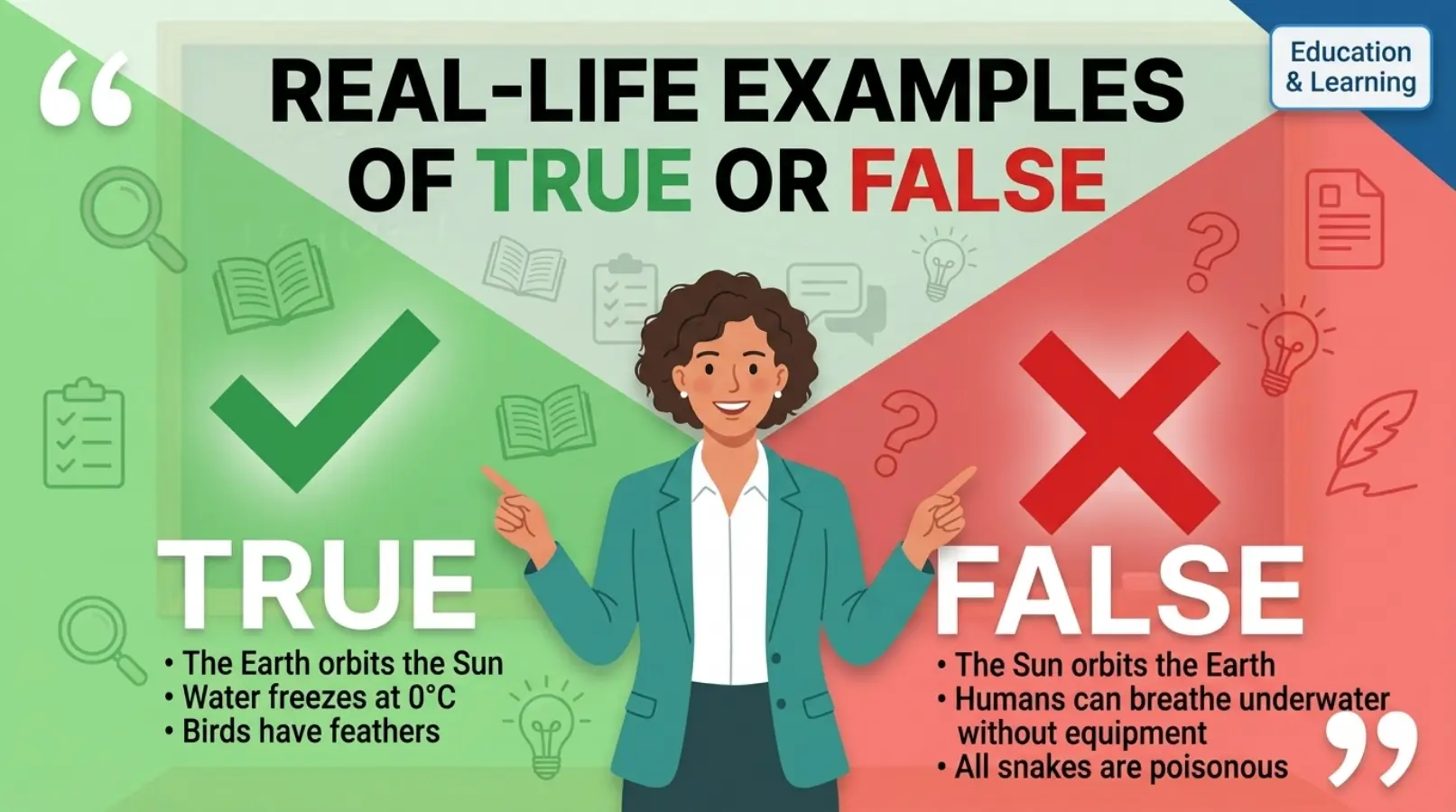
Birds have feathers.
Answer:
True
Statement:
Fish can breathe outside water forever.
Answer:
False
The answer depends on facts, not opinions.
Why Are True or False Questions Important?
These questions help measure knowledge quickly.
They also improve thinking skills.
Benefits include:
- Easy to understand
- Fast to answer
- Great for learning
- Good for testing memory
- Encourages careful reading
Teachers often use this format because it saves time.
Real-Life Examples of True or False
Here are common examples.
Science
Plants need sunlight to grow.
Answer:
True
Geography
Australia is the largest continent.
Answer:
False
Asia is the largest continent.
Mathematics
10 is greater than 8.
Answer:
True
History
The Titanic sailed after 1950.
Answer:
False
English
A noun is a naming word.
Answer:
True
True or False in School Exams
Many exams include true or false questions.
Examples include:
- Science tests
- English grammar quizzes
- Geography exams
- Computer courses
- Driving theory tests
Teachers use them to test basic understanding.
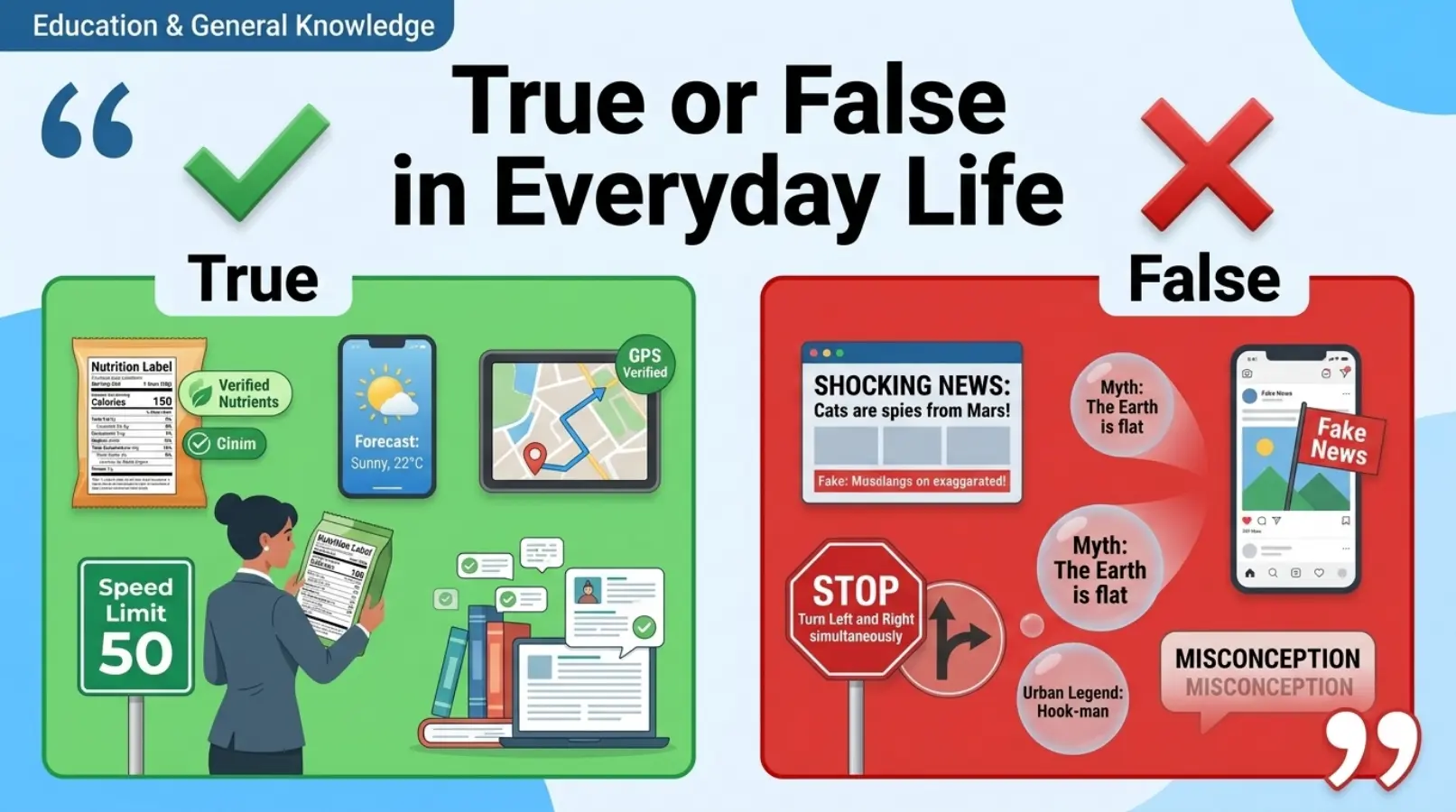
True or False in Everyday Life
People use this phrase outside classrooms too.
Examples include:
During conversations
“Is that story true or false?”
On social media
People check whether news is true or false.
At work
Employees verify information before making decisions.
While shopping
Buyers check whether product claims are true or false.
Common Types of True or False Questions
Fact-Based Questions
These depend on proven information.
Example:
The moon orbits Earth.
Answer:
True
Opinion-Based Statements
Opinions cannot be true or false unless presented as facts.
Example:
Chocolate ice cream tastes better than vanilla.
This is an opinion.
Mixed Statements
Sometimes only one word makes the statement false.
Example:
All birds can fly.
False
Penguins and ostriches cannot fly.
Common Mistakes People Make
Many people answer incorrectly because they read too quickly.
Here are common mistakes.
Ignoring small words
Words like:
- Always
- Never
- Only
- Every
- All
These words often change the answer.
Guessing
Never answer without reading carefully.
Confusing opinion with fact
Facts can be verified.
Opinions cannot
Assuming instead of checking
Always think before answering.
Tips to Answer True or False Questions Correctly
Read every word
One word can change the meaning.
Look for extreme words
Examples include:
- Always
- Never
- Everyone
- Nobody
These often make statements false.
Think before choosing
Do not rush.
Use logic
If something sounds impossible, check it carefully.
Practice often
The more questions you solve, the better you become.
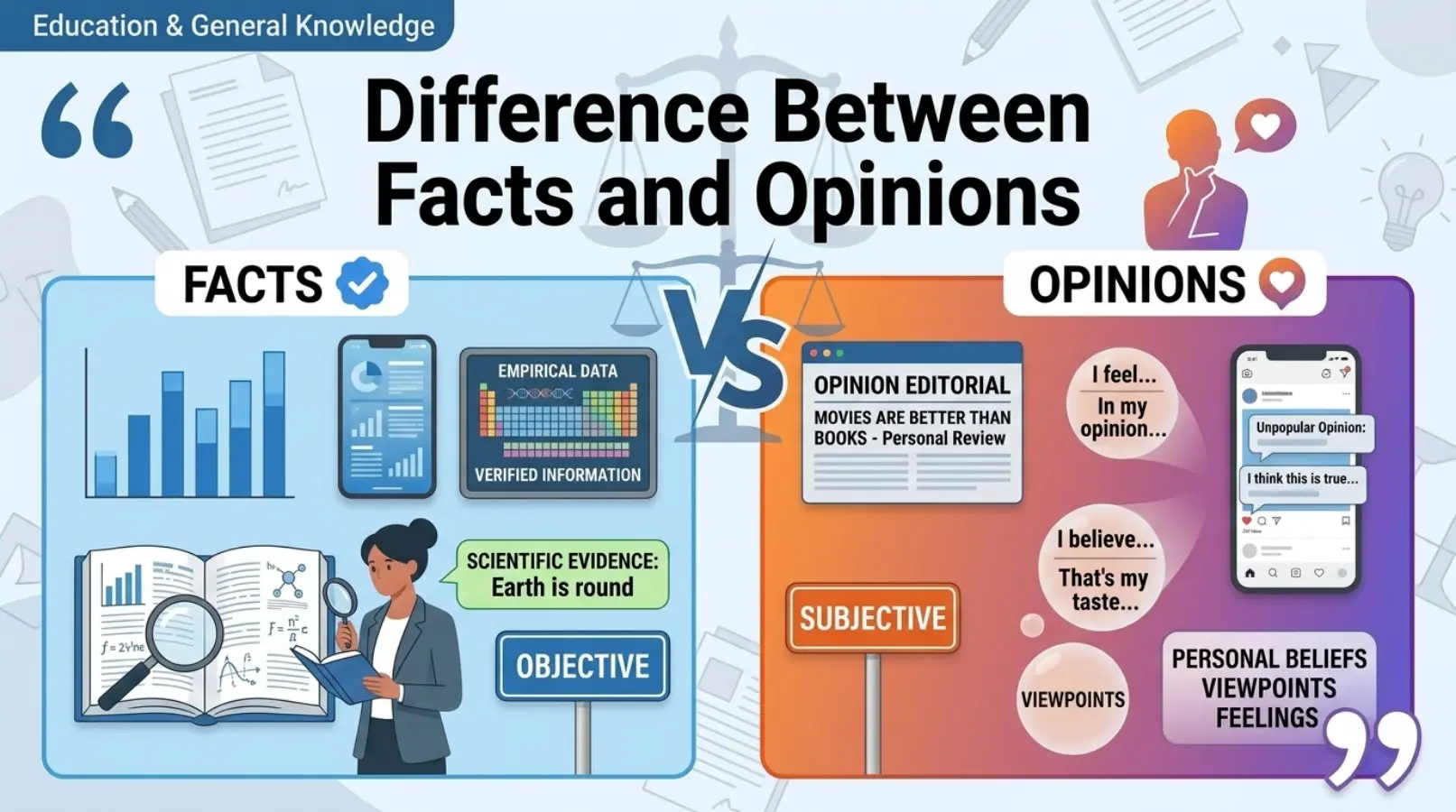
Difference Between Facts and Opinions
Understanding this difference helps answer correctly.
| Fact | Opinion |
| Can be proven | Personal belief |
| Has evidence | Based on feelings |
| True or false | Not always true or false |
| Same for everyone | Different for different people |
Example
Fact:
Water boils at 100°C (at sea level).
Opinion:
Summer is the best season.
Synonyms
- Correct or incorrect
- Right or wrong
- Fact or fiction
- Accurate or inaccurate
- Valid or invalid
Expert Insights
Education experts recommend using true or false questions to check basic understanding.
However, they work best with other question types.
Here are some expert tips:
- Read slowly before answering.
- Focus on facts instead of assumptions.
- Check every detail.
- Avoid guessing.
- Practice with different subjects.
- Review incorrect answers to improve.
These habits improve both learning and test scores.
True or False Practice Questions
1. The Sun rises in the east.
Answer:
True
2. Humans can breathe underwater without equipment.
Answer:
False
3. Water is made of hydrogen and oxygen.
Answer:
True
4. Penguins can fly.
Answer:
False
5. There are 12 months in a year.
Answer:
True
6. The Pacific Ocean is smaller than the Atlantic Ocean.
Answer:
False
7. A triangle has three sides.
Answer:
True
8. The Earth has two moons.
Answer:
False
Frequently Asked Questions (FAQs)
What does true or false mean?
It asks whether a statement is correct or incorrect.
What is a true statement?
A true statement matches facts and reality.
What is a false statement?
A false statement is incorrect or does not match facts.
Where are true or false questions used?
They appear in schools, quizzes, games, interviews, and online learning.
Can opinions be true or false?
Opinions usually cannot be judged as true or false because they are personal beliefs.
How do I answer true or false questions better?
Read carefully, focus on facts, and avoid guessing.
Why are true or false questions popular?
They are easy to create, simple to answer, and useful for testing knowledge.
Conclusion
Understanding true or false is important for learning, testing, and everyday decision-making. A true statement matches facts, while a false statement does not. Although the format seems simple, careful reading is essential because a single word can change the correct answer. By practicing regularly, checking facts, and avoiding assumptions, you can answer true or false questions with greater confidence. If you are preparing for an exam, playing a quiz game, or verifying information online, these skills will help you make better decisions. Remember, the best approach is to read carefully, think logically, and rely on evidence instead of guessing.
Discover More Post:
Compliment or Complement: What’s the Difference? and Rules
Cancelled or Canceled: Which Spelling Is Correct? Grammar Guide