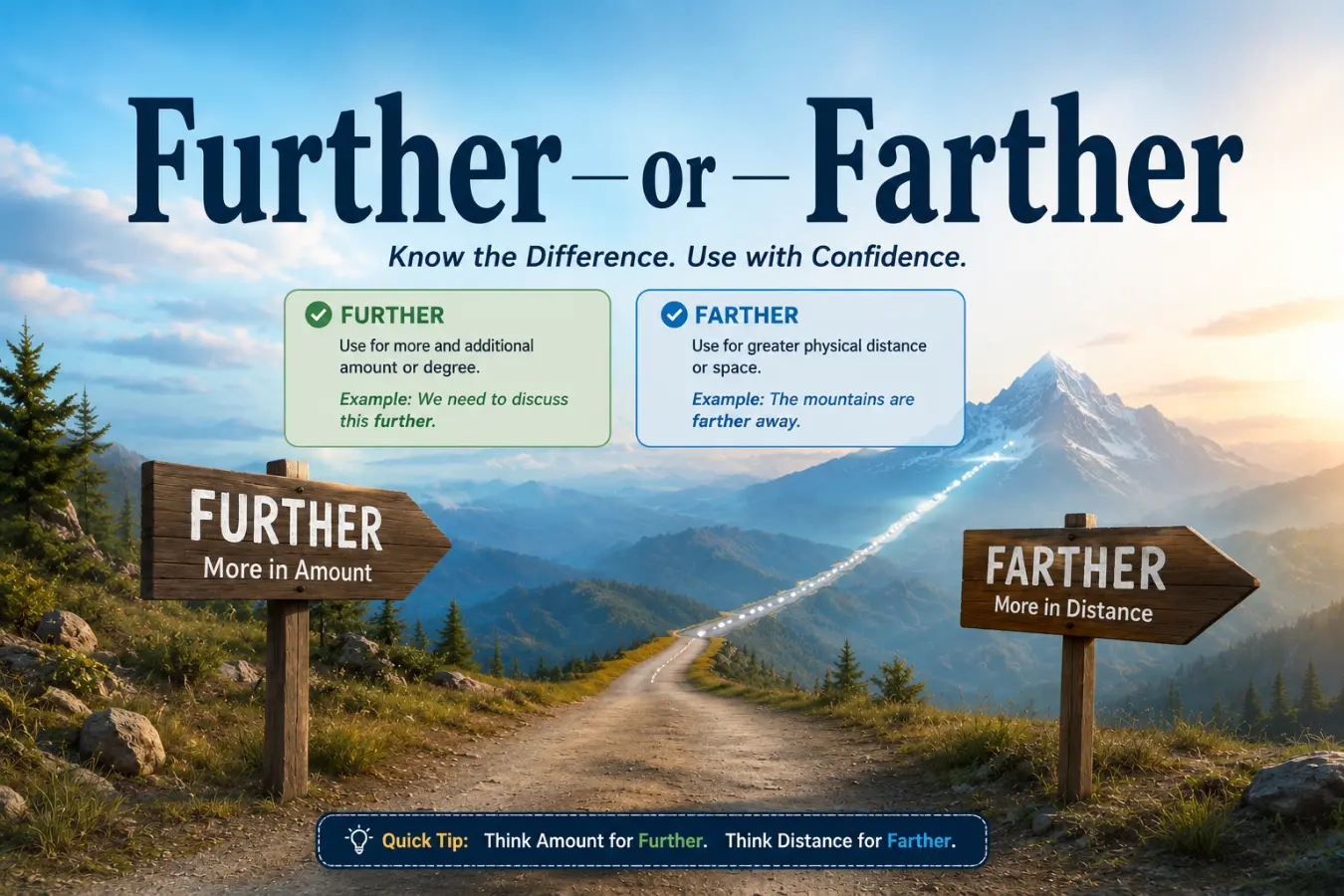
Further or farther is a common grammar question that confuses many English learners and native speakers. Both words relate to distance, but they are not always interchangeable. Knowing when to use each word makes your writing clearer and more professional. The good news is that the rule is simple once you understand it. In this guide, you will learn the meaning of both words, their differences, easy memory tricks, and real-life examples. You will also see a comparison table, common mistakes, and answers to popular questions. By the end, you will know exactly when to use further and when to use farther with confidence.
Quick Summary
- Farther refers to physical distance.
- Further refers to figurative or abstract distance.
- Many modern style guides accept further for both meanings.
- Use farther when talking about measurable locations.
- Use further for ideas, progress, discussions, education, or time.
- Remember: Far = Farther (physical distance).
- Knowing the difference improves writing and speaking.
What Do Further and Farther Mean?
Although these words look almost identical, they have different primary uses.
Further
Further means more, additional, or to a greater degree. It often describes abstract ideas rather than physical locations.
Examples:
- We need further research.
- She explained the topic further.
- Please contact us for further information.
Farther
It means at a greater physical distance.
Examples:
- The school is farther than the library.
- My office is farther down the street.
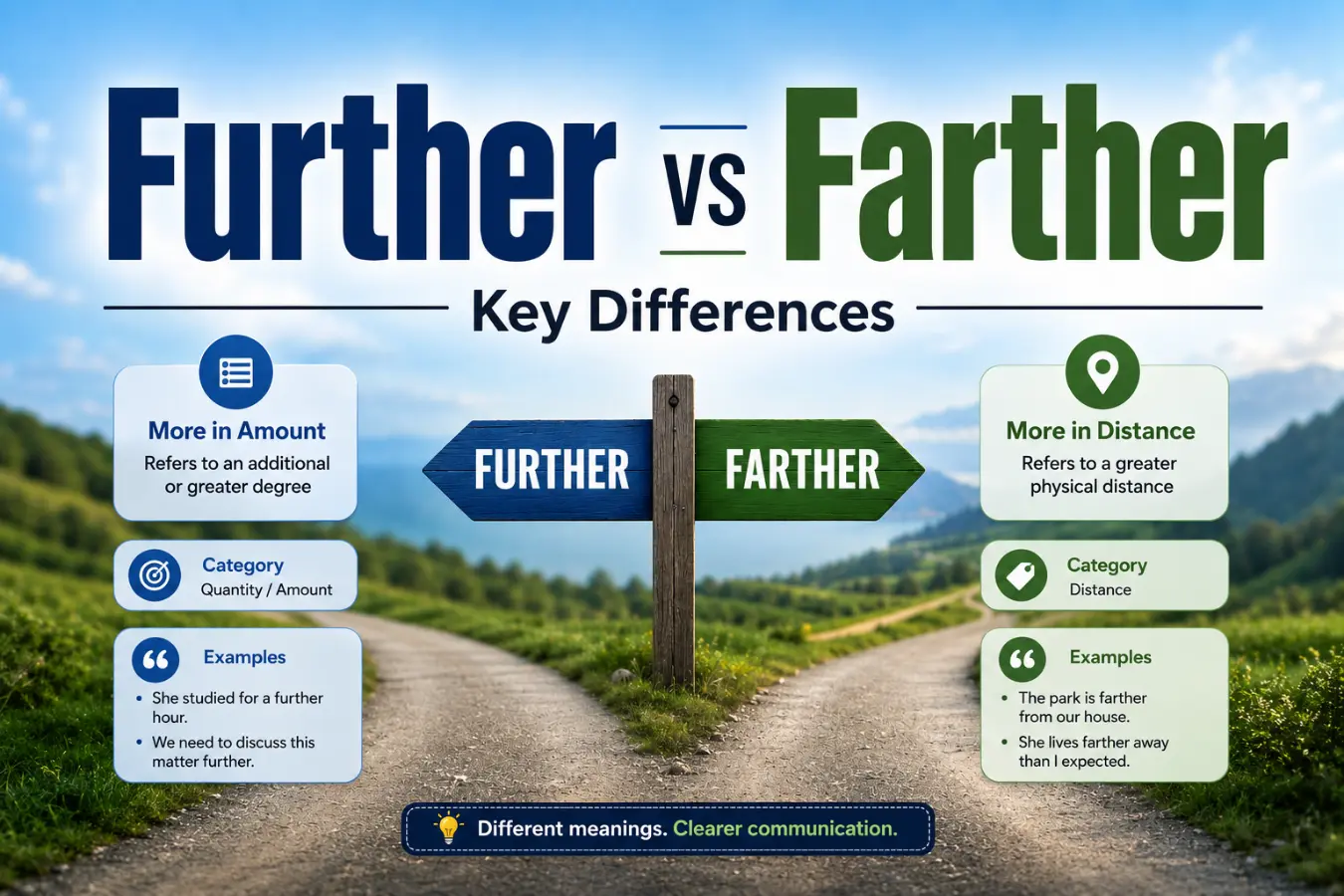
Further vs Farther: Key Differences
| Feature | Further | Farther |
| Main meaning | More or additional | Greater physical distance |
| Physical distance | Sometimes accepted | Best choice |
| Figurative distance | Yes | No |
| Common in formal writing | Yes | Yes |
| Everyday use | Very common | Mostly for physical distance |
| Example | Further discussion | Farther down the road |
Easy Rule
Farther = Far distance
Further = Figurative or additional
When to Use Farther
Use it whenever you talk about actual measurable distance.
Examples:
- Can you throw the ball farther?
- She ran farther than anyone else.
Physical Distance Examples
- farther north
- farther south
- farther away
- farther down the road
- farther into the park
When to Use Further
Use further for ideas, conversations, progress, education, or anything that cannot be measured physically.
Examples:
- We need further investigation.
- The teacher gave further instructions.
- I have no further questions.
- Let’s discuss this further.
- He continued his education further.
Abstract Examples
- further information
- further studies
- further explanation
- further improvement
- further development
Why Do People Confuse?
The confusion happens because both words originally shared similar meanings.
Modern English gradually gave them different roles.
Today:
- Both sometimes describe distance.
- Only further commonly describes abstract ideas.
- Many Americans still follow the traditional rule.
- Some British writers use further almost everywhere.
Because dictionaries accept some overlap, many people become unsure which word is better.
Easy Memory Trick
A simple trick helps you remember forever.
Think of the word “Far.”
Far is inside Farther.
That means:
Farther = Physical distance
Now think about Further.
It means moving further into an idea or discussion.
Memory Formula
- Far = Farther = Physical
- Further = Figurative + Additional
This trick works almost every time.
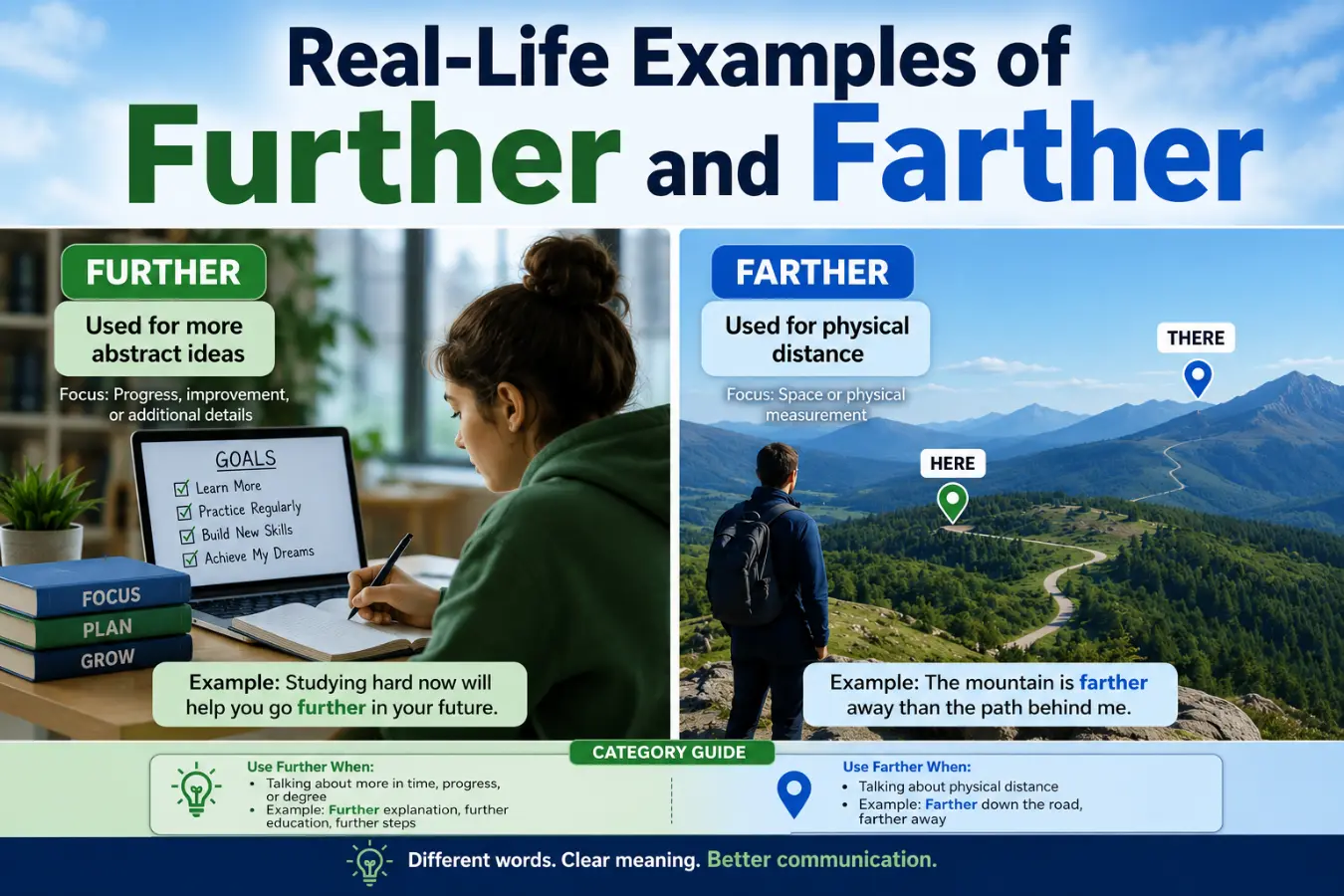
Real-Life Examples of Further and Farther
At School
✅ We need further explanation.
On a Road Trip
✅ The next gas station is farther away.
❌ The next gas station is further away. (Acceptable in some style guides but less preferred.)
At Work
✅ Please provide further details.
Hiking
✅ We walked farther into the woods.
Business Meeting
✅ Let’s discuss this further tomorrow.
Sports
✅ She threw the javelin farther than last year.
Everyday Sentences
Using Further
- Further information is available online.
- We need further testing.
- The company plans further expansion.
- She wants to study further.
- Further action may be necessary.
Using Farther
- The hotel is farther from the airport.
- Walk farther down the street.
- The lake is farther than I thought.
- He jumped farther than his teammate.
- We traveled farther this summer.
Common Mistakes to Avoid
Many learners mix these words.
Here are the most common mistakes.
Mistake 1
❌ We need farther information.
✅ We need further information.
Mistake 2
❌ The restaurant is further away.
✅ The restaurant is farther away.
Mistake 3
❌ Let’s talk farther.
✅ Let’s talk further.
Mistake 4
❌ She wants to farther her education.
✅ She wants to further her education.
Notice that further also works as a verb.
Example:
- The scholarship helped further her career.
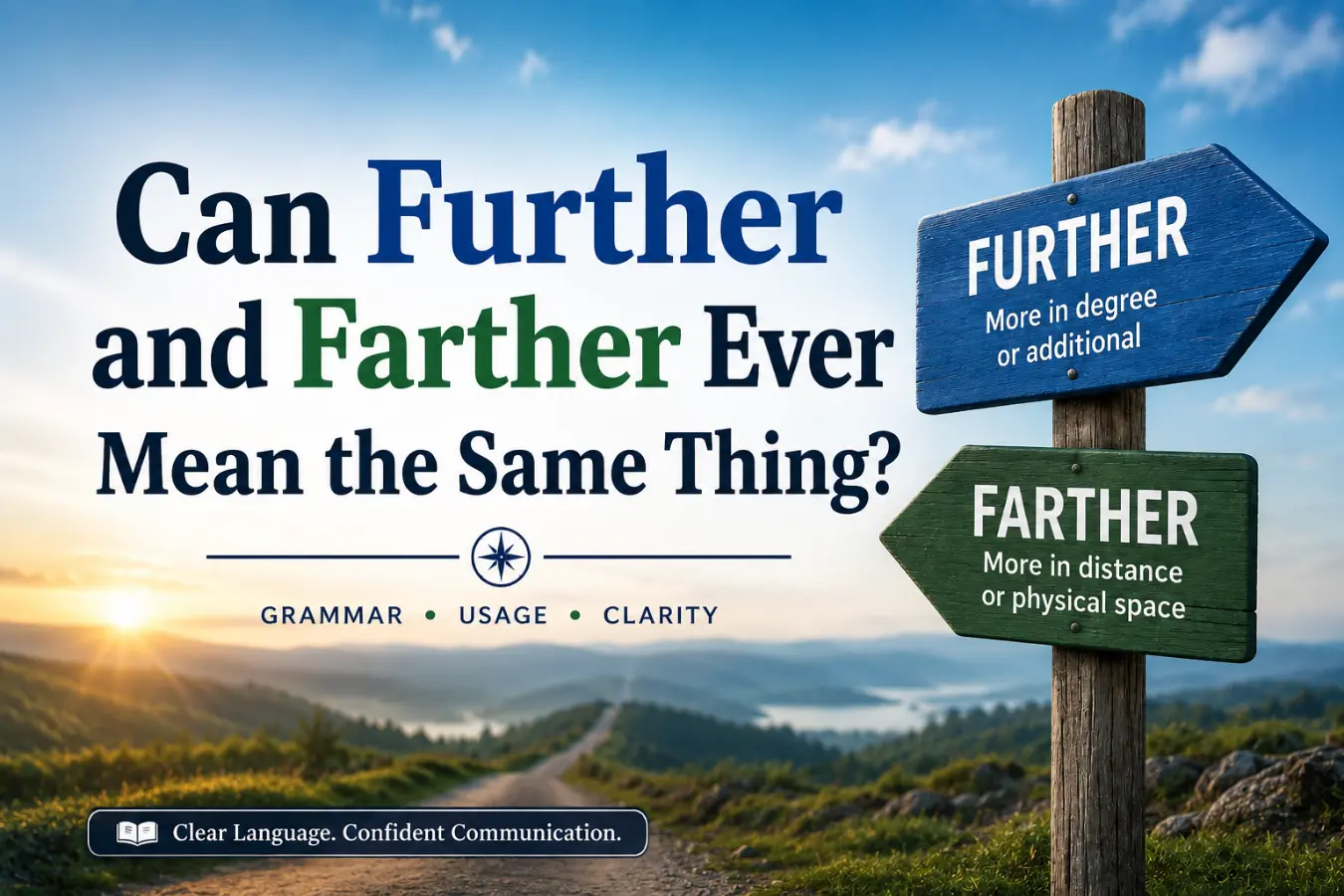
Can Further and Farther Ever Mean the Same Thing?
Yes.
When talking about physical distance, many dictionaries accept further.
Example:
- The station is further away.
- The station is farther away.
However, many editors recommend using farther because it is more precise.
In academic and professional writing, following the traditional rule is usually best.
Synonyms
Synonyms for Further
- Additional
- More
- Extra
- Extended
- Continued
- Advanced
- Beyond
- Moreover
Synonyms for Farther
- More distant
- Further away
- Beyond
- Remote
- More remote
- At a greater distance
Tips for Remembering the Difference
- Think Far = Farther.
- Use farther for places.
- Use further for ideas.
- Read your sentence aloud.
- Ask whether the distance is measurable.
- Practice with daily examples.
- Check grammar tools if unsure.
- Follow the traditional rule in formal writing.
Expert Insights: Why This Grammar Rule Matters
Understanding further or farther makes your writing more accurate.
Editors notice small grammar choices.
Correct word choice improves readability.
It also builds trust with readers.
Students earn better grades by using the right word.
Professionals create stronger emails and reports.
Writers sound more confident.
Although modern English allows flexibility, using the traditional distinction keeps your writing clear.
That is why many style guides still recommend it.
Frequently Asked Questions (FAQs)
Is farther only for physical distance?
Yes. Traditionally, farther refers to measurable physical distance.
Can I use further instead of farther?
Yes, many dictionaries allow it for distance. However, farther remains the preferred choice for physical locations.
Is further correct for information?
Yes.
Examples:
- Further information
- Further explanation
- Further research
Which word is more common?
Further appears more often because it has more meanings.
Is farther old-fashioned?
No.
It is still widely used, especially in American English.
Can further be a verb?
Yes.
Example:
- She wants to further her education.
Which word should students use?
Follow the simple rule:
- Physical distance → Farther
- Ideas or additional information → Further
Practice Quiz
Choose the correct word.
1. We need ______ information.
✅ Further
2. The store is ______ down the road.
✅ Farther
3. Let’s discuss this ______ tomorrow.
✅ Further
4. He threw the football ______ than before.
✅ Farther
5. We need ______ research.
✅ Further
Conclusion
Understanding further or farther becomes easy once you know the basic rule. Use farther when talking about measurable physical distance. Use further when discussing ideas, additional information, progress, or anything abstract. Although modern English sometimes accepts further for physical distance, farther remains the clearer and more traditional choice. Following this simple distinction makes your writing more accurate and professional. Whenever you hesitate, remember the easy trick: Far = Farther = Physical Distance. With regular practice and real-life examples, choosing between further and farther will soon become second nature.
Discover More Post:
Aid or Aide: What’s the Difference? Easy Guide With Examples
Is Cos X or Y? The Simple Guide to Understanding Cosine in Math