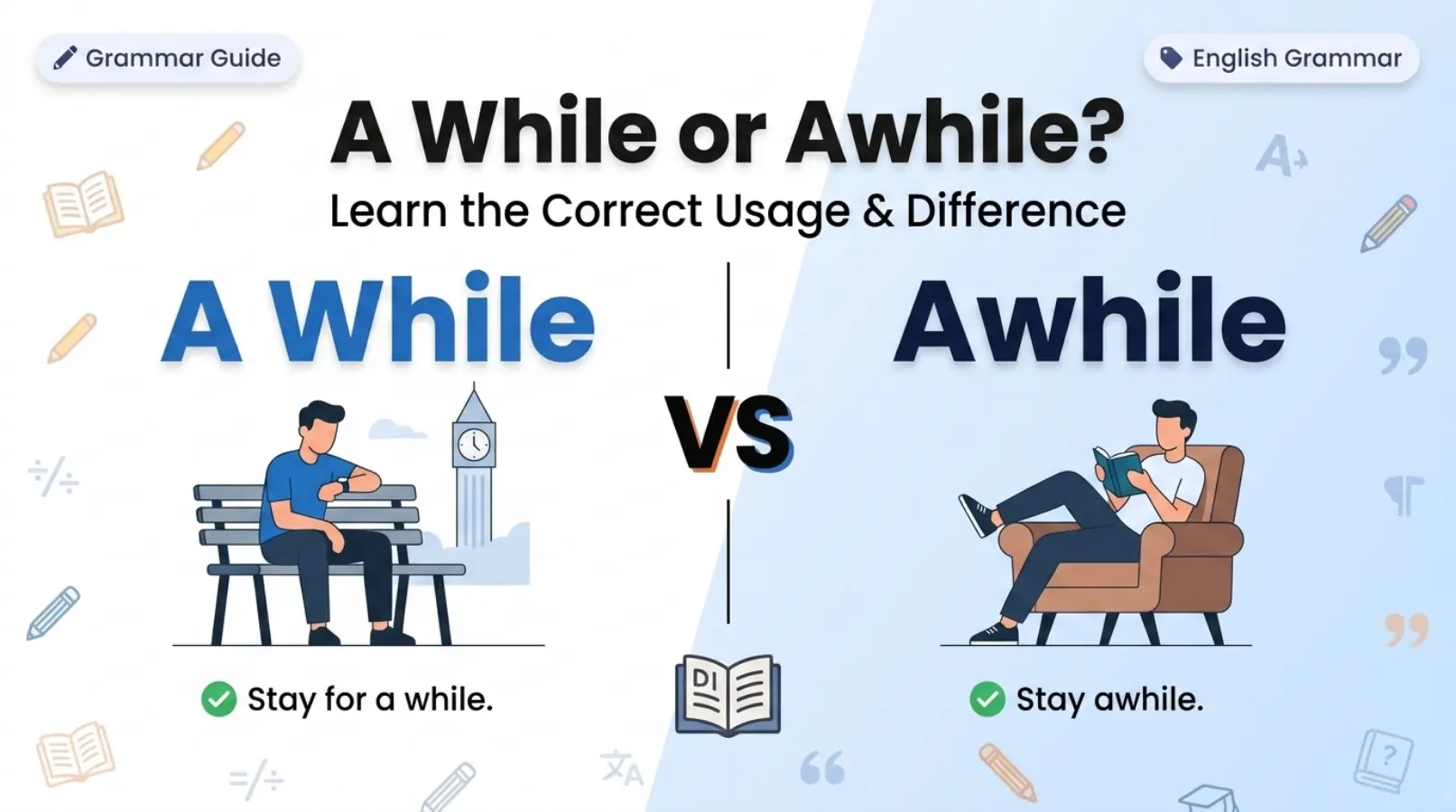
A while or awhile can confuse many English learners and even native speakers. These two words look almost the same. However, they have different meanings and uses. Knowing the difference helps you write clearly and speak correctly.
Many people use them interchangeably. That mistake can make your writing look less professional. The good news is that the rule is simple. Once you learn it, you will rarely make the mistake again.
In this guide, you will learn what its mean. You will also see simple examples, common mistakes, and easy tips to remember the difference. By the end, you will know exactly which one to use in every situation.
Quick Summary Box
- A while is a noun phrase.
- Awhile is an adverb.
- Use a while after a preposition like for, after, or in.
- Use awhile when it means for a short time without a preposition.
- Stay awhile. ✅
- Stay for a while. ✅
- Stay for awhile. ❌
What Does “A While” Mean?
A while is a noun phrase. It means a period of time.
You often use it after a preposition.
Examples
- I waited for a while.
- We talked for a while.
- She rested after a while.
- It has been a while since we met.
Think of a while as something that names a length of time.
What Does “Awhile” Mean?
Awhile is an adverb. It means for a short time.
It modifies a verb directly.
Examples
- Please stay awhile.
- They chatted awhile before leaving.
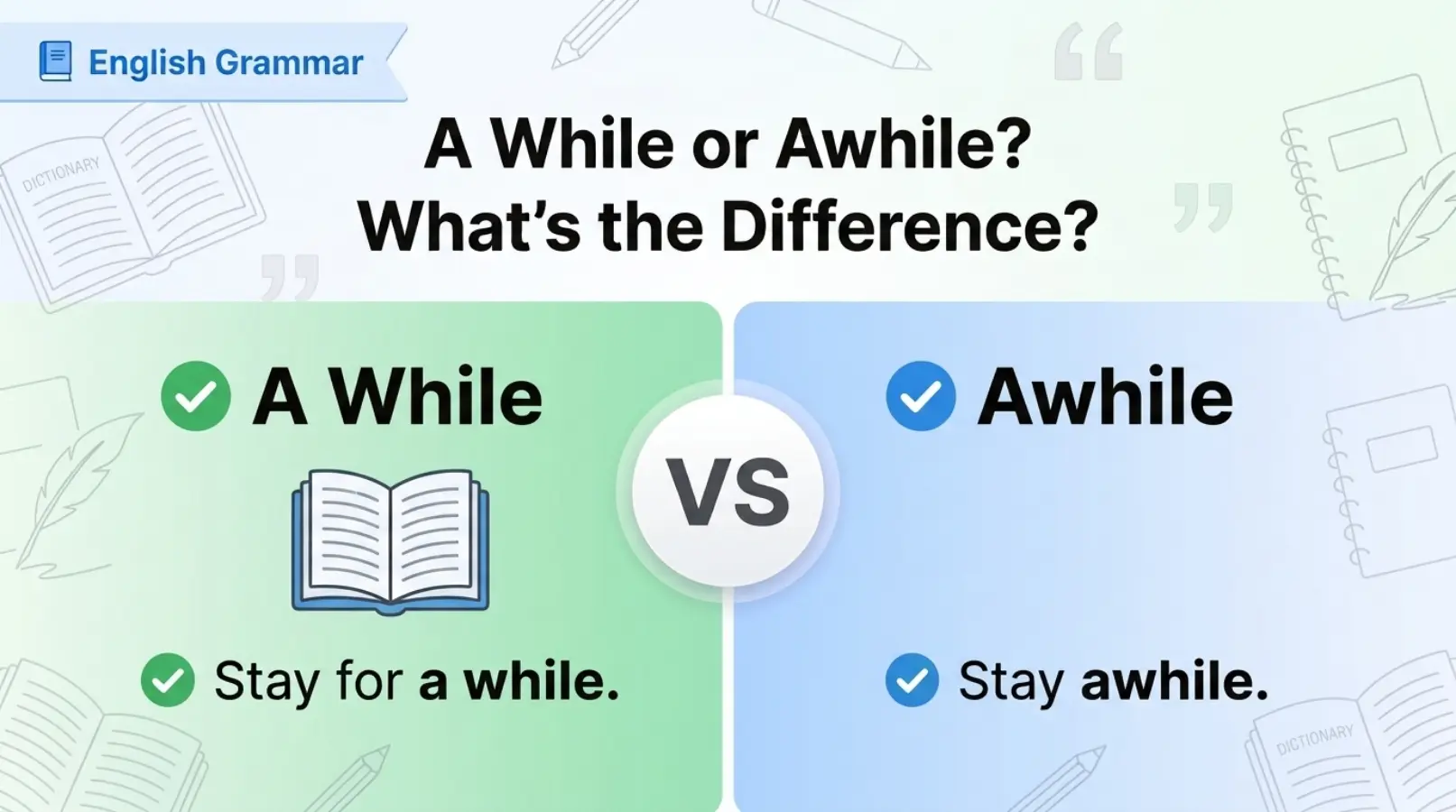
A While or Awhile: What’s the Difference?
The biggest difference is grammar.
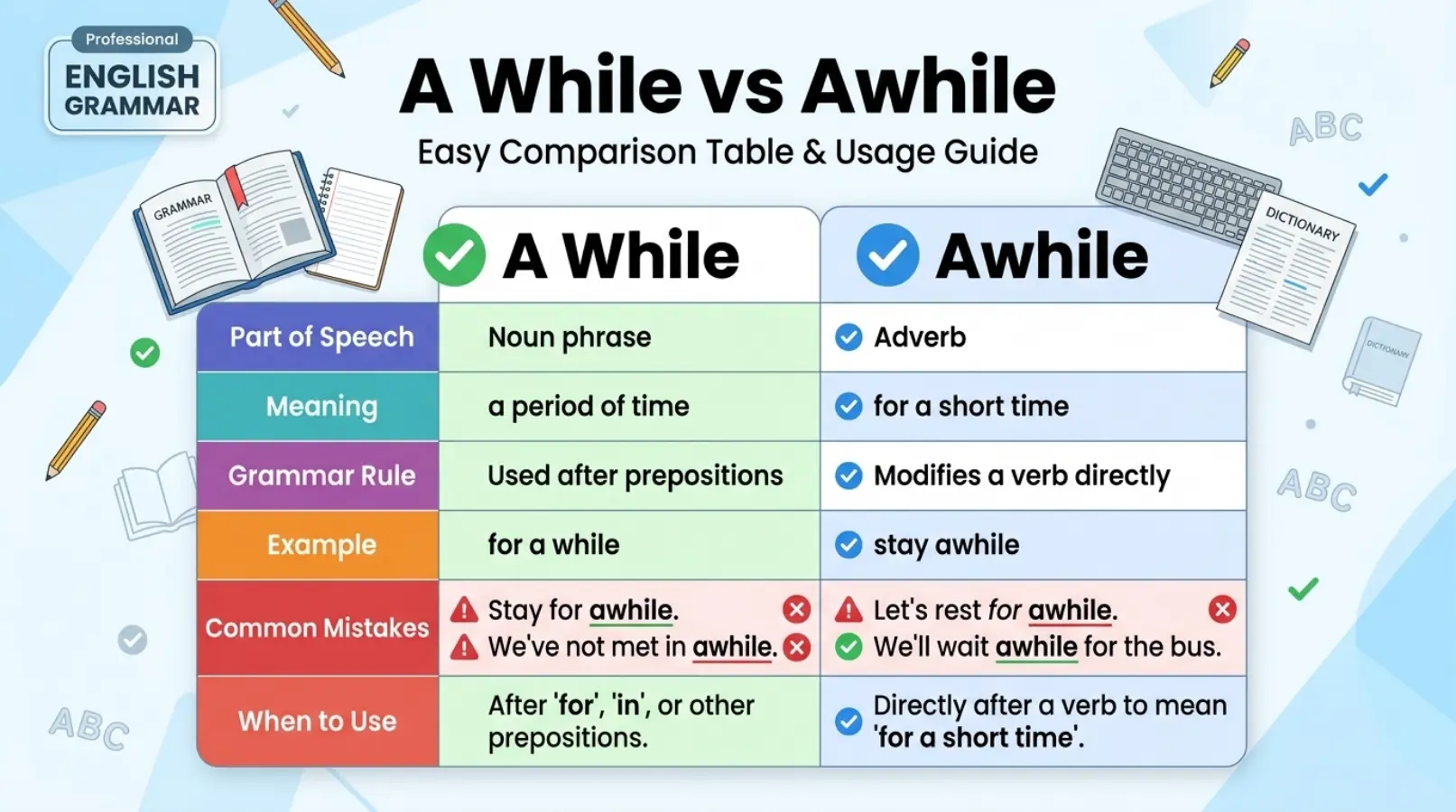
| Feature | A While | Awhile |
| Part of speech | Noun phrase | Adverb |
| Meaning | A period of time | For a short time |
| Used after prepositions | Yes | No |
| Common example | Wait for a while. | Wait awhile. |
| Correct after “for” | Yes | No |
Simple Rule
If you can remove for, use awhile.
If the sentence needs for, use a while.
When Should You Use “A While”?
Use a while whenever a preposition comes before it.
Common prepositions include:
- for
- after
- before
- in
- during
Correct Examples
- We waited for a while.
- After a while, everyone relaxed.
- It took a while to finish.
- I haven’t seen you in a while.
These sentences need the noun phrase.
When Should You Use “Awhile”?
Use awhile when it directly modifies the verb.
Correct Examples
- Rest awhile before driving.
- Sit awhile with us.
No preposition comes before it
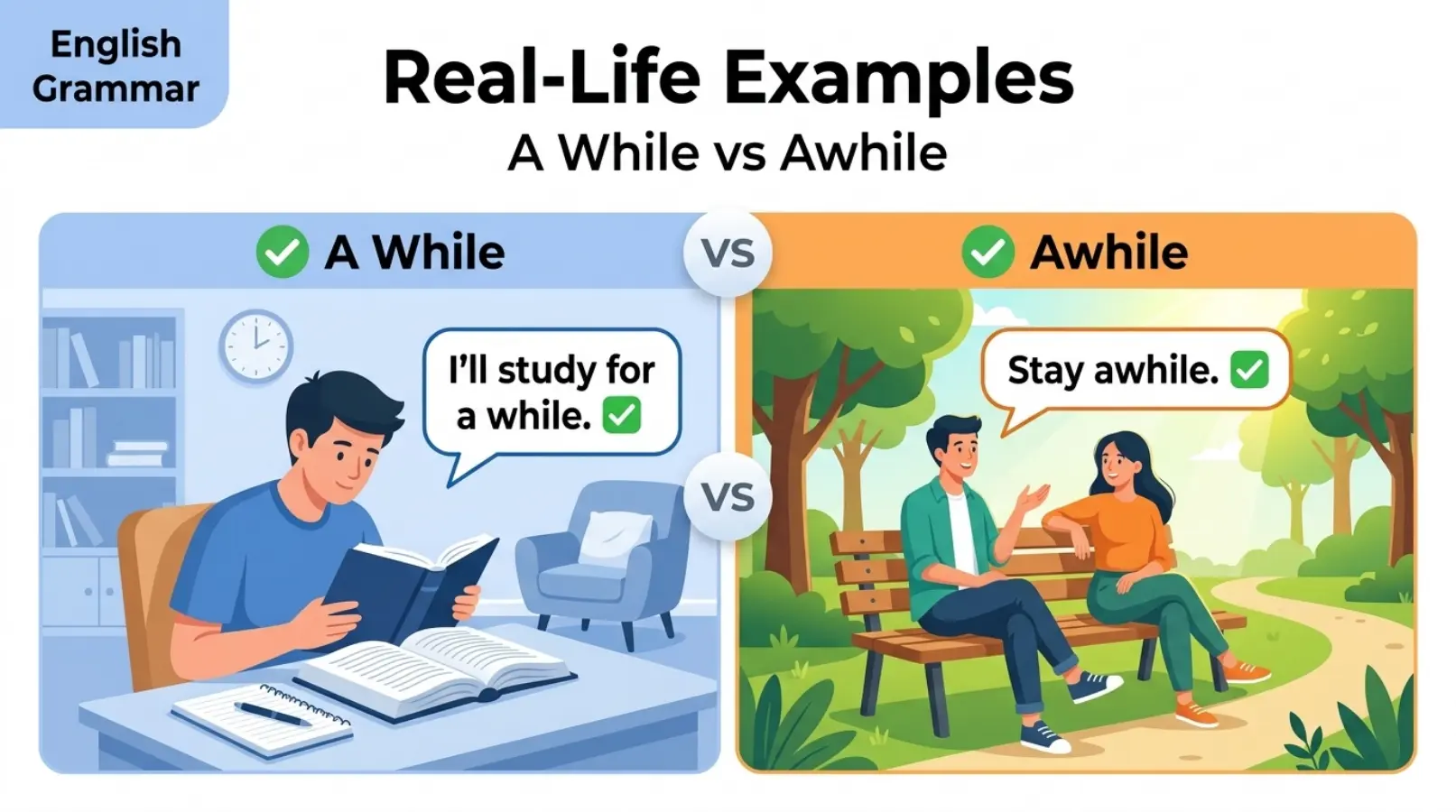
Real-Life Examples of A While vs Awhile
Here are examples you may hear every day.
At Home
Sit awhile.
Sit for a while.
At Work
Let’s talk awhile.
Let’s talk for a while.
With Friends
Stay awhile.
Stay for a while.
Traveling
We rested awhile.
We rested for a while.
Both forms can express similar ideas. The sentence structure decides which one is correct.
Common Mistakes People Make
Many writers confuse these expressions.
Mistake 1
❌ Stay for awhile.
✅ Stay for a while.
Mistake 2
❌ Waited awhile after dinner.
If “after” is part of the sentence structure, check whether you need a while.
Correct:
Waited for a while after dinner.
Mistake 3
❌ I haven’t seen you awhile.
Correct:
I haven’t seen you in a while.
Easy Trick to Remember the Difference
This memory trick works well.
Ask Yourself:
Is there a preposition before it?
If yes:
Use a while.
Examples:
- for a while
- after a while
- in a while
If no:
Use awhile.
Example:
- Stay awhile.
This simple rule solves most grammar problems.
A While vs Awhile Comparison Table
| Situation | Correct Choice | Example |
| After “for” | A while | We talked for a while. |
| After “after” | A while | After a while, it stopped raining. |
| After “in” | A while | I haven’t seen him in a while. |
| Directly after a verb | Awhile | Stay awhile. |
| Means “for a short time” | Awhile | Rest awhile. |
Usage in Everyday English
Native English speakers use both forms often.
Here are common expressions.
Using “A While”
- for a while
- after a while
- in a while
- quite a while
- a little while
Using “Awhile”
- stay awhile
- rest awhile
- chat awhile
Learning these phrases makes your English sound more natural.
Synonyms
- briefly
- temporarily
- momentarily
- shortly
- for some time
- for a short time
- briefly
- eventually (in some contexts)
Why Do People Confused?
The spellings are almost identical.
Also, both refer to time.
Because the meanings are close, many people think they are interchangeable.
They are not.
The grammar rule is what matters.
Remember:
- A while = noun phrase
- Awhile = adverb
Expert Insights
Professional editors often spot mistakes with a while and awhile immediately. Although the difference seems small, correct usage improves readability and shows strong grammar skills.
If you write blog posts, emails, reports, or academic papers, using the correct form builds trust with readers. Search engines also favor well-written content because it improves the user experience.
The easiest habit is to check for a preposition. If you see words like for, after, or in, choose a while. Otherwise, awhile is usually correct.
Frequently Asked Questions (FAQs)
Is it “a while” or “awhile”?
Both are correct. Use a while as a noun phrase and awhile as an adverb.
Is “stay awhile” correct?
Yes.
Is “stay for awhile” correct?
No. The correct form is stay for a while.
Why are “a while” and “awhile” different?
They belong to different parts of speech. One is a noun phrase, and the other is an adverb.
Can I use them interchangeably?
Not always. The sentence structure determines which one is correct.
Is “in awhile” correct?
Usually, no.
The correct expression is in a while.
Example:
“I’ll see you in a while.”
Is “wait awhile” correct?
Yes.
You can also say wait for a while.
Both are correct because the sentence structures differ.
Which form is more common?
Both are common in modern English. However, a while appears more often because many sentences include prepositions like for and in.
What is the difference between a while and awhile?
A while is a noun phrase that means a period of time. It usually follows a preposition like for, after, or in. Awhile is an adverb that means for a short time and directly modifies a verb. For example, Stay awhile is correct, while Stay for a while is also correct because the preposition for requires the noun phrase.
Conclusion
Understanding a while or awhile is easier than it first appears. The key difference is their grammatical role. A while acts as a noun phrase and follows prepositions like for, after, and in. Awhile acts as an adverb and directly modifies a verb without a preposition.
A simple memory trick can help you every time. If a preposition comes before the expression, choose a while. If there is no preposition and the word describes an action, choose awhile. With a little practice, this grammar rule becomes natural. Using the correct form will make your writing clearer, more accurate, and more professional.
Discover More Post:
My Ride or Die Meaning: Definition, Origin, Examples, and Usage
Gist or Jist: Which Is Correct? Meaning, and Grammar Guide