Greater than or equal to is a simple math symbol that helps compare two numbers or values. You may see it in school, business, coding, or everyday calculations. Learning this symbol makes math easier and helps you solve problems with confidence.
The symbol combines two ideas into one. It means one value is either bigger than another or exactly the same. This saves time and makes equations clear.
In this guide, you will learn the meaning of greater than or equal to, how to use the symbol, common mistakes to avoid, and real-life examples. By the end, you will understand this important math concept with ease.
Quick Summary Box
- Greater than or equal to symbol: ≥
- Meaning: A value is either larger than or equal to another value.
- Example: 10 ≥ 5 (True)
- Example: 5 ≥ 5 (True)
- Example: 3 ≥ 7 (False)
- Used in mathematics, algebra, statistics, programming, finance, and everyday comparisons.
- Opposite symbol: Less than or equal to (≤)
What Does Greater Than or Equal To Mean?
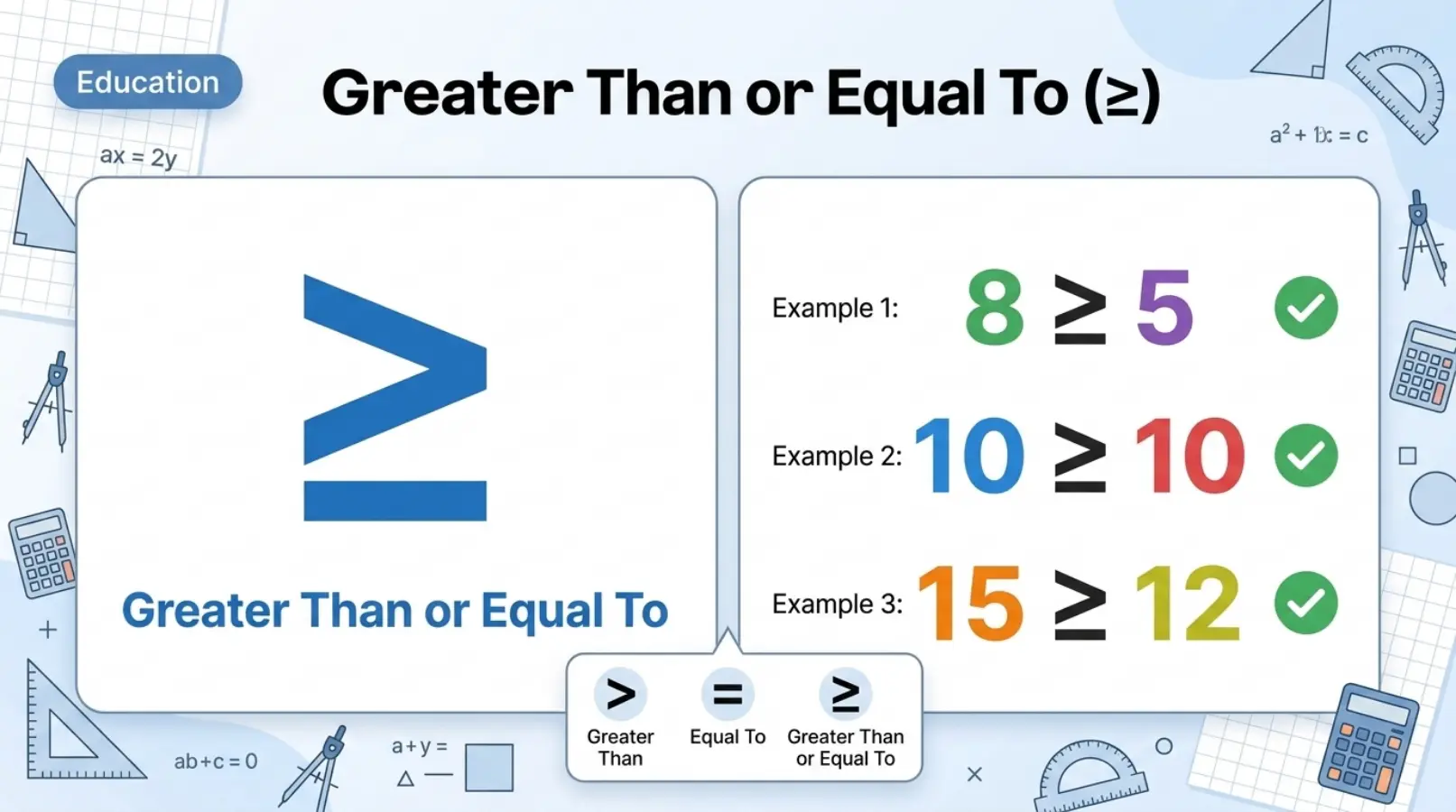
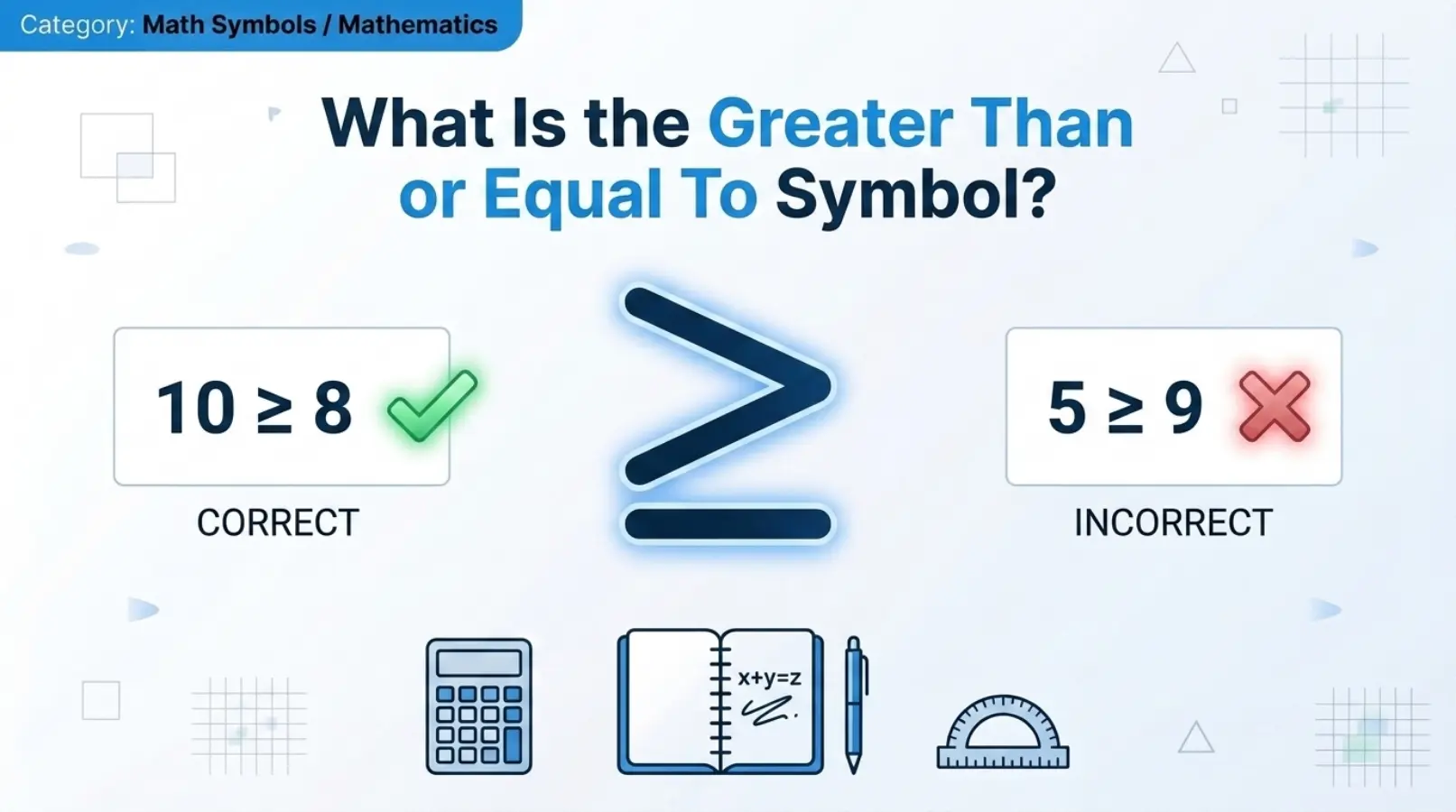
The greater than or equal to symbol (≥) shows that one number is:
- Greater than another number, or
- Equal to that number.
It combines two mathematical comparisons into one symbol.
For example:
- 8 ≥ 5 ✔ True
- 5 ≥ 5 ✔ True
- 2 ≥ 9 ✘ False
Think of it like saying:
“This number is at least this big.”
What Is the Greater Than or Equal To Symbol?
The symbol looks like this:
≥
It combines:
- Greater than sign (>)
- Equal sign (=)
Instead of writing:
Greater than or equal to
You simply write:
≥
Example:
Age ≥ 18
This means:
- Age can be 18
- Age can be 19
- Age can be 20
- Any age above 18
How to Read the Greater Than or Equal To Symbol
You can read the symbol in several ways.
| Expression | Read As |
| x ≥ 5 | x is greater than or equal to 5 |
| 12 ≥ 8 | 12 is greater than or equal to 8 |
| Score ≥ 60 | Score must be at least 60 |
| Height ≥ 150 cm | Height is 150 cm or more |
The phrase “at least” often means greater than or equal to.
Greater Than vs Greater Than or Equal To
Although these symbols look similar, they have different meanings.
| Greater Than (>) | Greater Than or Equal To (≥) |
| Must be larger | Can be larger or equal |
| Does not include equality | Includes equality |
| Example: 7 > 5 | Example: 7 ≥ 5 |
| Example: 5 > 5 ❌ | Example: 5 ≥ 5 ✔ |
Example
Suppose the passing score is:
- Greater than 60 (>60)
Then:
- 61 ✔
- 70 ✔
- 60 ✘
Now suppose it is:
- Greater than or equal to 60 (≥60)
Then:
- 60 ✔
- 61 ✔
- 90 ✔
Greater Than or Equal To vs Less Than or Equal To
These two symbols are opposites.
| Greater Than or Equal To | Less Than or Equal To |
| ≥ | ≤ |
| Larger or equal | Smaller or equal |
| x ≥ 10 | x ≤ 10 |
| Includes equality | Includes equality |
Example:
If a ride requires:
Height ≥ 120 cm
Children who are:
- 120 cm ✔
- 130 cm ✔
- 150 cm ✔
- 118 cm ✘
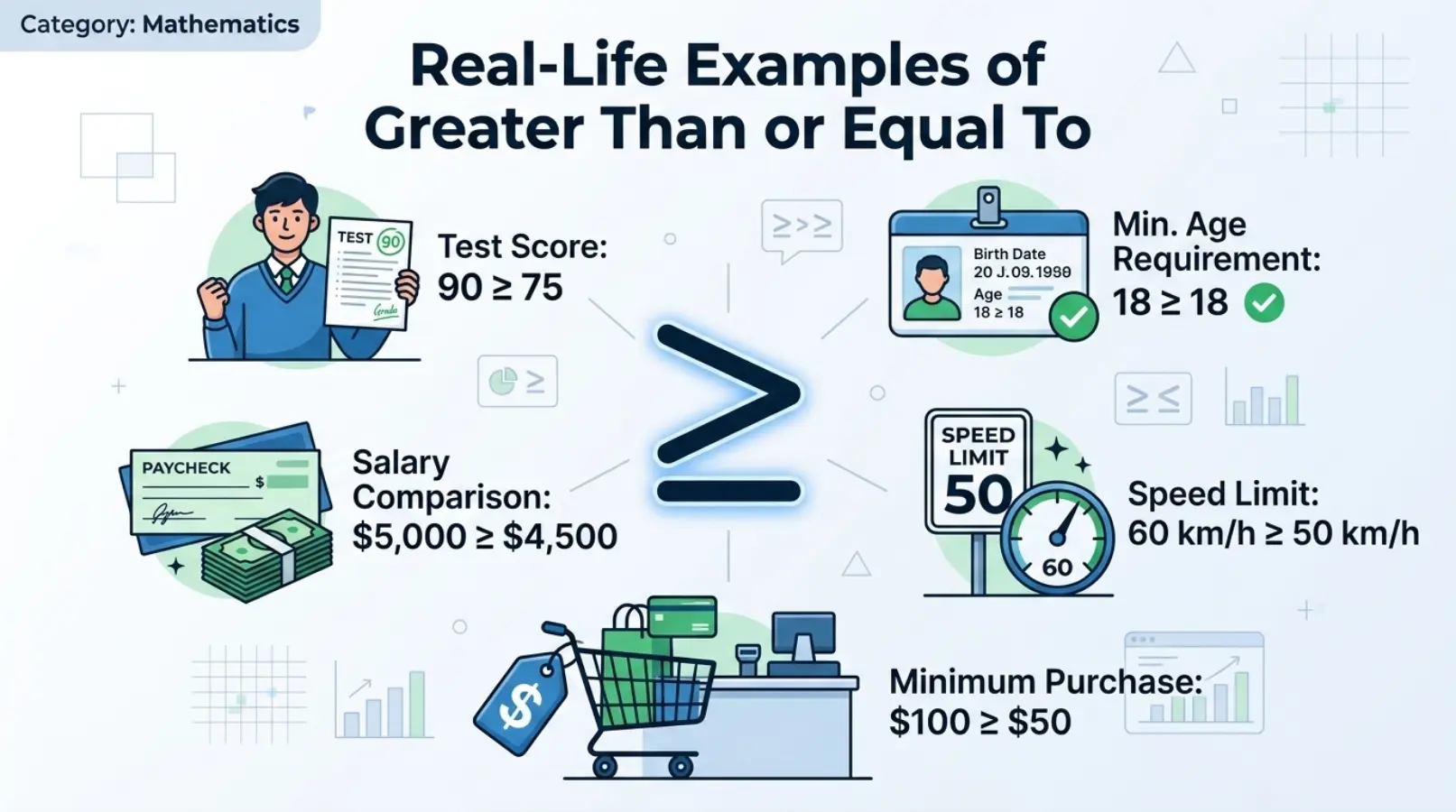
Real-Life Examples of Greater Than or Equal To
This symbol appears in many daily situations.
1. School Grades
Pass if:
Marks ≥ 50
Students with:
- 50 ✔
- 60 ✔
- 90 ✔
2. Age Requirement
Movie rating:
Age ≥ 18
Anyone 18 or older may enter.
3. Bank Balance
Minimum balance:
Balance ≥ $500
You must keep at least $500.
4. Shopping
Free delivery for orders:
Order ≥ $50
Spend $50 or more.
5. Sports
A player qualifies if:
Score ≥ 80
Any score of 80 or higher qualifies.
Greater Than or Equal To in Algebra
Algebra uses inequalities instead of equal signs.
Example:
x ≥ 12
Possible values:
- 12
- 13
- 20
- 100
Not possible:
- 11
- 10
- 5
Another example:
y ≥ -3
Possible values:
- -3
- 0
- 5
- 20
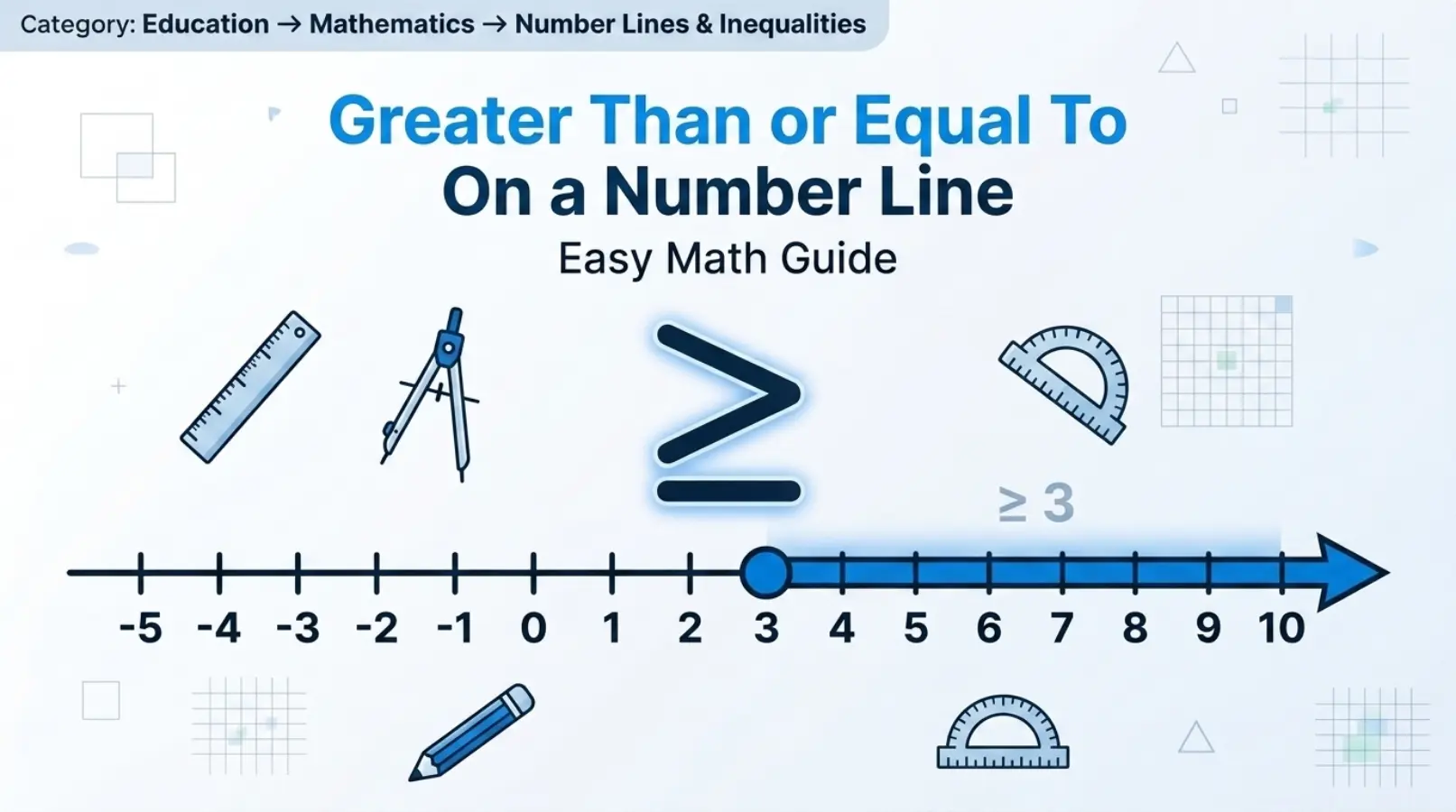
Greater Than or Equal To on a Number Line
Imagine a number line.
←——————————-→
1 2 3 4 5 6 7 8 9
●=====================>
5
The closed dot means:
5 is included.
The arrow means:
All numbers greater than 5.
So this graph represents:
x ≥ 5
How to Type the Greater Than or Equal To Symbol
Different devices use different methods.
| Device | Method |
| Windows | Alt + 242 (Numeric keypad) |
| Mac | Option + Period (varies by app) or Character Viewer |
| Microsoft Word | Insert → Symbol |
| Google Docs | Insert → Special Characters |
| HTML | >= is not correct; use ≥ or ≥ |
| LaTeX | \ge or \geq |
You can also copy this symbol:
≥
Common Mistakes People Make
Many beginners confuse comparison symbols.
Mistake 1
Writing:
>
Instead of:
≥
Remember:
Greater than does not include equality.
Mistake 2
Ignoring the equal part.
Example:
Requirement:
Age ≥ 16
Some people think 16 is not allowed.
Actually:
16 is allowed.
Mistake 3
Reading the symbol backward.
Always read:
Left side first.
Example:
12 ≥ 9
means:
12 is greater than or equal to 9.
Mistake 4
Mixing ≥ with ≤
These symbols point in opposite directions.
Practice reading them slowly.
Tips to Remember the Symbol Easily
Here are simple memory tricks.
Think “At Least”
Whenever you hear:
- At least
- Minimum
- Not less than
Use:
≥
Look for the Equal Line
The extra line means:
Equality is included.
Practice Daily
Compare simple numbers.
Example:
- 20 ≥ 10 ✔
- 8 ≥ 8 ✔
- 4 ≥ 9 ✘
Expert Insights: Why This Symbol Matters
The greater than or equal to symbol is one of the most useful symbols in mathematics. It appears in arithmetic, algebra, geometry, statistics, computer science, economics, and engineering.
Understanding it early builds a strong math foundation. It also helps you read graphs, solve inequalities, write formulas, and interpret data correctly.
When working with real-world rules such as minimum age, minimum balance, or passing scores, the symbol clearly shows that the limit itself is included. This reduces confusion and improves accuracy.
SEO Tip: If you’re learning math online, also study related topics like less than or equal to, inequalities, greater than symbol, and number line inequalities to build a complete understanding.
Frequently Asked Questions (FAQs)
What does greater than or equal to mean?
It means one value is either larger than another value or exactly equal to it.
What is the symbol for greater than or equal to?
The symbol is:
≥
Is 5 greater than or equal to 5?
Yes.
Since the numbers are equal, the statement is true.
Is 4 greater than or equal to 8?
No.
Four is smaller than eight.
What does “at least” mean in math?
“At least” usually means greater than or equal to (≥).
Where is the greater than or equal to symbol used?
It is used in:
- Mathematics
- Algebra
- Programming
- Statistics
- Finance
- Science
- Engineering
What is the opposite of greater than or equal to?
The opposite is:
Less than or equal to (≤).
How do I type the ≥ symbol?
You can copy and paste ≥, use your operating system’s symbol tools, or insert it from your word processor’s special characters menu.
Conclusion
The greater than or equal to symbol (≥) is a simple but powerful mathematical sign. It tells you that one value can be larger than another or exactly the same. You will see it in school, exams, programming, finance, and everyday situations such as age limits and minimum purchase requirements. Understanding how to read and use this symbol helps you solve inequalities, compare numbers, and avoid common mistakes. Remember that ≥ includes the value itself, unlike the greater than symbol (>). With regular practice and real-life examples, using greater than or equal to becomes natural and easy. Keep this rule in mind: if something must be at least a certain value, the greater than or equal to symbol is usually the right choice.
Discover More Post:
Winter Spring Summer or Fall: Weather, Nature, and Activities
Ready or Not PS5: Everything You Need to Know Before You Buy