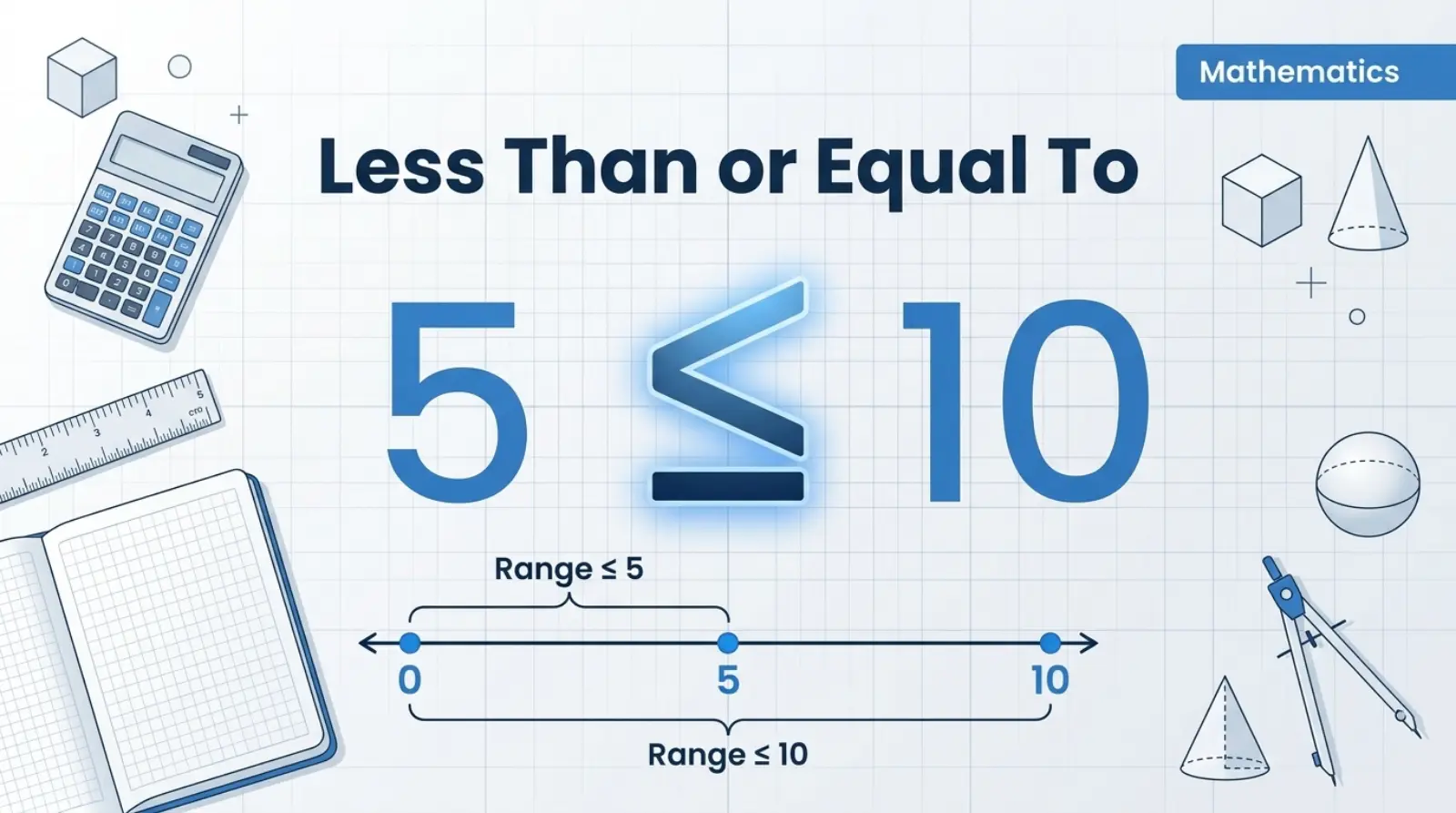
Less than or equal to is one of the most common math symbols used in school, business, science, and daily life. It helps compare two values quickly and clearly. If one value is smaller than another or exactly the same, you use the (≤) symbol.
Many students confuse this symbol with the simple less than (<) sign. However, they have different meanings. Learning the difference makes solving math problems much easier.
In this guide, you will learn what less than or equal to means, how to write it, when to use it, and common mistakes to avoid. You will also see real-life examples, comparison tables, expert tips, and answers to common questions.
Quick Summary Box
- Meaning: A value is either smaller than or equal to another value.
- Symbol: ≤
- Example: 5 ≤ 7
- Also True: 7 ≤ 7
- Not True: 9 ≤ 7
- Used in mathematics, algebra, graphs, programming, finance, and science.
- Opposite symbol: ≥ (Greater than or equal to)
What Does Less Than or Equal To Mean?
The symbol (≤) means one number can be:
- Smaller than another number
- Exactly equal to another number
Both situations make the statement true.
For example:
- 4 ≤ 6 ✅
- 6 ≤ 6 ✅
- 8 ≤ 6 ❌
Simply remember:
Smaller OR Equal
Understanding Less Than or Equal To in Simple Words
Imagine your teacher says:
“Students must score 80 or less.”
This means:
- 75 qualifies.
- 80 qualifies.
- 81 does not qualify.
The rule includes the number itself.
That is exactly what ≤ means.
Another example:
“You can bring 5 toys or fewer.”
Allowed:
- 1 toy
- 2 toys
- 5 toys
Not allowed:
- 6 toys
Less Than vs Less Than or Equal To
| Symbol | Meaning | Equal Allowed? | Example |
| < | Less than | No | 4 < 7 |
| ≤ | Less than or equal to | Yes | 7 ≤ 7 |
Examples
| Statement | True or False |
| 3 < 5 | True |
| 5 < 5 | False |
| 5 ≤ 5 | True |
| 2 ≤ 8 | True |
| 10 ≤ 8 | False |
The extra line under the symbol means “equal is included.”
Inequality Symbols: <, >, ≤, ≥ – Made Easy
Inequality symbols help us compare two numbers or values. They tell us whether one value is bigger, smaller, or equal to another. Once you understand these four symbols—<, >, ≤, and ≥—solving math problems becomes much easier.
What Are Inequality Symbols?
An inequality symbol shows that two values are not necessarily equal. Instead, it compares their size or value.
Here are the four main inequality symbols:
| Symbol | Meaning | Easy to Remember | Example |
|---|---|---|---|
| < | Less than | Left number is smaller | 3 < 7 |
| > | Greater than | Left number is bigger | 9 > 4 |
| ≤ | Less than or equal to | Smaller or the same | 5 ≤ 5 |
| ≥ | Greater than or equal to | Bigger or the same | 8 ≥ 8 |
Examples
You use inequalities every day without noticing.
- A movie ticket is for ages ≥ 13.
- Children under 5 (< 5) enter free.
- You need at least 70% (≥ 70%) to pass.
- Speed should be ≤ 60 km/h in some areas.
- Store discounts may apply to purchases > $100.
How to Read the ≤ Symbol
The symbol is read as:
- Less than or equal to
- At most
- No more than
- Up to
Examples:
- x ≤ 20
- Age ≤ 18
- Price ≤ $50
Each means the value can be smaller or exactly equal.
How to Type the Less Than or Equal To Symbol
Different devices use different methods.
| Device | Method |
| Windows | Alt + 243 (numeric keypad) |
| Mac | Option + , (varies by app) or Character Viewer |
| Microsoft Word | Insert → Symbol |
| Google Docs | Insert → Special Characters |
| HTML | <= is not correct; use ≤ or ≤ |
| LaTeX | \leq |
| Excel | Use <= in formulas |
Example in Excel:
=A1<=100
Returns TRUE if the value is 100 or less.
Real-Life Examples of Less Than or Equal To
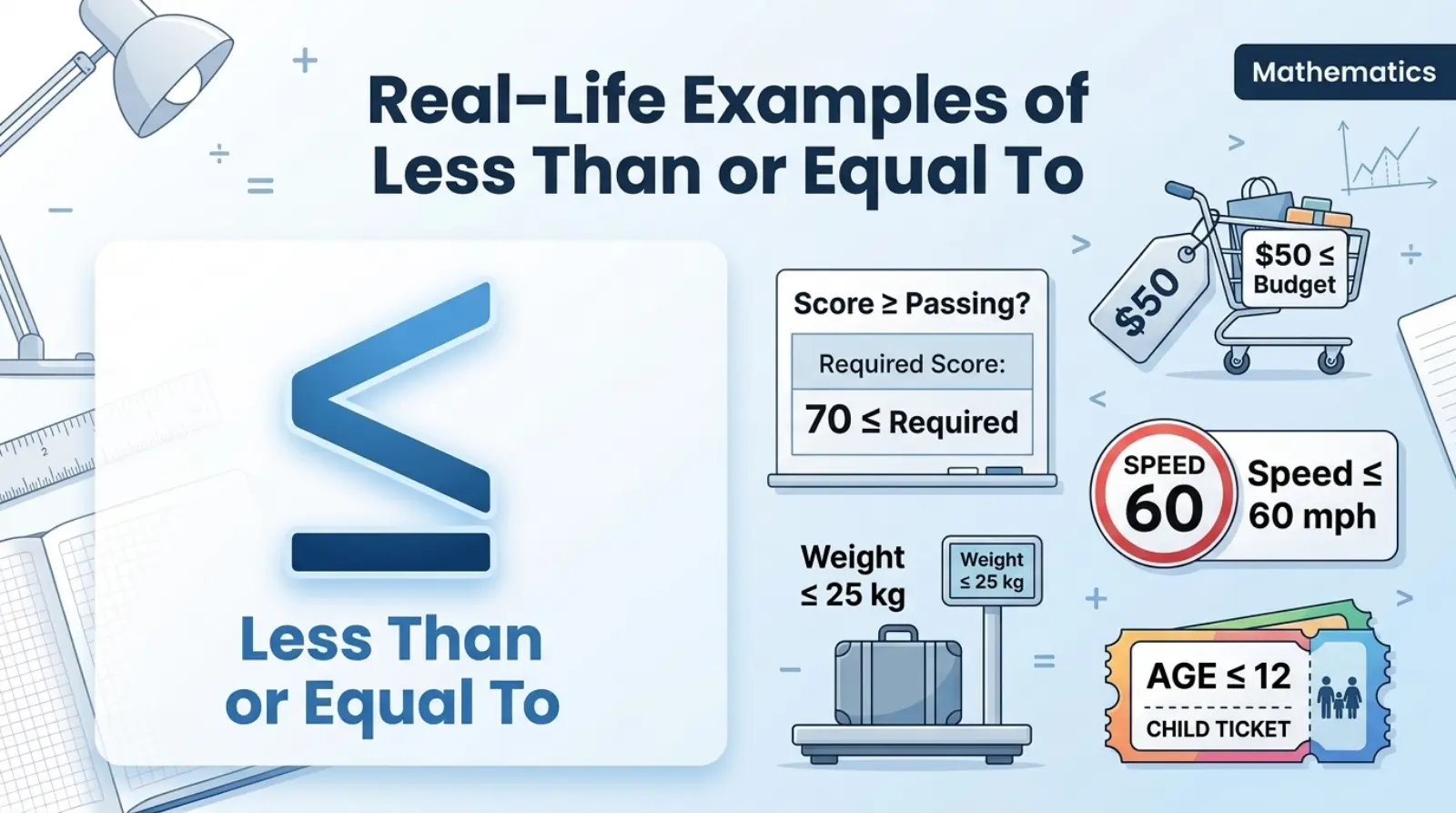
1. Speed Limit
Speed ≤ 60 km/h
Allowed:
- 45
- 60
Not allowed:
- 70
2. Age Requirement
Age ≤ 12
Children aged:
- 8
- 10
- 12
can enter.
3. Budget
Spend ≤ $100
You may spend:
- $75
- $95
- $100
Not:
- $120
4. Weight Limit
Bag Weight ≤ 20 kg
A bag weighing exactly 20 kg is allowed.
5. School Grades
Homework score ≤ 50
Any score from 0 to 50 fits.
Less Than or Equal To in Algebra
In algebra, variables often replace numbers.
Example:
x ≤ 12
Possible values:
- 0
- 5
- 8
- 12
Not allowed:
- 13
- 20
Another example:
2x ≤ 10
Divide both sides by 2:
x ≤ 5
Possible answers:
- 2
- 4
- 5
Less Than or Equal To on a Number Line
A number line helps visualize inequalities.
Example:
x ≤ 4
Draw:
- Closed circle at 4
- Shade everything to the left
Closed circles show the endpoint is included.
Open circles mean the endpoint is excluded.
Less Than or Equal To in Programming
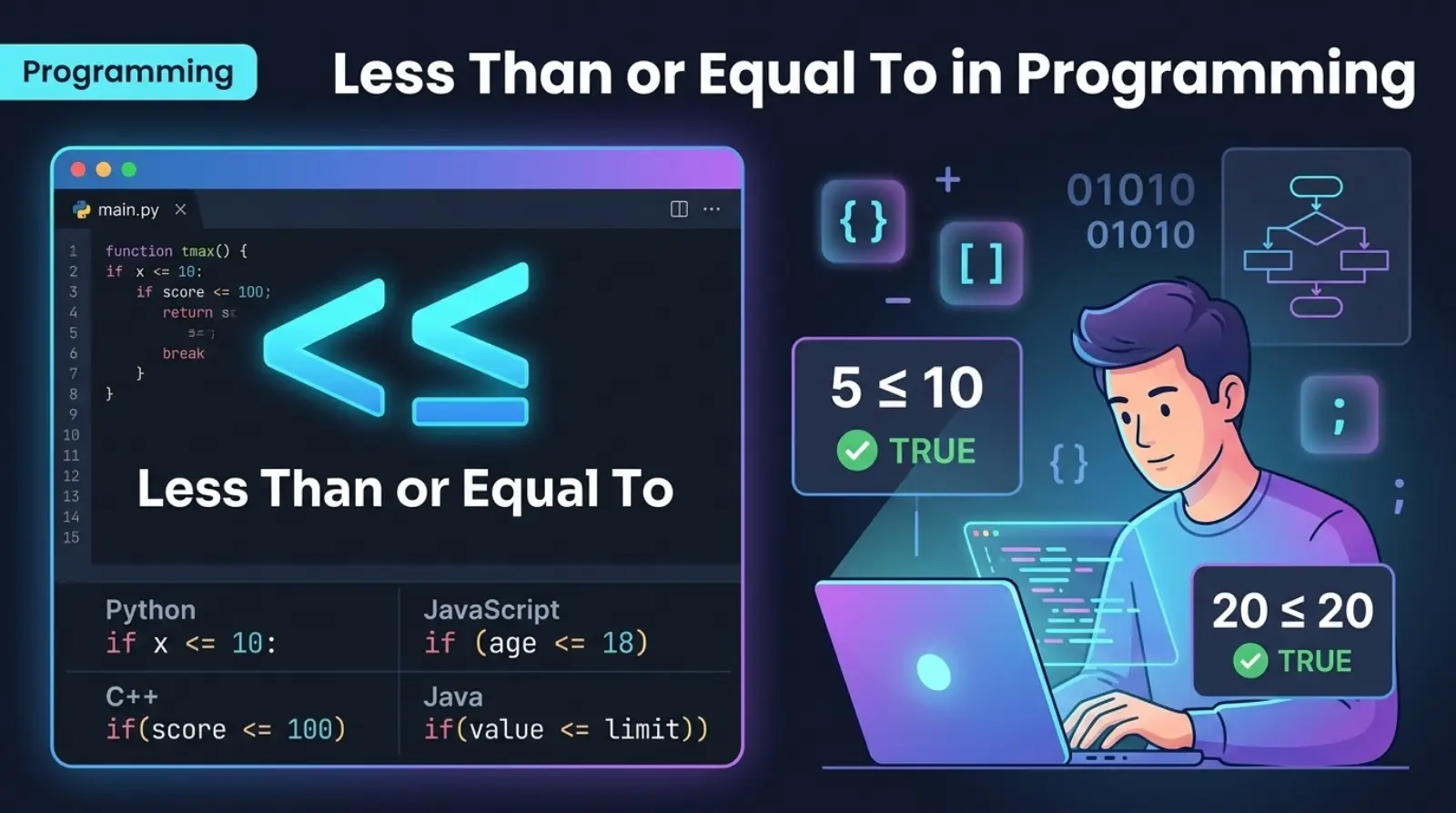
Programmers use <= because keyboards do not have the ≤ symbol.
Example in Python:
if age <= 18:
print(“Child Ticket”)
Example in JavaScript:
if(score <= 50){
console.log(“Needs Improvement”);
}
Programming languages commonly use:
- <=
- =
- <
Common Mistakes to Avoid
Mistake 1: Confusing < and ≤
Wrong idea:
5 < 5
Correct:
5 ≤ 5
Mistake 2: Forgetting Equal Is Included
Remember:
≤ always includes the endpoint.
Mistake 3: Reading the Symbol Backwards
The open side always faces the larger number.
Example:
3 ≤ 8
Correct.
Mistake 4: Using the Wrong Number Line Circle
Use:
- Closed circle for ≤
- Open circle for <
Tips for Remembering the Symbol
- The line underneath means equal is included.
- Think of ≤ as smaller OR same.
- Practice with number lines.
- Compare everyday examples like budgets and age limits.
- Remember that programmers type <=.
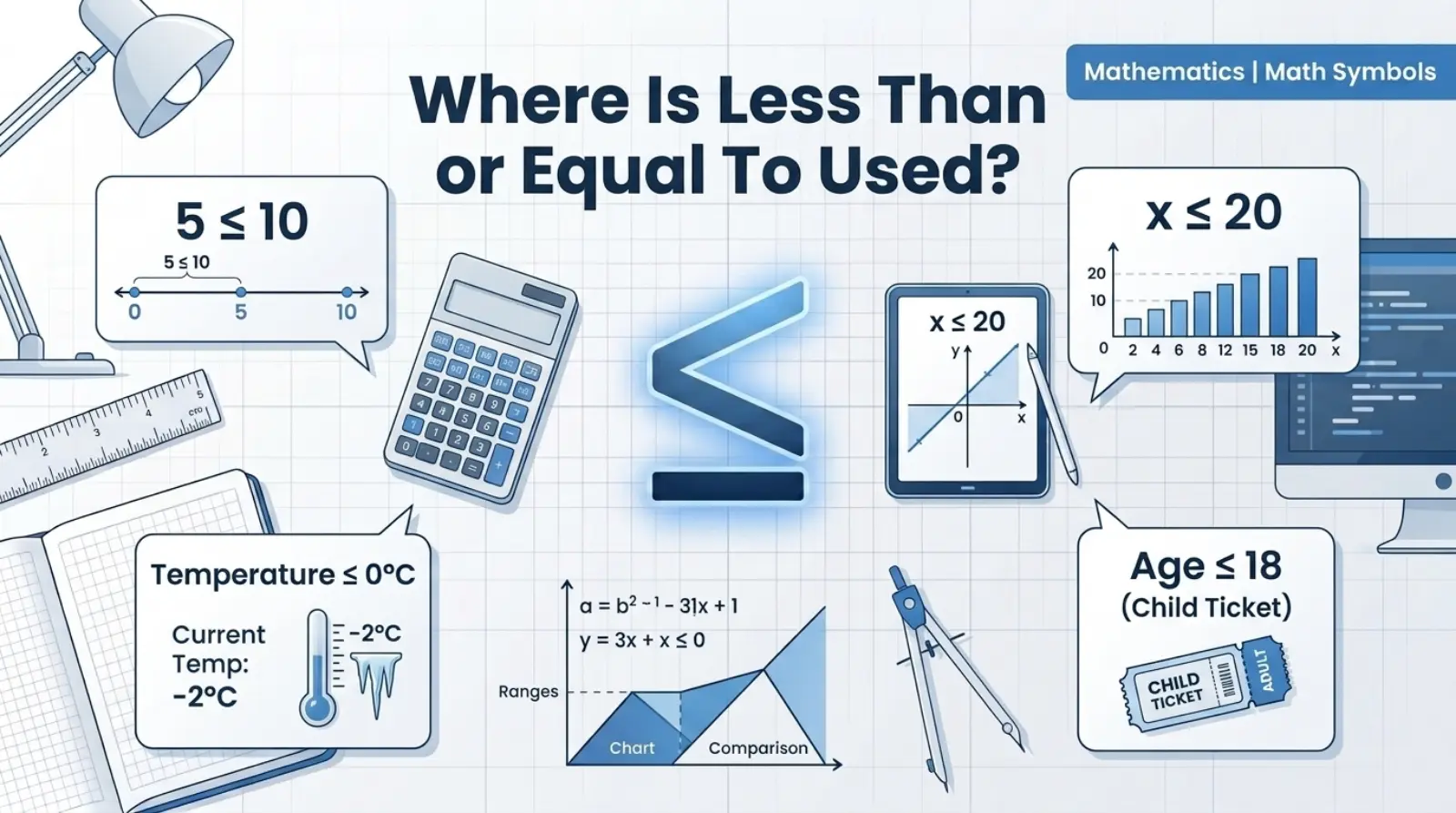
Where Is Less Than or Equal To Used?
You see this symbol in many places.
Mathematics
- Algebra
- Geometry
- Calculus
Science
- Temperature limits
- Chemical measurements
- Physics formulas
Finance
- Budget planning
- Loan approval
- Investment rules
Business
- Sales targets
- Inventory control
Computer Programming
- Conditions
- Loops
- Algorithms
Statistics
- Probability
- Data analysis
- Graphs
Less Than or Equal to Symbol LaTeX
The less than or equal to symbol in LaTeX is written using the \leq or \le command. It displays the mathematical symbol ≤, which means one value is either smaller than or exactly equal to another value.
This symbol is widely used in mathematics, algebra, calculus, inequalities, statistics, computer science, and academic research. Learning the correct LaTeX command ensures your equations are formatted professionally and clearly.
How to Write the Less Than or Equal to Symbol in LaTeX
To create the symbol, place the command inside math mode.
| LaTeX Code | Output | Meaning |
| a \leq b | a ≤ b | a is less than or equal to b |
| a \le b | a ≤ b | Short form of \leq |
Example:
$a \leq b$
Output:
a ≤ b
Display Mode Example
For centered equations, use display math.
\[
x \leq 10
\]
Output:
x ≤ 10
Inline Math Example
Use inline math when the equation appears within a sentence.
The value satisfies $x \leq 100$.
Output:
The value satisfies x ≤ 100.
Difference Between \le and \leq
There is no visual difference in most LaTeX distributions.
| Command | Output | Recommendation |
| \le | ≤ | Short and convenient |
| \leq | ≤ | Most commonly used in textbooks |
Most writers prefer \leq because it is more descriptive and easier to remember.
Common Examples
Example 1
x \leq 5
Output:
x ≤ 5
Example 2
n \leq 100
Output:
n ≤ 100
Example 3
a + b \leq c
Output:
a + b ≤ c
Example 4
\frac{x}{2} \leq 10
Output:
x/2 ≤ 10
Using the Symbol with Other Inequalities
| Inequality | LaTeX Command | Symbol |
| Less than | \lt or < | < |
| Less than or equal to | \le or \leq | ≤ |
| Greater than | > | > |
| Greater than or equal to | \ge or \geq | ≥ |
| Not equal | \neq | ≠ |
Synonyms
- At most
- No more than
- Up to
- Maximum
- Equal or less
- Not greater than
Expert Insights: Why Understanding Less Than or Equal To Matters
Learning inequality symbols builds strong math skills. These symbols appear in almost every level of mathematics, from elementary lessons to advanced calculus. They also play a key role in programming, engineering, economics, and scientific research.
Students who understand inequalities solve equations faster and make fewer mistakes. Professionals rely on these symbols to define limits, compare values, and create accurate formulas. Mastering less than or equal to improves logical thinking and prepares you for more advanced topics.
Frequently Asked Questions (FAQs)
What does less than or equal to mean?
It means a value is either smaller than another value or exactly the same.
What is the symbol for less than or equal to?
The symbol is:
≤
Is 5 less than or equal to 5?
Yes.
Because both numbers are equal.
What is the difference between < and ≤?
The < symbol does not include equality.
The ≤ symbol includes equality.
How do I type the less than or equal to symbol?
You can insert ≤ using your operating system’s symbol tools, use ≤ in HTML, \leq in LaTeX, or type <= in programming languages and spreadsheet formulas.
Where is less than or equal to used?
It is used in:
- Math
- Science
- Finance
- Programming
- Statistics
- Engineering
Can two equal numbers use the ≤ symbol?
Yes.
Example:
10 ≤ 10
This statement is true.
Why do programmers use <= instead of ≤?
Most keyboards do not have the ≤ symbol. Therefore, programming languages use <=.
Conclusion
The less than or equal to symbol (≤) is a simple but powerful mathematical tool. It tells us that one value can be smaller than another or exactly equal to it. Unlike the less than (<) symbol, it includes the endpoint, making it useful for setting limits, solving inequalities, and writing accurate formulas. You will encounter this symbol in mathematics, programming, finance, science, and everyday situations such as budgets, age requirements, and speed limits. By understanding its meaning, practicing with examples, and avoiding common mistakes, you can use it confidently in school and real life. Remember this easy rule: less than or equal to means “smaller or the same.” Once you master it, comparing values becomes much easier.
Discover More Post:
Gray or Grey: Which Spelling Is Correct? The Guide With Examples
This or That: Meaning, Examples, Differences, and How to Use It