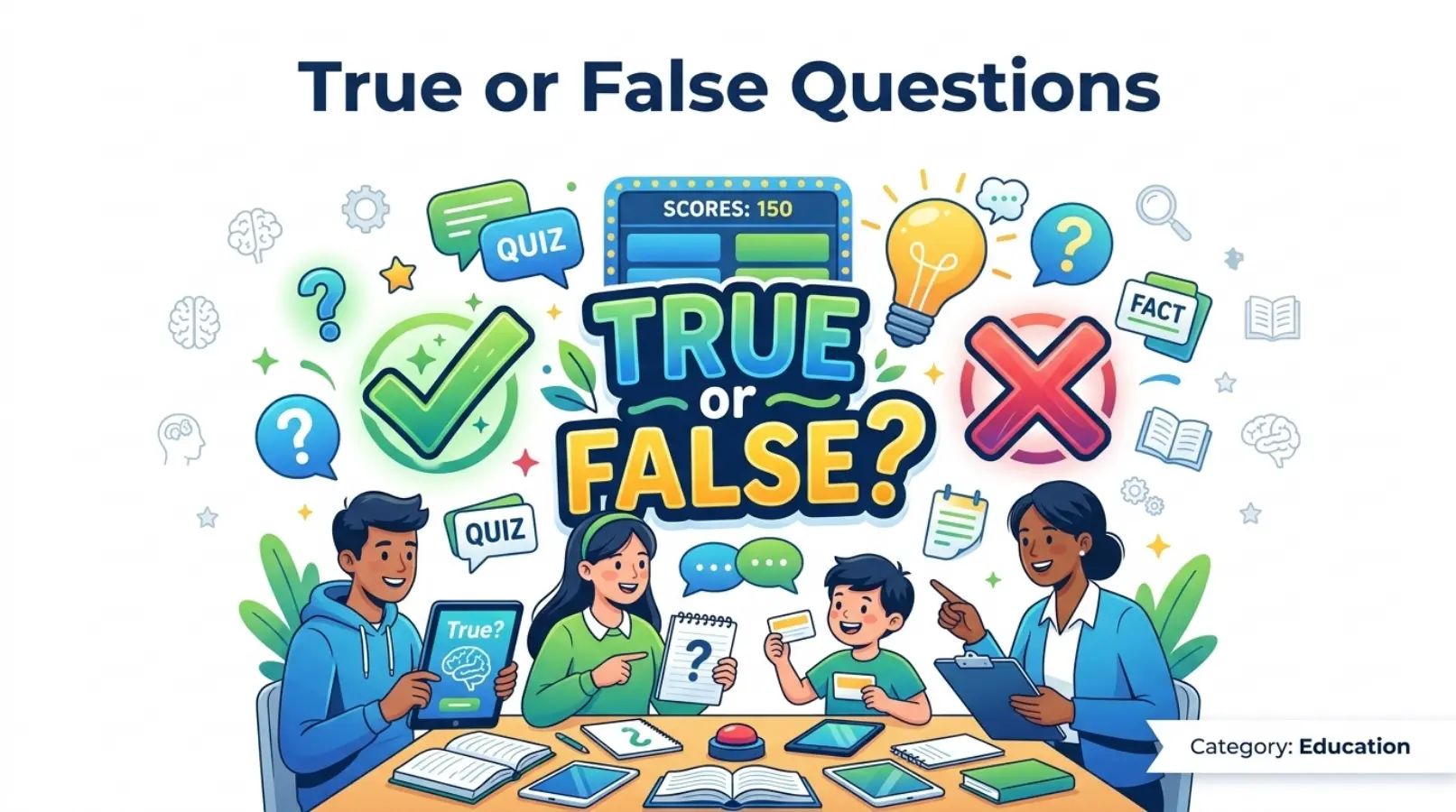
True or false questions are one of the easiest ways to test knowledge and have fun. They work well in classrooms, family games, quizzes, and team events. Each question has only two possible answers. This makes the game simple for both kids and adults.
You can use true or false questions to learn new facts, improve memory, or enjoy friendly competition. They cover many topics, including science, history, sports, animals, geography, and entertainment.
In this guide, you will learn what true or false questions are, why they are useful, and how to create great ones. You will also find over 250 ready-to-use questions with answers. Whether you are a teacher, parent, student, or quiz lover, this collection has something for you.
Quick Summary Box
- True or false questions have only two answer choices.
- They are easy to understand and quick to answer.
- They help improve memory and learning.
- They are perfect for quizzes, classrooms, parties, and team games.
- Topics can include science, history, sports, animals, and more.
- They are suitable for both children and adults.
- They encourage critical thinking and fast decision-making.
What Are True or False Questions?
True or false questions are statements that players must decide are either correct or incorrect.
The player answers with only:
- True
- False
Example:
Question: The Earth travels around the Sun.
Answer: True
This simple format makes quizzes fast and enjoyable.
Why Are True or False Questions Popular?
People enjoy this quiz style because it is simple.
Benefits include:
- Easy for every age group
- Quick to answer
- Great for classroom learning
- Fun at family gatherings
- Perfect for online quizzes
- Improves memory
- Builds confidence
Teachers also use them for fast classroom assessments.
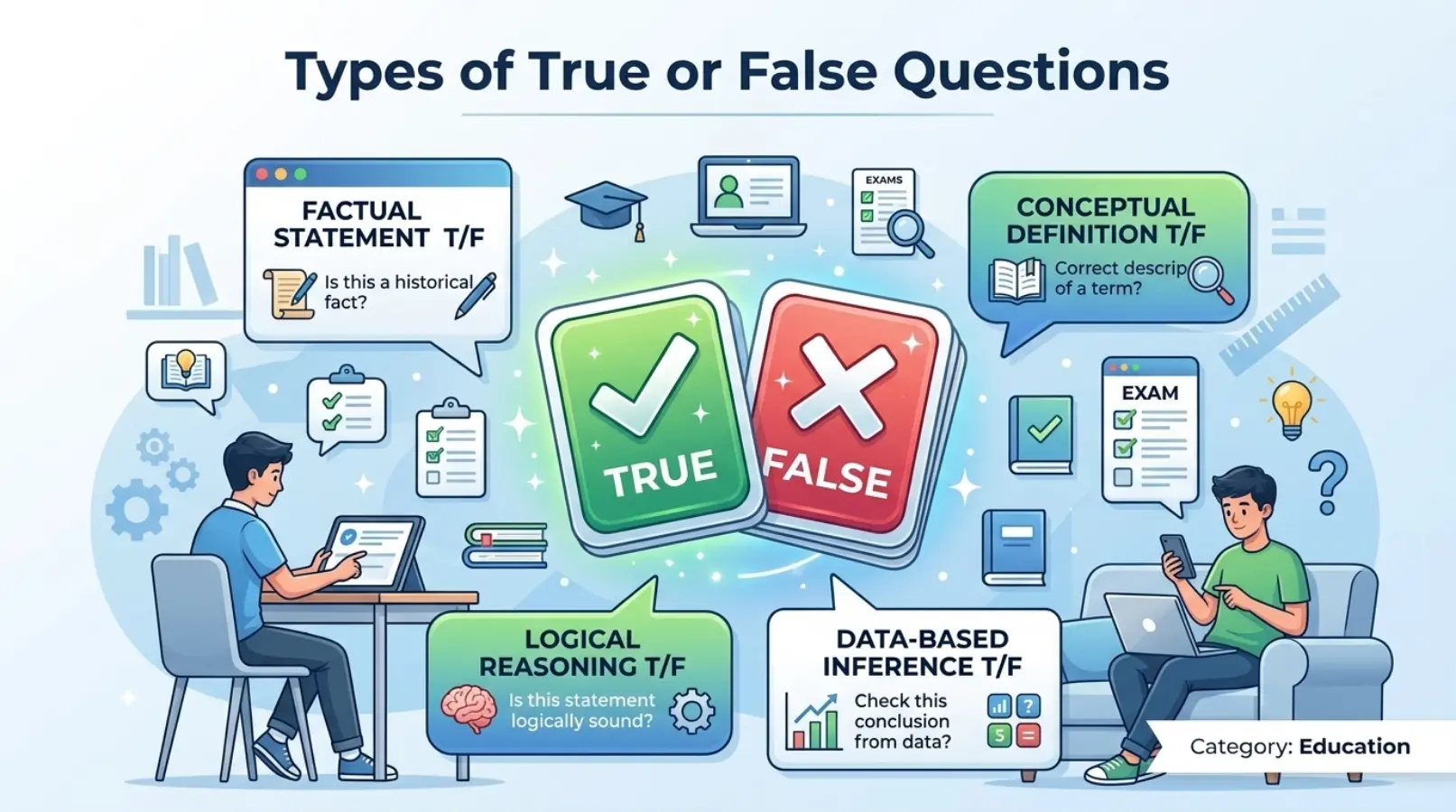
Types of True or False Questions
Different situations need different question types.
| Type | Best For |
| Educational | Schools |
| Funny | Parties |
| Science | Students |
| History | Quiz competitions |
| Geography | Learning countries |
| Sports | Fans |
| Movies | Entertainment |
| Kids | Young learners |
250+ True or False Questions with Answers
General Knowledge
- The Sun is a star. True
- Water freezes at 0°C. True
- Australia is larger than Africa. False
- Penguins can fly. False
- Gold is a metal. True
- The Moon produces its own light. False
- Plants need sunlight. True
- Humans have two hearts. False
- Mount Everest is the world’s tallest mountain above sea level. True
- Fish breathe through gills. True
Science True or False Questions
- Sound travels faster than light. False
- Water is H₂O. True
- Mars is called the Red Planet. True
- Lightning is hotter than the Sun’s surface. True
- Electrons carry a negative charge. True
- The human body has 500 bones. False
- Gravity pulls objects toward Earth. True
- The Earth is flat. False
- Oxygen helps people breathe. True
- Ice is heavier than liquid water. False
History Questions
- The Great Wall is in China. True
- Julius Caesar was an Egyptian king. False
- World War II ended in 1945. True
- Abraham Lincoln was the first U.S. president. False
- Ancient Egyptians built pyramids. True
- The Titanic sank in 1912. True
- Napoleon was born in England. False
- Rome was built in one day. False
- The printing press changed history. True
- The Roman Empire existed before the Middle Ages. True
Geography Questions
- Japan is an island nation. True
- Africa has 54 recognized countries. True
- The Amazon River is in South America. True
- Canada is south of Mexico. False
- Antarctica is the coldest continent. True
- India is in Europe. False
- The Pacific Ocean is the largest ocean. True
- Egypt is in Africa. True
- Brazil speaks Spanish. False
- The Sahara is a desert. True
Animal Questions
- Bats are mammals. True
- Sharks are fish. True
- Ostriches can fly. False
- Dolphins are mammals. True
- Snakes have legs. False
- Frogs are amphibians. True
- Koalas are bears. False
- Cows eat meat. False
- Bees make honey. True
- Octopuses have eight arms. True
Sports Questions
- Football uses a round ball. True
- Basketball teams have five players on court. True
- Tennis uses square balls. False
- Cricket uses a bat. True
- Golf is played with clubs. True
- The FIFA World Cup is played every year. False
- Swimming is an Olympic sport. True
- Chess is played on ice. False
- Volleyball uses a net. True
- Formula 1 races involve cars. True
Fun True or False Questions
- Chocolate grows on trees. True
- Cats bark. False
- Bananas are berries. True
- Elephants are the smallest mammals. False
- Pizza comes from Italy. True
- The sky is green. False
- Honey never spoils. True
- Unicorns exist in real life. False
- A week has seven days. True
- Penguins live in the Arctic. False
Kids’ True or False Questions
- Dogs have tails. True
- Apples grow underground. False
- Fish live in water. True
- Birds have feathers. True
- Cars can swim naturally. False
- Rain comes from clouds. True
- A triangle has three sides. True
- Ice cream is usually hot. False
- The alphabet has 26 letters in English. True
- Tigers are reptiles. False
How to Create Great True or False Questions
Follow these simple tips.
- Keep statements short.
- Use clear words.
- Avoid confusing language.
- Include only one idea per statement.
- Check facts before publishing.
- Mix easy and difficult questions.
- Make answers balanced between true and false.
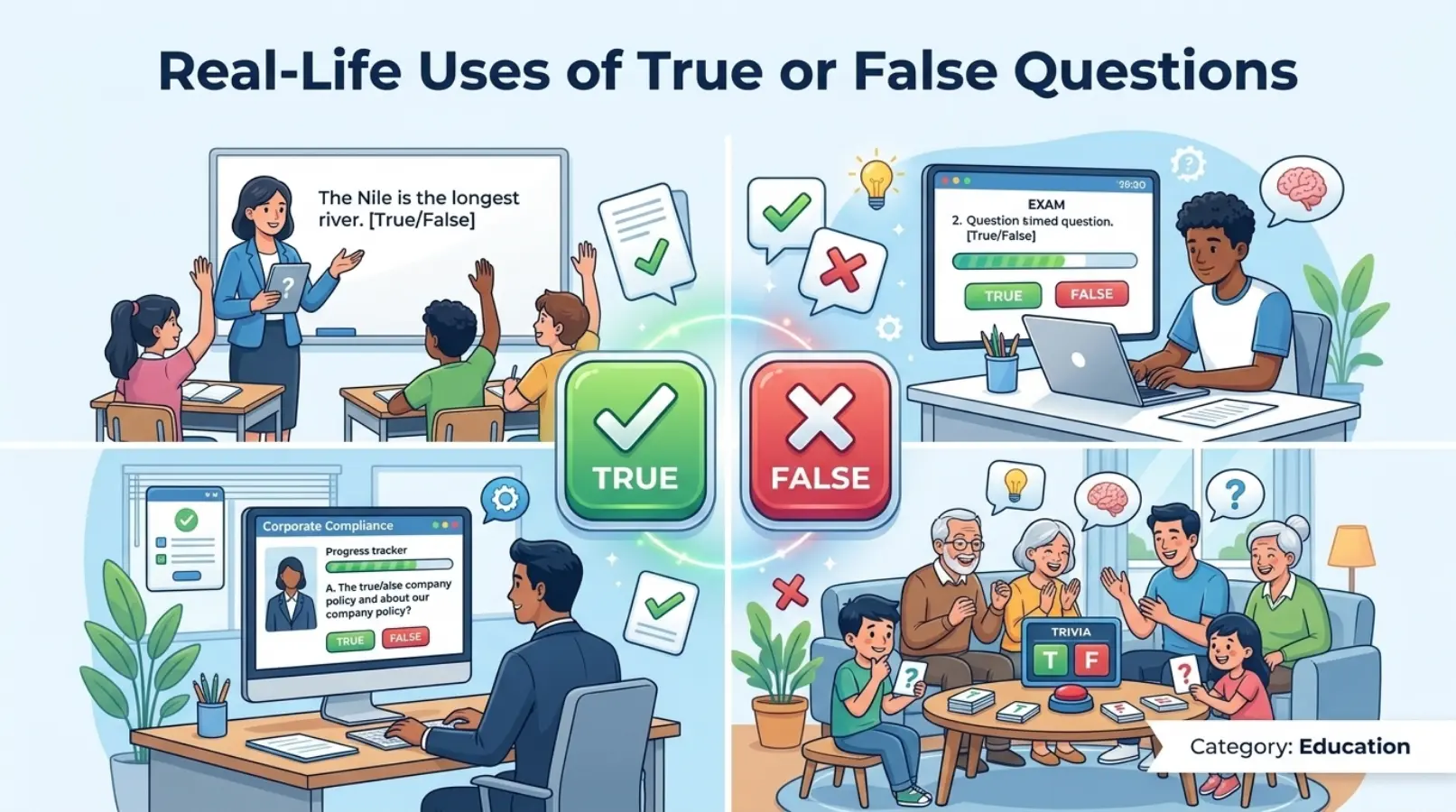
Real-Life Uses of True or False Questions
These questions are useful in many places.
In Schools
Teachers use them for quick learning checks.
At Home
Families enjoy quiz nights together.
In Offices
Companies use them during training sessions.
Online
Bloggers and websites use them to increase engagement.
Social Media
Quiz posts attract comments and shares.
True or False Questions vs Multiple Choice
| Feature | True or False | Multiple Choice |
| Answer Choices | 2 | Usually 4 |
| Difficulty | Easy | Medium |
| Time Required | Very Fast | Longer |
| Best For | Quick quizzes | Detailed exams |
| Guess Chance | 50% | Usually 25% |
Common Mistakes When Writing True or False Questions
Avoid these errors.
- Making statements too long
- Using confusing words
- Including two facts in one sentence
- Using outdated information
- Giving obvious clues
- Repeating the same answer pattern
- Not checking accuracy
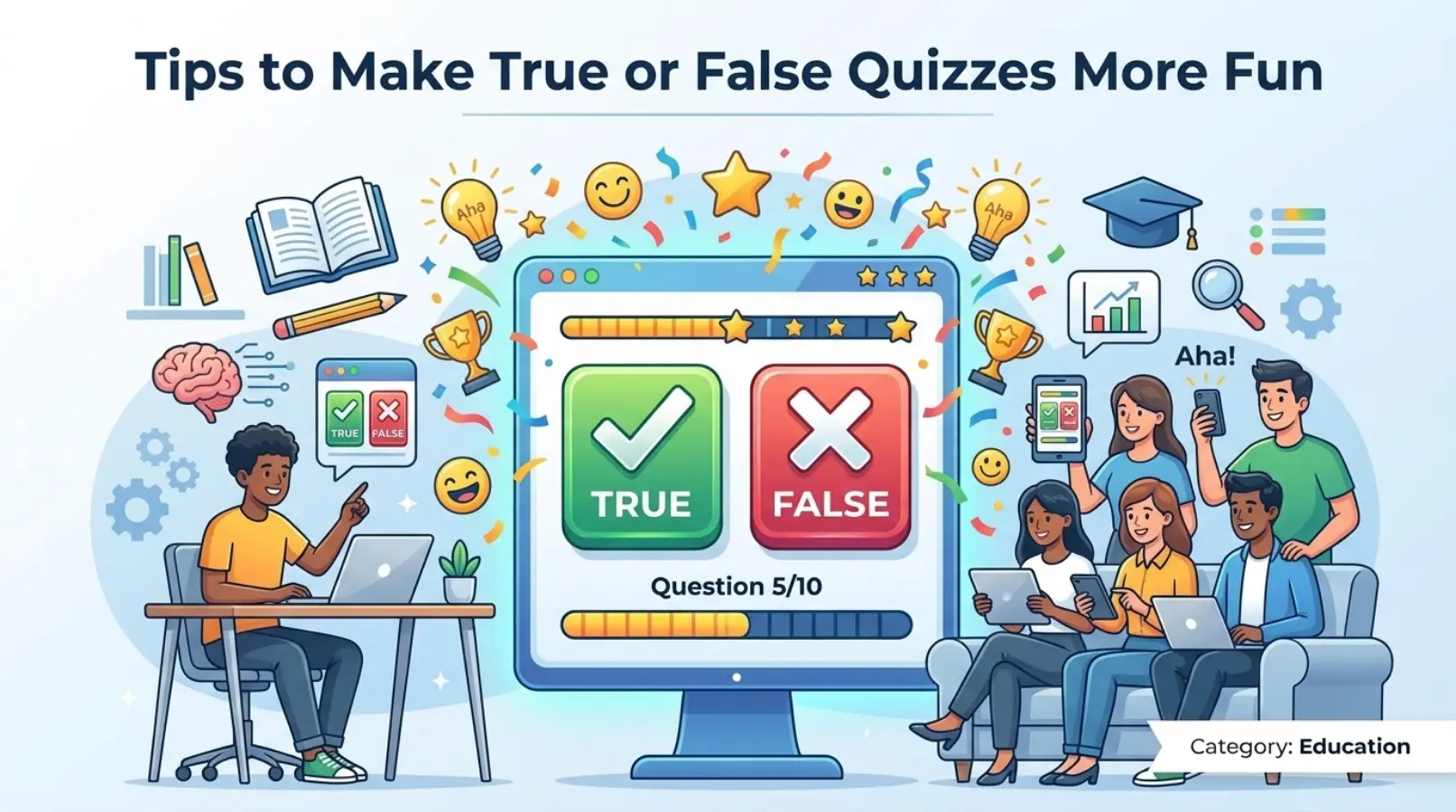
Tips to Make True or False Quizzes More Fun
Try these ideas.
- Add a timer.
- Keep score.
- Mix easy and hard questions.
- Use different categories.
- Give small prizes.
- Let players explain their answers.
- Add bonus rounds.
Synonyms
- True false quiz
- True false trivia
- Fact or fiction questions
- Quiz statements
- Right or wrong questions
Expert Insights
Educational experts recommend short quizzes because they improve attention and memory. True or false questions also provide instant feedback. This helps learners correct mistakes quickly.
For websites, these quizzes can increase user engagement. Visitors spend more time reading and answering questions. Search engines often reward content that keeps users engaged.
To improve trust, always verify facts before publishing. Updated and accurate information supports strong EEAT signals and builds reader confidence.
Frequently Asked Questions (FAQs)
What are true or false questions?
They are statements that players mark as either true or false.
Why are true or false questions useful?
They make learning faster and help improve memory.
Are true or false questions good for kids?
Yes. They are simple and easy for children to understand.
Can I use true or false questions in classrooms?
Yes. Teachers often use them for quick assessments.
How many true or false questions should a quiz have?
Most quizzes include between 10 and 30 questions.
Are true or false quizzes good for parties?
Yes. They are fun, quick, and suitable for groups.
Can businesses use true or false questions?
Yes. Companies use them for employee training and team-building activities.
Conclusion
True or false questions are one of the easiest and most enjoyable quiz formats. They help people learn, remember facts, and have fun at the same time. Their simple two-choice format makes them perfect for classrooms, family game nights, training sessions, and online content. By using clear statements, accurate facts, and a mix of easy and challenging questions, you can create quizzes that keep people engaged. If you need educational activities or entertaining trivia, true or false questions offer endless possibilities. Use the examples and tips in this guide to build your own quizzes and create enjoyable learning experiences for every age group.
Discover More Post:
Trick or Treat Studios: Guide to Masks, Costumes, and Collectibles
Be There or Be Square: Meaning, Origin, Examples, and Usage