Every day or everyday is one of the most common grammar questions in English. Many people use these words in the wrong way. They look almost the same, but they have different meanings.
Knowing the difference helps you write better emails, essays, blog posts, and social media updates. It also makes your English sound more natural.
The good news is that the rule is very simple. Once you learn it, you will remember it forever.
In this guide, you will learn what its mean. You will also see examples, common mistakes, useful tips, and an easy trick to choose the correct word every time.
Quick Summary Box
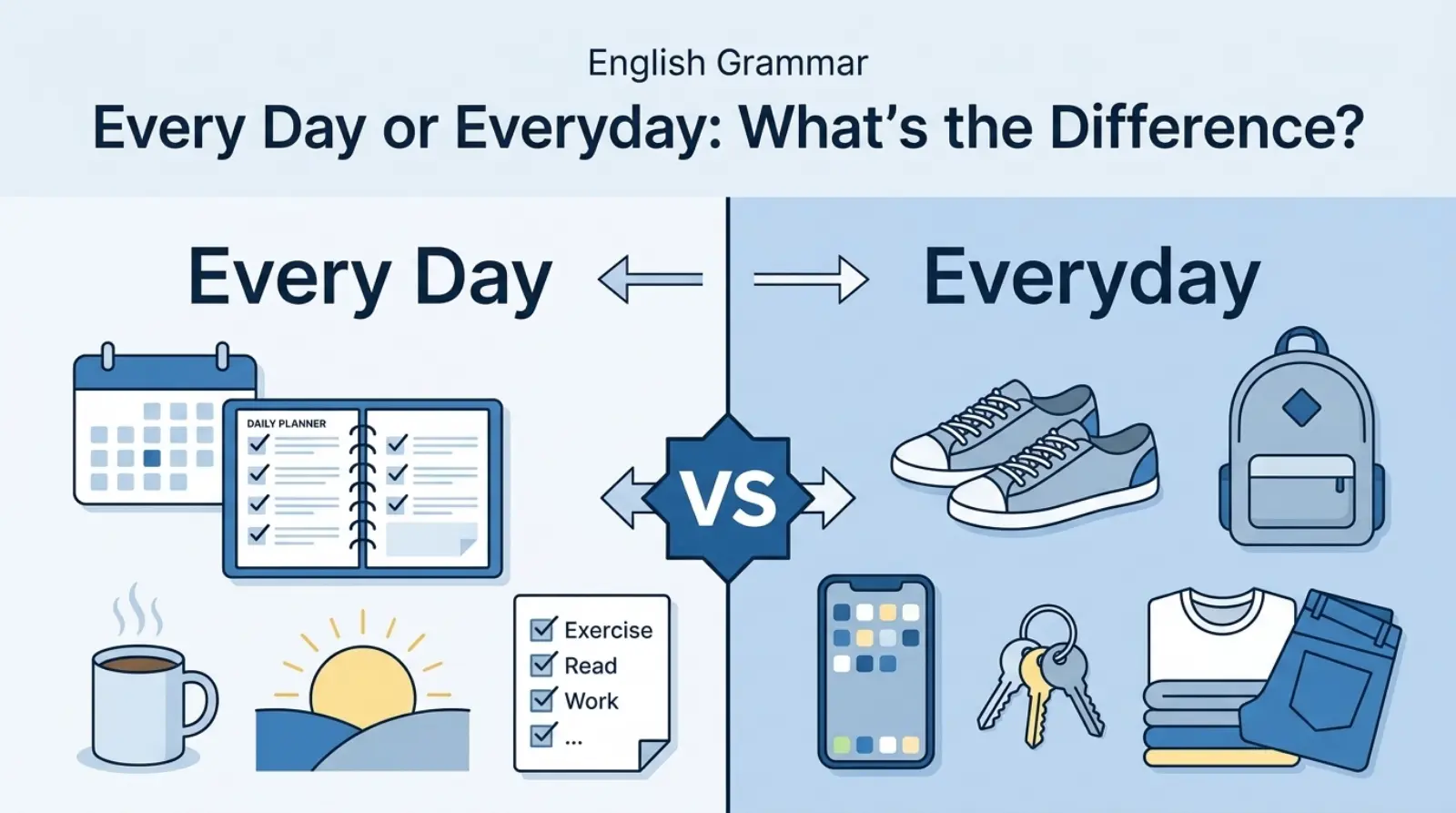
- Every day = means each day or daily
- Everyday = means common, ordinary, or usual
- Every day is a two-word phrase.
- Everyday is one adjective.
- Use every day when talking about time.
- Use everyday before a noun.
- Simple trick:
- If you can replace it with each day, use every day.
- If it describes a noun, use everyday.
What Does “Every Day” Mean?
Every day is a two-word phrase.
It means each day or daily.
It tells us when something happens.
Examples
- I drink coffee every day.
- She studies English every day.
- We walk after dinner every day.
- My father exercises every day.
- They call their grandparents every day.
In each sentence, every day shows frequency.
What Does “Everyday” Mean?
It is one word.
Its an adjective.
It describes something that is ordinary, common, or used regularly.
Examples
- This notebook is for everyday use.
- He enjoys simple everyday activities.
Notice that it comes before a noun.
Key Difference
The easiest way to remember the difference is this:
| Feature | Every Day | Everyday |
| Number of words | Two | One |
| Part of speech | Adverbial phrase | Adjective |
| Meaning | Each day | Ordinary or common |
| Describes | Time | A noun |
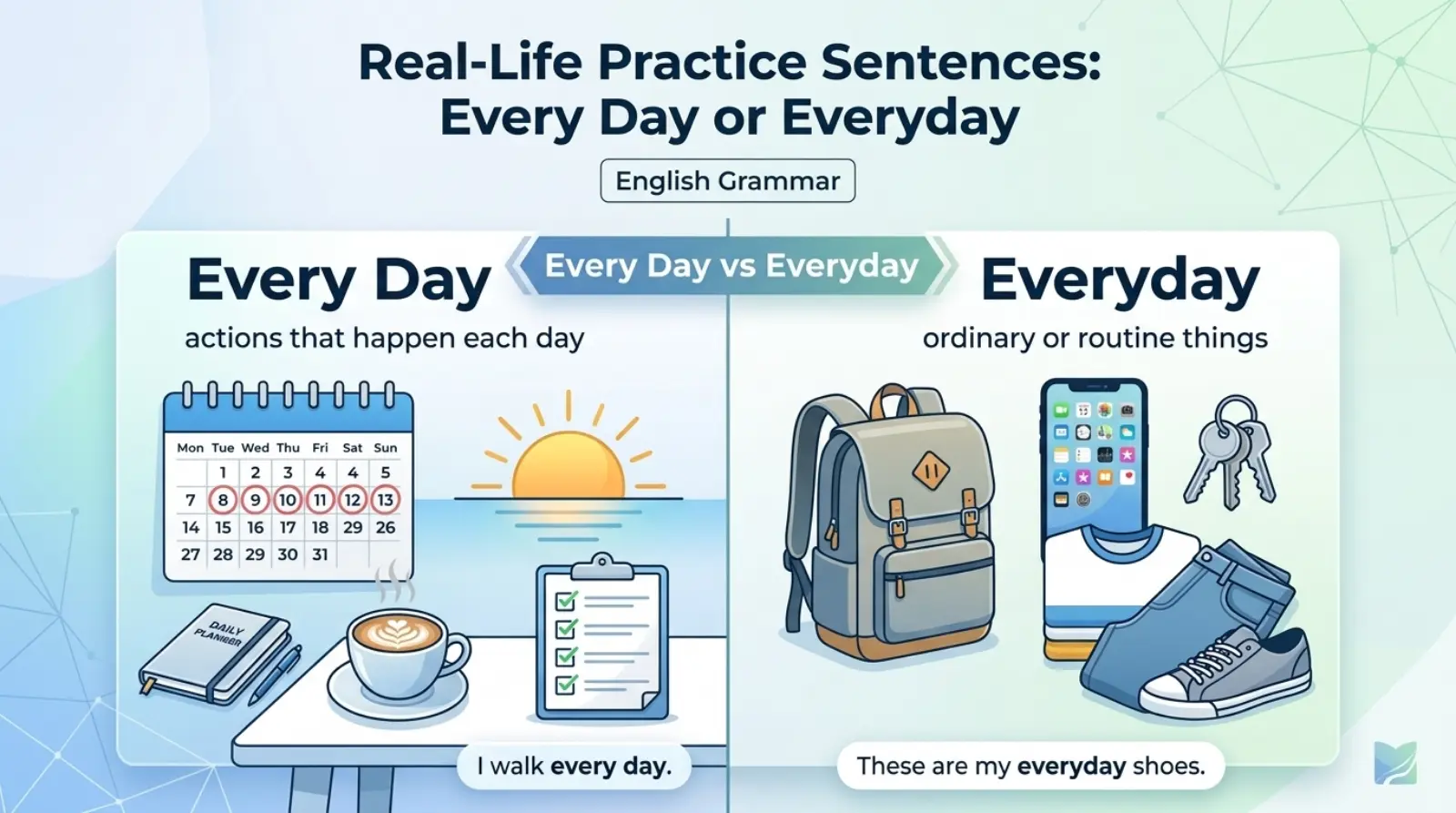
| Example | I run every day. | These are everyday shoes. |
Easy Trick to Remember
Try replacing every day with each day.
If the sentence still makes sense, use every day.
Example
✔ I read every day.
✔ I read each day.
Both work.
Now try another.
❌ These are each day clothes.
That sounds wrong.
✔ These are everyday clothes.
This trick works almost every time.
Real-Life Examples
Here are examples you may see every day.
School
- Students learn something new every day.
- An everyday backpack should be comfortable.
Work
- I check my email every day.
- This is an everyday office task.
Home
- We cook dinner every day.
- We use these everyday dishes.
While Shopping
- These are everyday essentials.
- I visit the grocery store every day.

Common Mistakes People Make
Many writers confuse these words.
Mistake 1
❌ I go to the gym everyday.
✔ I go to the gym every day.
Mistake 2
❌ These are every day shoes.
Mistake 3
❌ Everyday I study English.
✔ Every day I study English.
Mistake 4
❌ This is an every day activity.
Grammar Rules Explained Simply
Use “Every Day” When Talking About Time
Ask yourself:
When does it happen?
If the answer is each day, use every day.
Examples
- I walk every day.
- We practice every day.
- She cooks every day.
Use “Everyday” Before a Noun
Ask yourself:
Does it describe something?
If yes, use everyday.
Everyday vs Daily
- everyday clothing
- everyday routines
Many people wonder if these words mean the same thing.
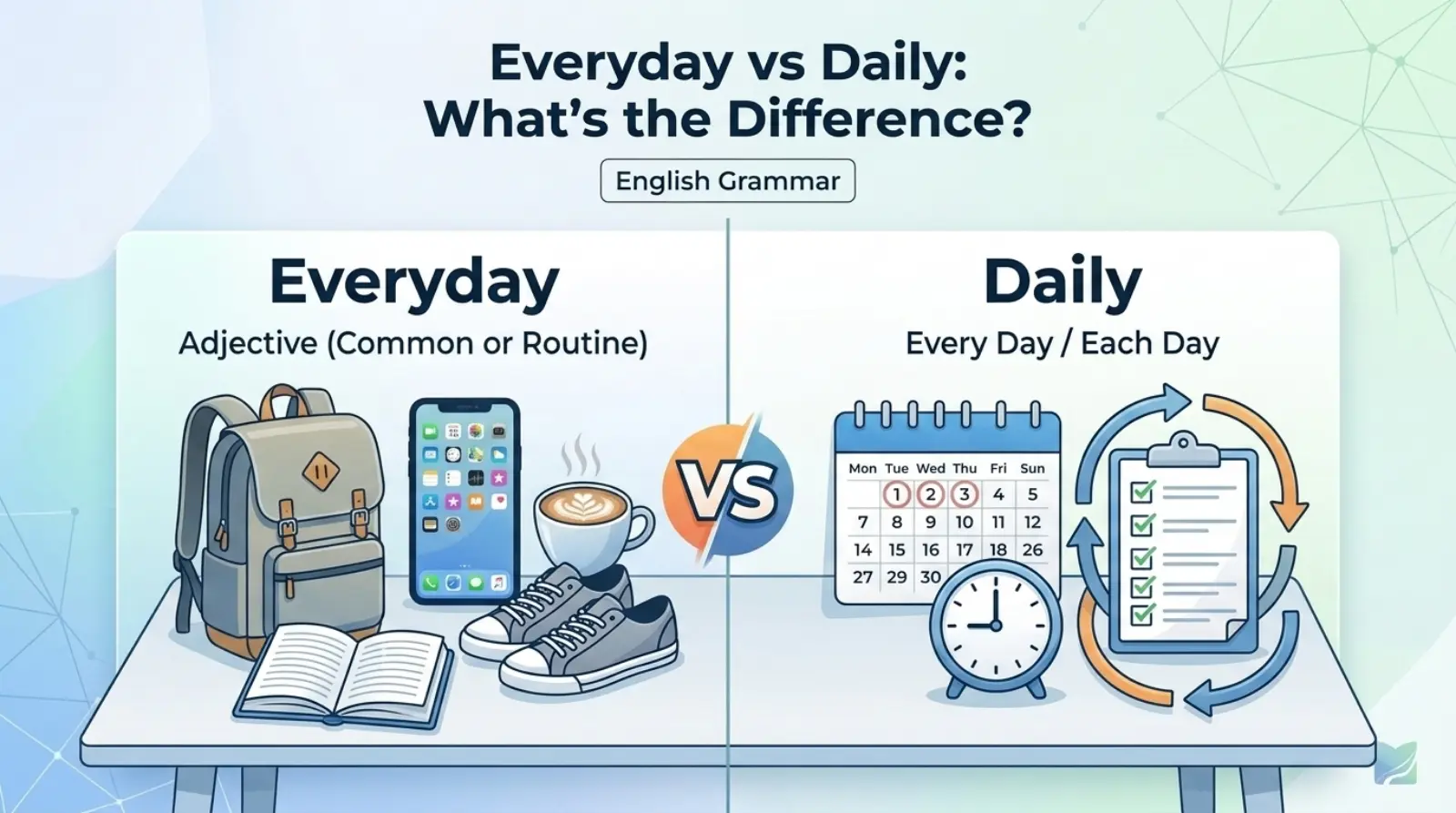
| Word | Meaning | Example |
| Every day | Each day | I exercise every day. |
| Daily | Each day | I exercise daily. |
| Everyday | Ordinary | These are everyday clothes. |
Everyday in Daily Life
You will see this word in many places.
Examples include:
- everyday fashion
- everyday makeup
- everyday technology
- everyday language
In these examples, it describes the noun.
Synonyms
for Every Day
- each day
- daily
- every single day
- day after day
- regularly
for Everyday
- ordinary
- common
- normal
- regular
- routine
- typical
- standard
- usual
Tips to Always Use the Correct Word
Remember these simple tips.
- Count the words.
- Replace every day with each day.
- Check if the word describes a noun.
- Read the sentence aloud.
- Look for the noun after everyday.
- Practice with simple sentences.
These tips help you avoid grammar mistakes.
Real-Life Practice Sentences
Choose the correct option.
- I exercise?
every day
- These are my ____________clothes.
everyday
- She reads before bed?
every day
- This is an ______________problem.
everyday
- We meet?
every day
Why This Grammar Rule Matters
Using the correct word improves your writing.
It helps readers understand your meaning.
It also makes your emails and reports look professional.
Teachers often check this mistake in assignments.
Writers, bloggers, and students benefit from learning the rule.
Small grammar improvements can create a better impression.
Expert Insights
Language experts recommend learning grammar through patterns instead of memorizing long rules.
The easiest pattern is simple.
- Every day answers when.
- Everyday describes what kind of thing.
Professional editors often use the “each day” test before publishing content.
This simple habit prevents one of the most common English writing mistakes.
Frequently Asked Questions (FAQs)
1. What is the difference between every day and everyday?
Every day means “each day” and acts as a phrase. Everyday is an adjective that describes something common or routine.
2. Is every day always written as two words?
Yes. When you mean “each day,” write it as every day. It should not be combined into one word in this context.
3. When should I use the one-word form?
Use the one-word form only before a noun to describe something ordinary or commonly used, such as everyday clothes or everyday tasks.
4. How can I quickly check which form is correct?
Replace it with each day. If the sentence still makes sense, use every day. If it describes a noun, use the one-word form.
5. Is I go to the gym every day correct?
Yes. This sentence means you go to the gym each day, so the two-word phrase is correct.
6. Can I say everyday life?
Yes. Everyday life is correct because the word describes the noun life.
7. Why do people often confuse these two forms?
They look almost identical, but they have different grammar roles. One is a phrase that refers to time, while the other is an adjective.
8. Is this mistake common in English writing?
Yes. Many English learners and native speakers occasionally mix them up, especially in casual writing.
9. What is the easiest way to remember the correct usage?
Remember this simple rule:
- Every day = each day
- Everyday = ordinary or common
10. Will using the correct form improve my writing?
Yes. Choosing the correct form makes your writing clearer, more professional, and grammatically accurate.
Conclusion
Understanding this phrase is easier than many people think. The main difference is simple. Every day means each day, while everyday means ordinary or common. Remember the “each day” test whenever you feel unsure. If you can replace the phrase with each day, use every day. If the word describes a noun, use everyday. With regular practice, this grammar rule becomes natural. If you are writing school assignments, business emails, blog posts, or social media captions, choosing the correct form makes your writing clearer and more professional. Keep this rule in mind, and you will use this phrase correctly every time.
Discover More Post:
Incase or In Case: Which Is Correct? Guide With Examples
True or False Questions: 250+ Fun, Easy, and Tricky Questions