
Use to or used to is a common grammar question in English. Many people feel confused about which one is correct. The good news is that the rule is simple once you understand it.
Both phrases talk about habits or actions from the past. However, they do not work the same way in every sentence. Sometimes you should write used to. Other times, use to is the right choice.
This guide explains the difference in clear and simple words. You will learn the grammar rules, see real-life examples, avoid common mistakes, and improve your writing. By the end, you will know exactly when to use each phrase with confidence.
Quick Summary
- Used to describes a past habit or past state.
- Use to appears after did, didn’t, or did not.
- Write I used to play soccer.
- Write Did you use to play soccer?
- Never write Did you used to in formal English.
- Remember: Did + use, not Did + used.
What Does “Used to” Mean?
Used to talks about something that happened regularly in the past but does not happen now.
It can also describe a situation that was true before but has changed.
Examples
- I used to walk to school.
- She used to wear glasses.
- We used to live in New York.
- My grandfather used to tell funny stories.
In every example, the action or situation belonged to the past.
What Does “Use to” Mean?
Use to usually appears after the helping verb did.
When did is present, the main verb stays in its base form.
Examples
- Did you use to play tennis?
- I didn’t use to drink coffee.
- Did they use to live here?
Notice that used becomes use because did already shows the past tense.
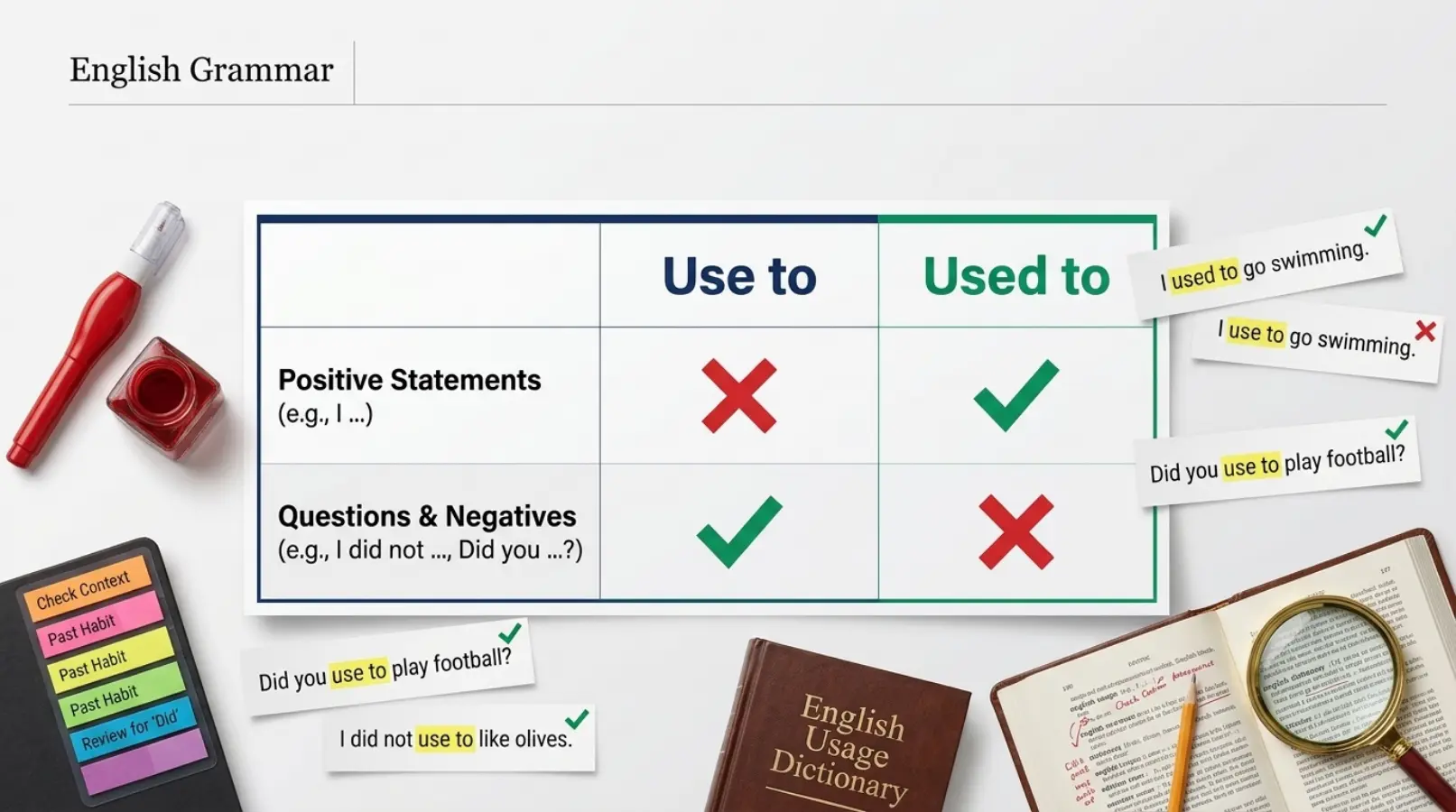
Use to or Used to: What’s the Difference?
The main difference depends on whether the sentence includes did.
| Used to | Use to |
| Used in positive statements | Used after did or didn’t |
| Shows past habits | Appears in questions and negatives |
| Example: I used to swim. | Example: Did you use to swim? |
| Past tense included | Base verb after did |
Easy Rule
- Positive sentence → used to
- Question with did → use to
- Negative with didn’t → use to
Why Does the Grammar Change?
English grammar follows a simple rule.
The helping verb did already tells us the sentence is in the past.
Because of this, the next verb returns to its base form.
Correct
- Did you use to travel?
- Didn’t she use to sing?
Incorrect
- Did you used to travel?
- Didn’t she used to sing?
When Should You Use “Used to”?
Use used to in positive statements.
It describes old habits, routines, or situations.
Examples
- I used to play football every weekend.
- Sarah used to read before bed.
- We used to visit our grandparents.
- My dog used to sleep outside.
- He used to work at a bank.
When Should You Use “Use to”?
Use use to after did, didn’t, or did not.
Examples
- Did you use to play chess?
- I didn’t use to like vegetables.
- Did she use to live in London?
- We didn’t use to watch TV much.
- Did they use to work together?
Real-Life Examples
Understanding real conversations makes the rule easier.
At School
Teacher: Did you use to study here?
Student: Yes, I used to study here five years ago.
At Work
Manager: Did you use to work in marketing?
Employee: Yes, I used to work for a small company.
Talking About Childhood
- I used to ride my bike every evening.
- We used to build tree houses.
- Did you use to climb trees?
Comparison Table: Use to vs Used to
| Feature | Used to | Use to |
| Meaning | Past habit or state | Base form after did |
| Sentence Type | Positive | Question or negative |
| Grammar | Used alone | Comes after did |
| Example | She used to dance. | Did she use to dance? |
| Formal English | Correct | Correct after did |
Common Mistakes People Make
Many English learners make these mistakes.
Mistake 1
❌ Did you used to play soccer?
✅ Did you use to play soccer?
Mistake 2
❌ I use to play soccer.
✅ I used to play soccer.
Mistake 3
❌ She didn’t used to smoke.
✅ She didn’t use to smoke.
Mistake 4
❌ We use to travel every summer.
✅ We used to travel every summer.
Simple Tips to Remember
These tricks help you remember the rule.
Tip 1
If there is did, write use.
Tip 2
If there is no did, write used.
Tip 3
Ask yourself:
“Is this a positive sentence?”
If yes, choose used to.
Tip 4
Read your sentence aloud.
It often sounds wrong if you choose the incorrect form.
How Native English Speakers Use These Phrases
Native speakers use used to often when talking about childhood.
Examples include:
- I used to love cartoons.
- We used to stay outside until sunset.
- My parents used to cook together.
Questions usually follow this pattern:
- Did you use to collect stamps?
- Didn’t you use to own a dog?

Use to or Used to in Daily Life
You hear these phrases every day.
Family
- I used to help my mother cook.
Travel
- We used to visit the beach every year.
School
- Did you use to wear a school uniform?
Sports
- He used to play basketball.
Friends
- Didn’t you use to live next door?

Expert Insights
Grammar experts recommend focusing on sentence structure instead of memorizing random examples.
Always look for the helping verb first.
If did appears, use the base verb.
This rule applies to many English verbs, not just use.
Learning this pattern improves grammar, speaking, and writing. It also helps you avoid common mistakes in school, exams, emails, and professional writing.
Frequently Asked Questions (FAQs)
Is it “use to” or “used to”?
Both are correct. Use used to in positive sentences. Use use to after did or didn’t.
Why do we say “Did you use to”?
Because did already shows the past tense. The following verb stays in its base form.
Is “Did you used to” correct?
No. Standard English uses Did you use to.
Can I say “I use to play football”?
No. The correct sentence is I used to play football.
Does “used to” always refer to the past?
Yes. It describes habits or situations that no longer exist.
Is “used to” the same as “would”?
Not always.
Used to can describe past habits and past states.
Would usually describes repeated past actions, not states.
Can “used to” describe feelings?
Yes.
Example:
- I used to feel nervous before exams.
Is “used to” common in spoken English?
Yes. Native speakers use it often when talking about past habits and childhood memories.
Conclusion
Understanding use to or used to becomes easy once you know one simple grammar rule. Used to belongs in positive sentences that describe past habits or situations. Use to appears after did, didn’t, or did not because the helping verb already shows the past tense.
Keep practicing with real examples until the pattern feels natural. Read your sentences aloud and check if they include did. This simple habit will help you avoid common grammar mistakes. With regular practice, you’ll use both forms correctly in conversations, emails, school assignments, and professional writing.
Discover More Post:
Weather or Not: Meaning, Correct Usage, Examples, and Mistakes
English or Spanish: Which Language Should You Learn?