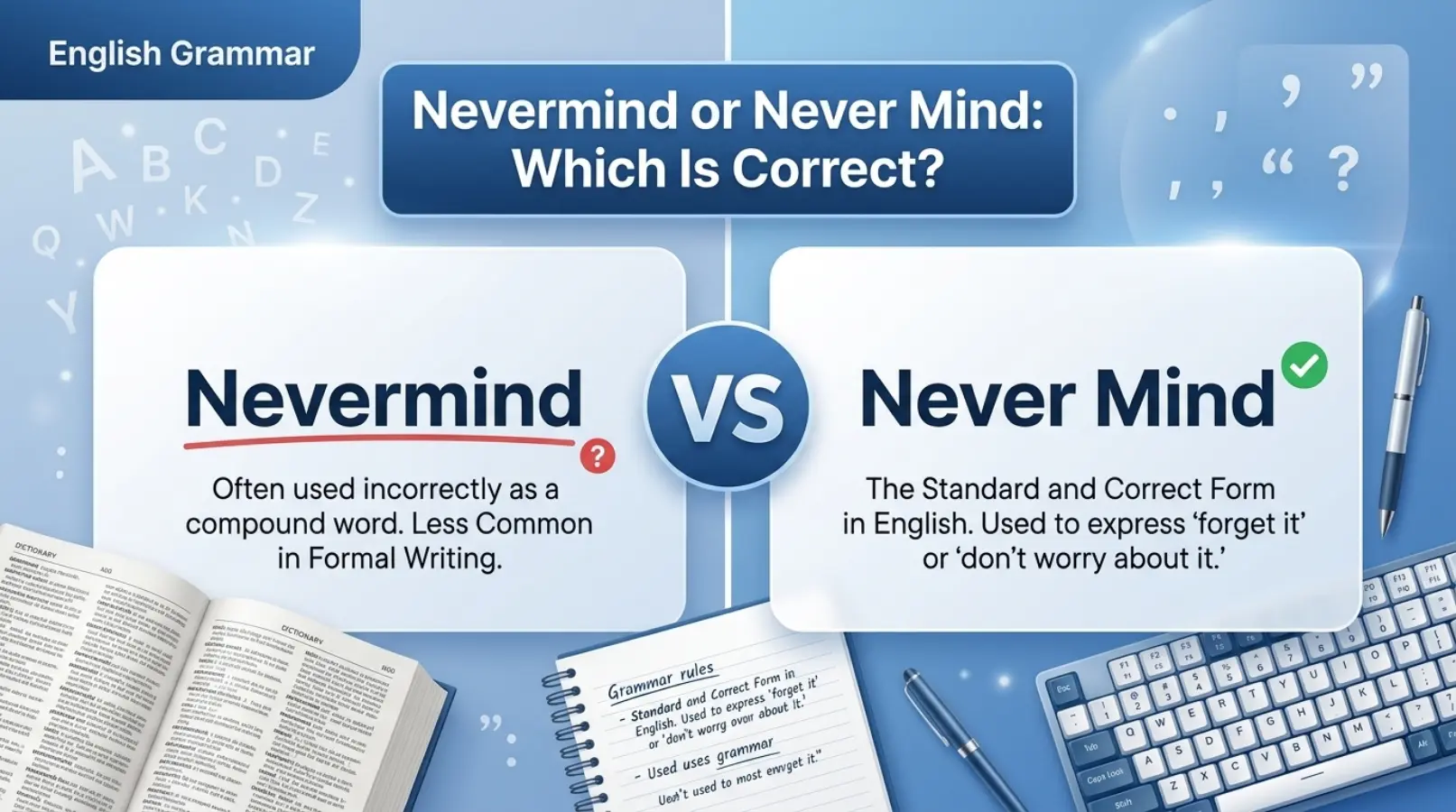
Nevermind or never mind is a common English language question that confuses many writers and speakers. While both forms look similar, they are not always used in the same way. Knowing when to write nevermind as one word or never mind as two words can help you communicate more clearly and avoid common grammar mistakes.
In simple terms, never mind is the traditional and widely accepted spelling in standard English. It is often used to tell someone to ignore something or to say that something is not important. Nevermind, written as one word, is an informal variation that appears in casual writing and digital conversations but is less common in formal English.
In this guide, you’ll learn the difference between nevermind and never mind, see real-life examples, understand common mistakes, and discover which form is correct in different situations. By the end, you’ll know exactly which version to use with confidence.
Quick Summary Box
- Primary Keyword: nevermind or never mind
- Correct standard English: Never mind (two words)
- Meaning: Forget it, do not worry, or it does not matter
- “Nevermind” (one word): Usually considered incorrect in formal writing
- Best choice: Use never mind in emails, essays, business writing, and school work
- Easy rule: If you mean “forget it,” always write never mind
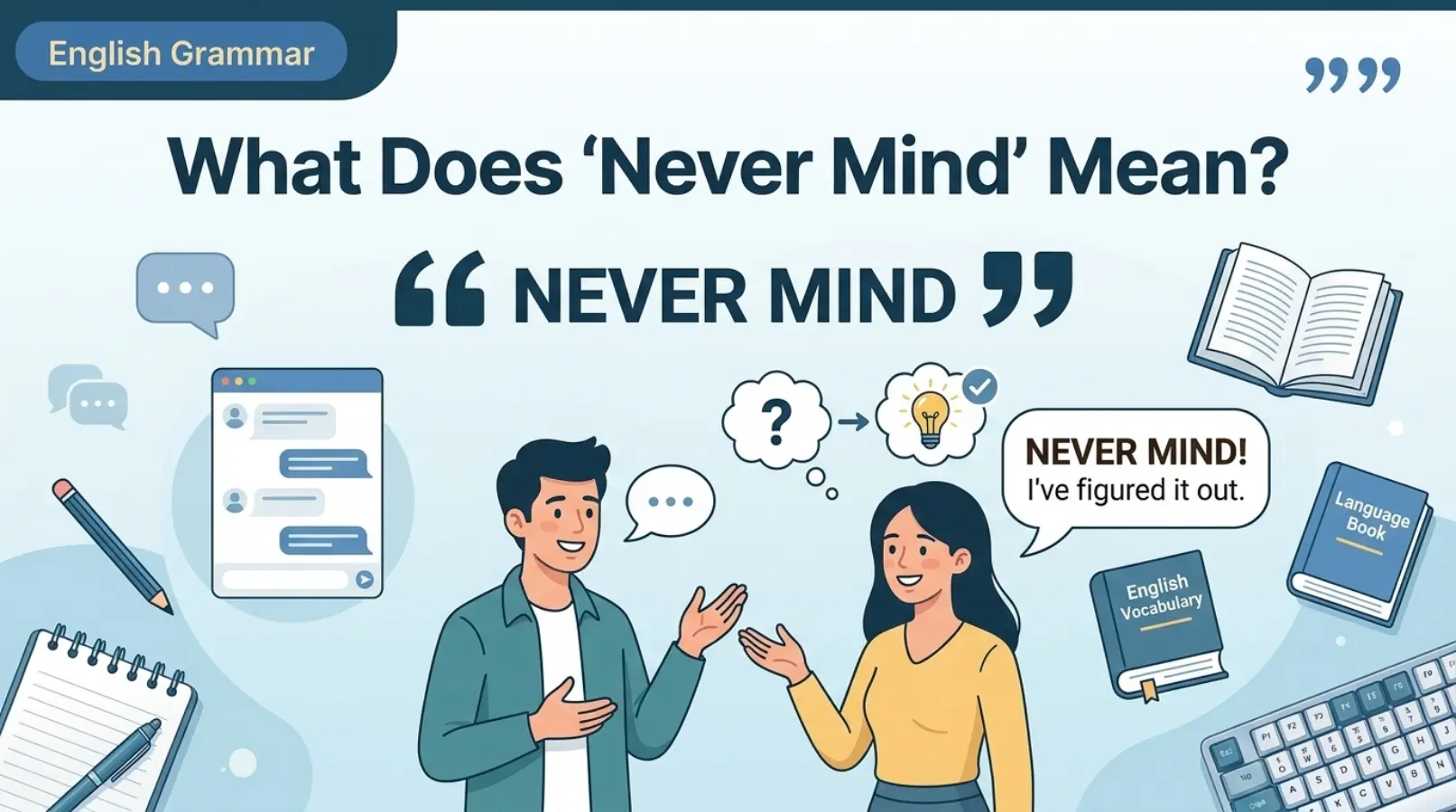
What Does “Never Mind” Mean?
Never mind is a phrase that tells someone to:
- Forget something
- Stop worrying
- Ignore a mistake
- Say something is not important anymore
It often appears in conversations.
Examples
- Never mind. I found my keys.
- Never mind the mess.
- Never mind what he said.
- Oh, never mind. I will do it myself.
- Never mind. Everything is okay now.
The phrase sounds polite and friendly in most situations.
Nevermind or Never Mind: Which Is Correct?
The correct spelling in standard English is never mind.
| Never Mind | Nevermind |
| Correct | Usually incorrect |
| Two words | One word |
| Accepted in formal writing | Avoid in formal writing |
| Used in schools, books, and business | Mostly informal or nonstandard |
Simple Rule
If you are writing English correctly, choose never mind.
Why Do People Write “Nevermind”?
Many people write nevermind because they see similar words like:
- anyway
- already
- everyone
- however
Since these words are written together, people assume nevermind should follow the same rule.
However, dictionaries and grammar guides still recommend never mind for standard writing.
Some informal websites, chats, and social media posts use nevermind, but that does not make it correct in formal English.
Never Mind Explained in Simple Words
Think of never mind as another way to say:
- Forget it.
- It does not matter.
- Do not worry.
- Ignore it.
- That is okay.
Conversation Examples
Example 1
Person A: I forgot your book.
Person B: Never mind. Bring it tomorrow.
Example 2
Person A: Sorry, I interrupted you.
Person B: Never mind.
Example 3
Person A: I cannot come today.
Person B: Never mind. We can meet later.
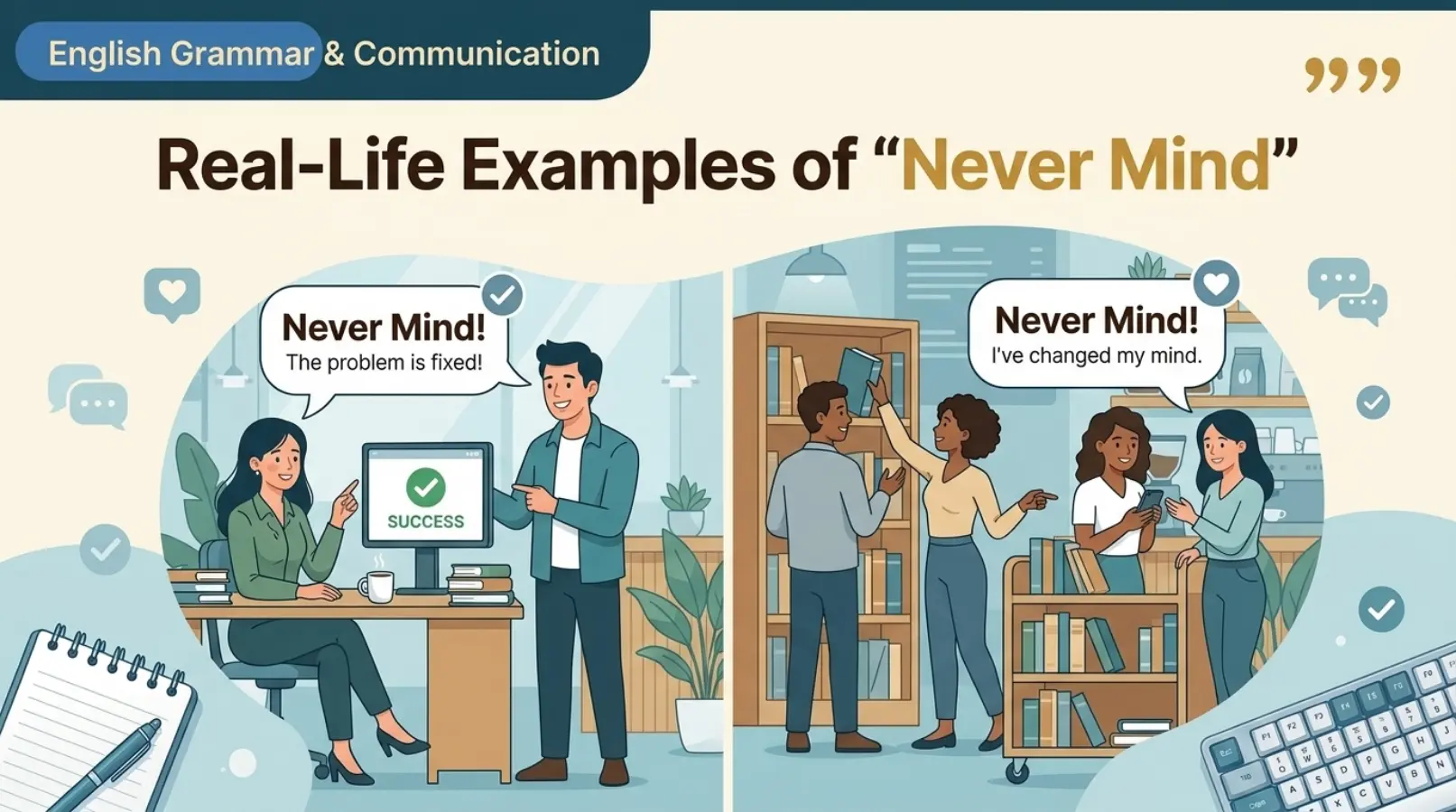
Real-Life Examples of Never Mind
Here are common situations where people use never mind.
At School
Teacher: Did everyone finish?
Student: Never mind. I understand now.
At Work
Manager: Sorry for the delay.
Employee: Never mind.
With Friends
Friend: I lost your pen.
You: Never mind. It was old anyway.
At Home
Parent: Sorry dinner is late.
Child: Never mind. I am not very hungry.
During Shopping
Customer: I found another size.
Worker: Never mind then.
Comparison Table: Nevermind vs Never Mind
| Feature | Never Mind | Nevermind |
| Correct spelling | Yes | Usually No |
| Dictionary recommendation | Yes | Rarely |
| Business emails | Yes | No |
| School assignments | Yes | No |
| Academic writing | Yes | No |
| Professional documents | Yes | No |
| Casual texting | Yes | Sometimes seen |
| Safe choice | Always | Avoid |
Common Mistakes People Make
Many writers make the same mistakes.
Mistake 1
❌ Nevermind, I already fixed it.
✅ Never mind, I already fixed it.
Mistake 2
❌ Nevermind about yesterday.
✅ Never mind about yesterday.
Mistake 3
❌ Nevermind if you are busy.
✅ Never mind if you are busy.
Mistake 4
Using nevermind in business emails.
Always choose never mind for professional writing.
Tips to Remember the Correct Form
Learning this rule is easy.
Tip 1
Think of the phrase:
Never + Mind
They stay separate.
Tip 2
Replace it with:
- Forget it
- It does not matter
If the sentence still works, use never mind.
Tip 3
When writing for school or work, always choose never mind.
Tip 4
Proofread your writing before publishing.
Tip 5
Most grammar checkers prefer never mind.
How to Use Never Mind in Daily Life
You can use never mind almost every day.
During Conversations
Never mind. I understand.
In Text Messages
Never mind. I’ll call later.
In Emails
Never mind the earlier message.
At Work
Never mind that mistake.
Let’s continue.
At School
Never mind the answer.
Try the next question.

Synonyms
- Forget it
- It does not matter
- No worries
- No problem
- That’s okay
- Ignore it
- Let it go
- Leave it
- Don’t worry
- No need
Expert Insights: Why Correct Spelling Matters
Using the correct spelling builds trust with readers.
Professional writing should follow accepted grammar rules. Teachers, employers, and editors expect correct spelling.
Small grammar mistakes can make good writing look less professional.
Choosing never mind instead of nevermind helps your writing appear polished and reliable.
If you write blogs or business content, correct grammar also improves readability and user experience. While grammar alone is not a direct ranking factor, clear and accurate writing supports better engagement and aligns with Google’s focus on helpful, high-quality content.
Frequently Asked Questions (FAQs)
Is nevermind one word or two?
The correct form is never mind, written as two words.
Is nevermind incorrect?
In most formal writing, yes. Use never mind instead.
Can I use nevermind in texting?
Some people do, but never mind is still the better choice.
What does never mind mean?
It means “forget it,” “do not worry,” or “it does not matter.”
Is never mind formal?
Yes. It works in both formal and informal writing.
Which spelling should students use?
Students should always write never mind.
Is never mind an idiom?
It is commonly used as a fixed phrase rather than a traditional idiom. It has a clear, accepted meaning.
Can never mind start a sentence?
Yes.
Example:
Never mind. We can try again tomorrow.
Conclusion
Choosing between nevermind or never mind is easier than it first appears. In almost every situation, never mind is the correct and accepted spelling. It works in conversations, emails, school assignments, blogs, and professional documents. The one-word form nevermind may appear in casual online writing, but it is not the standard choice for formal English.
Whenever you want to say “forget it,” “don’t worry,” or “it doesn’t matter,” write never mind as two words. Following this simple rule will make your writing clearer, more professional, and easier for readers to trust.
Discover More Post:
Is Teal Blue or Green? Complete Color Guide With Easy Examples
Nerve Wracking or Racking? Which Is Correct? Grammar Guide