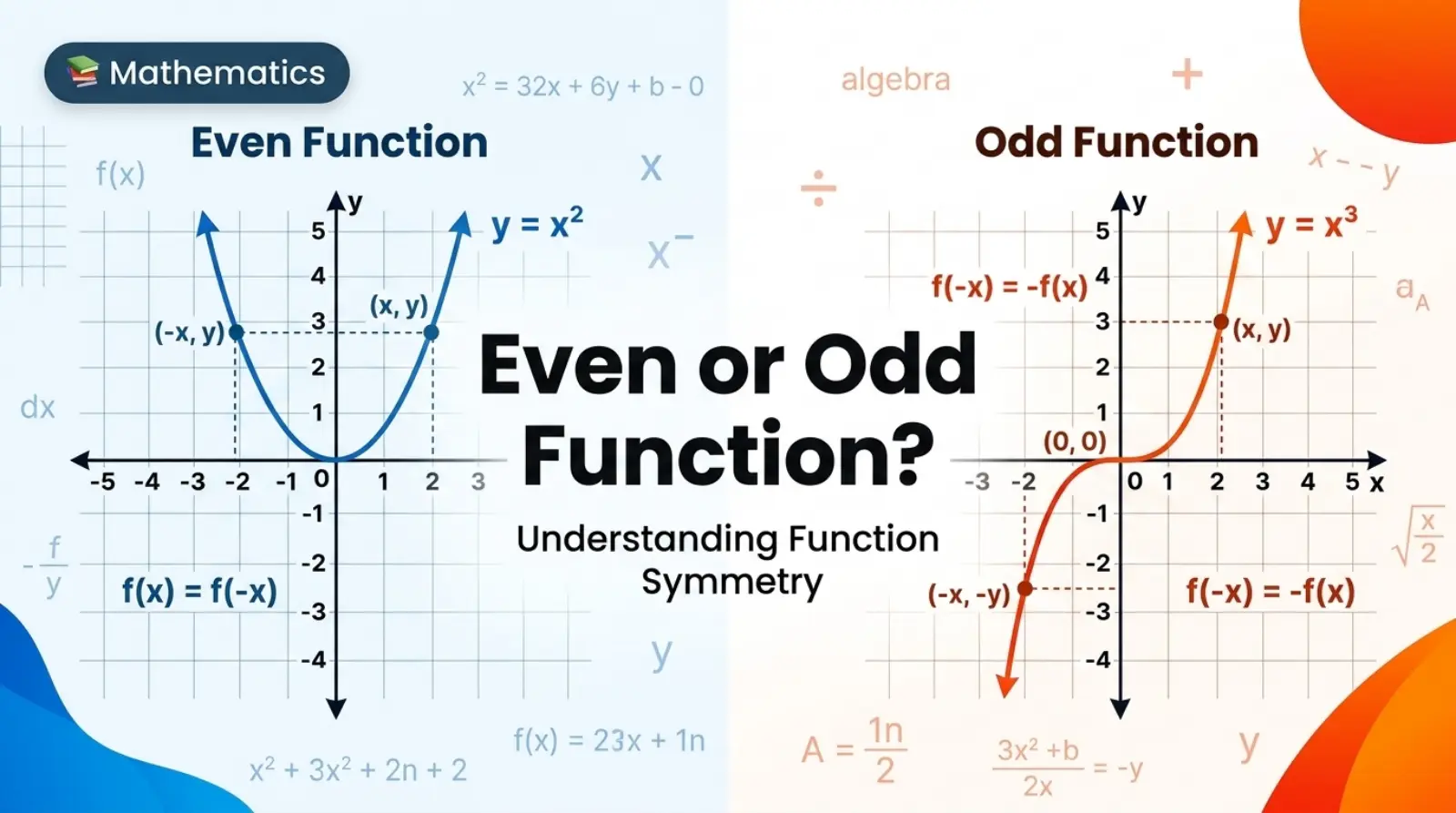
Even or odd function is an important concept in mathematics. It helps us understand how functions behave on a graph.
Many students find this topic confusing at first. However, it becomes simple once you learn the basic rules.
An even function has a special type of symmetry. An odd function has a different type of symmetry. Some functions are neither even nor odd.
Knowing if a function is even or odd can save time when solving equations. It also helps in calculus, algebra, physics, and engineering.
In this guide, you will learn the definition, rules, examples, comparison tables, common mistakes, and expert tips. Everything is explained in simple English.
Quick Summary Box
- An even function satisfies f(-x) = f(x).
- An odd function satisfies f(-x) = -f(x).
- Even functions are symmetric about the y-axis.
- Odd functions are symmetric about the origin.
- Some functions are neither even nor odd.
- Checking symmetry helps identify function types quickly.
- Examples of even functions: x², x⁴, cos(x).
- Examples of odd functions: x³, x⁵, sin(x).
What Is an Even or Odd Function?
It describes how a function behaves when the input changes from positive to negative.
Mathematicians use special rules to classify functions into three categories:
- Even functions
- Odd functions
- Neither even nor odd functions
The classification depends on the relationship between f(x) and f(-x).
Understanding this relationship makes graph analysis easier.
Definition of an Even Function
A function is even when:
f(-x) = f(x)
This means replacing x with -x gives the same result.
Example
Function:
[
f(x)=x^2
]
Check:
[
f(-x)=(-x)^2=x^2
]
Since:
[
f(-x)=f(x)
]
The function is even.
Graph Property
Even functions show symmetry about the y-axis.
If one point exists on the right side, a matching point appears on the left side.
Definition of an Odd Function
A function is odd when:
[
f(-x)=-f(x)
]
The output changes sign when the input changes sign.
Example
Function:
[
f(x)=x^3
]
Check:
[
f(-x)=(-x)^3=-x^3
]
Since:
[
f(-x)=-f(x)
]
Graph Property
Odd functions show symmetry about the origin.
Rotating the graph 180 degrees around the origin gives the same graph.
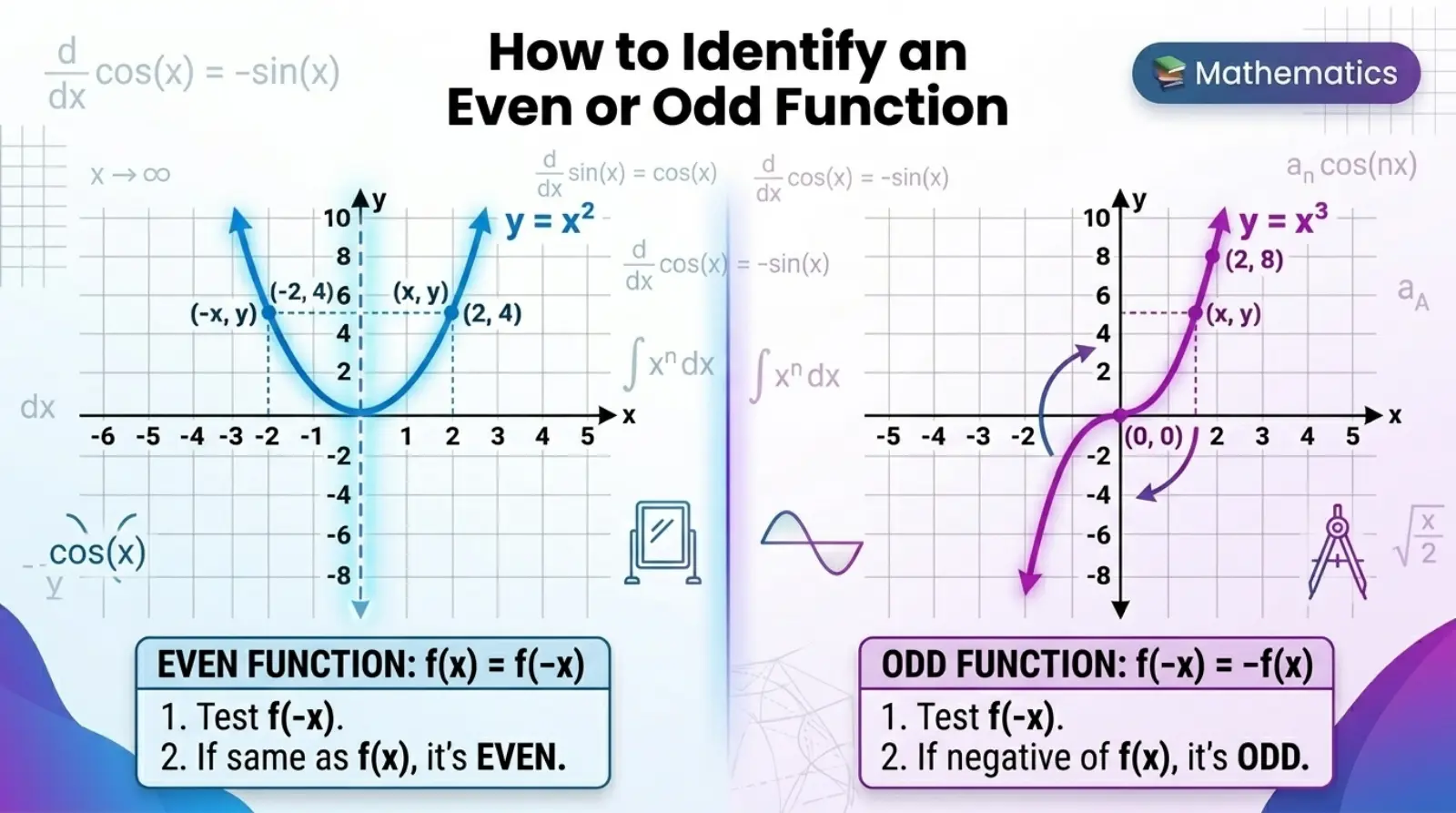
How to Identify an Even or Odd Function
Follow these simple steps:
Step 1: Replace x with -x
Find:
[
f(-x)
]
Step 2: Compare Results
Check if:
[
f(-x)=f(x)
]
If yes, the function is even.
Or check if:
[
f(-x)=-f(x)
]
If yes, the function is odd.
Step 3: Check Graph Symmetry
- Y-axis symmetry → Even
- Origin symmetry → Odd
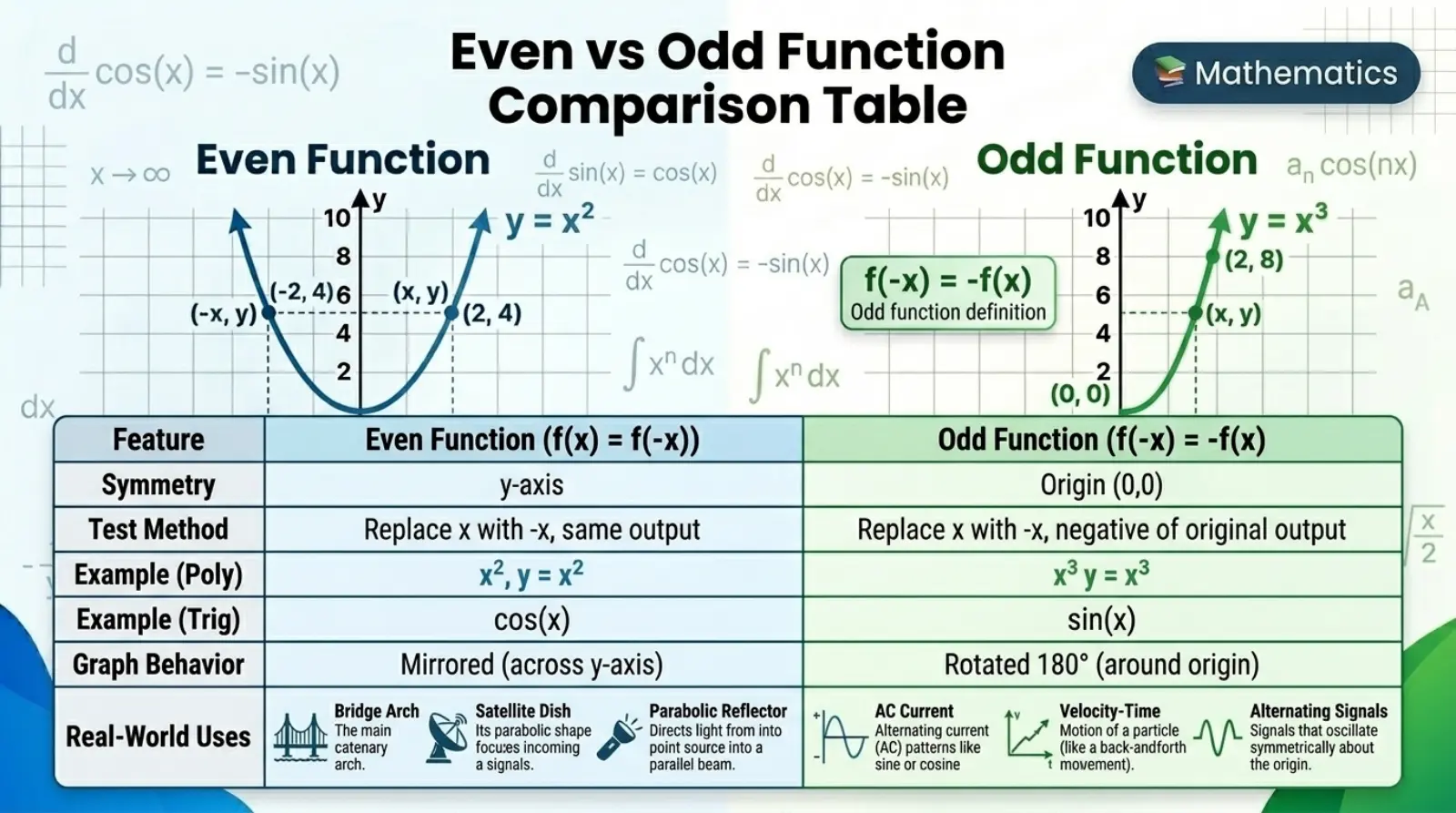
Even vs Odd Function Comparison Table
| Feature | Even Function | Odd Function |
| Rule | f(-x)=f(x) | f(-x)=-f(x) |
| Symmetry | Y-axis | Origin |
| Example | x² | x³ |
| Cosine/Sine | cos(x) | sin(x) |
| Graph Reflection | Mirror image | Rotational symmetry |
| Constant Function | Usually even | Not odd (except 0) |
| Integration Property | Useful symmetry | Useful cancellation |
Examples of Even Functions
1. x²
[
f(-x)=(-x)^2=x^2
]
Even function.
2. x⁴
[
f(-x)=(-x)^4=x^4
]
Even function.
3. cos(x)
Cosine satisfies:
[
\cos(-x)=\cos(x)
]
Even function.
4. |x|
Absolute value satisfies:
[
|-x|=|x|
]
Even function.
Examples of Odd Functions
1. x³
[
f(-x)=(-x)^3=-x^3
]
Odd function.
2. x⁵
[
f(-x)=(-x)^5=-x^5
]
Odd function.
3. sin(x)
Sine satisfies:
[
\sin(-x)=-\sin(x)
]
Odd function.
4. tan(x)
Tangent satisfies:
[
\tan(-x)=-\tan(x)
]
Odd function.
Functions That Are Neither Even Nor Odd
Not every function belongs to these categories.
Example
[
f(x)=x^2+x
]
Check:
[
f(-x)=(-x)^2+(-x)
]
[
=x^2-x
]
This is not equal to:
[
f(x)=x^2+x
]
And it is not equal to:
[
-f(x)=-x^2-x
]
Therefore, the function is neither even nor odd.
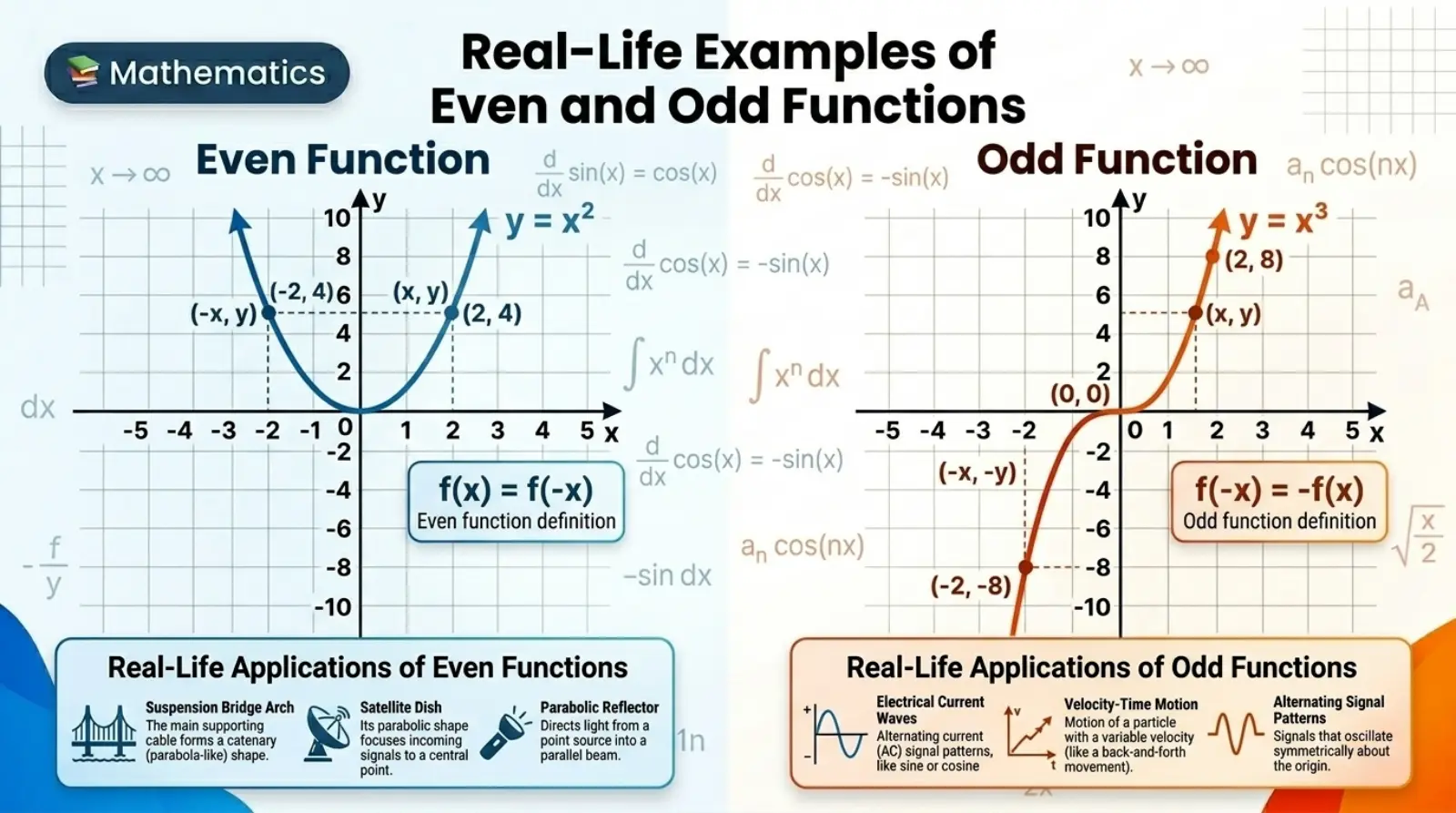
Real-Life Examples of Even and Odd Functions
Mathematics appears everywhere.
Even Function Example
The shape of a satellite dish often shows y-axis symmetry.
Both sides match perfectly.
Odd Function Example
Certain electrical wave patterns show origin symmetry.
These patterns behave like odd functions.
Engineering Applications
Engineers use function symmetry to simplify calculations.
Physics Applications
Wave motion and signal analysis often involve even and odd functions.
Why Are Even and Odd Functions Important?
Understanding function symmetry offers many benefits.
Faster Calculations
Symmetry reduces computation time.
Easier Graph Analysis
You can predict graph shapes quickly.
Useful in Calculus
Integration becomes simpler.
Important in Engineering
Signal processing relies heavily on symmetry.
Helps in Advanced Mathematics
Topics like Fourier Series use even and odd functions extensively.
Common Mistakes Students Make
Mistake 1: Looking Only at the Graph
Always verify using algebra.
Mistake 2: Forgetting the Negative Sign
Many students calculate f(-x) incorrectly.
Mistake 3: Assuming Every Function Is Even or Odd
Some functions belong to neither category.
Mistake 4: Confusing Symmetry Types
Remember:
- Y-axis symmetry = Even
- Origin symmetry = Odd
Mistake 5: Skipping Simplification
Always simplify expressions completely before comparing.
Easy Tricks to Remember Even and Odd Functions
Trick 1: Think of Mirror Images
Even functions act like a mirror across the y-axis.
Trick 2: Think of Rotation
Odd functions look the same after a 180-degree rotation.
Trick 3: Check Exponents
Generally:
- Even powers → Often even functions
- Odd powers → Often odd functions
Examples:
- x² → Even
- x⁴ → Even
- x³ → Odd
- x⁵ → Odd
Trick 4: Remember Trigonometric Functions
- cos(x) → Even
- sin(x) → Odd
- tan(x) → Odd
Expert Insights: Why This Topic Matters
Experts view function symmetry as a foundational mathematical skill.
Students who understand symmetry often solve graph problems faster.
Engineers use symmetry to simplify designs and calculations.
Physicists use even and odd functions when studying waves and signals.
Learning this concept early builds a strong base for calculus, trigonometry, and advanced mathematics.
The ability to recognize patterns quickly is a valuable problem-solving skill.
Frequently Asked Questions (FAQs)
What is an even function?
An even function satisfies the rule:
[
f(-x)=f(x)
]
It has y-axis symmetry.
What is an odd function?
[
f(-x)=-f(x)
]
It has origin symmetry.
Is x² an even function?
Yes. Because:
[
(-x)^2=x^2
]
Is x³ an odd function?
Yes. Because:
[
(-x)^3=-x^3
]
Can a function be both even and odd?
Only the zero function can be both even and odd.
Is sin(x) even or odd?
sin(x) is odd.
Is cos(x) even or odd?
cos(x) is even.
What if a function is neither even nor odd?
Then it does not satisfy either symmetry rule.
Conclusion
Understanding the concept helps you analyze mathematical functions with confidence. An even function satisfies f(-x) = f(x) and shows y-axis symmetry. An odd function satisfies f(-x) = -f(x) and shows origin symmetry. Some functions fit neither category.
By learning the simple testing method, you can classify functions quickly and accurately. This skill helps in algebra, calculus, physics, and engineering. Remember to substitute -x, simplify carefully, and compare the results. With practice, identifying function types becomes easy.
Mastering even and odd functions builds a strong foundation for more advanced math topics and improves problem-solving abilities.