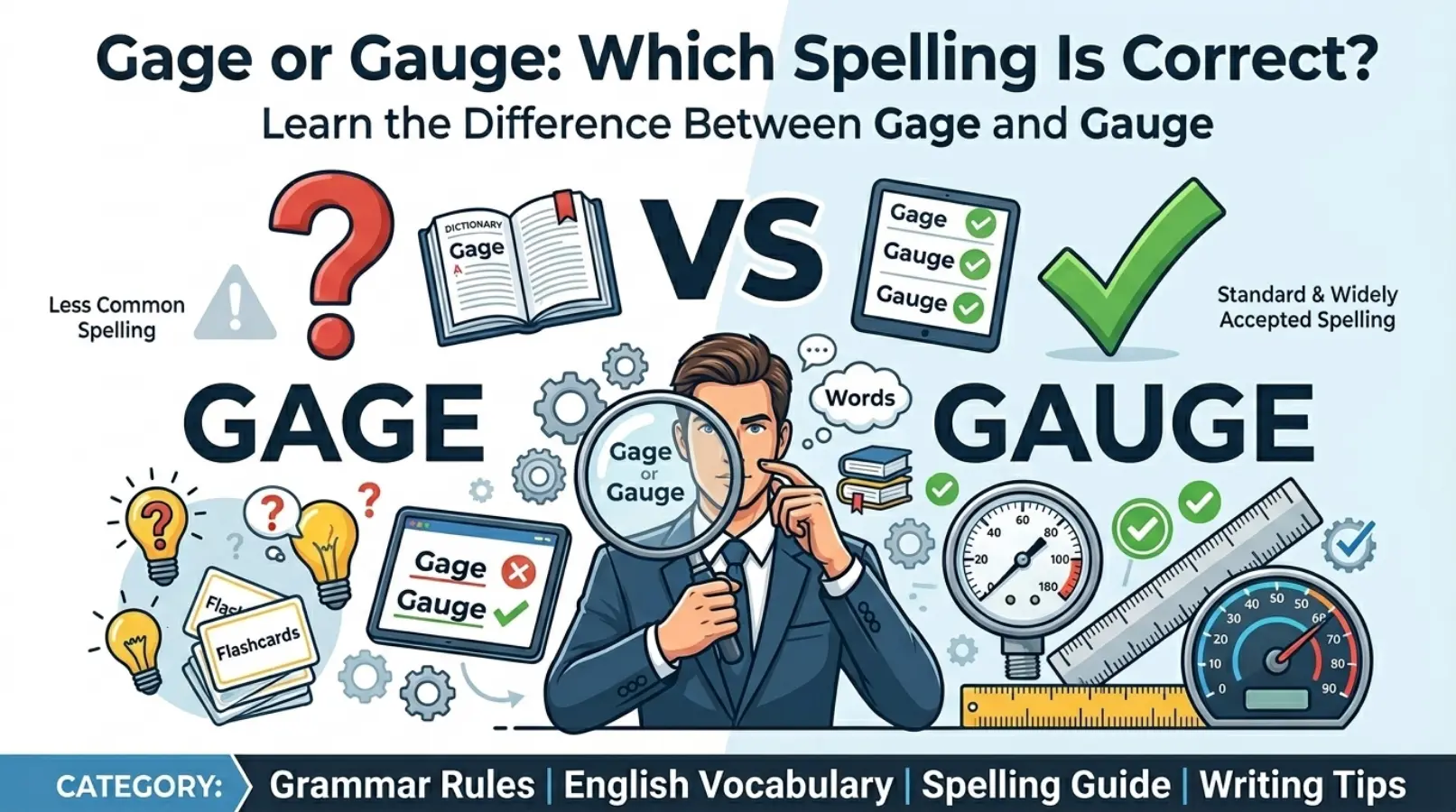
Gage or gauge is a common spelling question that confuses many English writers. At first glance, both words look similar. However, they do not always mean the same thing.
Most people use gauge when talking about measuring something. You may see it in phrases like “fuel gauge” or “rain gauge.” On the other hand, gage is less common and appears in specific situations.
Knowing the difference helps you write more clearly. It also prevents spelling mistakes in school, work, and everyday communication.
In this guide, you’ll learn the meaning of both words, their correct usage, common mistakes, and easy tips to remember the difference. By the end, you’ll know exactly when to use gage and when to use gauge.
Quick Summary Box
- Gauge is the modern and most common spelling.
- Gauge usually means to measure, estimate, or evaluate.
- Gage is an older spelling of gauge.
- Gage can also refer to a pledge, challenge, or security deposit.
- In most writing, gauge is the correct choice.
- Use gage only in special historical or technical contexts.
What Does Gauge Mean?
The word gauge mainly relates to measuring or estimating something.
Gauge as a Noun
A gauge is a tool or device that measures something.
Examples:
- The fuel gauge shows how much gas remains.
- The pressure gauge measured the tire pressure.
- The rain gauge collected rainfall data.
Gauge as a Verb
Gauge can also mean to estimate or judge.
Examples:
- She tried to gauge the audience’s reaction.
- We must gauge customer satisfaction.
- He gauged the distance before jumping.
Simple Definition
Gauge = Measure, estimate, or evaluate.
What Does Gage Mean?
The word gage is much less common today.
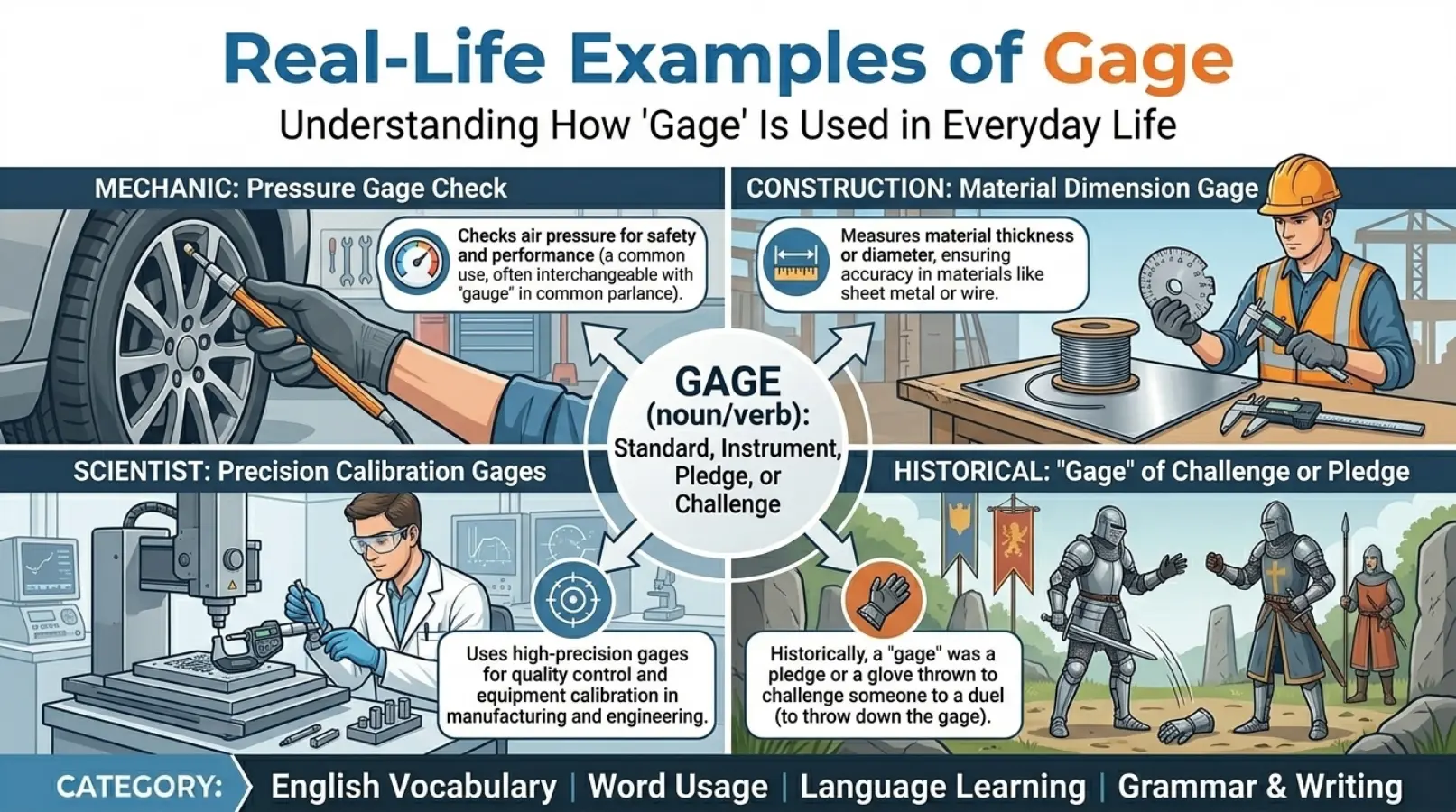
Historically, it referred to:
- A pledge
- A guarantee
- Something given as security
- A challenge to fight
Examples
- The knight threw down a gage.
- The borrower offered a gage for the loan.
Today, most people rarely use this meaning.
Gage vs Gauge: Key Differences
| Feature | Gage | Gauge |
| Modern usage | Rare | Very common |
| Meaning | Pledge, challenge, security | Measure, estimate, evaluate |
| Used in everyday writing | No | Yes |
| Accepted spelling for measurement | Usually no | Yes |
| Found in dictionaries | Yes | Yes |
| Common in technical fields | Rare | Very common |
Quick Rule
If you’re talking about measuring, estimating, or evaluating something, use gauge.
Why Do People Confuse Gage and Gauge?
Several reasons cause confusion.
1. Similar Spelling
The words differ by only one letter.
2. Shared History
Gauge evolved from older forms of English and French. The spelling “gage” survived in some contexts.
3. Pronunciation
Both words sound almost identical.
4. Spell Check Issues
Some software accepts both spellings, creating uncertainty.
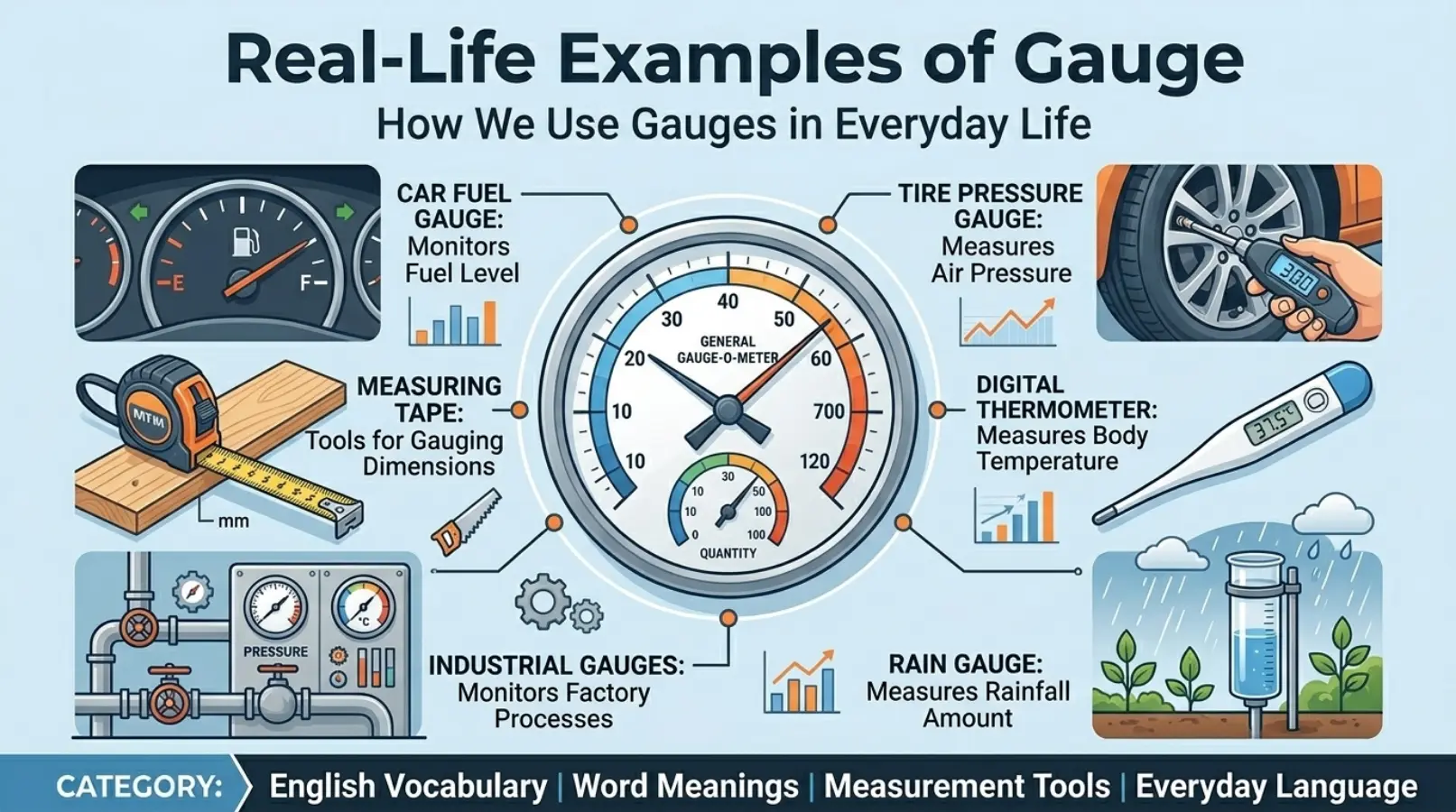
Real-Life Examples of Gauge
Understanding real-world usage makes the difference easier.
Cars
- Check the fuel gauge before a long trip.
- The temperature gauge showed overheating.
Business
- Companies gauge customer satisfaction through surveys.
- Managers gauge employee performance.
Education
- Teachers gauge student understanding through quizzes.
Weather Reports
- Meteorologists use rain gauges to measure rainfall.
Construction
- Workers use thickness gauges for precise measurements.
Real-Life Examples of Gage
Although uncommon, you may still encounter gage.
Historical Writing
- The warrior accepted the gage of battle.
Legal and Financial Contexts
- The property served as a gage for repayment.
Names and Places
Sometimes Gage appears as:
- A surname
- A place name
- A company name
Examples:
- Thomas Gage
- Gage County
In these cases, Gage is a proper noun rather than a common word.
Which Spelling Should You Use Today?
For nearly all modern writing, use gauge.
Correct
Gauge customer interest
Fuel gauge
Pressure gauge
Gauge performance
Usually Incorrect
Gage customer interest
Fuel gage
Pressure gage
Gage performance
Unless you mean the historical definition, gauge is the preferred spelling.
Common Mistakes People Make
Mistake 1: Using Gage Instead of Gauge
Incorrect:
- We need to gage the results.
Correct:
- We need to gauge the results.
Mistake 2: Misspelling Technical Terms
Incorrect:
- Tire gage
Correct:
- Tire gauge
Mistake 3: Assuming Both Are Always Interchangeable
They are not interchangeable in most contexts.
Mistake 4: Ignoring Context
Always check whether the word relates to measurement or a historical pledge.
Easy Tips to Remember the Difference
Tip 1: Think of the Letter “U”
The “u” in gauge can remind you of:
- Understanding
- Units
- Utility
All relate to measuring.
Tip 2: Remember Modern Usage
If you’re writing today, choose gauge.
Tip 3: Check the Context
Ask yourself:
“Am I measuring or estimating something?”
If yes, use gauge.
Tip 4: Learn Common Phrases
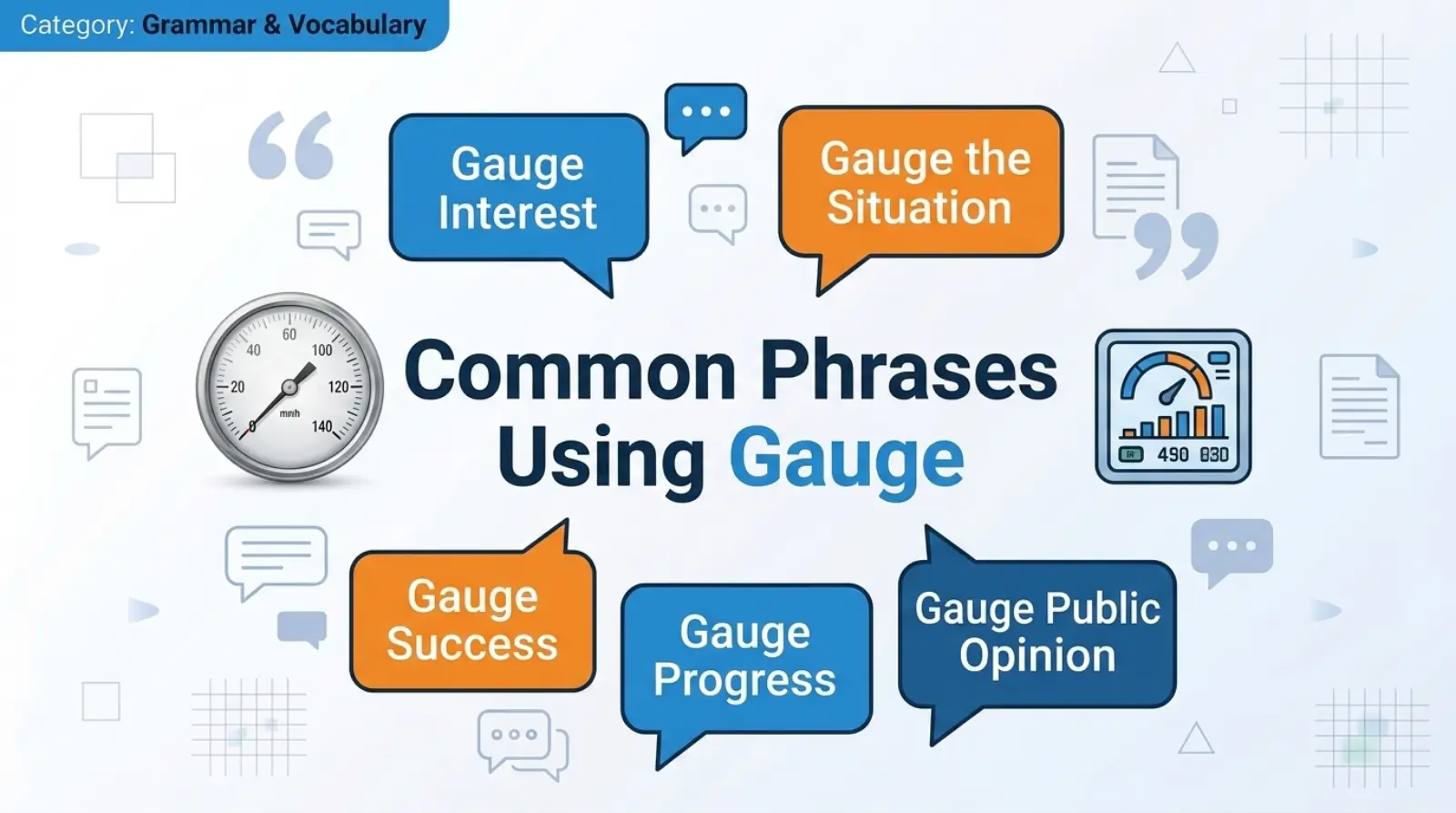
Common expressions include:
- Gauge interest
- Gauge success
- Fuel gauge
- Pressure gauge
- Rain gauge
You rarely see these with gage.
Synonyms
for Gauge (Verb)
- Measure
- Estimate
- Assess
- Evaluate
- Judge
- Determine
- Analyze
- Calculate
for Gauge (Noun)
- Meter
- Indicator
- Instrument
- Scale
- Measuring device
Usage in Daily Life
You probably use the concept of gauge every day.
Shopping
You gauge product quality before buying.
Driving
You check the fuel gauge regularly.
Work
Managers gauge project progress.
School
Teachers gauge student performance.
Sports
Coaches gauge team readiness before games.
Because the word appears in many situations, knowing the correct spelling matters.
Expert Insights: Why Correct Spelling Matters
Correct spelling builds trust.
Readers notice mistakes quickly. Using the wrong word can make content seem less professional.
Why Experts Prefer Gauge
- It follows modern English standards.
- It appears in dictionaries and style guides.
- It prevents confusion.
- It improves readability.
Common Phrases Using Gauge
Here are phrases you will often see:
| Phrase | Meaning |
| Fuel gauge | Measures fuel level |
| Pressure gauge | Measures pressure |
| Rain gauge | Measures rainfall |
| Gauge interest | Estimate interest level |
| Gauge performance | Assess performance |
| Gauge reaction | Evaluate response |
| Wire gauge | Thickness measurement |
| Gauge accuracy | Measure precision |
Is It Gage or Gauge?
Gauge is the correct spelling in most modern English writing. It means to measure, estimate, evaluate, or indicate a quantity. Gage is an older and less common spelling that usually refers to a pledge, challenge, or security. For everyday use, choose gauge.
Frequently Asked Questions (FAQs)
1. Is it gage or gauge?
Gauge is the preferred spelling in modern English.
2. What does gauge mean?
Gauge means to measure, estimate, assess, or evaluate something.
3. Is gage a real word?
Yes. Gage is a real word, but it is uncommon today.
4. Can gage and gauge be used interchangeably?
Usually no. Gauge is the correct choice for measurement and estimation.
5. Why is gauge more common?
Modern English dictionaries and style guides prefer gauge.
6. What is a fuel gauge?
A fuel gauge measures the amount of fuel in a vehicle.
7. What does “gauge interest” mean?
It means to estimate or assess how interested people are.
8. Is gage an incorrect spelling?
Not always. It has historical meanings, but gauge is preferred for modern usage.
Conclusion
The difference between gage or gauge is simple once you understand their meanings. In modern English, gauge is the standard spelling. It refers to measuring, estimating, evaluating, or indicating information. You will find it in common terms like fuel gauge, pressure gauge, and gauge interest.
Meanwhile, gage is an older word with specialized meanings related to pledges, guarantees, or challenges. Most writers rarely need to use it.
When in doubt, choose gauge. It is the spelling readers expect and the one used in most professional, academic, and everyday writing. Remember this rule, and you’ll avoid one of the most common spelling mistakes in English.