Meantime or mean time is a common grammar question that confuses many English learners and writers. These two terms look similar, but they do not always work the same way. Using the correct form can make your writing clearer and more professional.
Many people use “meantime” and “mean time” interchangeably. However, grammar rules and context matter. Knowing when to use each form helps you avoid common mistakes.
In this guide, you will learn the meaning of both terms, their differences, examples, common errors, and expert writing tips. By the end, you will know exactly which form fits your sentence.
Quick Summary Box
- Meantime is usually one word.
- It means during the time before something happens.
- Mean time is usually a two-word phrase used in technical fields.
- In everyday English, meantime is more common.
- Example: “The report will arrive tomorrow. In the meantime, review the data.”
- Use mean time mainly in statistics, engineering, and reliability terms.
- Knowing the difference improves grammar and writing accuracy.
What Does Meantime Mean?
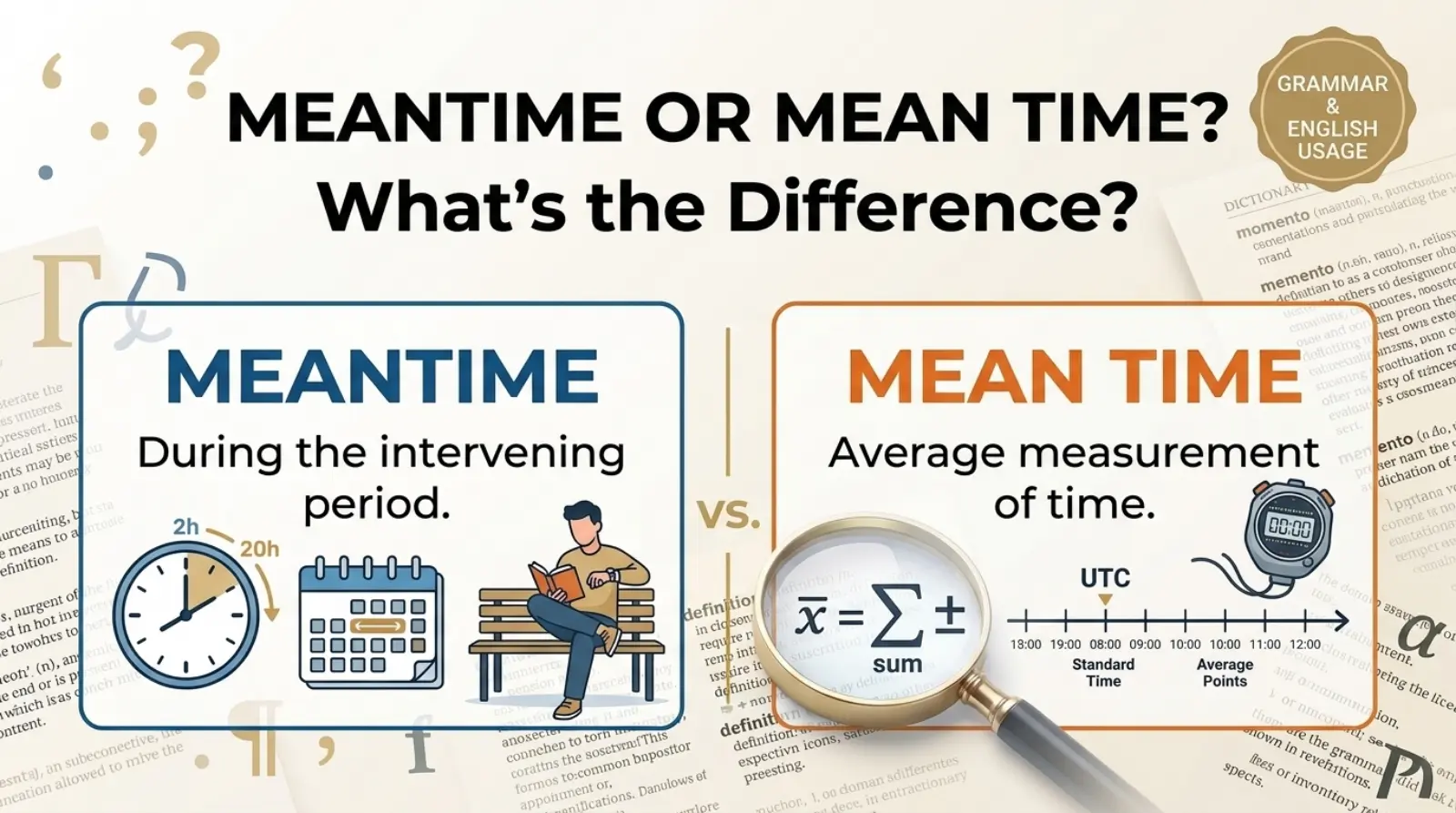
Meantime is a noun or adverb that refers to the period between two events.
Simple Definition
Meantime means:
The time between now and a future event.
Examples
- The doctor will see you soon. In the meantime, please wait.
- We are preparing the project. Meantime, the team is gathering data.
- Dinner will be ready in an hour. In the meantime, relax.
In most cases, “meantime” appears in the phrase:
“In the meantime”
This phrase is very common in daily conversations and formal writing.
What Does Mean Time Mean?
Mean time is a technical phrase with a different meaning.
It usually refers to an average measurement of time.
Simple Definition
Mean time means:
The average amount of time calculated from several measurements.
Examples
- Engineers measured the mean time between failures.
- Scientists recorded the mean time of completion.
- The system’s mean time to repair was two hours.
You will often see this phrase in engineering, technology, mathematics, and science.
Meantime vs Mean Time: Key Differences
| Feature | Meantime | Mean Time |
| Form | One word | Two words |
| Meaning | Time between events | Average calculated time |
| Common Usage | Everyday English | Technical fields |
| Grammar Role | Noun or adverb | Noun phrase |
| Example | In the meantime, wait. | Mean time between failures. |
| Frequency | Very common | Less common |
Quick Rule
If you mean “while waiting”, use meantime.
If you mean “average time measurement”, use mean time.
Why Do People Confuse Meantime and Mean Time?
The confusion happens because both terms contain the word “time.”
However, their meanings differ greatly.
People often:
- Split “meantime” into two words by mistake.
- Assume both spellings mean the same thing.
- Ignore the technical meaning of “mean time.”
Learning the context solves the problem quickly.
How to Use Meantime in Everyday Writing
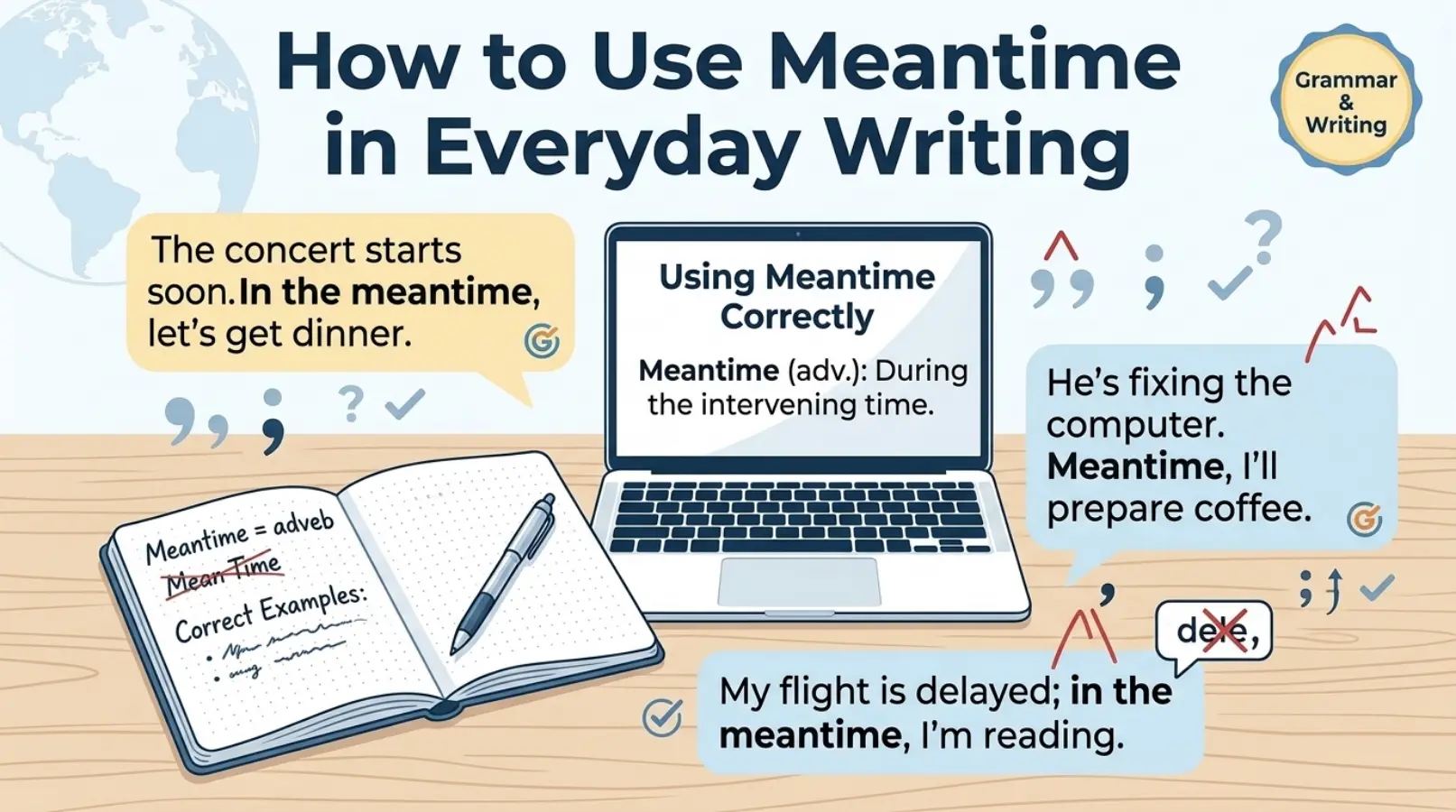
Meantime works well in conversations, emails, blogs, and professional writing.
Examples
- The package will arrive tomorrow. In the meantime, track the shipment.
- We are waiting for approval. In the meantime, prepare the documents.
- School starts next week. Meantime, students can review lessons.
Daily Situations
At Work
“We are waiting for client feedback. In the meantime, let’s update the presentation.”
At Home
“The laundry is drying. In the meantime, clean the kitchen.”
At School
“The teacher is printing the worksheets. In the meantime, read chapter three.”
How to Use Mean Time in Technical Writing
Mean time appears often in engineering and data analysis.
Common Technical Terms
- Mean Time Between Failures (MTBF)
- Mean Time To Repair (MTTR)
- Mean Time To Recovery
- Mean Time To Failure (MTTF)
Example
A computer server may have a mean time between failures of 20,000 hours.
This means the server operates for an average of 20,000 hours before experiencing a failure.
Real-Life Examples of Meantime and Mean Time
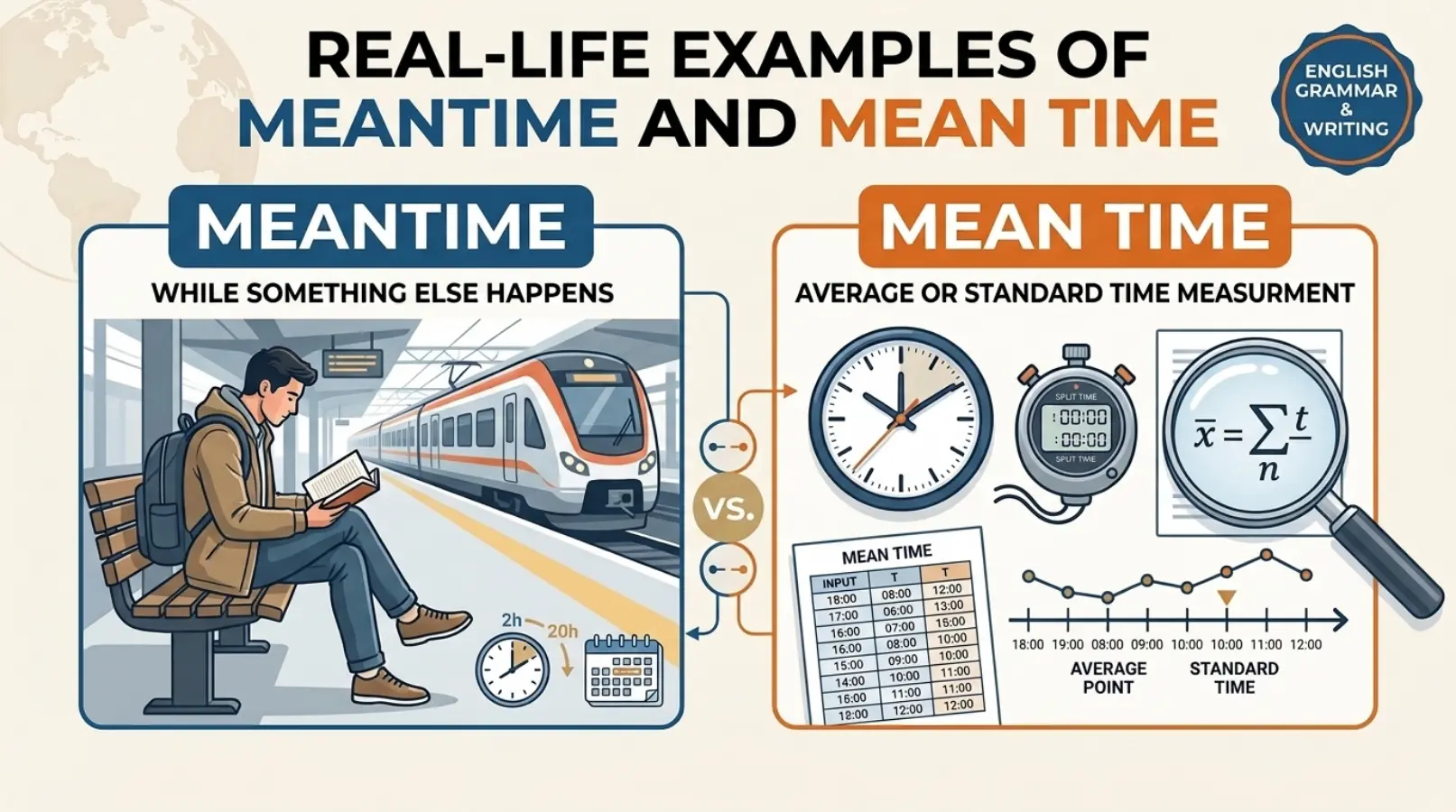
Meantime Examples
- The flight leaves at noon. In the meantime, grab lunch.
- The meeting starts in 30 minutes. In the meantime, review the agenda.
- We are waiting for the results. In the meantime, continue working.
Mean Time Examples
- The machine’s mean time to repair is three hours.
- Engineers improved the mean time between failures.
- Researchers studied the mean time needed to complete the task.
These examples show how context determines the correct choice.
Common Mistakes People Make
Mistake 1: Writing “Mean Time” Instead of “Meantime”
❌ In the mean time, please wait.
✅ In the meantime, please wait.
Mistake 2: Using Meantime in Technical Reports
❌ The meantime between failures is 10,000 hours.
✅ The mean time between failures is 10,000 hours.
Mistake 3: Assuming Both Mean the Same Thing
They look similar but serve different purposes.
Always check whether you mean:
- A waiting period → meantime
- An average measurement → mean time
Easy Trick to Remember the Difference
Use this simple memory tip:
Meantime = Waiting Time
If you can replace it with:
- meanwhile
- during that period
- until then
Use meantime.
Mean Time = Average Time
If you can replace it with:
- average duration
- average time measurement
Use mean time.
This trick works in most situations.
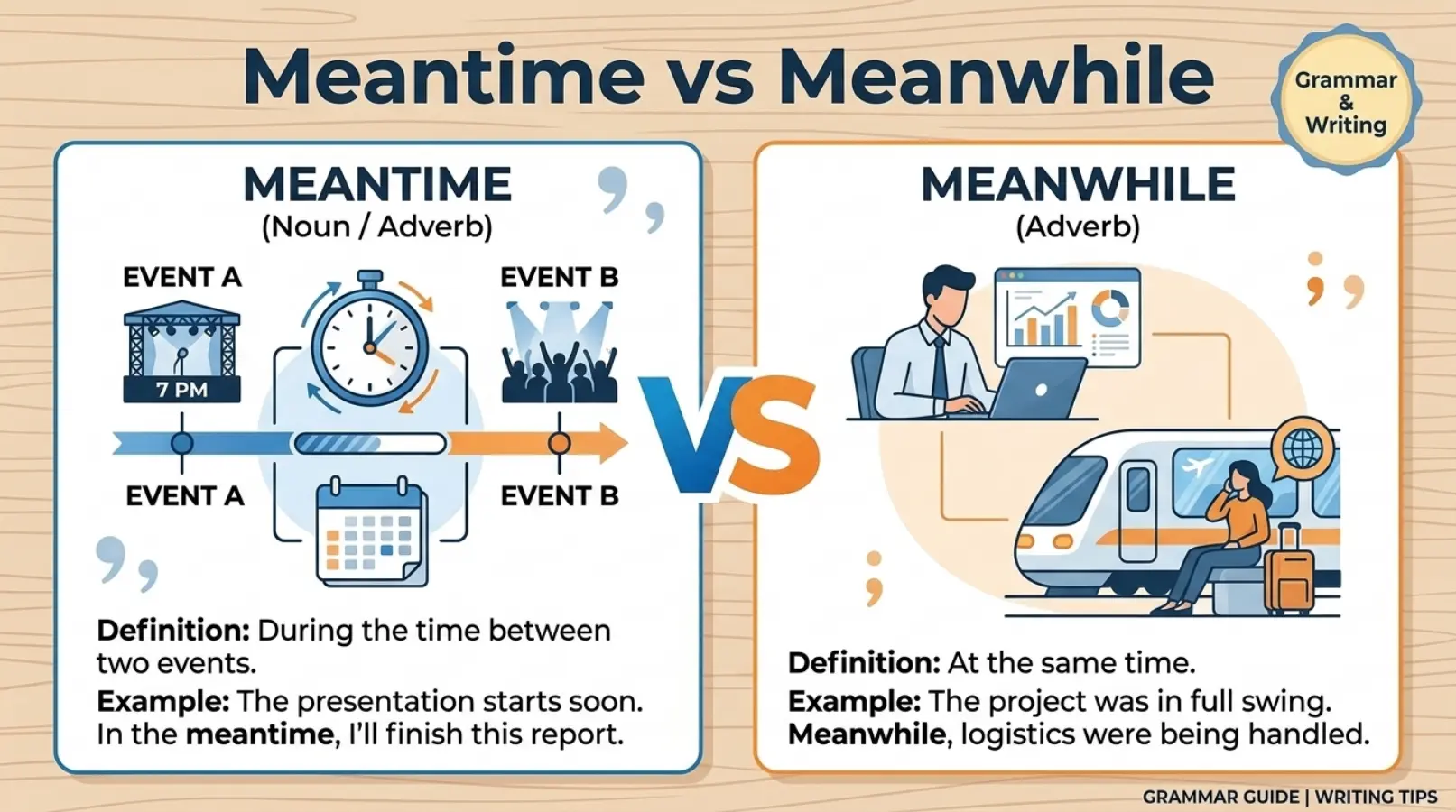
Meantime vs Meanwhile
Many people also confuse “meantime” with “meanwhile.”
Comparison Table
| Word | Meaning | Example |
| Meantime | Time between events | In the meantime, wait. |
| Meanwhile | At the same time | Sarah cooked. Meanwhile, John cleaned. |
Example
- The report is being printed. In the meantime, check your email.
- Sarah prepared the slides. Meanwhile, David organized the meeting room.
Both are correct but serve different purposes.
Synonyms
- Meanwhile
- For now
- Until then
- During that period
- At the same time
- Temporarily
Expert Insights: Why Correct Usage Matters
Correct word choice improves communication.
Readers notice grammar mistakes quickly. Small errors can affect credibility.
Professional writers, students, and business professionals benefit from understanding these differences.
Expert Tips
- Use “in the meantime” in everyday writing.
- Double-check technical documents for “mean time.”
- Read the sentence aloud to test meaning.
- Replace the phrase with “average time” to verify technical usage.
- Use grammar tools for final proofreading.
Clear writing builds trust and improves readability.
Frequently Asked Questions (FAQs)
Is it meantime or mean time?
In everyday English, meantime is usually correct. Mean time is mainly technical.
What does “in the meantime” mean?
It means during the period before something else happens.
Is mean time one word or two?
The technical phrase is two words: mean time.
Can I use meantime and meanwhile interchangeably?
Often yes, but not always. Their sentence structures can differ.
What is mean time between failures?
It is a reliability metric that measures the average operating time before a failure occurs.
Is “in the mean time” wrong?
In most everyday writing, yes. The preferred form is “in the meantime.”
Which spelling appears more often?
Meantime appears much more frequently in general English writing.
Is meantime formal or informal?
It works in both formal and informal contexts.
Conclusion
Understanding meantime or mean time is easier once you know the difference in meaning. Meantime refers to the period between two events and appears often in everyday English. The phrase “in the meantime” is the most common form. On the other hand, mean time is a technical term that describes an average measurement of time, especially in science and engineering.
The key is context. If you are talking about waiting for something to happen, choose meantime. If you are discussing averages or reliability metrics, use mean time. Keeping this simple rule in mind will help you write more clearly, avoid mistakes, and communicate with confidence.
Discover More Post:
Momento or Memento: Meaning, Usage, and Examples