Who or whom is one of the most common grammar questions in English. Many people feel confused about which word is correct. The good news is that the rule is simple once you understand it.
Both words are pronouns, but they have different jobs in a sentence. Using the right one makes your writing clear and professional. It also helps you avoid common grammar mistakes.
In this guide, you will learn the difference between who and whom in simple words. You will also see easy examples, comparison tables, memory tricks, and common mistakes. By the end, you will know exactly when to use each word with confidence.
Quick Summary Box
- Who is a subject pronoun.
- Whom is an object pronoun.
- Use who when the person performs the action.
- Use whom when the person receives the action.
- Replace with he/she to test for who.
- Replace with him/her to test for whom.
- In everyday conversation, who is more common.
- In formal writing, whom is still correct in many situations.
What Do “Who” and “Whom” Mean?
Both who and whom refer to people. They help ask questions or introduce extra information.
The difference depends on the person’s role in the sentence.
- Who = subject
- Whom = object
Examples
Who called you?
Whom did you call?
The first person performs the action. The second person receives the action.
What Is “Who”?
Who works as the subject of a sentence or clause.
The subject performs the action.
Examples
- Who opened the door?
- Who wants pizza?
- Who wrote this book?
- Sarah is the person who won the prize.
In every example, who performs the action.
What Is “Whom”?
Whom works as the object of a verb or preposition.
The object receives the action.
Examples
- Whom did you invite?
- To whom should I send the email?
- Whom are they looking for?
- The teacher, whom everyone respected, retired.
Here, whom receives the action.
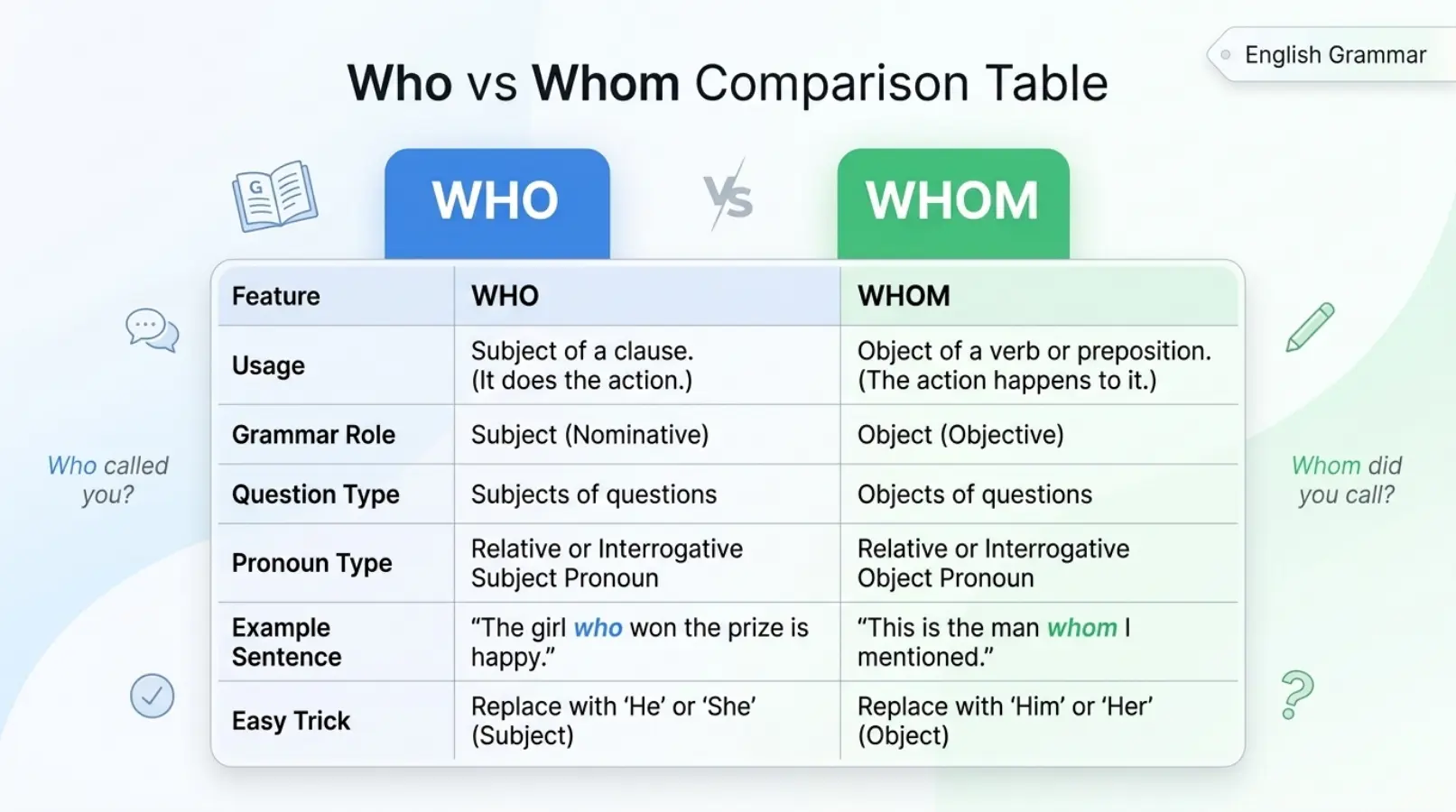
Who vs Whom Comparison Table
| Feature | Who | Whom |
| Grammar role | Subject | Object |
| Performs action | Yes | No |
| Receives action | No | Yes |
| Similar pronoun | He/She | Him/Her |
| Common in speech | Very common | Less common |
| Formal writing | Yes | Yes |
The Easy He/Him Trick
This is the fastest way to decide between who and whom.
Step 1
Replace the word with he or him.
If “he” fits:
Use who.
Example:
Who is coming?
He is coming.
Correct:
Who is coming?
If “him” fits:
Use whom.
Example:
You invited him.
Correct:
Whom did you invite?
Real-Life Examples of Who and Whom
Asking Questions
Who is your teacher?
Whom did your teacher call?
At Work
Who approved the project?
To whom should I report?
At School
Who finished the homework?
Whom did the principal praise?
With Friends
Who wants coffee?
Whom did you meet yesterday?
In Emails
Who should receive this message?
To whom may I address this letter?

Who vs Whom in Questions
Many English questions begin with who or whom.
Use “Who”
- Who called?
- Who won?
- Who helped you?
- Who made dinner?
Use “Whom”
- Whom did you see?
- Whom should I thank?
- Whom are you waiting for?
- With whom did you travel?
Who vs Whom After Prepositions
A preposition often signals that whom is correct.
Common prepositions include:
- to
- for
- with
- by
- about
- from
- among
Examples
- To whom did you speak?
- With whom are you working?
- About whom are they talking?
- From whom did you receive the package?
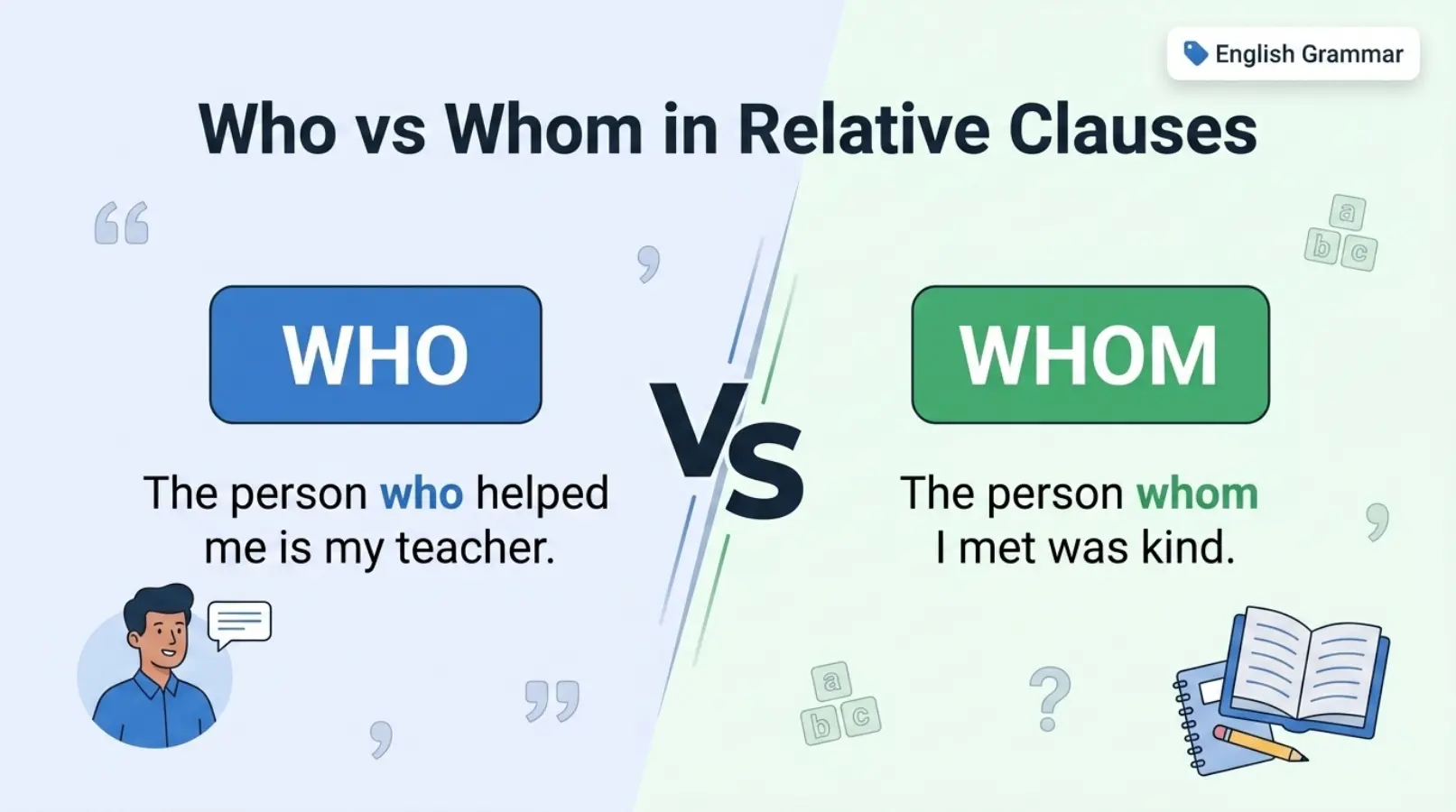
Who vs Whom in Relative Clauses
Relative clauses describe a person.
Subject
The woman who lives next door is kind.
Object
The woman whom I met yesterday is a doctor.
Both are correct because they play different grammar roles.
Modern English Usage
Modern English has become more relaxed.
Many native speakers use who instead of whom, especially in conversation.
Casual English
Who did you invite?
This is widely accepted.
Formal English
Whom did you invite?
This remains grammatically correct.
If you write academic papers, business documents, or legal writing, using whom correctly still matters.
Common Mistakes People Make
Mistake 1
❌ Whom is calling?
✅ Who is calling?
Mistake 2
❌ Who did you invite?
This is acceptable in casual speech.
Formal English:
✅ Whom did you invite?
Mistake 3
❌ Give it to who?
Formal:
✅ Give it to whom?
Casual:
✅ Give it to who?
Mistake 4
❌ Who should I send this to?
Formal:
✅ To whom should I send this?
Both forms are common today.
Tips to Remember Who and Whom
- Think he = who.
- Think him = whom.
- Look for prepositions.
- Find the subject first.
- Ask who performs the action.
- Ask who receives the action.
- Read the sentence aloud.
- Practice with simple examples.
Daily Life Usage
You hear these words almost every day.
At Home
Who cooked dinner?
At School
Who answered the question?
At the Office
Whom should I contact?
On Social Media
Who shared this post?
While Shopping
Who helped you today?
Most conversations naturally use who, even where whom could be technically correct.
Synonyms
- Subject pronoun
- Object pronoun
- Relative pronoun
- Interrogative pronoun
- English grammar
- Grammar rules
- Sentence structure
- Formal English
- Informal English
- Pronoun examples
Expert Insights: Why Correct Usage Matters
Using who and whom correctly improves your grammar skills.
Professional writing often requires accurate pronoun use. Correct grammar also builds trust with readers.
Still, language changes over time. Today, many style guides accept who in casual conversation where whom once appeared.
The best approach is simple:
- Use whom in formal writing.
- Use who naturally in everyday speech.
- Always choose clarity over sounding overly formal.
Frequently Asked Questions (FAQs)
Is it “who” or “whom” that called?
Use who.
The person performs the action.
Is “whom” still correct?
Yes.
It remains correct, especially in formal writing.
Why do people rarely use “whom”?
Modern English prefers simpler language.
Many speakers naturally choose who.
Can I always use “who”?
In casual conversation, usually yes.
In formal writing, whom is still appropriate in some cases.
Is “to whom it may concern” correct?
Yes.
This is one of the most common formal uses of whom.
Is “Who did you invite?” wrong?
No.
It is standard in everyday English.
Formal grammar prefers:
Whom did you invite?
How can I remember the rule?
Replace the word with he or him.
- He → Who
- Him → Whom
Who vs Whom
| Question | Answer |
| When do you use who? | Use who as the subject of a sentence. |
| When do you use whom? | Use whom as the object of a verb or preposition. |
| Easy memory trick | He = Who, Him = Whom |
| Which is more common today? | Who is more common in everyday English. |
Conclusion
Understanding who or whom becomes much easier once you know the difference between a subject and an object. Who performs the action, while whom receives it. The simple he/him test can help you choose the correct word in seconds. Although everyday English often favors who, whom still has an important place in formal writing, business communication, and academic work. Learning this rule will improve your grammar, strengthen your writing, and boost your confidence. Keep practicing with real-life examples, and soon choosing between who and whom will feel natural.
Discover More Post:
Led or Lead: What’s the Difference? Guide with Examples
Its or It’s: What’s the Difference? Grammar Guide with Examples