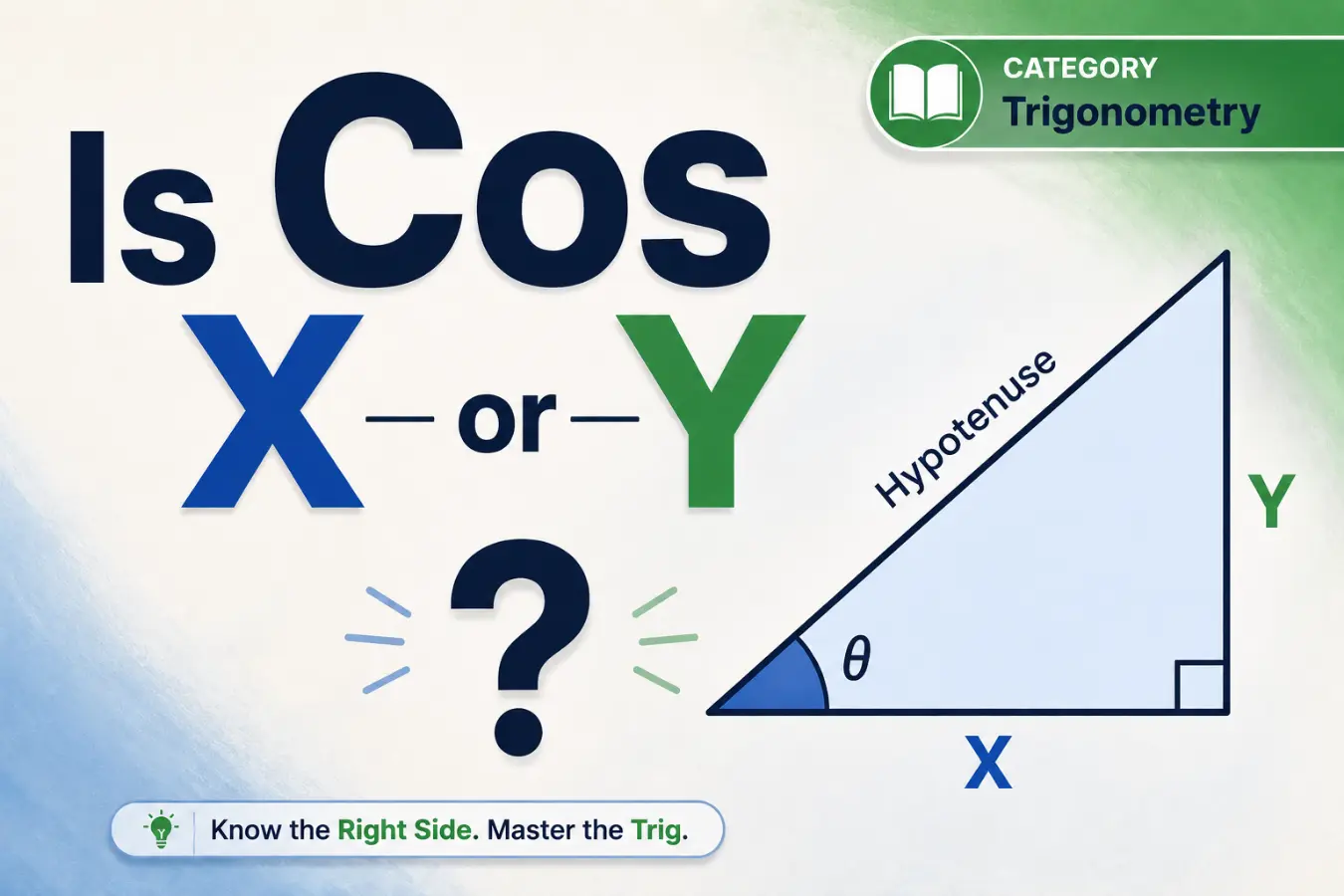
Is cos x or y? This is a common question for students learning trigonometry. Many people get confused about whether cosine represents x, y, or something else. The good news is that the answer is simple once you understand how coordinates work on a graph and the unit circle.
Cosine does not always mean only x or only y. Its meaning depends on the situation. In coordinate geometry and the unit circle, cosine relates to the x-coordinate. In a right triangle, cosine compares two side lengths.
This guide explains everything in easy words. You will learn what cosine means, why it is linked to x, and how to use it in real problems. By the end, you will answer this question with confidence.
Quick Summary
- Cos x usually represents the x-coordinate on the unit circle.
- Sin x usually represents the y-coordinate on the unit circle.
- In a right triangle, cos θ = adjacent ÷ hypotenuse.
- Cosine is not the same as the variable x.
- The variable x often represents the angle.
- Cosine helps solve geometry, physics, engineering, and navigation problems.
What Does “Is Cos X or Y” Mean?
Many beginners ask whether cosine equals x or y because they see equations like:
- cos x
- sin x
- tan x
Here, x is not a coordinate. It is usually the angle.
For example:
- cos 30°
- cos 45°
- cos 60°
In these examples, 30°, 45°, and 60° are angles.
When using the unit circle, the answer becomes:
- Cosine = x-coordinate
- Sine = y-coordinate
This is why people often say:
Cos = x and Sin = y
What Is Cosine?
Cosine is one of the three basic trigonometric functions.
The three main functions are:
- Sine (sin)
- Cosine (cos)
- Tangent (tan)
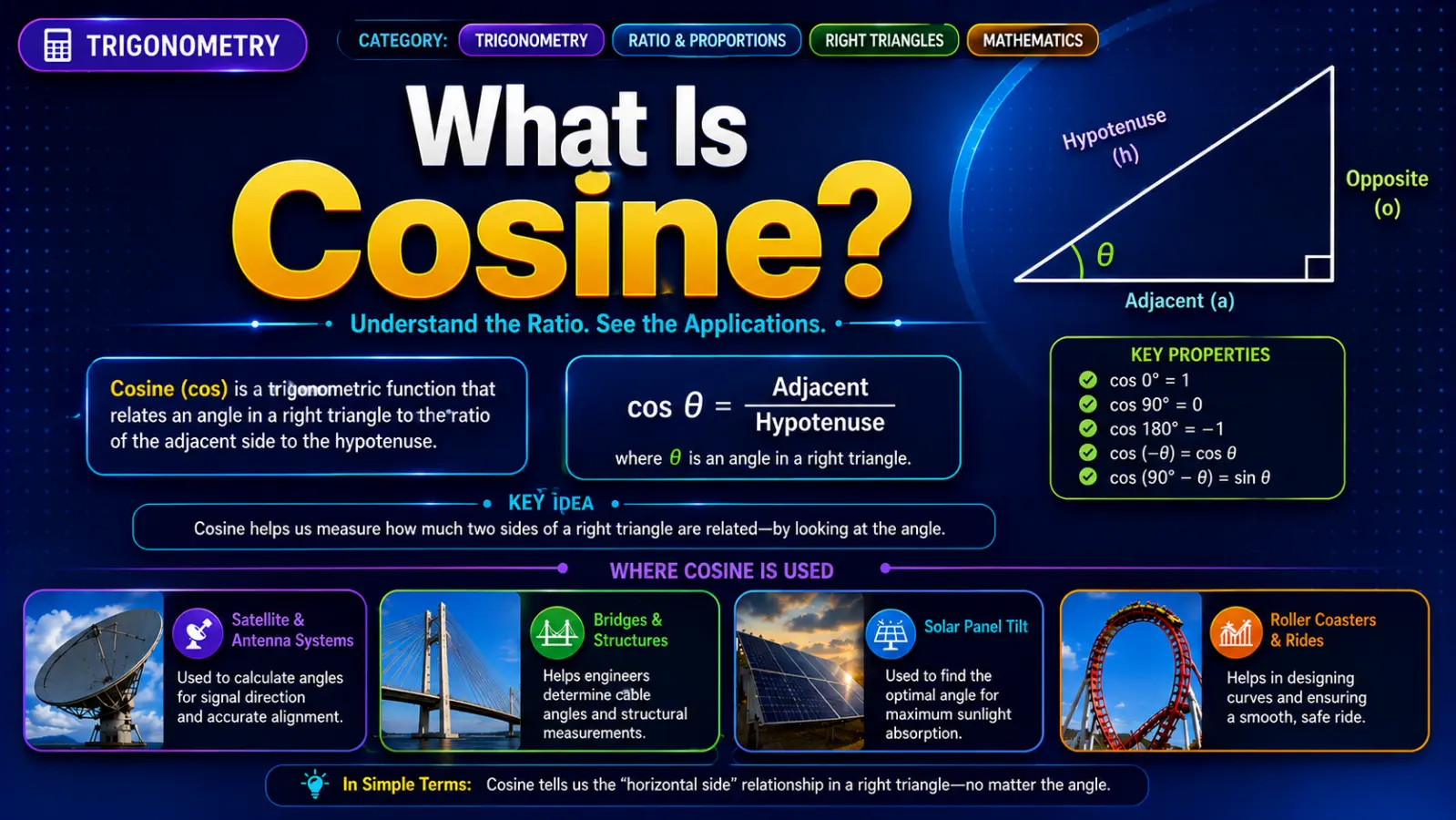
Cosine tells us the relationship between an angle and the sides of a right triangle.
Formula
[
\cos \theta=\frac{\text{Adjacent Side}}{\text{Hypotenuse}}
]
This formula helps find:
- Missing sides
- Missing angles
- Distances
- Heights
Why Is Cosine Associated With X?
The connection comes from the unit circle.
A point on the unit circle has coordinates:
(cos θ, sin θ)
That means:
- First value = cosine
- Second value = sine
Example:
At 0°
Point:
(1,0)
So,
- cos 0° = 1
- sin 0° = 0
Notice that cosine matches the x-coordinate.
Another example:
At 90°
Point:
(0,1)
Here:
- cos 90° = 0
- sin 90° = 1
Again, cosine matches the x-value.
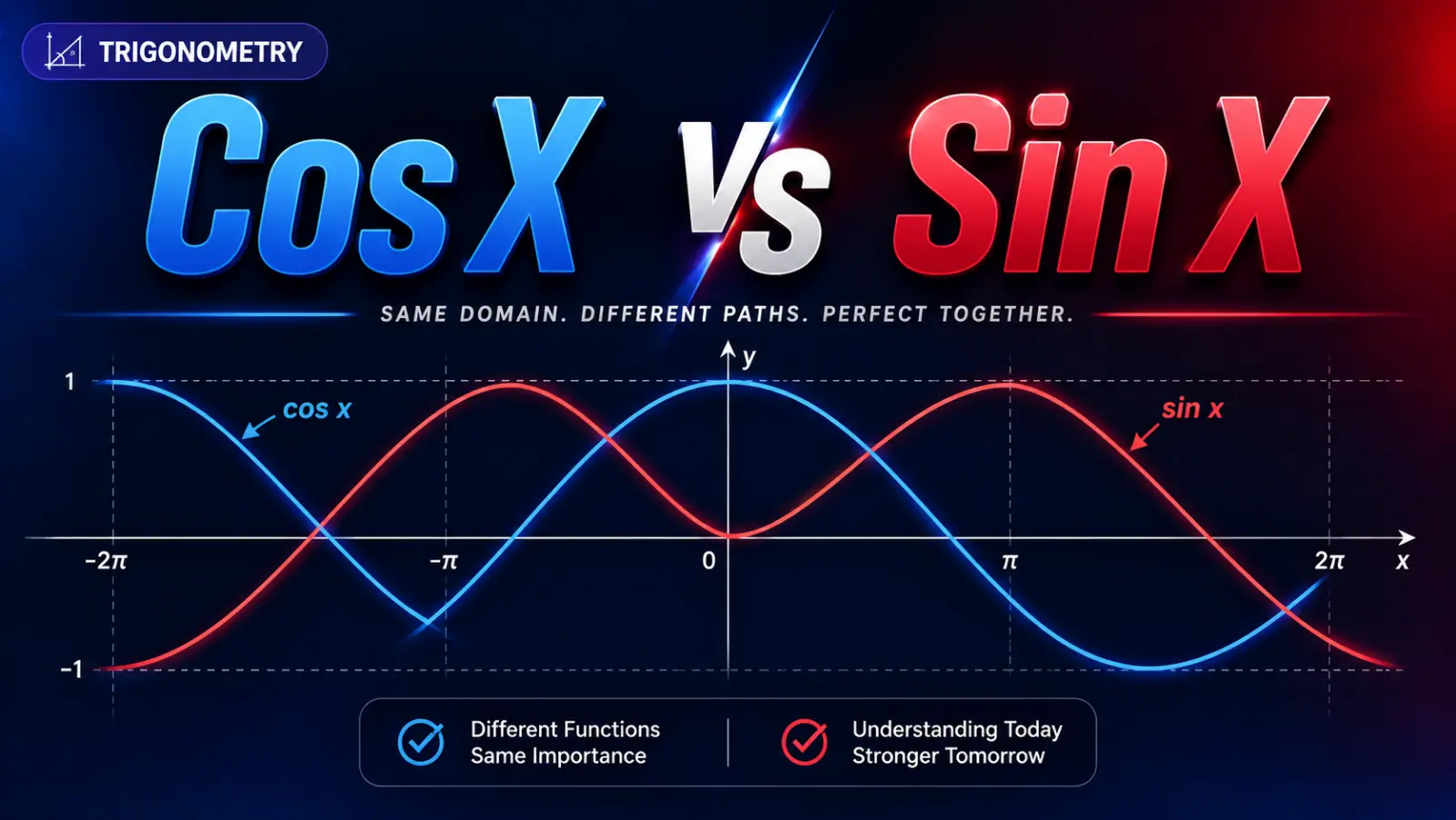
Cos X vs Sin X
| Feature | Cos x | Sin x |
| Represents | x-coordinate | y-coordinate |
| Triangle Formula | Adjacent ÷ Hypotenuse | Opposite ÷ Hypotenuse |
| Unit Circle Position | Horizontal | Vertical |
| Starts At | 1 | 0 |
| Maximum Value | 1 | 1 |
| Minimum Value | -1 | -1 |
Easy memory trick:
- Cos → x
- Sin → y
Understanding Cosine in Simple Words
Imagine standing in the center of a circle.
You point toward the edge.
Your pointing direction creates an angle.
The horizontal distance from the center equals the cosine.
The vertical distance equals the sine.
So,
Horizontal = Cos
Vertical = Sin
This simple idea explains why cosine represents the x-coordinate.
Cosine in a Right Triangle
In a right triangle,
[
\cos \theta=\frac{\text{Adjacent}}{\text{Hypotenuse}}
]
Example:
Adjacent side = 8
Hypotenuse = 10
Then,
Cos θ = 8 ÷ 10
Cos θ = 0.8
This value tells us something about the angle.
Real-Life Examples of Cosine
Cosine appears in many everyday situations.
1. GPS Navigation
Maps use trigonometry to measure positions.
2. Building Construction
Engineers calculate roof angles.
3. Aviation
Pilots determine flight paths.
4. Video Games
Characters move using sine and cosine.
5. Robotics
Robot arms rotate using trigonometric calculations.
6. Physics
Scientists calculate motion and forces.

Common Mistakes Students Make
Mistake 1
Thinking cos x means “cos equals x.”
Correct:
The x is usually the angle.
Mistake 2
Mixing cosine and sine.
Remember:
- Cos = x-coordinate
- Sin = y-coordinate
Mistake 3
Using the wrong triangle side.
Cosine always uses:
Adjacent ÷ Hypotenuse
Mistake 4
Ignoring calculator mode.
Always check:
- Degrees
- Radians
Mistake 5
Confusing coordinates with variables.
The coordinate x and the variable x are different ideas.
Easy Tricks to Remember Cosine
Trick 1: SOH CAH TOA
SOH
Sin = Opposite / Hypotenuse
CAH
Cos = Adjacent / Hypotenuse
TOA
Tan = Opposite / Adjacent
Trick 2
Think:
Cos → Horizontal
Sin → Vertical
Trick 3
Remember the unit circle.
(cos θ, sin θ)
First comes cosine.
First coordinate is x.
Is Cos X Always the X-Coordinate?
No.
This is important.
When you write:
cos x
The x usually represents an angle.
When you look at:
(cos θ, sin θ)
Cosine gives the x-coordinate.
So the meaning depends on context.
| Expression | Meaning |
| cos x | Cosine of angle x |
| (cos x, sin x) | Coordinates on the unit circle |
| x-coordinate | Equal to cosine on the unit circle |
Expert Insights: Why Understanding Cosine Matters
Learning cosine builds a strong math foundation. It helps with algebra, geometry, calculus, physics, engineering, and computer science.
Students who understand the link between cosine and the unit circle often solve trigonometry problems more quickly and accurately. Instead of memorizing formulas, focus on visualizing the unit circle and the relationship between angles and coordinates. This approach improves long-term understanding and reduces mistakes in advanced math.
Frequently Asked Questions (FAQs)
Is cosine x or y?
On the unit circle, cosine is the x-coordinate.
Is sine the y-coordinate?
Yes. Sine represents the y-coordinate.
What does x mean in cos x?
The x usually represents an angle.
Does cos x equal the x-coordinate?
Only in the unit circle, where the point is (cos x, sin x).
Why is cosine called the x-coordinate?
Because the horizontal position on the unit circle equals cosine.
Is cosine adjacent over hypotenuse?
Yes. In a right triangle:
Cos = Adjacent ÷ Hypotenuse.
Can cosine be negative?
Yes. Cosine is negative in the second and third quadrants.
Why do students confuse cosine and x?
Because x can represent either an angle or a coordinate, depending on the problem.
Conclusion
If you have ever wondered, “is cos x or y?”, the answer depends on the context. In the expression cos x, the x is usually the angle. On the unit circle, however, cosine gives the x-coordinate, while sine gives the y-coordinate. In a right triangle, cosine is the ratio of the adjacent side to the hypotenuse. Understanding these ideas makes trigonometry much easier and helps you solve problems with confidence. Remember the simple rule: (cos θ, sin θ) means cosine comes first, so it matches the x-coordinate. With practice and the SOH CAH TOA rule, you’ll quickly recognize when cosine refers to an angle, a ratio, or the horizontal position on the unit circle.
Discover More Post:
Your Money or Your Life: Meaning, Origin, Examples, and Usage
Is NaCl Ionic or Covalent? Simple Explanation with Examples