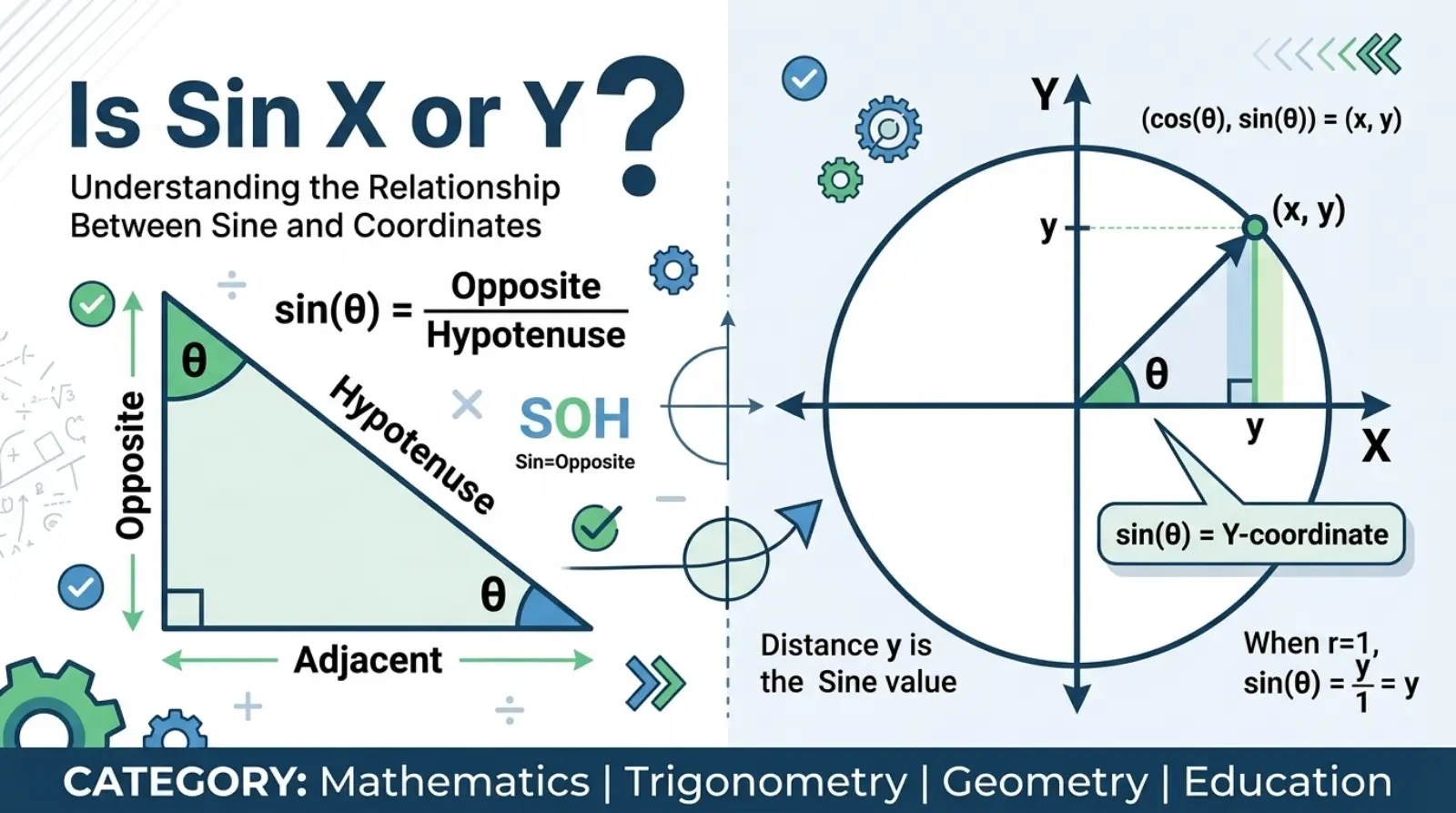
Is sin x or y? This is a common question for students learning trigonometry and graphing. The answer depends on how you use the sine function.
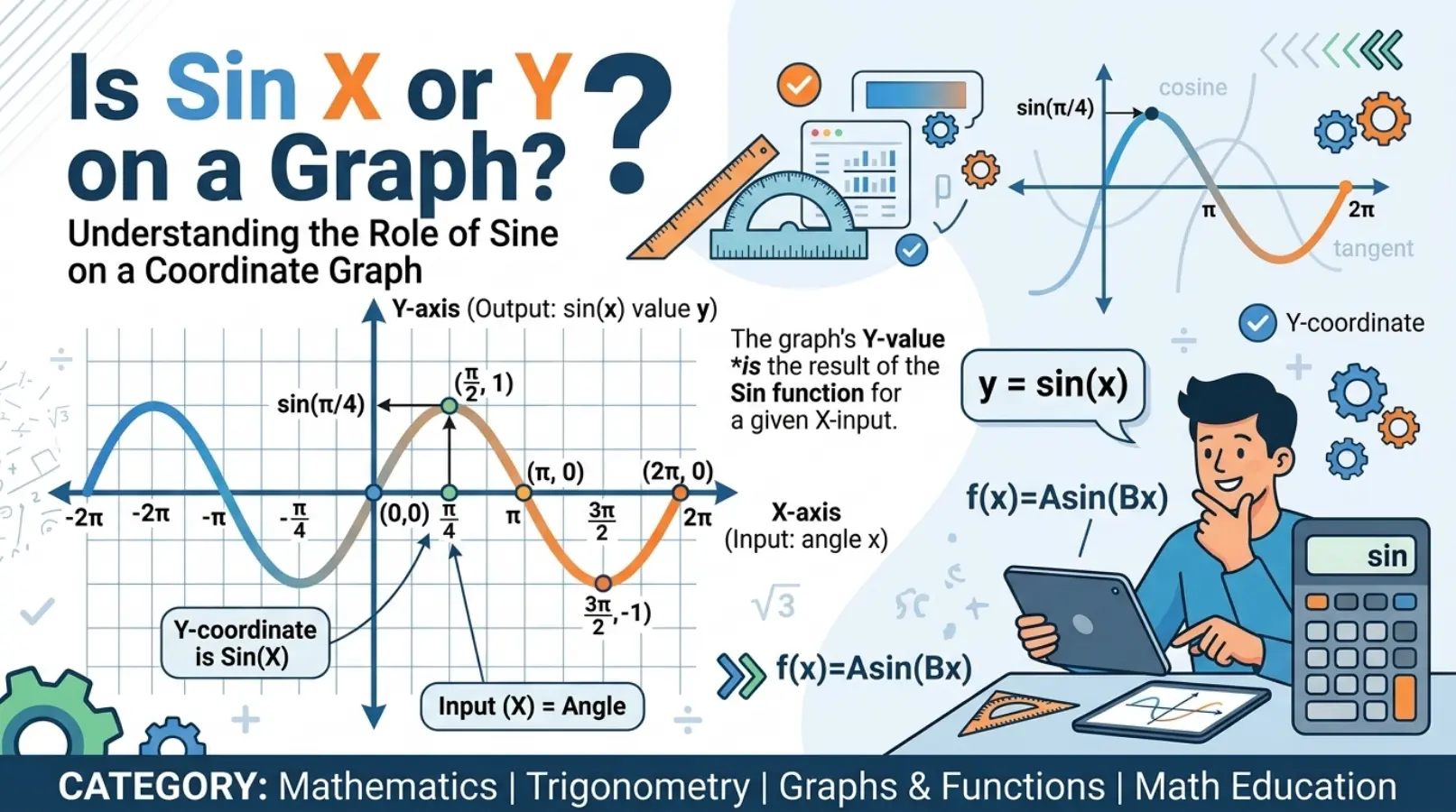
In a graph of y = sin(x), the sine function is the y-value. The variable x is the input, and sin(x) gives the output. Therefore, sine is usually represented by y on a graph.
Many learners get confused because sine comes from angles, triangles, and graphs. However, once you understand the relationship between x and y, the concept becomes much easier.
This guide explains everything in simple language. You will learn what sine means, how it works on graphs, common mistakes to avoid, and real-life examples that make the concept clear.
Quick Summary Box
- Sine is a trigonometric function.
- In the equation y = sin(x), sine is the y-value.
- x is the input or angle.
- sin(x) is the output.
- Sine describes a wave-like pattern.
- The graph of sine oscillates between -1 and 1.
- On a graph, x and y have different roles.
- Sine is not x itself; it is the result of applying the sine function to x.
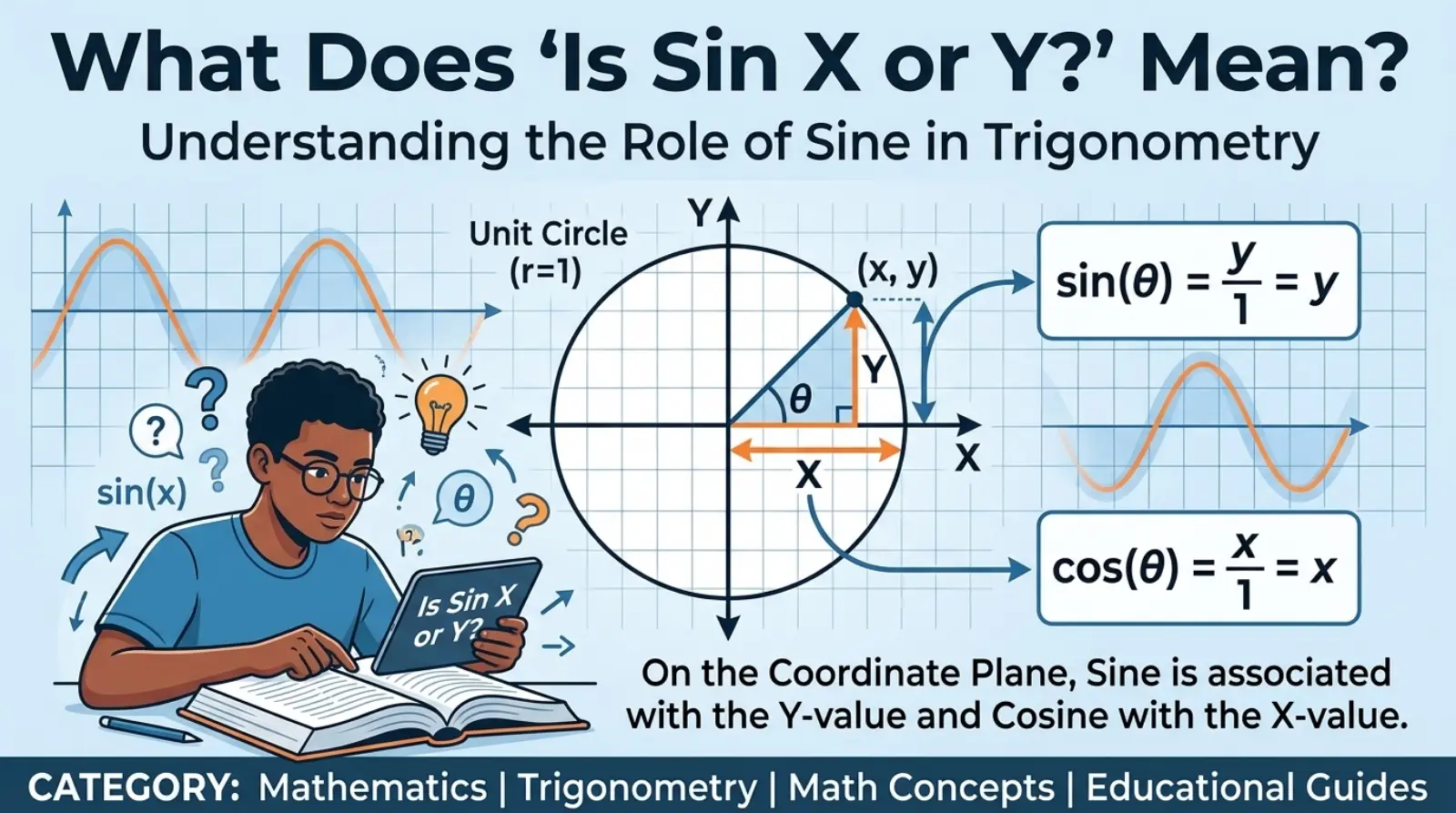
What Does “Is Sin X or Y?” Mean?
Many students see the equation:
y = sin(x)
Then they wonder:
- Is sine the x-value?
- Is sine the y-value?
- Is sine both?
The answer is simple.
In this equation:
- x = input
- sin(x) = function
- y = output
Since y equals sin(x), the sine value becomes the y-coordinate on the graph.
For example:
| x | sin(x) | y |
| 0° | 0 | 0 |
| 30° | 0.5 | 0.5 |
| 90° | 1 | 1 |
Here, the sine value and y-value are the same.
What Is Sine?
Sine is one of the main trigonometric functions.
In a right triangle:
sin(θ) = Opposite Side ÷ Hypotenuse
Where:
- θ (theta) is the angle
- Opposite side is across from the angle
- Hypotenuse is the longest side
Sine tells us the ratio between these two sides.
This ratio always falls between:
- -1 and 1
That is why the sine graph never goes above 1 or below -1.
Understanding Sine in Simple Words
Think of sine as a machine.
Input
You put an angle into the machine.
Example:
- 0°
- 30°
- 45°
- 90°
Output
The machine gives you a sine value.
Example:
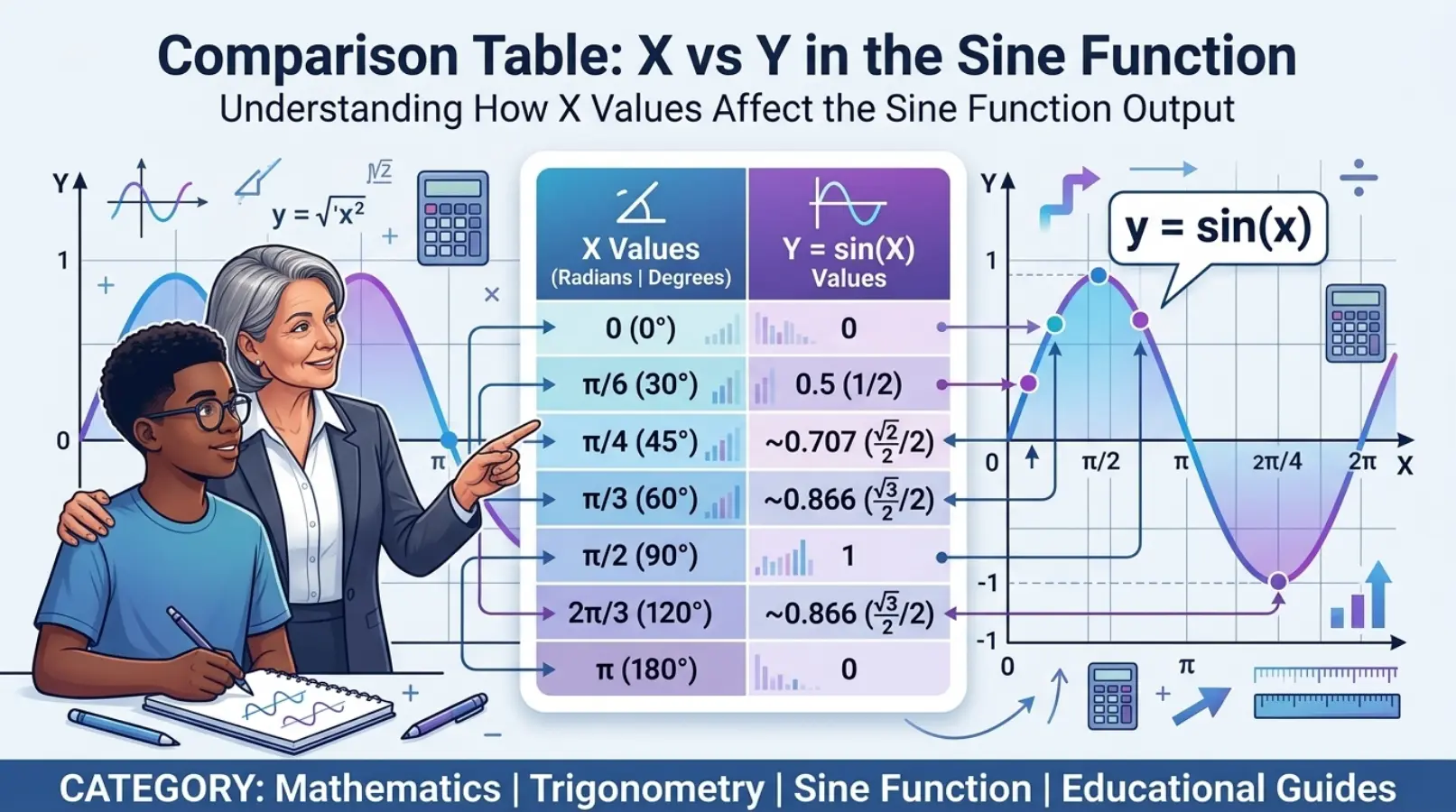
- sin(0°) = 0
- sin(30°) = 0.5
- sin(45°) ≈ 0.707
- sin(90°) = 1
The output becomes the y-value on the graph.
So, sine is generally represented by y, not x.
Is Sin X or Y on a Graph?
When graphing the sine function:
y = sin(x)
The graph works like this:
| Part | Meaning |
| x | Input angle |
| sin(x) | Function |
| y | Output value |
Therefore:
- x goes on the horizontal axis.
- y goes on the vertical axis.
- y equals sin(x).
This is the most common interpretation in mathematics.
Comparison Table: X vs Y in the Sine Function
| Feature | X | Y |
| Role | Input | Output |
| Axis | Horizontal | Vertical |
| Represents | Angle or value | Sine result |
| Changes first? | Yes | No |
| Formula | x | sin(x) |
| Example | 30° | 0.5 |
This comparison helps explain why sine is usually associated with y.
How the Sine Graph Works
The sine graph forms a smooth wave.
Important points include:
| x | y = sin(x) |
| 0° | 0 |
| 90° | 1 |
| 180° | 0 |
| 270° | -1 |
| 360° | 0 |
As x increases:
- y rises to 1.
- y falls back to 0.
- y drops to -1.
- y returns to 0.
Then the pattern repeats.
This repeating behavior is called a periodic function.
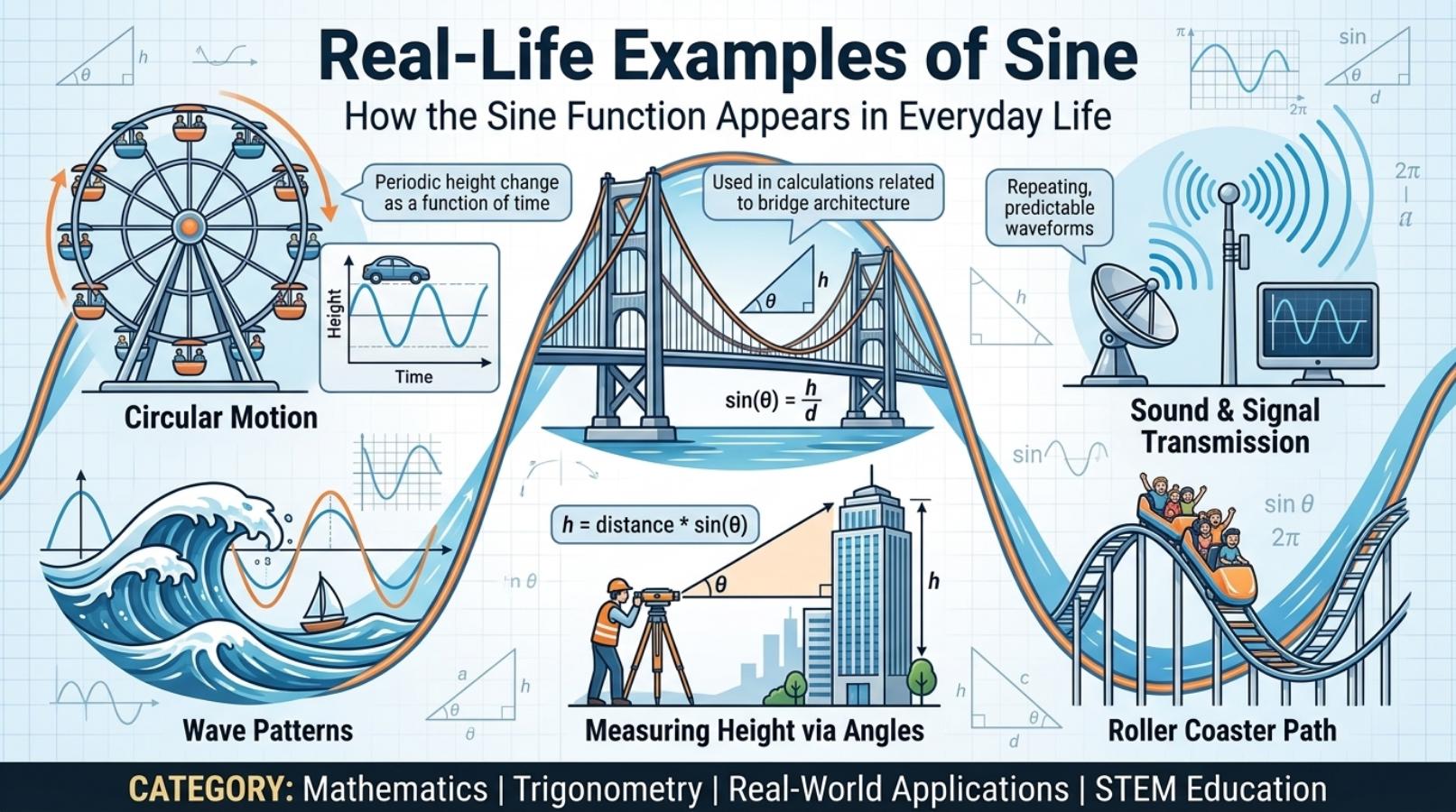
Real-Life Examples of Sine
Sine appears in many real-world situations.
Ocean Waves
Wave height changes smoothly over time.
Scientists often model waves using sine functions.
Sound Waves
Music and sound vibrations follow sine wave patterns.
Ferris Wheels
The height of a rider changes like a sine graph.
Electricity
Alternating current (AC) uses sine waves.
Engineering
Engineers use sine functions to analyze motion and vibration.
These examples show why understanding sine matters.
Why Students Get Confused About Sin X and Y
Several reasons cause confusion.
Mixing Variables and Functions
Students sometimes think sin(x) is another variable.
It is actually a function.
Triangle vs Graph Concepts
In triangles:
- Sine is a ratio.
In graphs:
- Sine becomes a y-value.
Ignoring the Equation
Many learners forget that:
y = sin(x)
The equation clearly shows the relationship.
Common Mistakes to Avoid
Mistake 1: Thinking Sin Equals X
Wrong:
- sin(x) = x
Correct:
- sin(x) is calculated from x.
Mistake 2: Mixing Up Axes
Wrong:
- Putting sine values on the x-axis.
Correct:
- Put sine values on the y-axis.
Mistake 3: Forgetting Input and Output
Remember:
- x is input.
- y is output.
Mistake 4: Confusing Degrees and Radians
Many graphs use radians.
Check which unit your problem uses.
Easy Tips to Remember
Tip 1: Think of a Function Machine
Input x.
Get output y.
Tip 2: Read the Equation Carefully
If:
y = sin(x)
Then y is the sine value.
Tip 3: Remember Graph Axes
- Horizontal = x
- Vertical = y
Tip 4: Practice with Simple Angles
Start with:
- 0°
- 30°
- 45°
- 60°
- 90°
These are easy to memorize.
Using Sine in Daily Life
Many people use sine without realizing it.
Architects
They design structures with accurate angles.
Pilots
They calculate positions and directions.
Surveyors
They measure land distances.
Engineers
They analyze movement and forces.
Scientists
They study waves and vibrations.
Sine helps solve practical problems every day.
Expert Insights: Why Understanding Sine Matters
Understanding sine builds a strong math foundation.
Students who understand sine often learn:
- Cosine
- Tangent
- Calculus
- Physics
more easily.
Knowing that sin(x) becomes y on a graph removes confusion and improves graph-reading skills.
Math experts recommend focusing on:
- Input versus output
- Function relationships
- Visual graph interpretation
These skills support success in higher mathematics.
Frequently Asked Questions (FAQs)
Is sin(x) the x-value or y-value?
In the equation y = sin(x), sin(x) is the y-value.
What does x represent in sin(x)?
x is the input, usually an angle.
Why is sine plotted on the y-axis?
Because the graph uses the equation y = sin(x).
Can sine be greater than 1?
No. Sine always stays between -1 and 1.
What is the formula for sine?
sin(θ) = Opposite ÷ Hypotenuse
Is sin(x) a function?
Yes. It takes an input and produces an output.
Does sine repeat?
Yes. The sine graph repeats in regular cycles.
Is sine used in real life?
Yes. It is used in physics, engineering, sound, electricity, and wave analysis.
Conclusion
So, is sin x or y? In graphing, the answer is usually y. The variable x serves as the input, while sin(x) gives the output. Since y = sin(x), the sine value becomes the y-coordinate on the graph.
Understanding this relationship makes trigonometry much easier. It helps you read graphs, solve equations, and understand real-world applications of sine waves. Remember the simple rule: x goes into the sine function, and y comes out. Once you keep input and output separate, the confusion disappears.
Whether you are studying basic trigonometry or advanced mathematics, knowing how sine relates to x and y is an essential skill that will help you build a stronger understanding of mathematical functions.