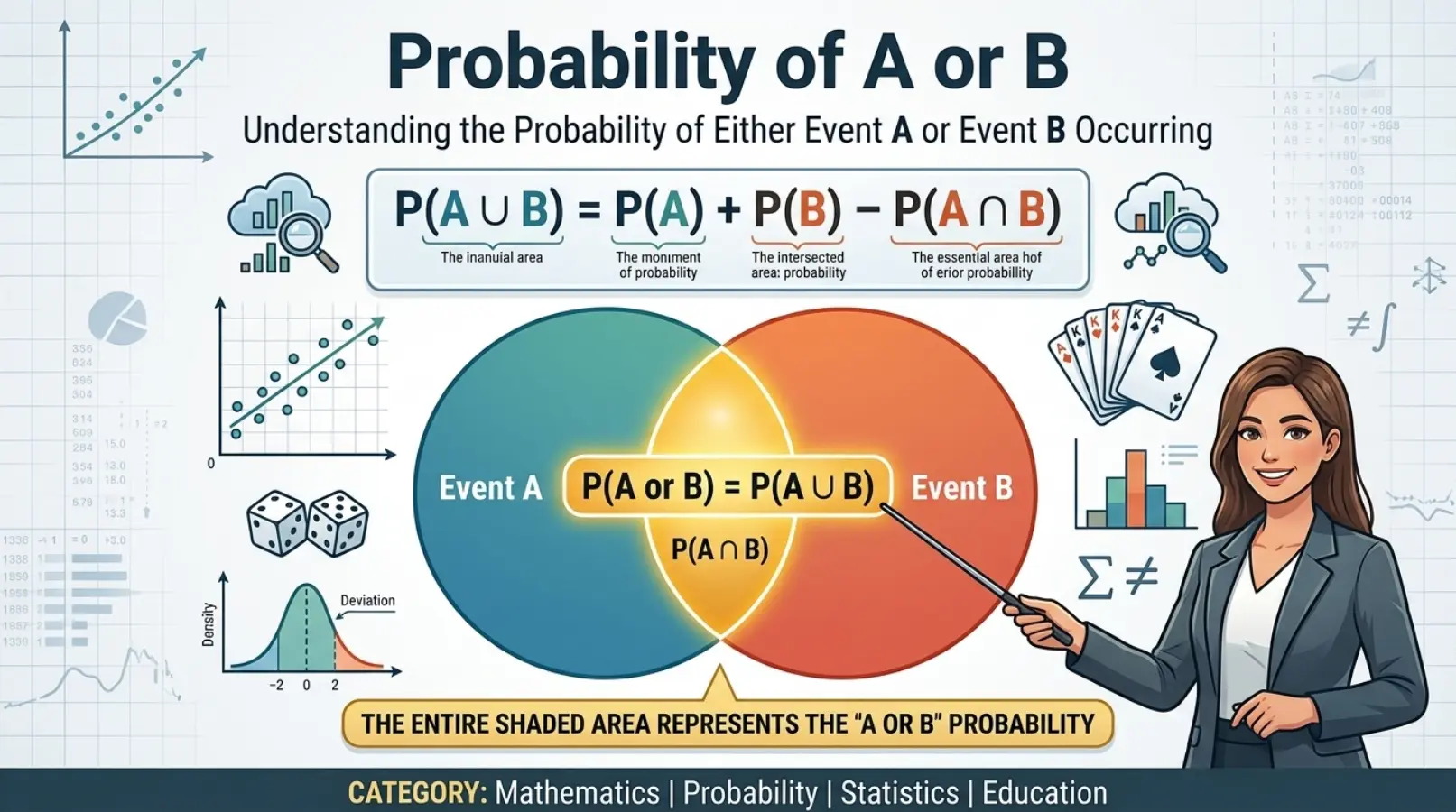
Probability of a or b is a common concept in mathematics and statistics. It helps us find the chance that one event or another event will happen.
You may use this idea when tossing coins, rolling dice, or making everyday decisions. Understanding it makes probability much easier.
Many students get confused about when to add probabilities and when to subtract them. However, the rule becomes simple once you learn the formula.
In this guide, you will learn the meaning of probability of a or b, the formula, real-life examples, common mistakes, and expert tips. By the end, you will know exactly how to solve these probability questions with confidence.
Quick Summary Box
- Probability measures the chance of an event occurring.
- “A or B” means either event A, event B, or both.
- Formula: P(A or B) = P(A) + P(B) − P(A and B)
- Subtract the overlap to avoid double counting.
- Used in mathematics, statistics, business, and everyday life.
- Helps calculate the likelihood of multiple possible outcomes.
- Important for exams and real-world decision-making.
What Does Probability of a or b Mean?
Probability of a or b refers to the chance that event A happens, event B happens, or both happen.
The word “or” in probability is inclusive. This means it includes situations where both events occur together.
Example
Suppose:
- Event A = Drawing a red card
- Event B = Drawing a king
The probability of A or B includes:
- Any red card
- Any king
- The red kings
Therefore, we count all favorable outcomes but avoid counting the red kings twice.
Probability of a or b Formula
The standard formula is:
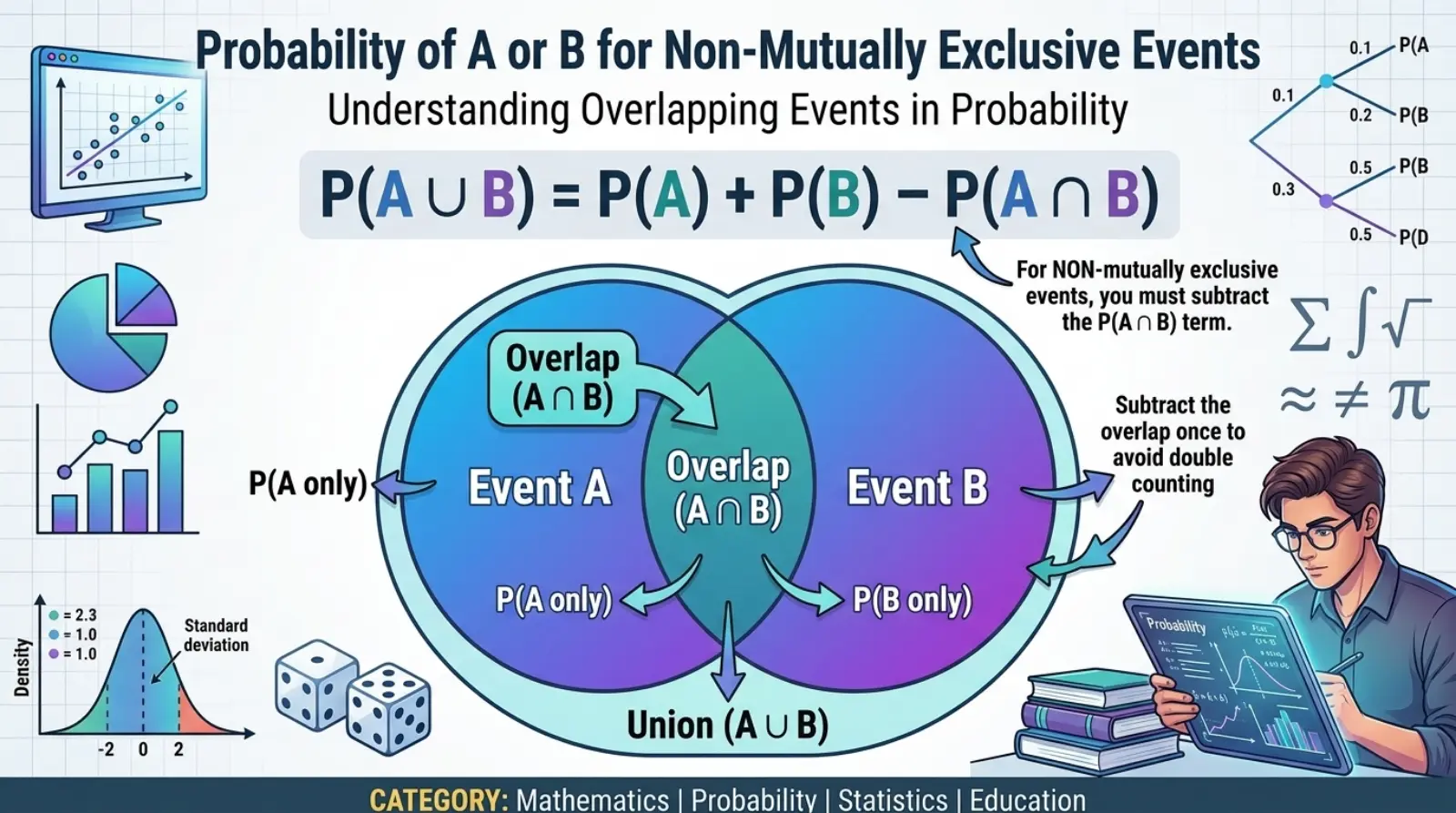
P(A or B) = P(A) + P(B) − P(A and B)
Where:
- P(A) = Probability of event A
- P(B) = Probability of event B
- P(A and B) = Probability both events happen
Why Do We Subtract?
When we add P(A) and P(B), overlapping outcomes get counted twice.
Subtracting P(A and B) fixes this problem.
Featured Snippet Formula
Probability of A or B Formula:
P(A or B) = P(A) + P(B) − P(A and B)
This formula calculates the probability that either event A, event B, or both events occur.
Understanding the Formula in Simple Words
Think about two circles that overlap.
- One circle represents event A.
- The other circle represents event B.
- The overlapping area represents both events.
When adding both circles, the overlap gets counted twice.
Therefore, we subtract the overlap once.
This gives the correct answer.
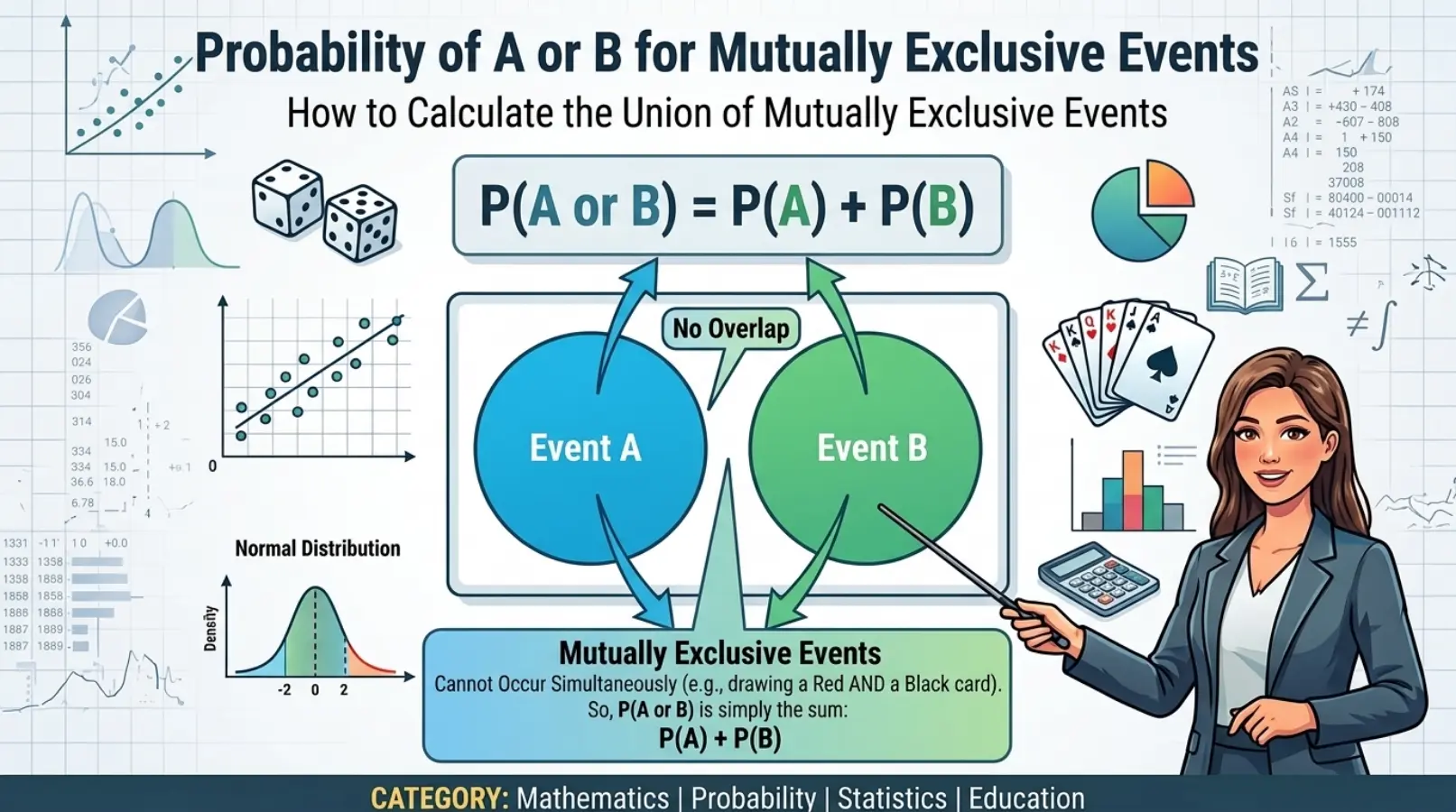
Probability of a or b for Mutually Exclusive Events
Mutually exclusive events cannot happen together.
In this case:
P(A and B) = 0
So the formula becomes:
P(A or B) = P(A) + P(B)
Example
Rolling a die:
- Event A = Rolling a 2
- Event B = Rolling a 5
These events cannot happen at the same time.
Therefore:
P(A) = 1/6
P(B) = 1/6
P(A or ) = 1/6 + 1/6
= 2/6
= 1/3
Probability of a or b for Non-Mutually Exclusive Events
Some events can happen together.
These are called non-mutually exclusive events.
Example
Drawing one card from a deck:
- Event A = Red card
- Event B = King
There are:
- 26 red cards
- 4 kings
- 2 red kings
Formula:
P(A or B)
= 26/52 + 4/52 − 2/52
= 28/52
Therefore, the probability is 7/13.
Real-Life Examples of Probability of a or b
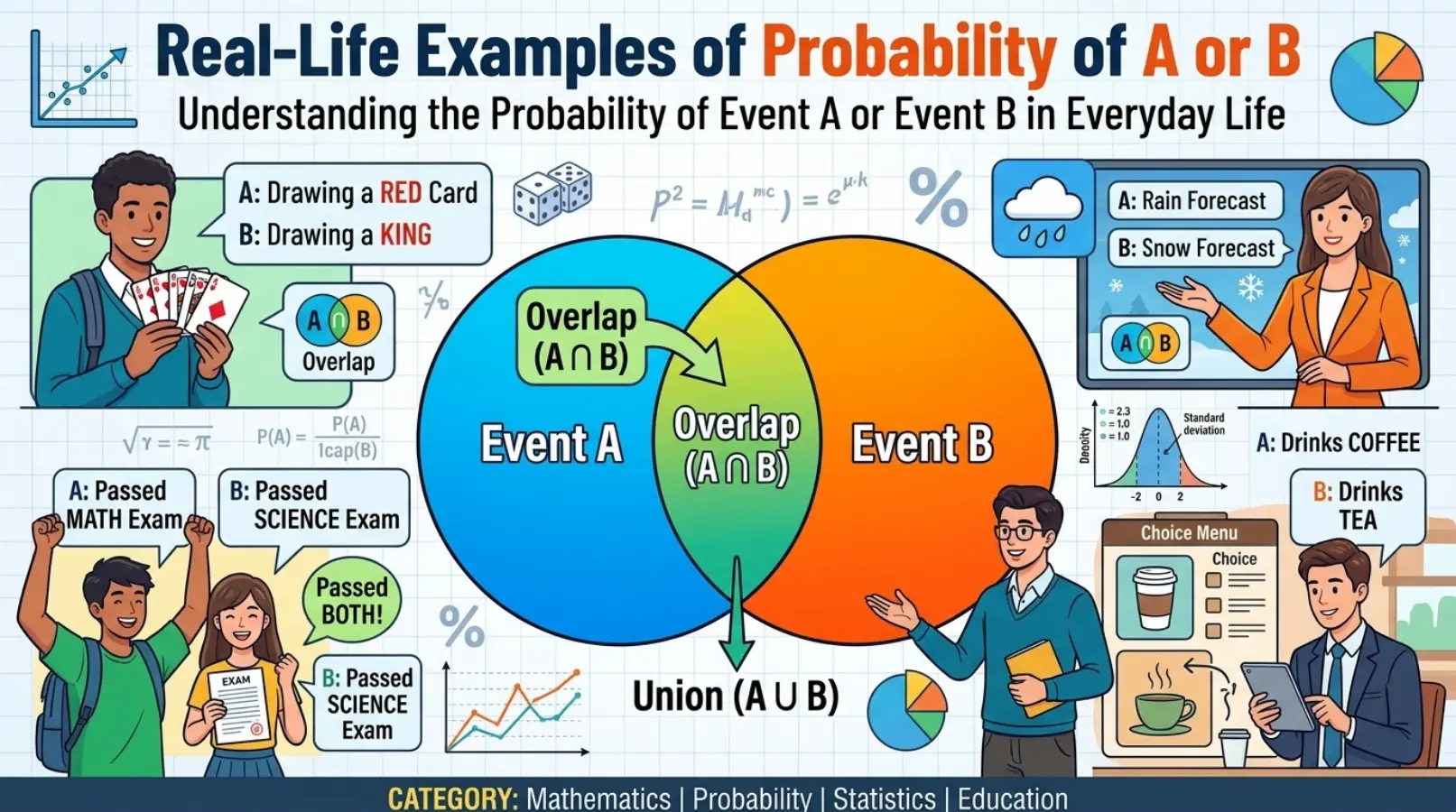
Probability appears everywhere.
Weather Forecast
- A = Rain in the morning
- B = Rain in the evening
You may want the chance of rain occurring at either time.
Sports
- A = Team scores in first half
- B = Team scores in second half
Analysts calculate the chance of scoring in either half.
Business
- A = Customer buys Product A
- B = Customer buys Product B
Companies estimate purchase probabilities.
Healthcare
- A = Patient has symptom A
- B = Patient has symptom B
Doctors use probabilities for diagnosis support.
Step-by-Step Example Problems
Example 1: Rolling a Die
Find the probability of rolling an even number or a number greater than 4.
Event A = Even number
{2, 4, 6}
P(A) = 3/6
Event B = Greater than 4
{5, 6}
P(B) = 2/6
Overlap:
{6}
P(A and B) = 1/6
Apply formula:
P(A or B)
= 3/6 + 2/6 − 1/6
= 4/6
Answer: 2/3
Example 2: Drawing Cards
Event A = Ace
Event B = Heart
P(A) = 4/52
P(B) = 13/52
Overlap:
Ace of Hearts
P(A and B) = 1/52
Formula:
P(A or B)
= 4/52 + 13/52 − 1/52
= 16/52
Answer: 4/13
Probability of a or b vs Probability of a and b
Many students confuse these concepts.
Comparison Table
| Feature | Probability of A or B | Probability of A and B |
| Meaning | At least one event occurs | Both events occur |
| Keyword | Or | And |
| Formula | P(A)+P(B)-P(A and B) | Depends on event relationship |
| Includes overlap | Yes | Only overlap |
| Result | Usually larger | Usually smaller |
| Common use | Multiple possible outcomes | Simultaneous outcomes |
Quick Example
- A = Getting a red card
- B = Getting a king
“A or B” counts all red cards and kings.
“A and B” counts only red kings.
Common Mistakes When Calculating Probability of a or b
1. Forgetting the Overlap
Many people simply add probabilities.
This often produces an incorrect answer.
2. Confusing “Or” With “And”
“Or” means at least one event occurs.
“And” means both events occur.
3. Using Wrong Total Outcomes
Always use the correct sample space.
4. Ignoring Mutually Exclusive Rules
Check whether events can happen together.
5. Simplifying Fractions Incorrectly
Reduce fractions carefully.
Easy Tips and Tricks
Draw a Venn Diagram
Visual diagrams help identify overlaps.
Highlight Shared Outcomes
Find common outcomes before calculating.
Memorize the Formula
Remember:
Add, then subtract overlap.
Check Your Answer
Probability must stay between 0 and 1.
Practice Often
More examples improve understanding quickly.
How Probability of a or b Is Used in Daily Life
Many people use probability without realizing it.
Shopping Decisions
Stores estimate customer choices.
Insurance
Companies calculate risk levels.
Weather Predictions
Meteorologists forecast possible conditions.
Medical Research
Researchers study disease probabilities.
Financial Planning
Investors evaluate possible outcomes.
Understanding probability helps make smarter decisions.
Expert Insights: Why This Concept Matters
Probability forms the foundation of statistics.
Students learn it early because it supports advanced topics later.
Understanding the probability of a or b helps with:
- Data analysis
- Research studies
- Risk management
- Business forecasting
- Scientific experiments
Experts recommend focusing on the relationship between events before using formulas.
Once you identify overlap correctly, most probability questions become much easier.
Frequently Asked Questions (FAQs)
What is the formula for probability of a or b?
The formula is:
P(A or B) = P(A) + P(B) − P(A and B)
Why do we subtract P(A and B)?
We subtract it because overlapping outcomes get counted twice.
What does “or” mean in probability?
It means event A occurs, event B occurs, or both occur.
When can I simply add probabilities?
You can simply add them when events are mutually exclusive.
What is the difference between “or” and “and”?
“Or” means at least one event occurs.
“And” means both events occur together.
Can probability be greater than 1?
No. Probability always stays between 0 and 1.
What are mutually exclusive events?
They are events that cannot happen at the same time.
Where is probability used in real life?
It is used in business, sports, healthcare, weather forecasting, insurance, and finance.
Conclusion
The probability of a or b helps calculate the chance that one event, another event, or both events occur. The key formula is P(A or B) = P(A) + P(B) − P(A and B). This formula prevents double counting by subtracting overlapping outcomes.
Understanding this concept makes probability questions much easier. It also builds a strong foundation for statistics, data analysis, and real-world decision-making. Whether you are solving math problems, analyzing business risks, or studying scientific data, the probability of a or b plays an important role.
Remember one simple rule: add the probabilities, then subtract the overlap. With practice, you can solve these questions quickly and accurately.