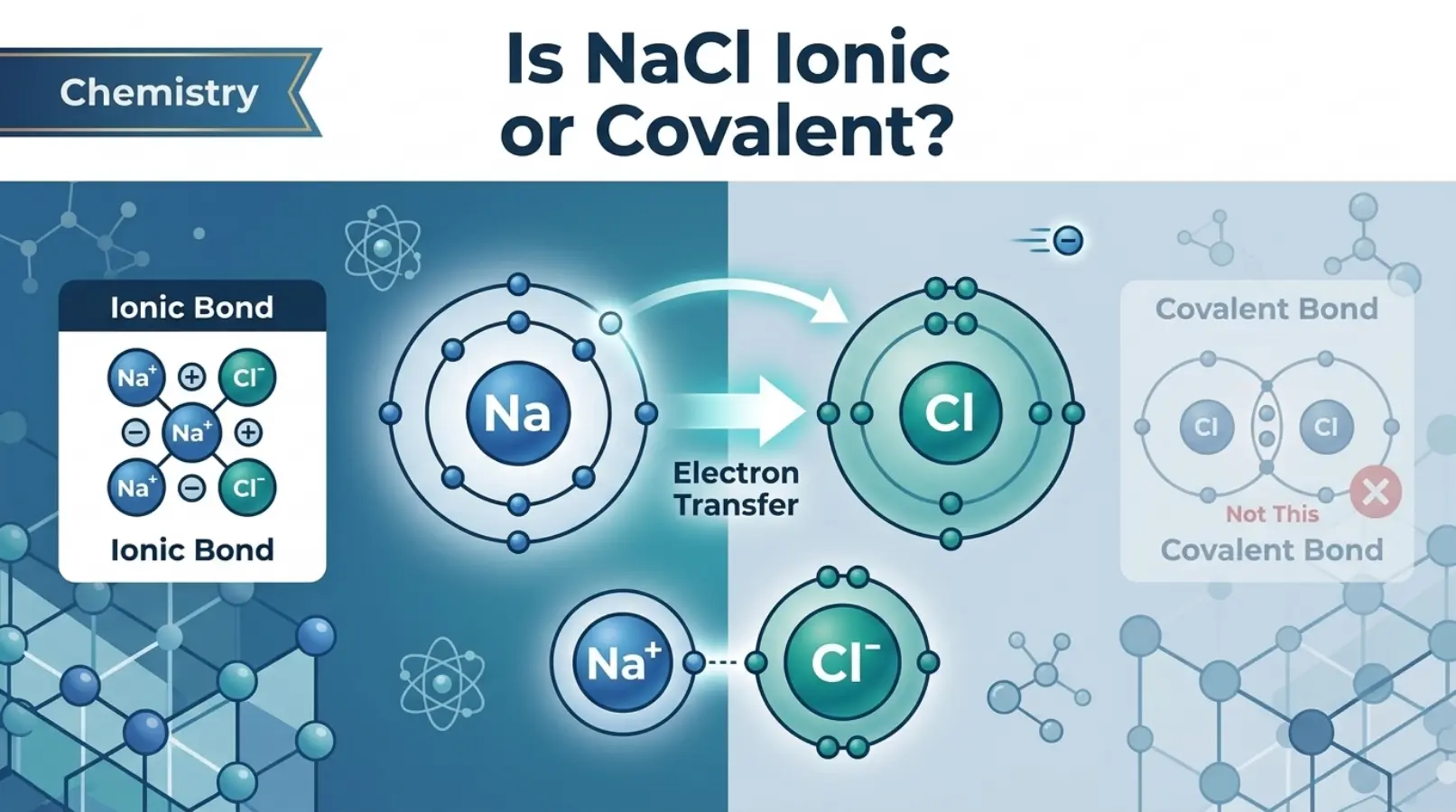
Is NaCl ionic or covalent? The simple answer is that NaCl is an ionic compound. Sodium chloride forms when sodium transfers one electron to chlorine. This creates two charged particles called ions. These ions attract each other with a strong electrical force.
Many students confuse ionic and covalent bonds because both join atoms together. However, they form in different ways. Understanding this difference helps you learn chemistry faster. It also makes topics like chemical reactions and bonding much easier.
In this guide, you will learn why NaCl is ionic, how the bond forms, and how it compares with covalent compounds. You will also see real-life examples, common mistakes, and expert tips that make this topic easy to understand.
Quick Summary Box
- NaCl stands for sodium chloride.
- NaCl is an ionic compound.
- Sodium loses one electron.
- Chlorine gains one electron.
- The electron transfer creates oppositely charged ions.
- Positive and negative ions attract each other.
- Ionic bonds are stronger than many covalent bonds.
- Table salt is the most common example of an ionic compound.
What Is NaCl?
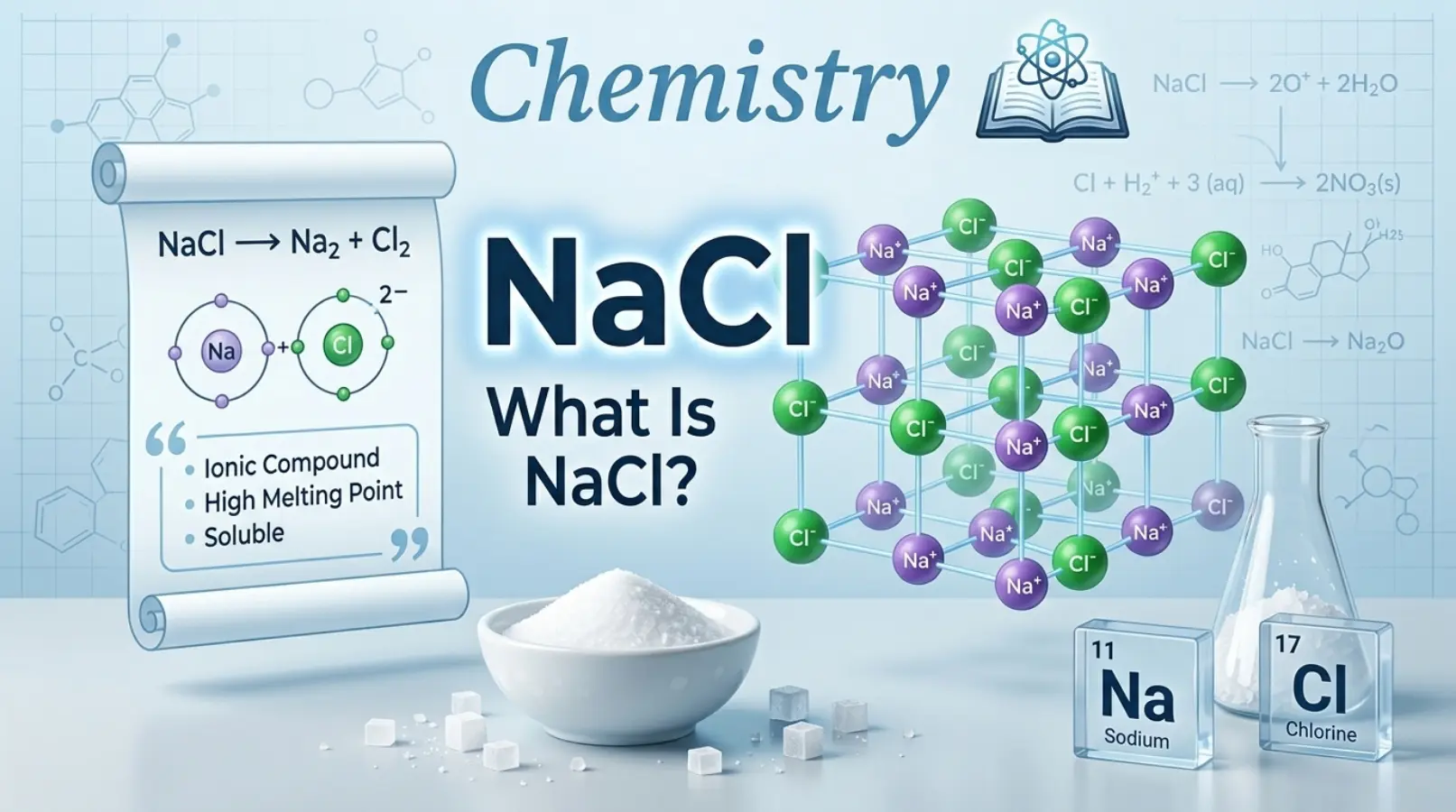
NaCl is the chemical formula for sodium chloride, also known as table salt.
It contains:
- One sodium (Na) atom
- One chlorine (Cl) atom
Sodium belongs to Group 1 of the periodic table. It has one valence electron.
Chlorine belongs to Group 17. It needs one electron to complete its outer shell.
This difference allows sodium and chlorine to form a stable ionic bond.
Is NaCl Ionic or Covalent?
The direct answer is:
NaCl is an ionic compound because sodium transfers one electron to chlorine.
After the electron transfer:
- Sodium becomes Na⁺
- Chlorine becomes Cl⁻
These charged ions attract each other.
This attraction creates an ionic bond.
Unlike covalent compounds, NaCl does not share electrons.
What Is an Ionic Bond?
An ionic bond forms when one atom gives electrons to another atom.
Instead of sharing electrons, the atoms become ions.
Simple steps
- Sodium loses one electron.
- Chlorine gains that electron.
- Sodium becomes positively charged.
- Chlorine becomes negatively charged.
- Opposite charges attract.
- An ionic compound forms.
This process makes both atoms more stable.
How Does NaCl Form?
Here is the bonding process.
Step 1
Sodium has one outer electron.
Na → Na⁺ + e⁻
Step 2
Chlorine needs one electron.
Cl + e⁻ → Cl⁻
Step 3
The ions attract each other.
Na⁺ + Cl⁻ → NaCl
The final compound is electrically neutral because the charges balance.
Why Is NaCl Ionic Instead of Covalent?
The main reason is electron transfer.
Covalent compounds share electrons.
NaCl transfers electrons instead.
Here are the reasons:
- Sodium easily loses one electron.
- Chlorine easily gains one electron.
- Large electronegativity difference exists.
- Opposite charges attract strongly.
- The result is an ionic crystal.
This makes NaCl an ionic compound rather than a covalent molecule.
Ionic vs Covalent Bond Comparison
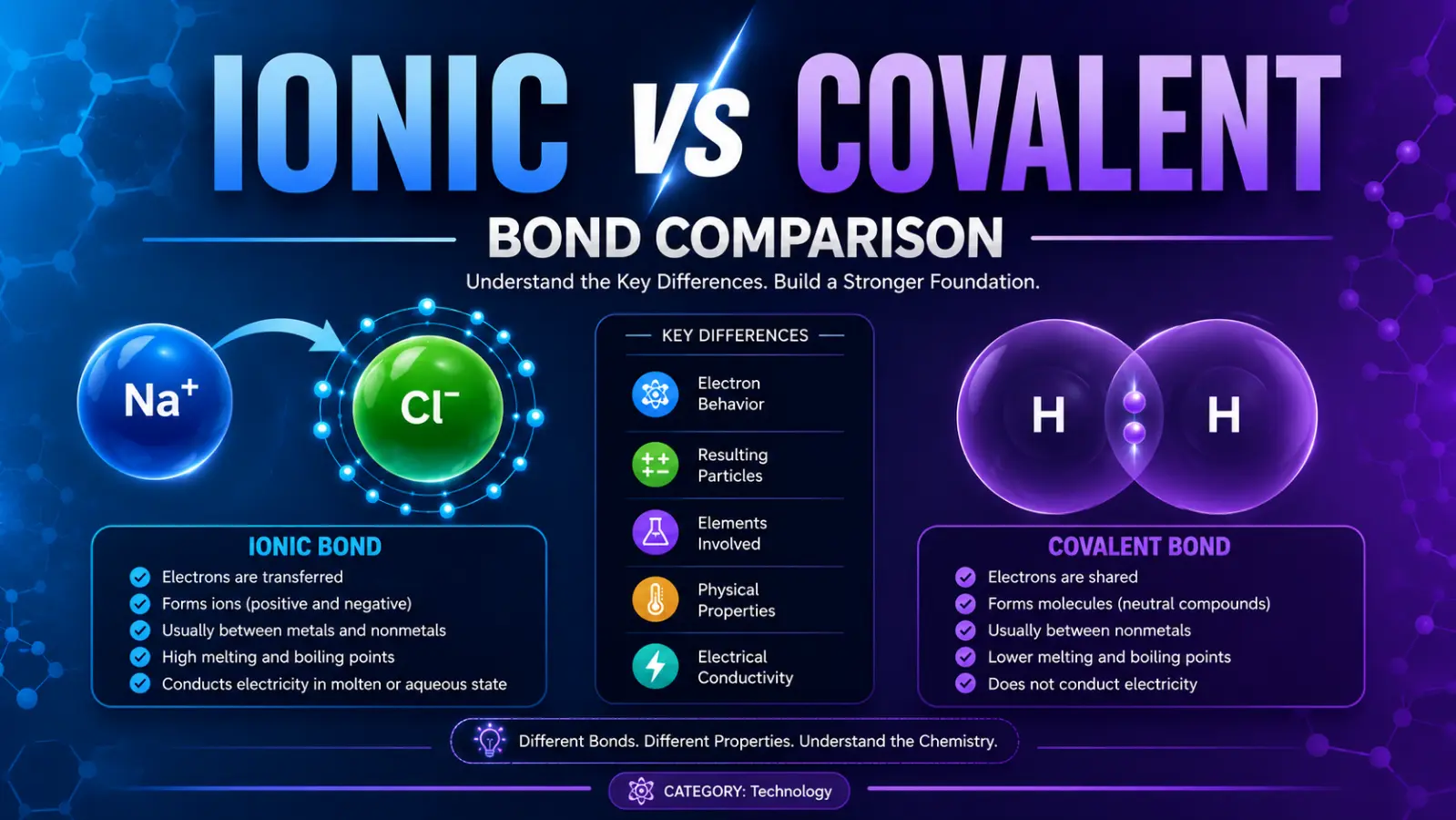
| Feature | Ionic Bond (NaCl) | Covalent Bond (H₂O, CO₂) |
| Electron behavior | Transfer | Sharing |
| Elements involved | Metal + Nonmetal | Nonmetal + Nonmetal |
| Particles formed | Ions | Molecules |
| Electrical conductivity | Conducts when melted or dissolved | Usually does not conduct |
| Melting point | High | Usually lower |
| Crystal structure | Yes | Usually no crystal lattice |
| Example | NaCl | H₂O, CH₄, CO₂ |
Electron Configuration of Na and Cl
Understanding electron configuration makes bonding easier.
Sodium (Na)
Electron configuration:
2, 8, 1
It wants to lose one electron.
After losing:
2, 8
Now sodium becomes stable.
Chlorine (Cl)
Electron configuration:
2, 8, 7
It needs one electron.
After gaining:
2, 8, 8
Now chlorine also becomes stable.
Both atoms achieve a complete outer shell.
Properties of NaCl That Show It Is Ionic
Several properties prove NaCl is ionic.
High melting point
NaCl melts at about 801°C.
Strong ionic forces require lots of heat.
Crystal structure
NaCl forms a regular crystal lattice.
Each sodium ion surrounds chloride ions.
Conducts electricity
Solid NaCl does not conduct electricity.
However, molten NaCl and saltwater conduct electricity because ions can move.
Water solubility
NaCl dissolves easily in water.
Water separates the ions.
This is another sign of an ionic compound.
Real-Life Examples of Ionic Compounds
NaCl is not the only ionic compound.
Here are common examples.
| Compound | Common Name | Use |
| NaCl | Table salt | Cooking |
| KCl | Potassium chloride | Fertilizer |
| MgO | Magnesium oxide | Medicine |
| CaCl₂ | Calcium chloride | Road de-icing |
| NaF | Sodium fluoride | Toothpaste |
| LiF | Lithium fluoride | Batteries |
These compounds all contain positive and negative ions.
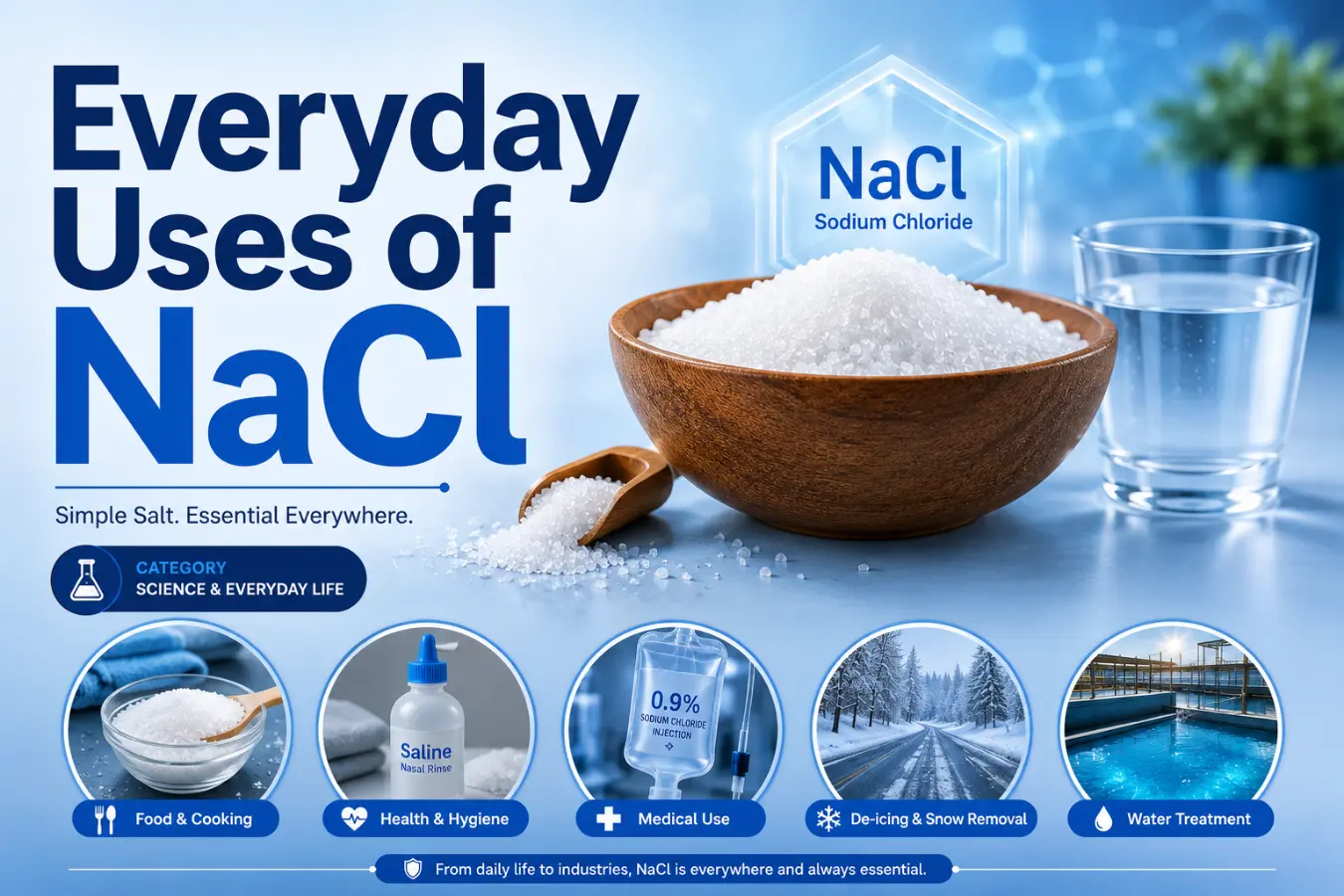
Everyday Uses of NaCl
You see sodium chloride almost every day.
Cooking
It improves food flavor.
Food preservation
Salt slows bacterial growth.
Medical saline
Doctors use saline solutions for hydration.
Water softening
Salt helps remove hard minerals.
Chemical industry
NaCl helps produce chlorine and sodium hydroxide.
Common Mistakes Students Make
Many learners confuse ionic and covalent bonding.
Avoid these mistakes.
Mistake 1
Thinking all chemical compounds are molecules.
Correct: Ionic compounds form crystal lattices.
Mistake 2
Believing NaCl shares electrons.
Correct: Sodium transfers an electron.
Mistake 3
Thinking ionic compounds cannot dissolve.
Correct: Many ionic compounds dissolve well in water.
Mistake 4
Assuming solid NaCl conducts electricity.
Correct: Only molten or dissolved NaCl conducts.
Mistake 5
Ignoring electronegativity difference.
Large differences usually indicate ionic bonding.
Easy Trick to Identify Ionic Compounds
Use these simple rules.
Metal + Nonmetal = Usually Ionic
Nonmetal + Nonmetal = Usually Covalent
Examples:
- NaCl → Ionic
- MgO → Ionic
- KBr → Ionic
- H₂O → Covalent
- CO₂ → Covalent
- CH₄ → Covalent
This shortcut works for most beginner chemistry questions.
Expert Insights: Why Understanding NaCl Bonding Matters
Chemistry experts recommend learning why bonds form instead of memorizing them.
When you understand electron transfer, many chemistry topics become easier.
This knowledge helps with:
- Chemical reactions
- Periodic table trends
- Electrolysis
- Solubility
- Acids and bases
- Materials science
Students who understand bonding often perform better in chemistry exams.
Frequently Asked Questions (FAQs)
Is NaCl ionic or covalent?
NaCl is an ionic compound because sodium transfers one electron to chlorine.
Why is NaCl not covalent?
Covalent compounds share electrons. NaCl transfers electrons instead.
Does NaCl contain ions?
Yes. It contains Na⁺ and Cl⁻ ions.
Does NaCl conduct electricity?
Solid NaCl does not conduct electricity.
Molten or dissolved NaCl conducts electricity.
Is table salt an ionic compound?
Yes. Table salt is sodium chloride, which is ionic.
Why does sodium lose an electron?
It becomes more stable after reaching a full outer shell.
Why does chlorine gain an electron?
It completes its outer electron shell and becomes stable.
What is another example of an ionic compound?
Potassium chloride (KCl), magnesium oxide (MgO), and calcium chloride (CaCl₂) are ionic compounds.
Conclusion
If you have ever wondered, is NaCl ionic or covalent, the answer is clear. NaCl is an ionic compound. Sodium transfers one electron to chlorine, creating positive and negative ions. These ions attract each other and form a strong ionic bond. This process differs from covalent bonding, where atoms share electrons. Understanding this concept helps explain why table salt has a high melting point, dissolves in water, and conducts electricity when melted or dissolved. Once you learn the difference between electron transfer and electron sharing, identifying ionic and covalent compounds becomes much easier. Remember this simple rule: metal plus nonmetal usually forms an ionic compound, just like sodium chloride.
Discover More Post:
To Late or Too Late? Which Is Correct? Explained with Examples