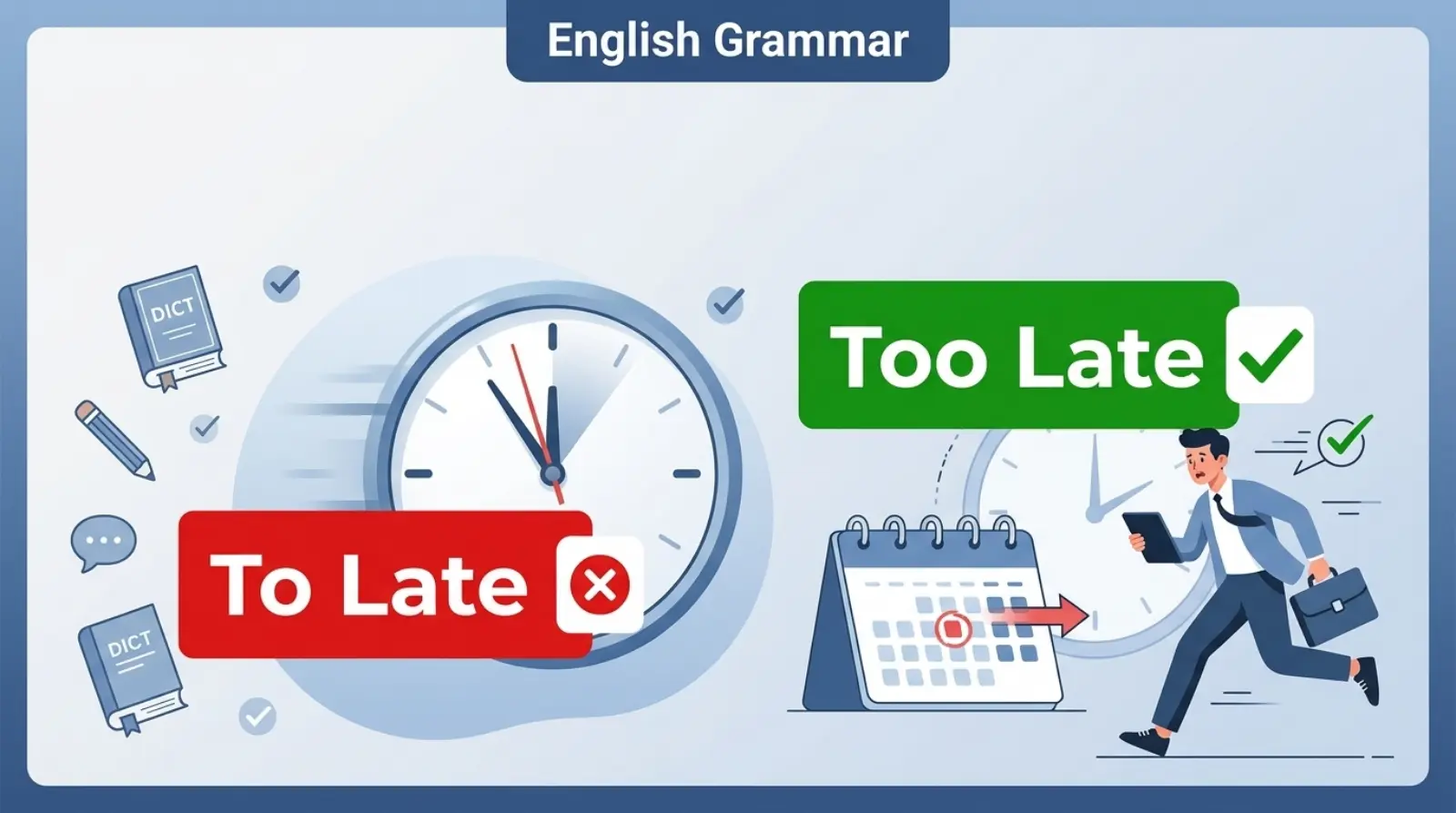
To late or too late is a common grammar question. Many people type to late by mistake. The correct phrase is too late in almost every case. This small spelling difference can change your writing quality.
English has many words that sound the same but have different meanings. To, too, and two are classic examples. Learning the difference helps you write clearly and avoid common mistakes.
In this guide, you will learn the meaning of too late, why to late is incorrect, and how to use the phrase with confidence. You will also see simple examples, a comparison table, common mistakes, expert tips, and answers to popular questions.
Quick Summary Box
- Correct phrase: Too late
- Incorrect phrase: To late
- Too means also or more than needed.
- To is a preposition or part of an infinitive verb.
- Use too late when something happens after the right time.
- Example: We arrived too late to catch the train.
What Does “Too Late” Mean?
It means something happens after the right or expected time. It describes a missed opportunity or a delay.
Simple Definition
It means an action happened after it should have happened.
Examples
- We were too late for the movie.
- The store closed because we came too late.
Is It “To Late” or “Too Late”?
The correct phrase is too late.
The phrase to late is almost always a spelling mistake.
| Phrase | Correct? | Meaning |
| Too late | Yes | After the proper time |
| To late | No | Incorrect grammar |
Whenever you want to say something happened after the right time, use too late.
Why Is “To Late” Incorrect?
The word to does not mean “more than enough” or “after the right time.”
“To” Has Different Jobs
It can show:
- Direction
- Destination
- Purpose
- Part of an infinitive verb
Examples:
- Go to school.
- Give it to me.
- I want to sleep.
- Walk to the park.
Notice that none of these examples mean “after the right time.”
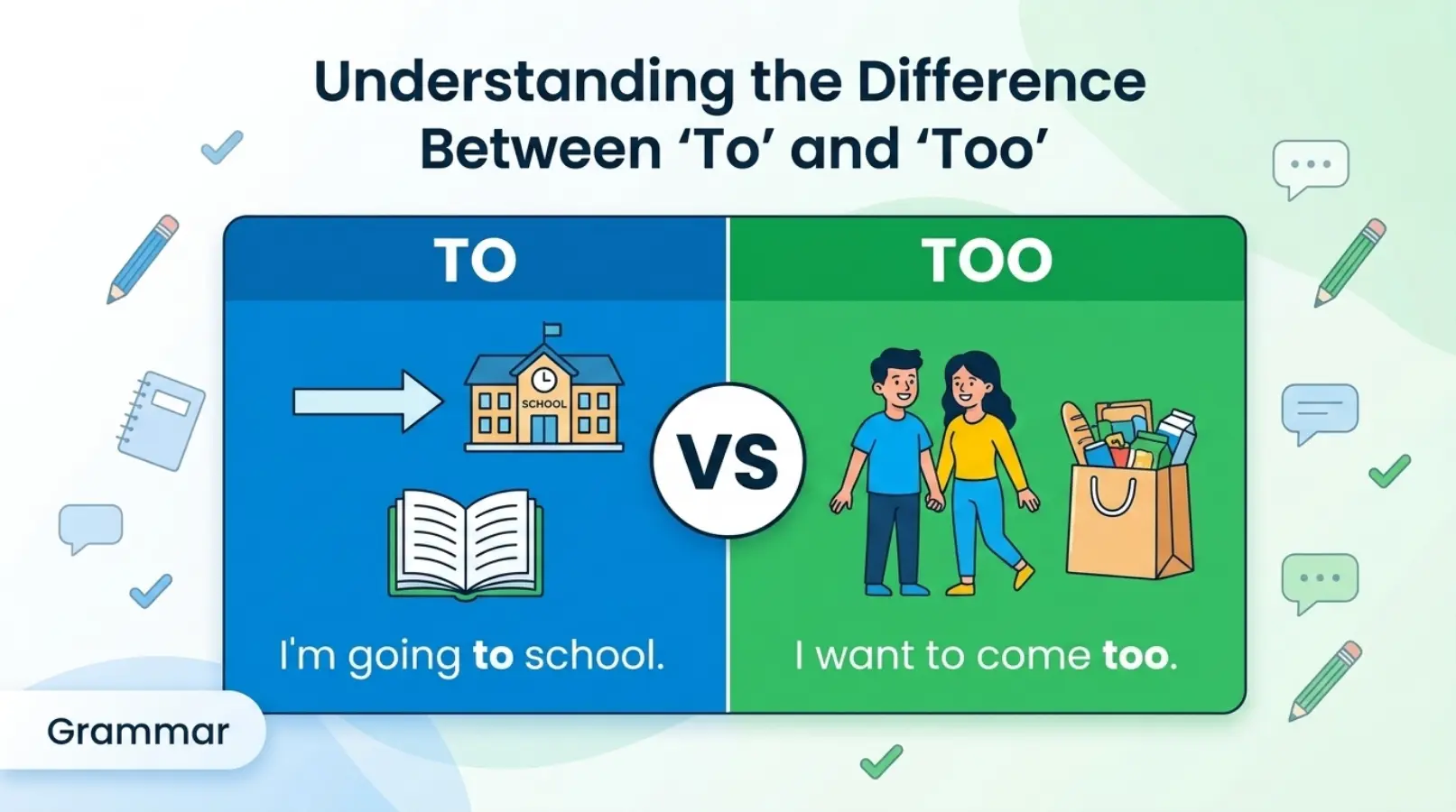
Understanding the Difference Between “To” and “Too”
Many English learners confuse these words because they sound the same.
| Word | Meaning | Example |
| To | Shows direction or forms infinitive verbs | Go to school |
| Too | Also or more than needed | Too late, too hot |
| Two | Number 2 | Two books |
Easy Memory Trick
Think about the extra “O”.
Too has an extra letter because it means extra, also, or more than needed.
Example:
- Too much
- Too fast
- Too expensive
When Should You Use “Too Late”?
Use too it whenever something happens after the correct time.
1. Missing an Opportunity
- We arrived too late for the concert.
2. Missing a Deadline
- She submitted the form too late.
3. Missing Transportation
- They reached the airport too late.
4. Realizing Something
- He apologized too late.
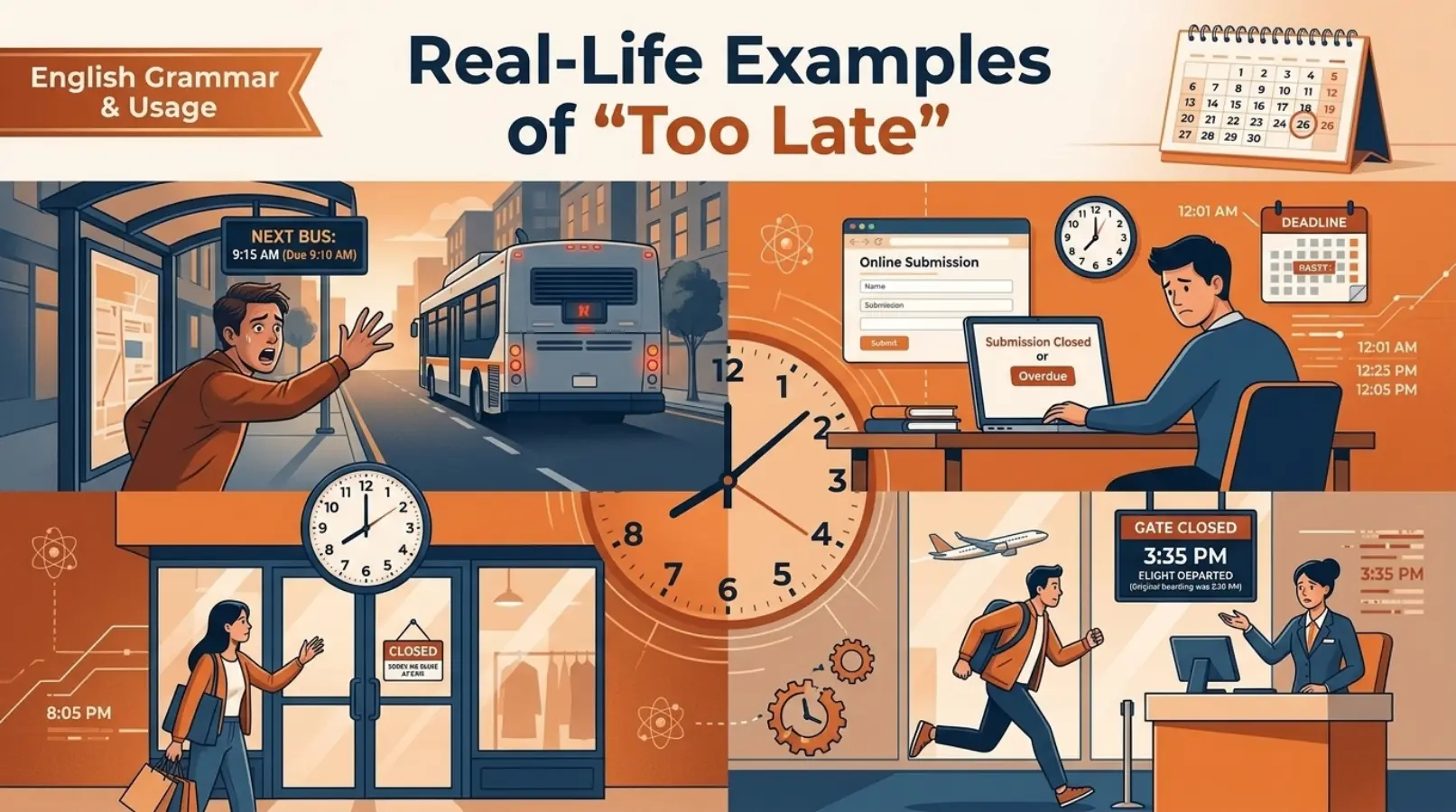
Real-Life Examples of “Too Late”
Here are everyday sentences.
School
- I finished my homework too late.
- The teacher had already collected it.
Work
- She arrived too late for the meeting.
- The presentation had started.
Home
- We ordered dinner too late.
- The restaurant had closed.
During Travel
- They reached the station too late.
- The train had left.
Sports
- The team scored too late.
- They lost the game.
Common Mistakes People Make
Many writers confuse similar words.
Mistake 1
❌ To late
✅ Too late
Mistake 2
❌ I am to tired.
✅ I am too tired.
Mistake 3
❌ It is to expensive.
✅ It is too expensive.
Mistake 4
❌ She came to early.
✅ She came too early.
Mistake 5
❌ We were to slow.
✅ We were too slow.
Easy Tips to Remember the Correct Spelling
These tricks make the rule easy.
Remember the Extra O
Too has an extra “O.”
That extra letter reminds you of extra, more, or also.
Think of “Very”
If you can replace the word with very, use too.
Example:
It is very late.
The sentence still makes sense.
Check the Meaning
Ask yourself:
“Do I mean after the right time?”
If yes, choose too late.
Read the Sentence Again
Proofreading helps catch simple spelling mistakes.
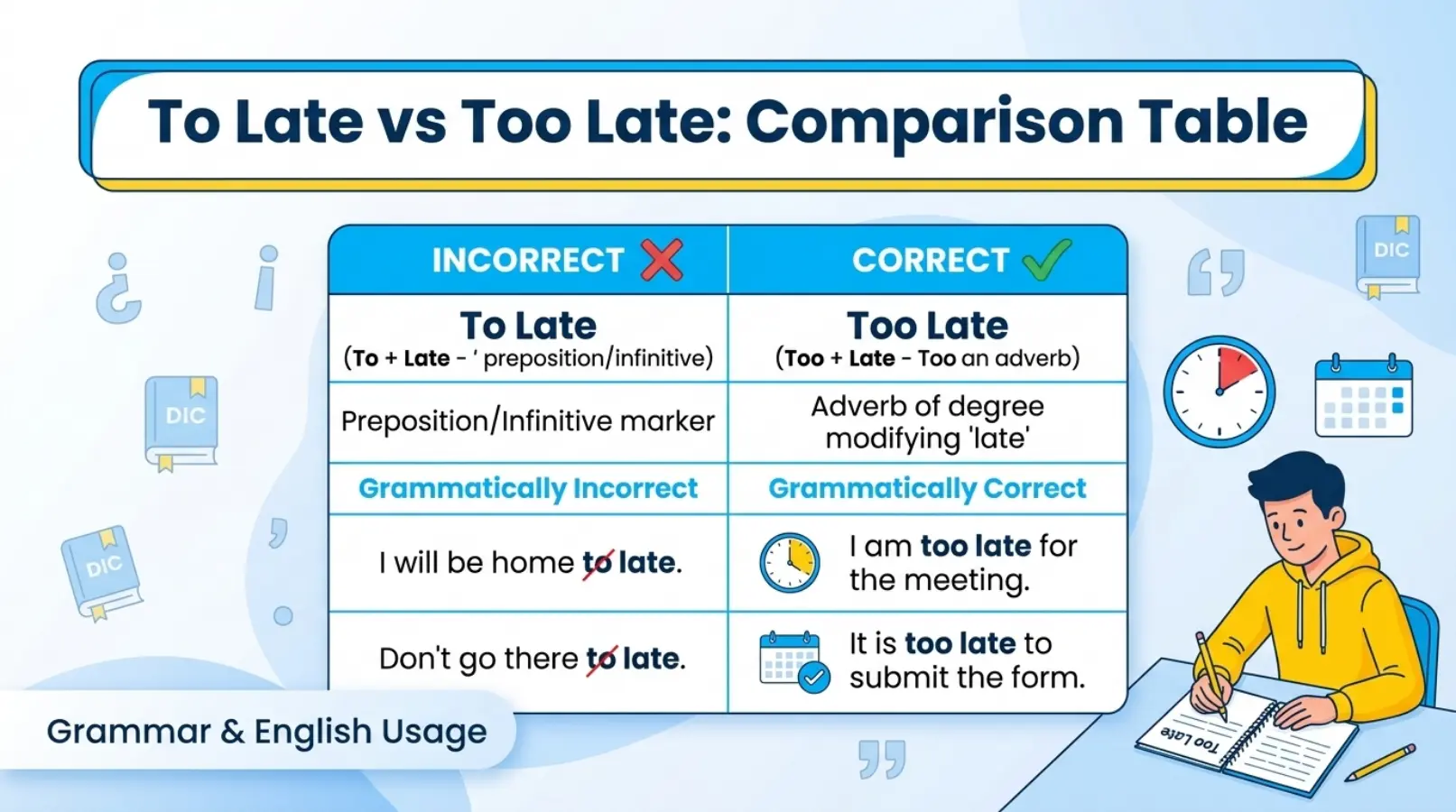
To Late vs Too Late Comparison Table
| Feature | To Late | Too Late |
| Correct spelling | No | Yes |
| Standard English | No | Yes |
| Means after the proper time | No | Yes |
| Used in writing | Never | Very common |
| Accepted in grammar | No | Yes |
Synonyms
- Delayed
- Behind schedule
- Overdue
- Tardy
- Belated
- Missed
- Afterward
- Behind time
Usage in Daily Life
You hear too late almost every day.
Family
“It’s too late to stay outside.”
School
“You submitted the assignment too late.”
Office
“We received your application too late.”
Shopping
“You came too late. The sale ended yesterday.”
Health
“Don’t wait until it’s too late.”
Expert Insights: Why Correct Grammar Matters
Correct grammar builds trust with readers.
Using too late instead of to late makes your writing look professional.
Search engines also reward clear, high-quality content. Readers stay longer when text is easy to understand.
Whether you write emails, blog posts, homework, or social media captions, using the correct phrase improves your communication.
Good grammar also helps students, professionals, and businesses create a positive impression.
Frequently Asked Questions (FAQs)
Is “to late” ever correct?
No. It is considered a spelling mistake in standard English.
Why do people write “to late”?
People confuse to and too because they sound exactly alike.
What does “too late” mean?
It means something happened after the correct or expected time.
Can I use “too late” in formal writing?
Yes. It is correct in both formal and informal English.
How can I remember the difference?
Remember that too has an extra O, which stands for something extra.
Is “never too late” grammatically correct?
Yes. It is a common and correct English expression.
Is “too late” an adverb phrase?
Yes. It commonly functions as an adverbial phrase describing timing.
Can “too” mean “also”?
Yes.
Example:
“I want to come too.”
Here, too means also, not “after the right time.”
Conclusion
Understanding to the phrase is simple once you know the difference between to and too. The correct phrase is too late because too means more than needed or describes something happening after the proper time. The phrase to late is a common spelling mistake and should be avoided in all types of writing. By remembering the extra O in too, you can quickly choose the correct word. Practice with everyday examples, proofread your work, and apply these simple grammar rules. Small improvements like this make your writing clearer, more professional, and easier for readers to trust.
Discover More Post:
Sunflower Oil Good or Bad? Benefits, Risks, and Healthiest Way
A Hour or An Hour: Which One Is Correct? Simple Grammar Guide