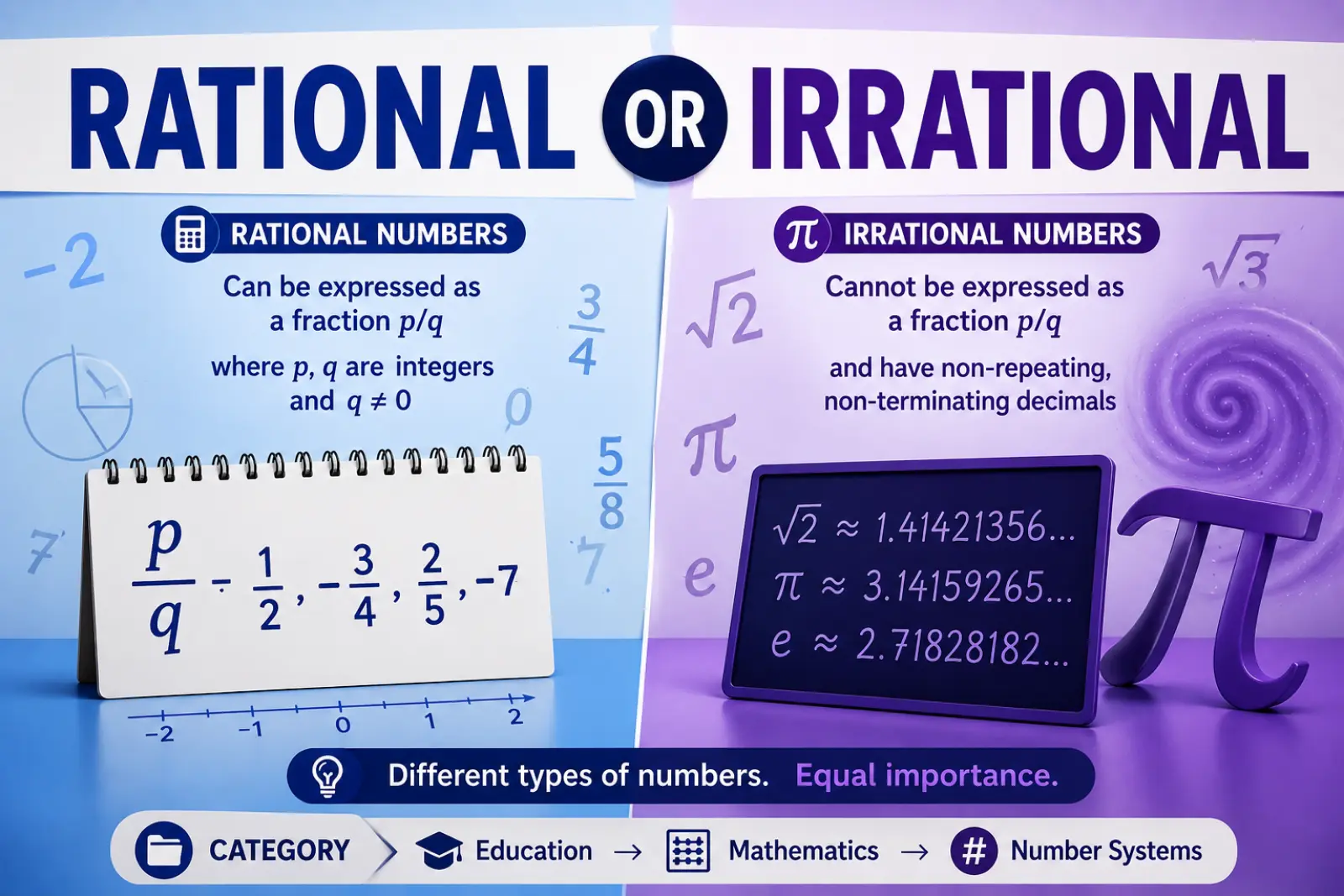
Rational or irrational is one of the most important concepts in mathematics. Understanding the difference helps students solve problems faster and with more confidence.
At first, these terms may seem confusing. However, the idea is actually simple. A rational number can be written as a fraction. An irrational number cannot.
You use rational and irrational numbers in math, science, engineering, and everyday calculations. Knowing the difference helps you work with decimals, fractions, and square roots correctly.
In this guide, you’ll learn the meaning of rational and irrational numbers, how to identify them, common mistakes to avoid, and real-life examples. By the end, you’ll be able to tell whether a number is rational or irrational in seconds.
Quick Summary Box
Rational vs Irrational Numbers at a Glance
- Rational number: Can be written as a fraction (a/b).
- Irrational number: Cannot be written as a simple fraction.
- Rational numbers have terminating or repeating decimals.
- Irrational numbers have non-terminating, non-repeating decimals.
- Examples of rational numbers: 1/2, 5, -3, 0.75.
- Examples of irrational numbers: √2, π, √3.
- Every irrational number is a real number.
- Rational and irrational numbers together make up the real number system.
What Does Rational or Irrational Mean?
A number is called rational if it can be written as:
\frac{a}{b}
Where:
- a and b are integers
- b is not equal to zero
A number is called irrational if it cannot be written in this form.
Examples
Rational Numbers
- 1/2
- 3/4
- 5
- -10
- 0.25
Irrational Numbers
- π
- √2
- √5
- e
Understanding Rational Numbers in Simple Words
A rational number can always be expressed as a fraction.
For example:
- 5 = 5/1
- 0.5 = 1/2
- 0.75 = 3/4
- -8 = -8/1
Even whole numbers are rational because they can be written as fractions.
Key Characteristics
- Can be written as a fraction
- Decimals terminate or repeat
- Includes integers and fractions
- Easy to represent exactly
Understanding Irrational Numbers in Simple Words
An irrational number cannot be expressed as a simple fraction.
Its decimal form goes on forever without repeating a pattern.
Examples
- π = 3.141592653…
- √2 = 1.41421356…
- √7 = 2.64575131…
These numbers continue infinitely and never repeat.
Key Characteristics
- Cannot be written as a fraction
- Decimal never ends
- Decimal never repeats
- Often involve roots and special constants
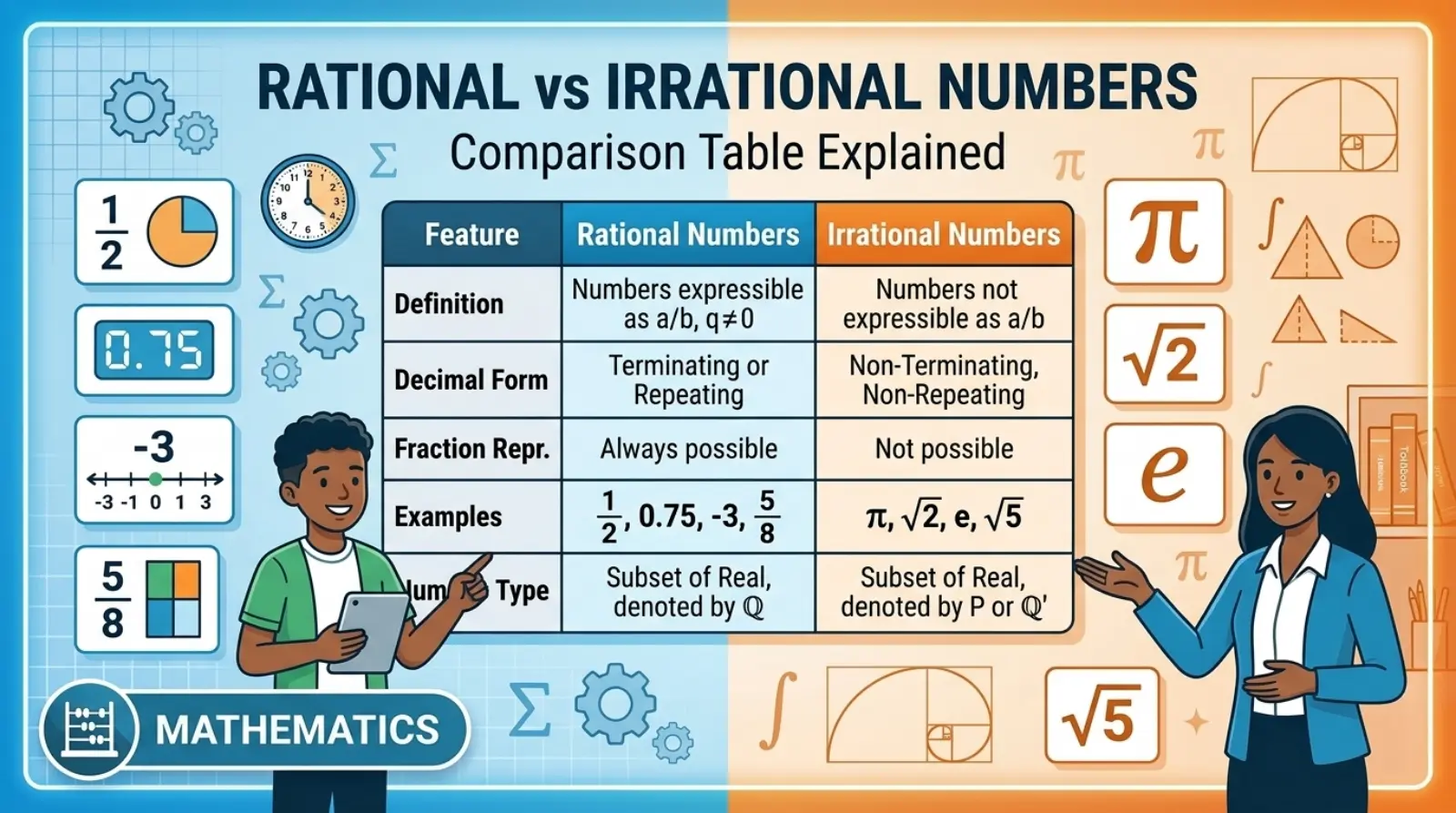
Rational vs Irrational Numbers: Comparison Table
| Feature | Rational Numbers | Irrational Numbers |
| Can be written as a fraction | Yes | No |
| Decimal form | Terminating or repeating | Non-terminating and non-repeating |
| Examples | 1/2, 5, 0.75 | π, √2, e |
| Exact representation | Easy | Impossible in decimal form |
| Includes integers | Yes | No |
| Frequency in daily calculations | Very common | Less common |
How to Tell if a Number Is Rational or Irrational
Use these simple rules.
Rule 1: Check for Fractions
If it can be written as a fraction, it is rational.
Example:
- 4 = 4/1
Rational.
Rule 2: Check the Decimal
If the decimal ends or repeats, it is rational.
Examples:
- 0.5
- 0.333333…
Both are rational.
Rule 3: Look for Square Roots
Square roots of perfect squares are rational.
Examples:
- √9 = 3
- √16 = 4
Square roots of non-perfect squares are irrational.
Examples:
- √2
- √10
Real-Life Examples of Rational Numbers
Rational numbers appear everywhere.
Money
- $2.50
- $10.75
Measurements
- 1/2 cup
- 3/4 inch
Time
- 1.5 hours
- 0.25 hours
Shopping
- Discount percentages
- Product prices
Most everyday calculations use rational numbers.
Real-Life Examples of Irrational Numbers
Irrational numbers also appear in practical situations.
Circles
The value of π helps calculate:
- Circumference
- Area
- Diameter relationships
Engineering
Square roots help determine:
- Distances
- Structural designs
- Geometry calculations
Science
Many formulas use irrational constants.
Examples include:
- π
- e
- √2
Common Examples Students Get Wrong
Is √4 Rational or Irrational?
√4 = 2
Answer: Rational
Is √8 Rational or Irrational?
√8 = 2√2
Answer: Irrational
Is 0.777777… Rational or Irrational?
Repeating decimal
Answer: Rational
Is π Rational or Irrational?
Cannot be written as a fraction
Answer: Irrational
Is 7 Rational or Irrational?
7 = 7/1
Answer: Rational
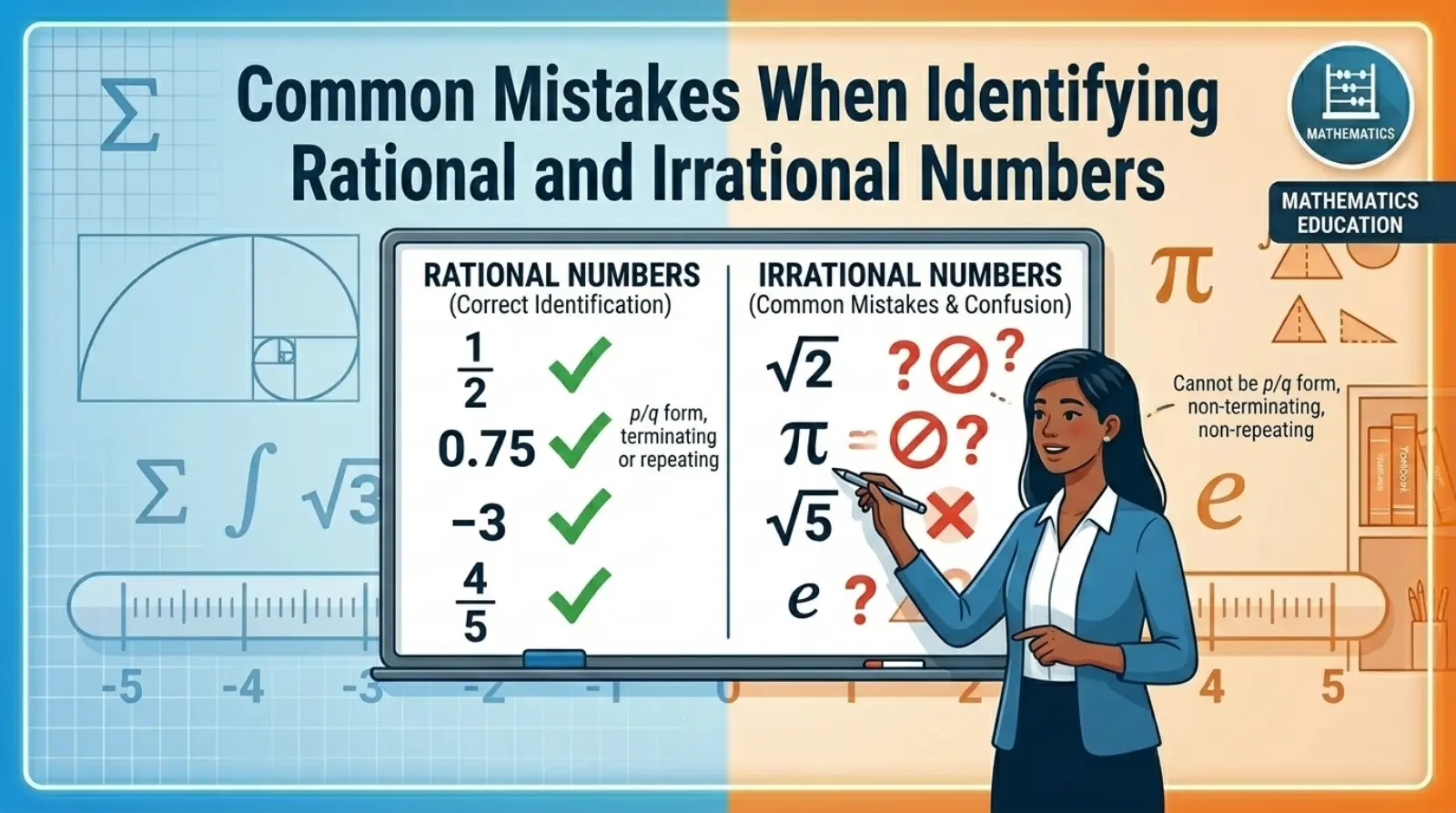
Common Mistakes When Identifying Rational and Irrational Numbers
Mistake 1: Assuming All Square Roots Are Irrational
Wrong.
√25 = 5
This is rational.
Mistake 2: Thinking Long Decimals Are Irrational
A long decimal may still be rational if it repeats.
Example:
0.666666…
Mistake 3: Forgetting Whole Numbers
Whole numbers are rational.
Example:
10 = 10/1
Mistake 4: Confusing Non-Terminating with Irrational
A decimal that repeats forever is still rational.
Easy Tricks to Remember the Difference
Rational = Ratio
The word “rational” comes from “ratio.”
If you can make a ratio (fraction), the number is rational.
Irrational = Impossible Fraction
If no fraction can represent the number exactly, it is irrational.
Remember This Rule
- Repeating decimal = Rational
- Non-repeating decimal = Irrational
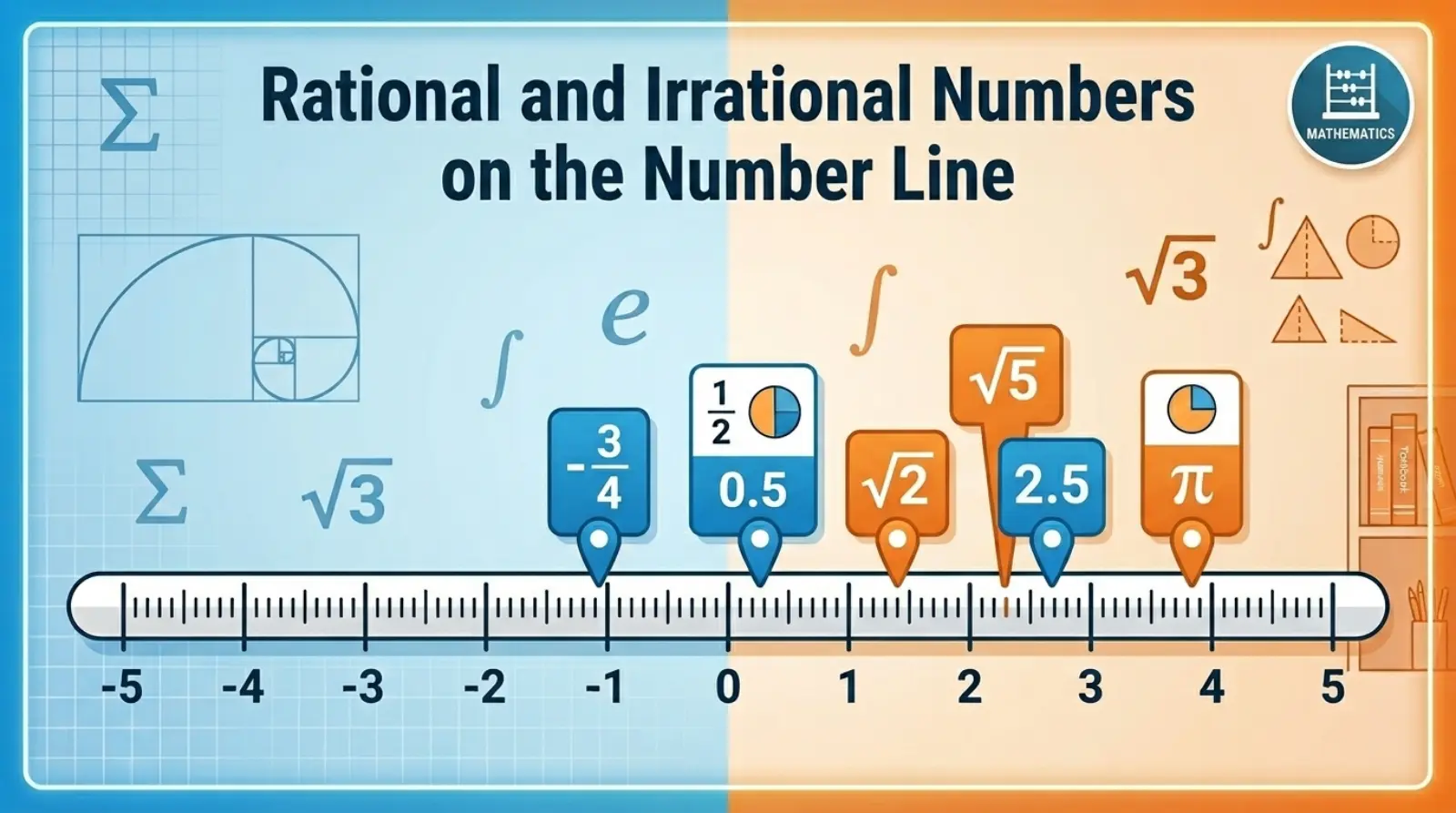
Rational and Irrational Numbers on the Number Line
Both types exist on the same number line.
Examples:
- Rational: 1, 2, 3, 1/2
- Irrational: π, √2, √3
Every irrational number lies between rational numbers.
For example:
- √2 lies between 1 and 2.
Synonyms
- Rational number definition
- Irrational number definition
- Rational vs irrational numbers
- Real numbers
- Number system
- Repeating decimals
- Non-repeating decimals
- Fractions and decimals
- Square roots
- Mathematical constants
Why Rational and Irrational Numbers Matter
Understanding number types improves math skills.
Benefits include:
- Better algebra understanding
- Easier geometry calculations
- Stronger problem-solving skills
- Improved exam performance
- Foundation for advanced mathematics
Students who master this topic often find later math concepts easier.
Expert Insight
Mathematics experts recommend learning decimal patterns first.
When identifying numbers:
- Check if the decimal repeats.
- Look for a fraction form.
- Examine square roots carefully.
- Memorize common irrational numbers like π and √2.
This approach reduces mistakes and improves speed during exams.
Understanding rational and irrational numbers is essential because these concepts appear in algebra, geometry, calculus, engineering, and science.
Frequently Asked Questions (FAQs)
What is a rational number?
A rational number can be written as a fraction of two integers.
What is an irrational number?
An irrational number cannot be written as a simple fraction.
Is π rational or irrational?
π is irrational because its decimal never ends or repeats.
Is √2 rational or irrational?
√2 is irrational because it cannot be expressed as a fraction.
Is 0.5 rational?
Yes. It equals 1/2.
Are all integers rational?
Yes. Every integer can be written over 1.
Can a number be both rational and irrational?
No. A number can only belong to one category.
Is every irrational number a real number?
Yes. All irrational numbers are part of the real number system.
Conclusion
Understanding rational or irrational numbers is a fundamental math skill. Rational numbers can be written as fractions and have terminating or repeating decimals. Irrational numbers cannot be expressed as simple fractions and have non-terminating, non-repeating decimals.
The easiest way to identify a number is to check its decimal pattern or determine whether it can be written as a fraction. Numbers such as 1/2, 5, and 0.75 are rational, while π and √2 are irrational.
By learning these simple rules and examples, you can quickly classify numbers and avoid common mistakes. Whether you’re studying for an exam or strengthening your math foundation, understanding rational and irrational numbers will make many future math concepts easier to understand.