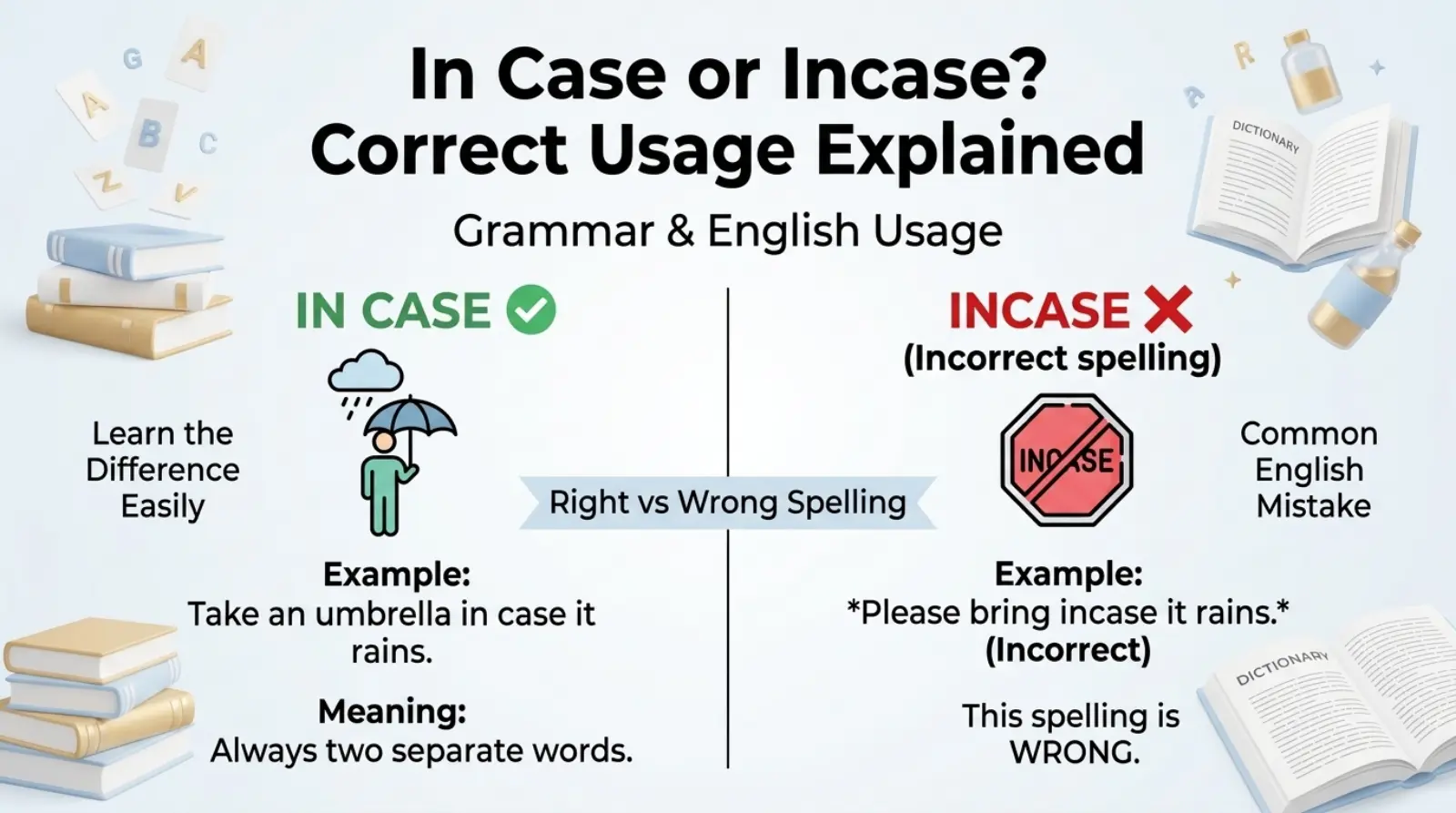
In case or incase is a very common English confusion.
Many people mix these two spellings in writing.
“In case” is the correct form in English grammar.
“Incase” is usually incorrect in formal writing.
This topic is important for students, writers, and bloggers.
Small spelling errors can affect your credibility online.
In this article, you will learn the correct usage easily.
We will also share examples, rules, and common mistakes.
Everything is explained in very simple English for better understanding.
Quick Summary Box
- “In case” is the correct spelling
- “Incase” is not standard English
- “In case” means “if something happens”
- It is used for safety or preparation
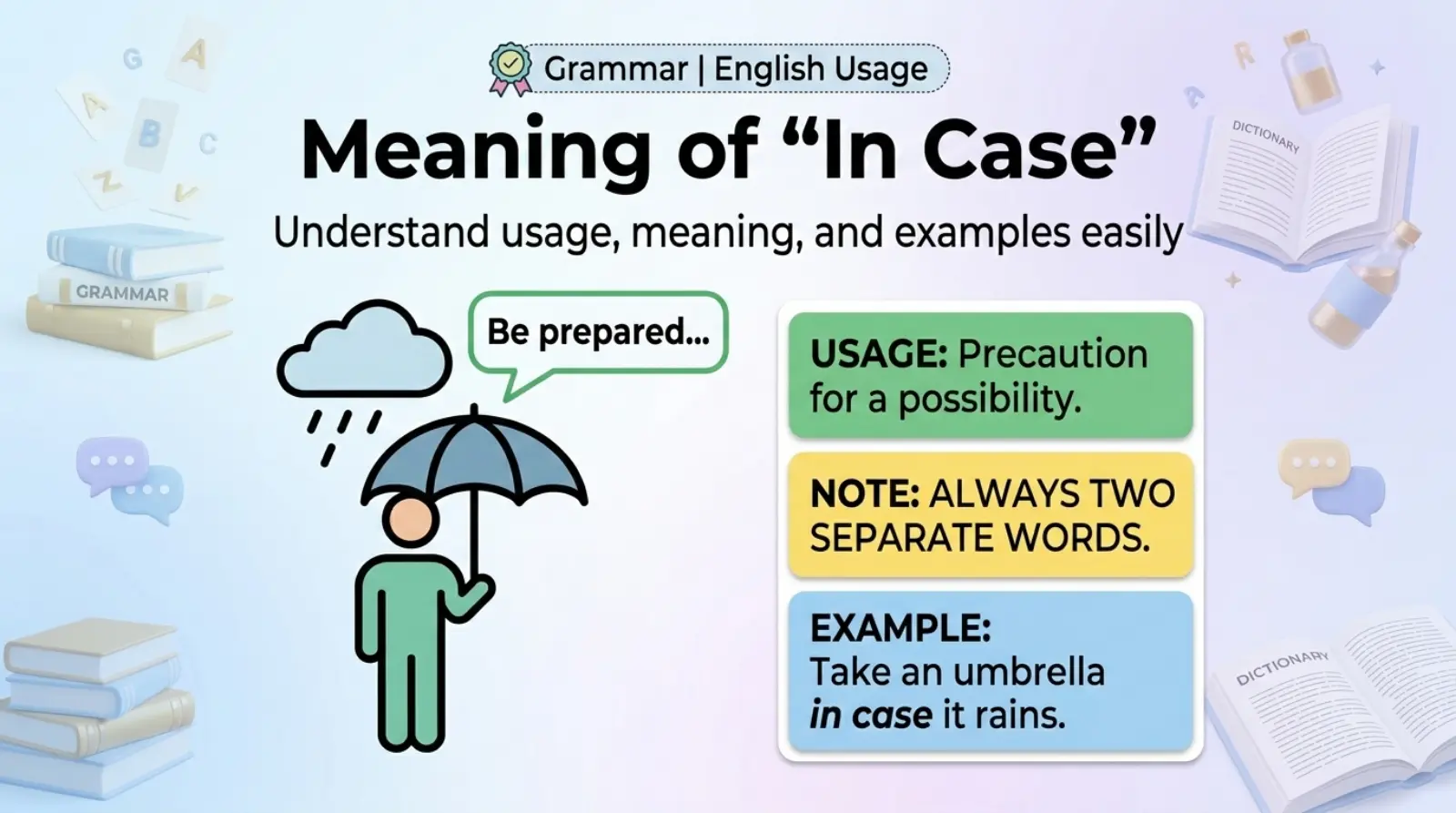
- Example: Take an umbrella in case it rains
- Always write it as two words
- It is a preposition + conjunction phrase
Meaning of “In Case”
“In case” means if something happens or might happen.
We use it to prepare for a possible situation.
It shows caution or planning for the future.
Simple meaning:
- If something happens
- For safety
- As a precaution
Example:
- I will take a jacket in case it gets cold.
Is “Incase” Correct?
“Incase” is often used in informal writing.
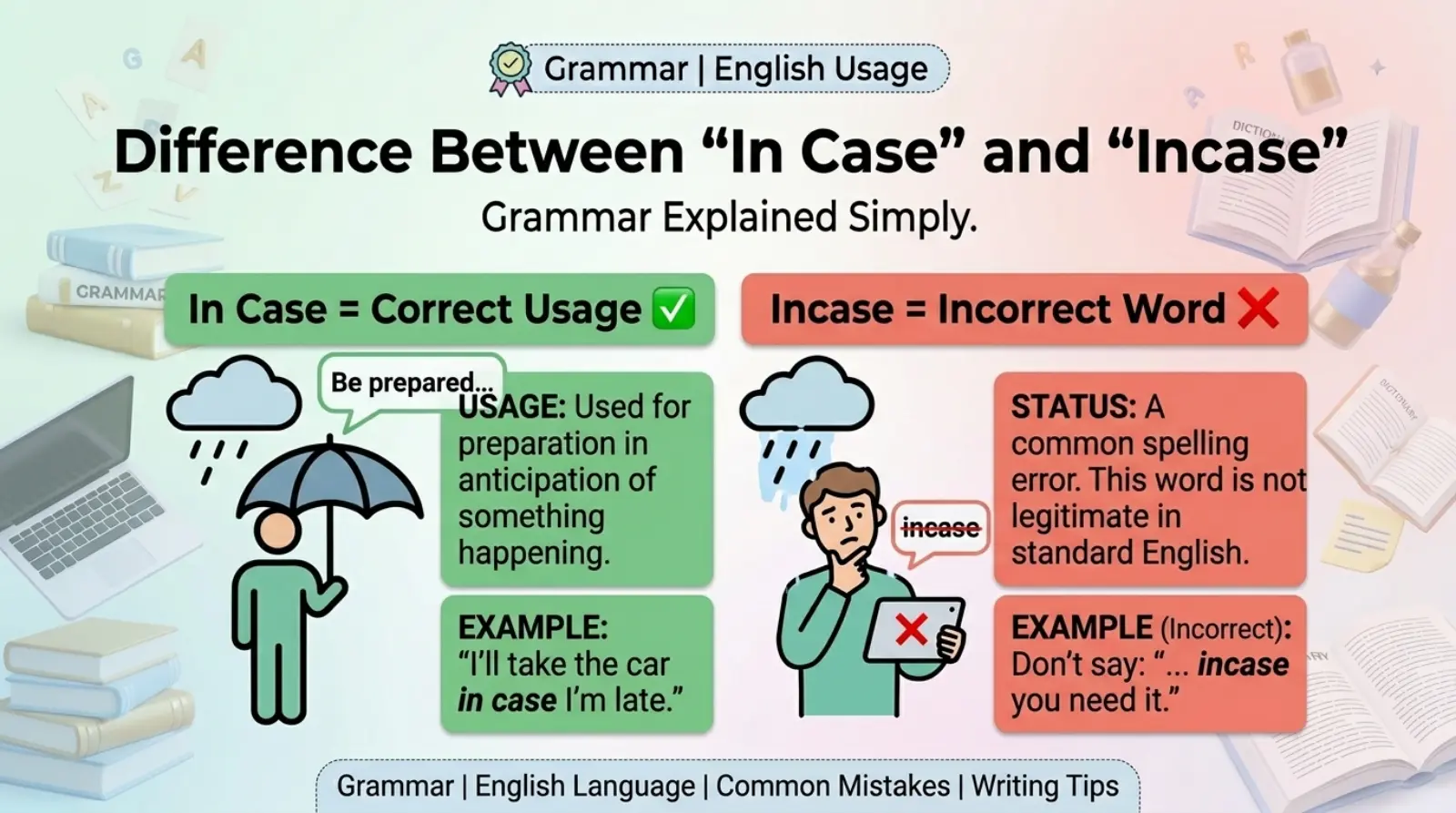
However, it is not correct in standard English grammar.
Many people mistakenly write it as one word.
But dictionaries and grammar rules do not support it.
Correct form:
- In case
Incorrect form:
- Incase
Difference Between “In Case” and “Incase”
Here is the simple difference:
| Feature | In case | Incase |
| Correctness | Correct | Incorrect |
| Word type | Phrase | Misspelling |
| Meaning | If something happens | No official meaning |
| Usage | Formal + informal writing | Avoid using |
| Grammar support | Yes | No |
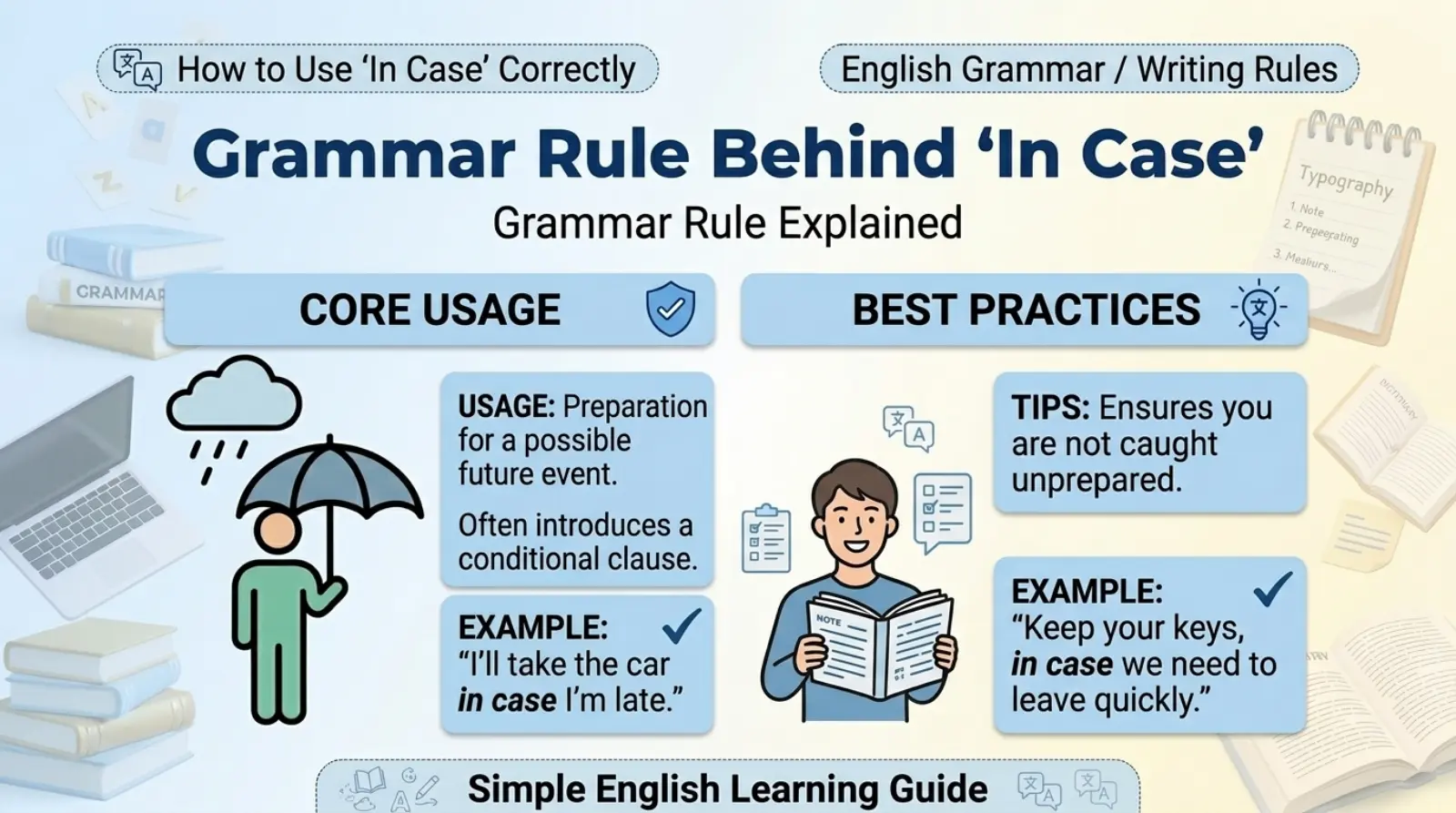
Grammar Rule Behind “In Case”
“In case” is made of two parts:
- “In” = preposition
- “Case” = noun
Together, they form a phrase that shows condition.
It is often used with future possibilities.
Example structure:
- In case + subject + verb
Example:
- Call me in case you need help.
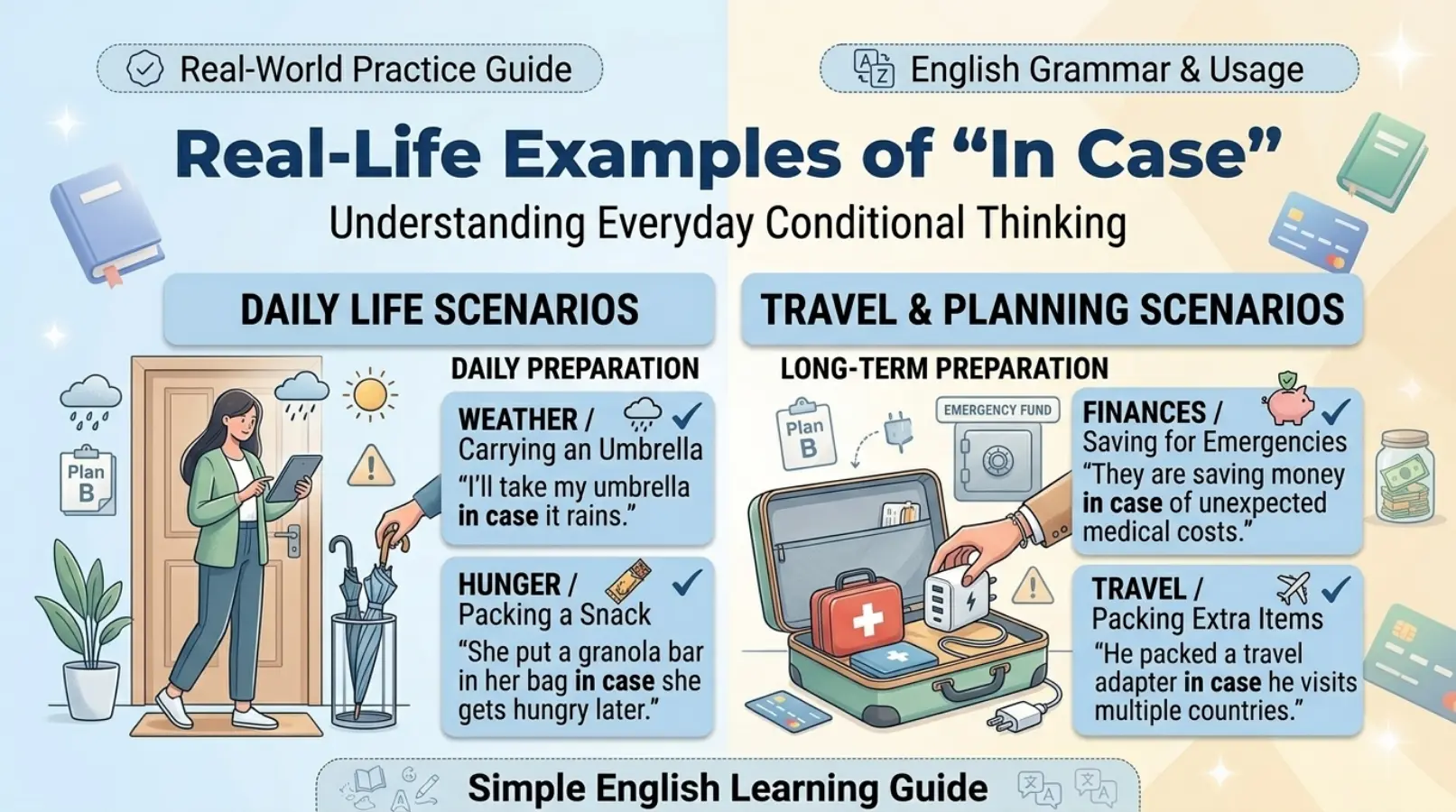
Real-Life Examples of “In Case”
Here are simple daily life examples:
- Take your phone in case you get lost.
- I saved money in case of emergencies.
- Keep extra food in case guests arrive.
- She carries a pen in case she needs to write.
- I wrote it down in case I forget.
These show preparation for uncertain events.
Common Mistakes People Make
Many learners make these errors:
1. Writing “incase” instead of “in case”
- ❌ Incase it rains
- ✔ In case it rains
2. Forgetting space between words
- ❌ Incase
- ✔ In case
3. Using it without context
- Wrong sentence structure
4. Confusing with “in case of”
- “In case of” is followed by a noun
- Example: In case of fire, exit quickly
Comparison Table: “In case” vs “In case of”
| Usage Type | In case | In case of |
| Followed by | Subject + verb | Noun |
| Example | In case it rains | In case of rain |
| Meaning | If something happens | During an event |
| Grammar use | Conjunction phrase | Prepositional phrase |
Usage in Daily English
“In case” is used in many situations:
1. Travel
- Take extra cash in case cards don’t work.
2. Study
- Revise notes in case of exams.
3. Work
- Save files in case the system crashes.
4. Health
- Carry medicine in case you feel sick.
It helps you stay prepared in daily life.
Tips to Remember Correct Usage
- Always write “in case” as two words
- Think of it as “if something happens”
- Avoid writing “incase” in formal content
- Use “in case of” before nouns
- Practice with daily examples
- Read sentences aloud for clarity
Expert Insights (EEAT Section)
Grammar accuracy improves trust in your writing.
Search engines prefer clean and correct language.
“In case” is widely used in academic and professional English.
Correct spelling improves readability and SEO performance.
Experts recommend avoiding common misspellings like “incase”.
Such errors reduce content quality and authority.
If you are a blogger, always double-check spelling rules.
This small habit improves ranking and user trust.
FAQs About “In Case or Incase”
1. What is correct: in case or incase?
“In case” is correct. “Incase” is incorrect.
2. What does in case mean?
It means “if something happens” or “for safety”.
3. Is incase a real English word?
No, it is a common spelling mistake.
4. Can I use incase in writing?
No, avoid it in formal and academic writing.
5. What is an example of in case?
Take an umbrella in case it rains.
6. What is the difference between in case and in case of?
“In case” uses a verb clause. “In case of” uses a noun.
7. Why do people write incase?
Because they hear it as one word in speech.
8. Is in case formal or informal?
It is correct in both formal and informal writing.
Conclusion
“In case or incase” is a simple but important grammar topic.
The correct form is always “in case” as two words.
“Incase” is a common mistake that should be avoided.
Using the correct form improves writing quality and clarity.
“In case” is used for safety, planning, and future possibilities.
It appears in daily conversations, education, and professional writing.
Always remember this rule to improve your English skills.
Small grammar corrections make a big difference in communication.