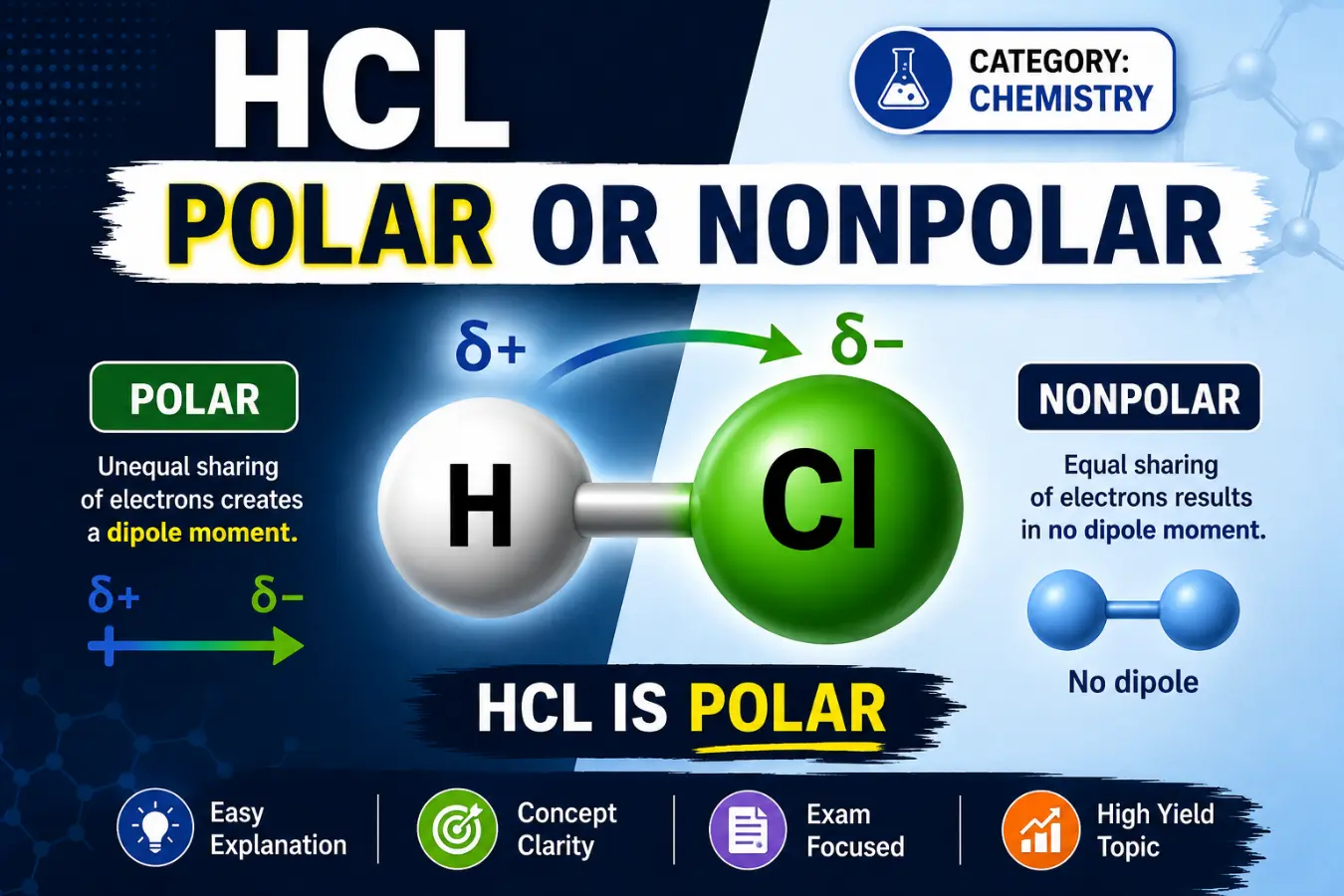
HCL polar or nonpolar is a common question in chemistry. Many students want a simple answer. The good news is that the concept is easy to understand.
Hydrogen chloride (HCl) is a molecule made of hydrogen and chlorine atoms. These atoms do not share electrons equally. Because of this unequal sharing, the molecule develops a charge difference.
Understanding polarity helps explain many chemical properties. It affects how substances dissolve, react, and interact with other molecules.
In this guide, you will learn why HCl is polar, how polarity works, and how to identify polar molecules easily. We will also look at examples, comparisons, common mistakes, and expert tips.
Quick Summary Box
- HCl stands for Hydrogen Chloride.
- HCl is a polar molecule.
- Hydrogen and chlorine share electrons unequally.
- Chlorine attracts electrons more strongly than hydrogen.
- This creates a positive end and a negative end.
- Polar molecules have an uneven distribution of charge.
- HCl has a permanent dipole moment.
- HCl dissolves well in polar solvents like water.
What Is HCl?
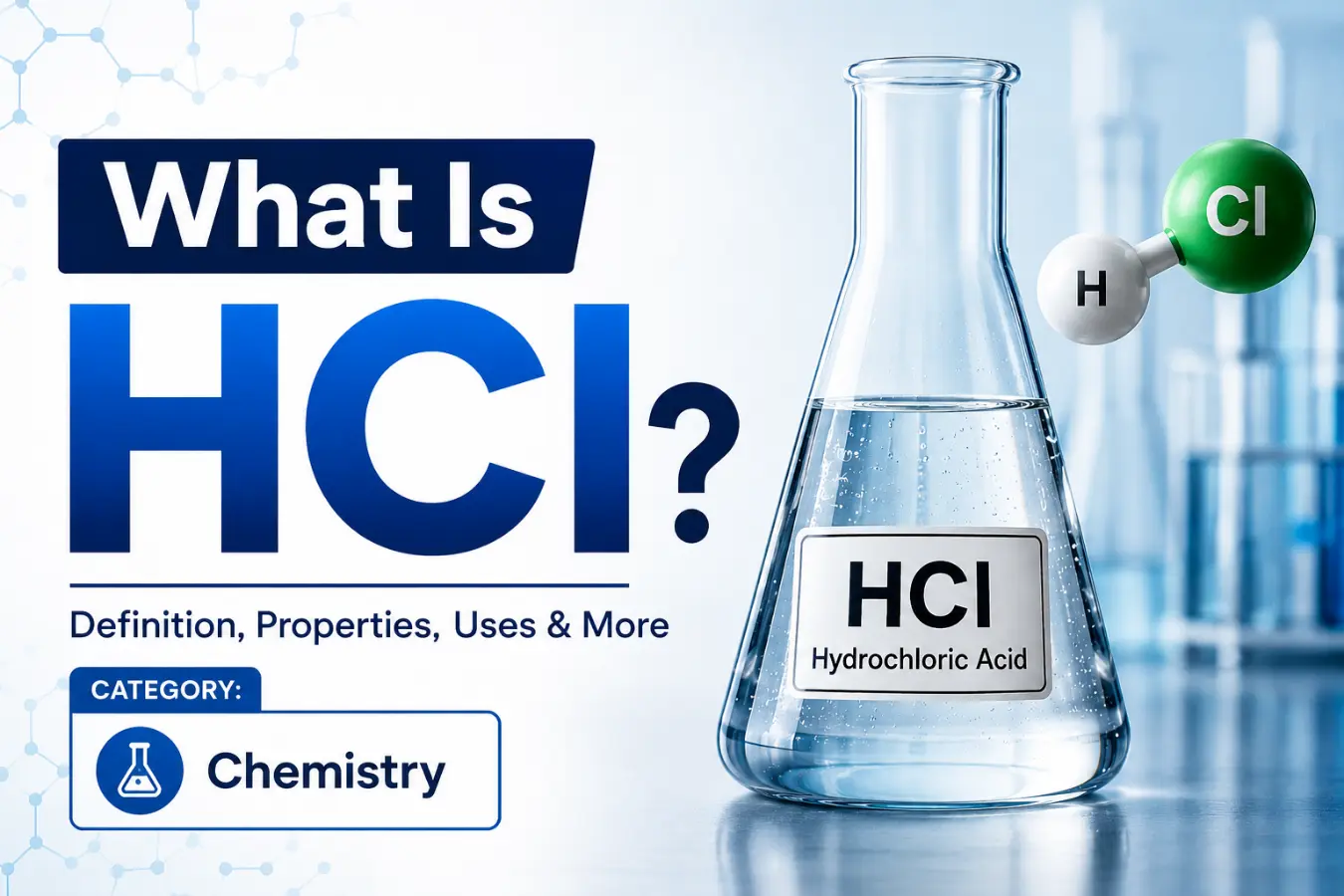
HCl stands for Hydrogen Chloride.
It contains:
- One hydrogen atom (H)
- One chlorine atom (Cl)
Chemical Formula
HCl
Basic Properties
| Property | Value |
| Name | Hydrogen Chloride |
| Formula | HCl |
| Bond Type | Covalent |
| Molecular Shape | Linear |
| Polarity | Polar |
| Molar Mass | 36.46 g/mol |
Hydrogen chloride exists as a gas. When dissolved in water, it forms hydrochloric acid.
What Does Polar Mean?
A molecule is polar when electrons are not shared equally.
This unequal sharing creates:
- A slightly positive end (δ+)
- A slightly negative end (δ−)
The separation of charge forms a dipole.
Simple Example
Think of a tug-of-war.
If both teams pull equally, the rope stays centered.
If one team pulls harder, the rope moves toward that side.
The same thing happens with electrons in polar molecules.
Is HCL Polar or Nonpolar?
The Simple Answer
HCl is a polar molecule.
Hydrogen and chlorine do not attract electrons equally.
Chlorine is much more electronegative than hydrogen.
As a result:
- Chlorine becomes slightly negative (δ−)
- Hydrogen becomes slightly positive (δ+)
This unequal charge distribution makes HCl polar.
Featured Snippet Answer
HCl is a polar molecule because chlorine attracts shared electrons more strongly than hydrogen. This unequal electron distribution creates a dipole, giving HCl a positive end and a negative end.
Why Is HCL Polar?
The main reason is electronegativity difference.
Electronegativity Values
| Atom | Electronegativity |
| Hydrogen | 2.20 |
| Chlorine | 3.16 |
The difference is:
3.16 − 2.20 = 0.96
This difference is large enough to create a polar covalent bond.
What Happens?
- Hydrogen and chlorine share electrons.
- Chlorine pulls the electrons closer.
- Electron density shifts toward chlorine.
- A dipole forms.
- The molecule becomes polar.
Understanding HCL Polarity Through Electron Distribution
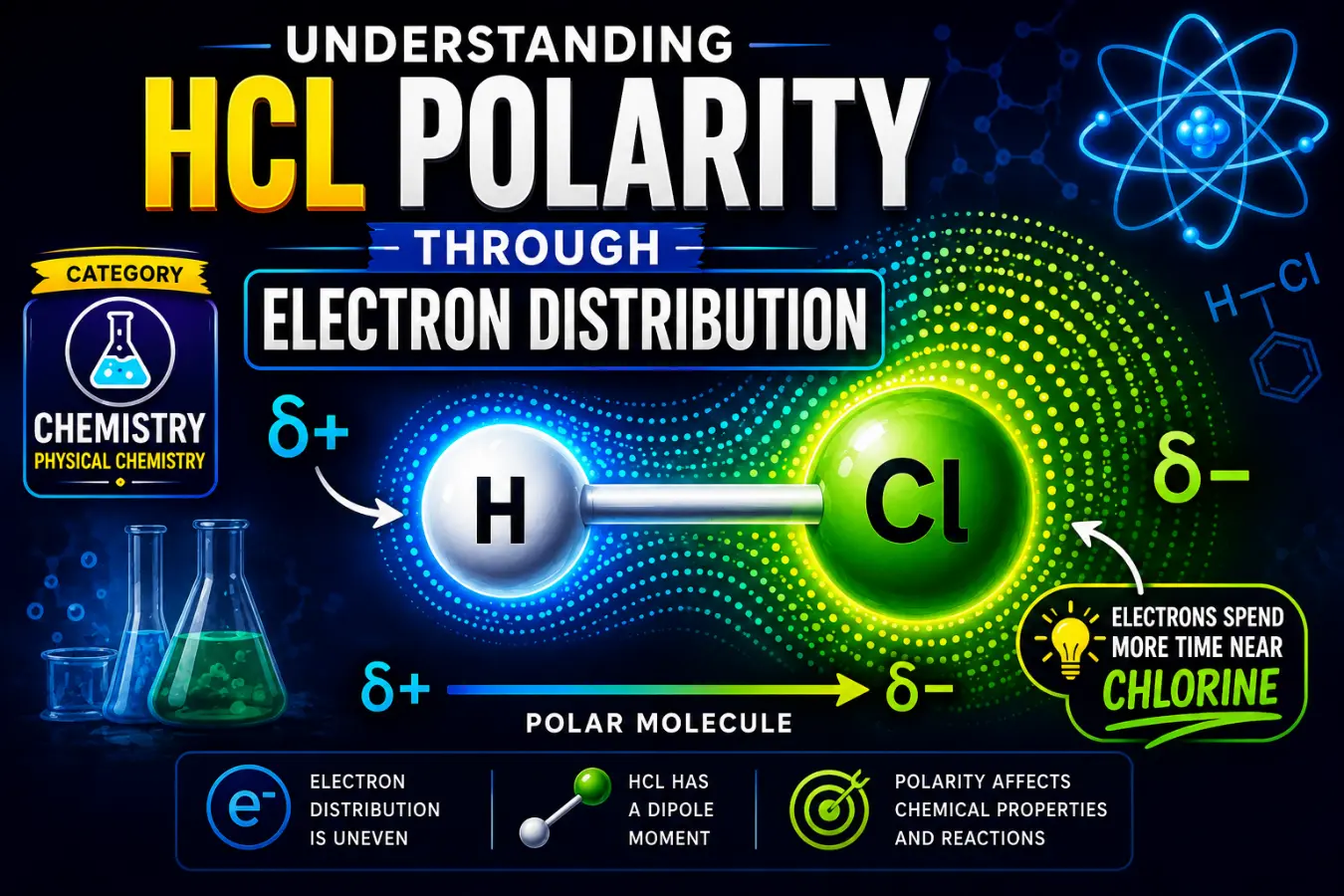
Electrons spend more time near chlorine.
Because of this:
Hδ+ — Clδ−
The chlorine side becomes negative.
The hydrogen side becomes positive.
Since HCl contains only two atoms, there is no way for the dipole to cancel.
Therefore, the molecule remains polar.
HCL Molecular Geometry and Shape
The shape of HCl is very simple.
It consists of only two atoms connected by one bond.
Molecular Shape
- Linear
Bond Angle
- 180°
Since there are only two atoms, the molecule forms a straight line.
The dipole points toward chlorine.
Because there is no opposite dipole, the polarity remains.
HCL Polar vs Nonpolar Molecules
Understanding the difference helps students identify polarity faster.
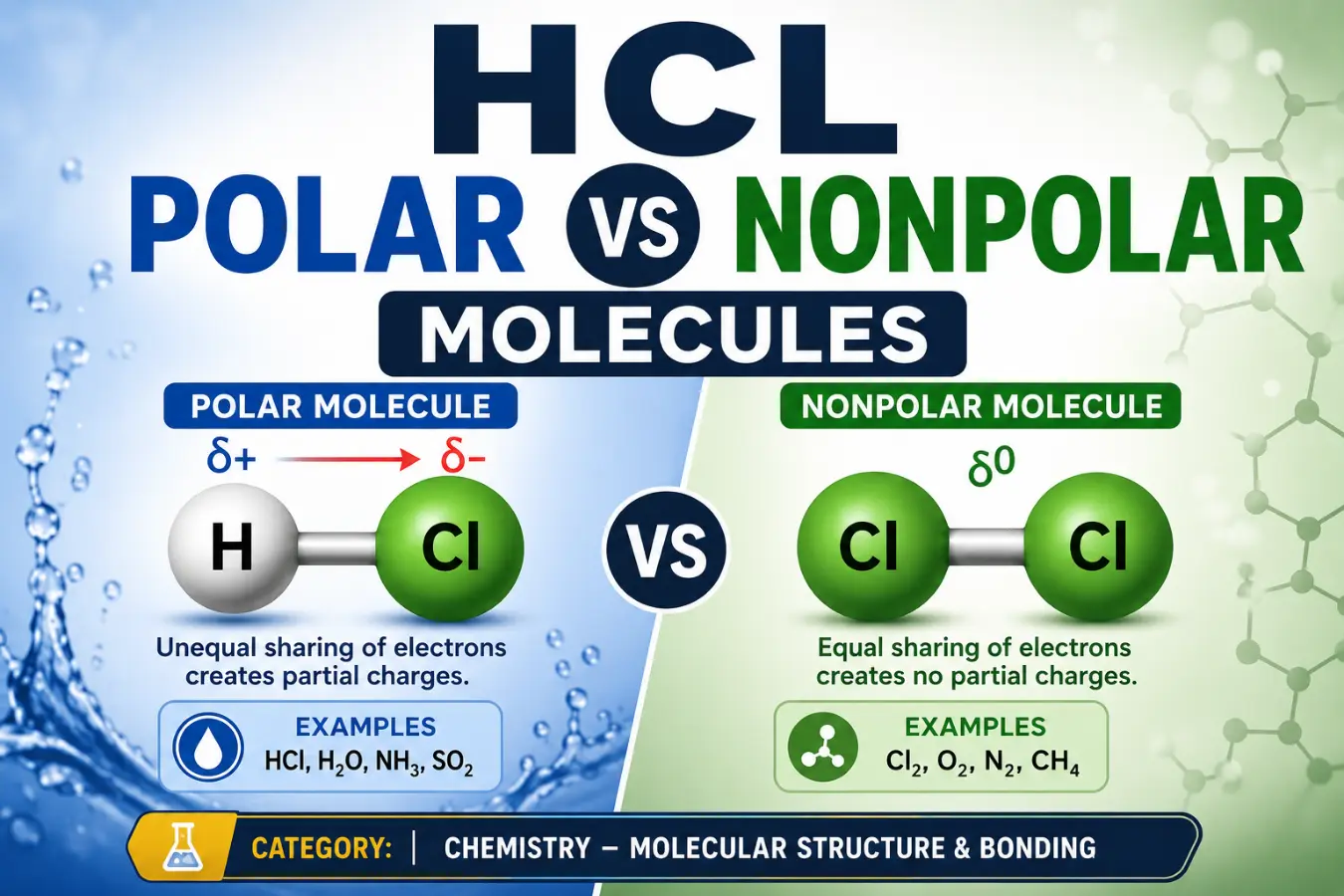
| Feature | Polar Molecules | Nonpolar Molecules |
| Charge Distribution | Uneven | Even |
| Dipole Moment | Present | Absent |
| Electron Sharing | Unequal | Equal or balanced |
| Solubility in Water | Usually high | Usually low |
| Example | HCl, H₂O, NH₃ | O₂, N₂, CH₄ |
HCl clearly fits the polar category.
Real-Life Examples of Polar Molecules
HCl is not the only polar molecule.
Common Polar Molecules
- Water (H₂O)
- Ammonia (NH₃)
- Hydrogen Fluoride (HF)
- Sulfur Dioxide (SO₂)
- Hydrogen Chloride (HCl)
Why They Matter
Polar molecules:
- Dissolve in water
- Form hydrogen bonds (some molecules)
- Participate in many chemical reactions
HCL vs H2 Comparison
Students often compare HCl with H₂.
| Property | HCl | H₂ |
| Molecule Type | Heteronuclear | Homonuclear |
| Electron Sharing | Unequal | Equal |
| Dipole Moment | Present | None |
| Polarity | Polar | Nonpolar |
| Electronegativity Difference | 0.96 | 0 |
H₂ is nonpolar because both atoms pull electrons equally.
HCl is polar because chlorine pulls harder.
How to Determine Whether a Molecule Is Polar
Use these simple steps.
Step 1: Check Electronegativity
Large differences usually create polar bonds.
Step 2: Look at Molecular Shape
Some molecules contain polar bonds but become nonpolar due to symmetry.
Step 3: Check Dipole Cancellation
If dipoles cancel, the molecule is nonpolar.
If they do not cancel, the molecule is polar.
Applying These Steps to HCl
- Electronegativity difference exists ✔
- Linear shape ✔
- No dipole cancellation ✔
Result:
HCl is polar.
Common Mistakes About HCL Polarity
Students often make these errors.
Mistake 1: Assuming All Covalent Molecules Are Nonpolar
Many covalent molecules are actually polar.
HCl is one example.
Mistake 2: Ignoring Electronegativity
Electronegativity determines electron attraction.
Always check the values.
Mistake 3: Looking Only at Shape
Shape matters, but electronegativity matters too.
Both factors determine polarity.
Mistake 4: Confusing HCl with H₂
H₂ shares electrons equally.
HCl does not.
Tips and Tricks to Remember HCL Is Polar
Use the Chlorine Rule
Chlorine strongly attracts electrons.
When chlorine bonds with hydrogen, expect polarity.
Remember the Dipole Arrow
The dipole points toward chlorine.
Think About Charge Separation
If one side becomes more negative, the molecule is likely polar.
Quick Memory Trick
“Cl grabs electrons.”
If chlorine grabs electrons, HCl becomes polar.
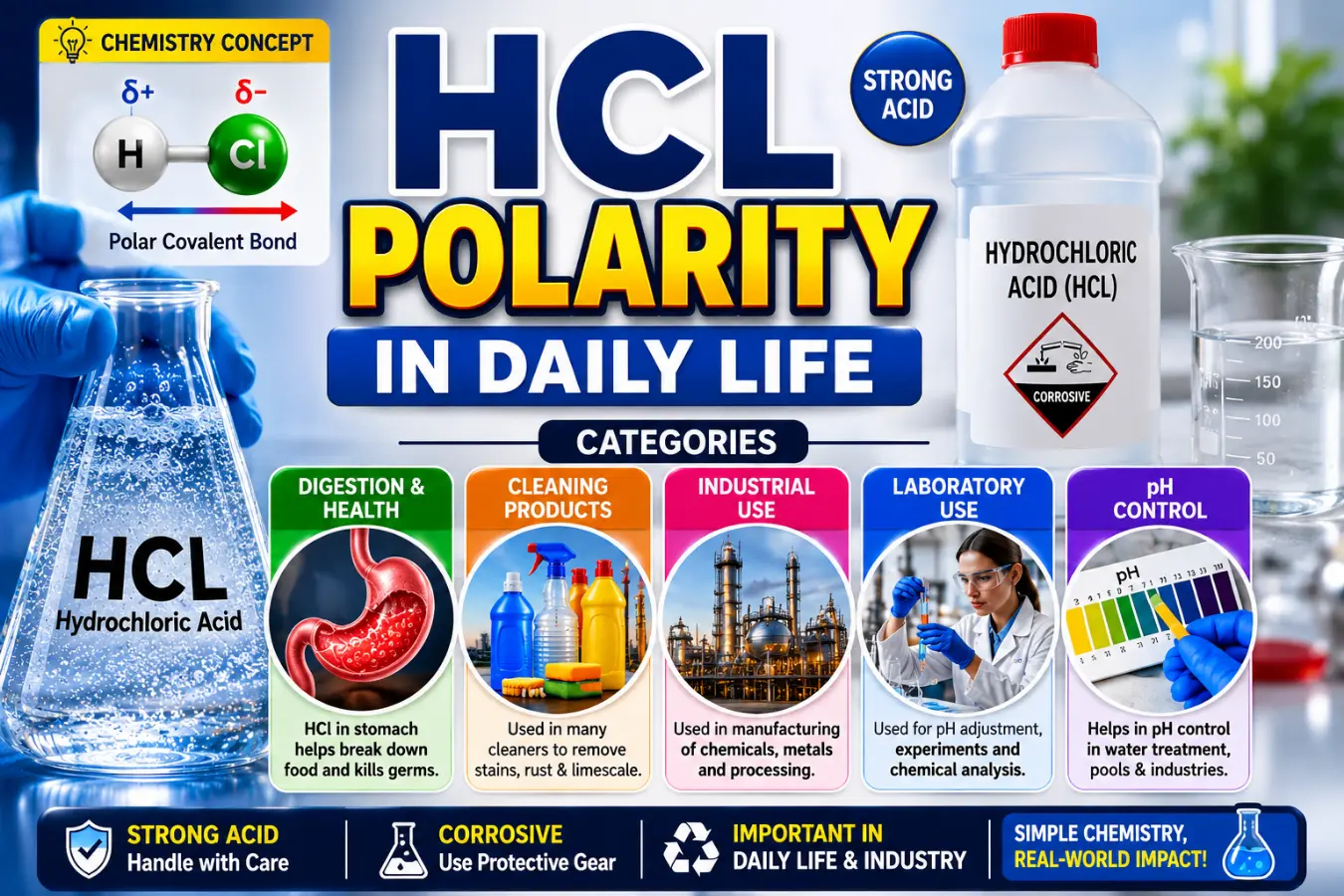
HCL Polarity in Daily Life
Polarity affects many real-world applications.
Dissolving in Water
HCl dissolves easily in water because both are polar.
Industrial Uses
Hydrochloric acid is used in:
- Metal cleaning
- Food processing
- Chemical manufacturing
Laboratory Reactions
Many chemical reactions depend on molecular polarity.
Scientists use polarity to predict behavior.
Expert Insights: Why Understanding HCL Polarity Matters
Chemistry experts use polarity to predict molecular behavior.
Understanding HCl polarity helps you:
- Predict solubility
- Understand chemical reactions
- Learn intermolecular forces
- Master chemical bonding concepts
Many advanced chemistry topics build on polarity.
Students who understand HCl polarity often find molecular chemistry easier.
Expert Tip
Always examine:
- Electronegativity difference
- Molecular shape
- Dipole cancellation
These three factors solve most polarity questions.
Frequently Asked Questions (FAQs)
Is HCl polar or nonpolar?
HCl is polar because chlorine attracts electrons more strongly than hydrogen.
Why is HCl considered a polar molecule?
It has unequal electron sharing and a permanent dipole moment.
What makes HCl different from H₂?
H₂ contains identical atoms. HCl contains different atoms with different electronegativities.
Does HCl have a dipole moment?
Yes. HCl has a permanent dipole moment directed toward chlorine.
Is the H-Cl bond polar?
Yes. The H-Cl bond is a polar covalent bond.
Can HCl dissolve in water?
Yes. HCl dissolves readily in water because both substances are polar.
Is HCl ionic or covalent?
HCl contains a polar covalent bond.
What is the molecular shape of HCl?
HCl has a linear molecular shape.
Conclusion
If you are wondering whether HCL is polar or nonpolar, the answer is simple: HCl is a polar molecule. Chlorine attracts electrons more strongly than hydrogen. This unequal sharing creates a positive end and a negative end within the molecule. As a result, HCl develops a permanent dipole moment and behaves as a polar compound.
Understanding HCl polarity helps explain its solubility, reactivity, and chemical behavior. The easiest way to identify HCl as polar is to look at the electronegativity difference between hydrogen and chlorine. Since the dipole does not cancel, the molecule remains polar.
Remember this simple rule: chlorine pulls electrons strongly, making HCl polar.