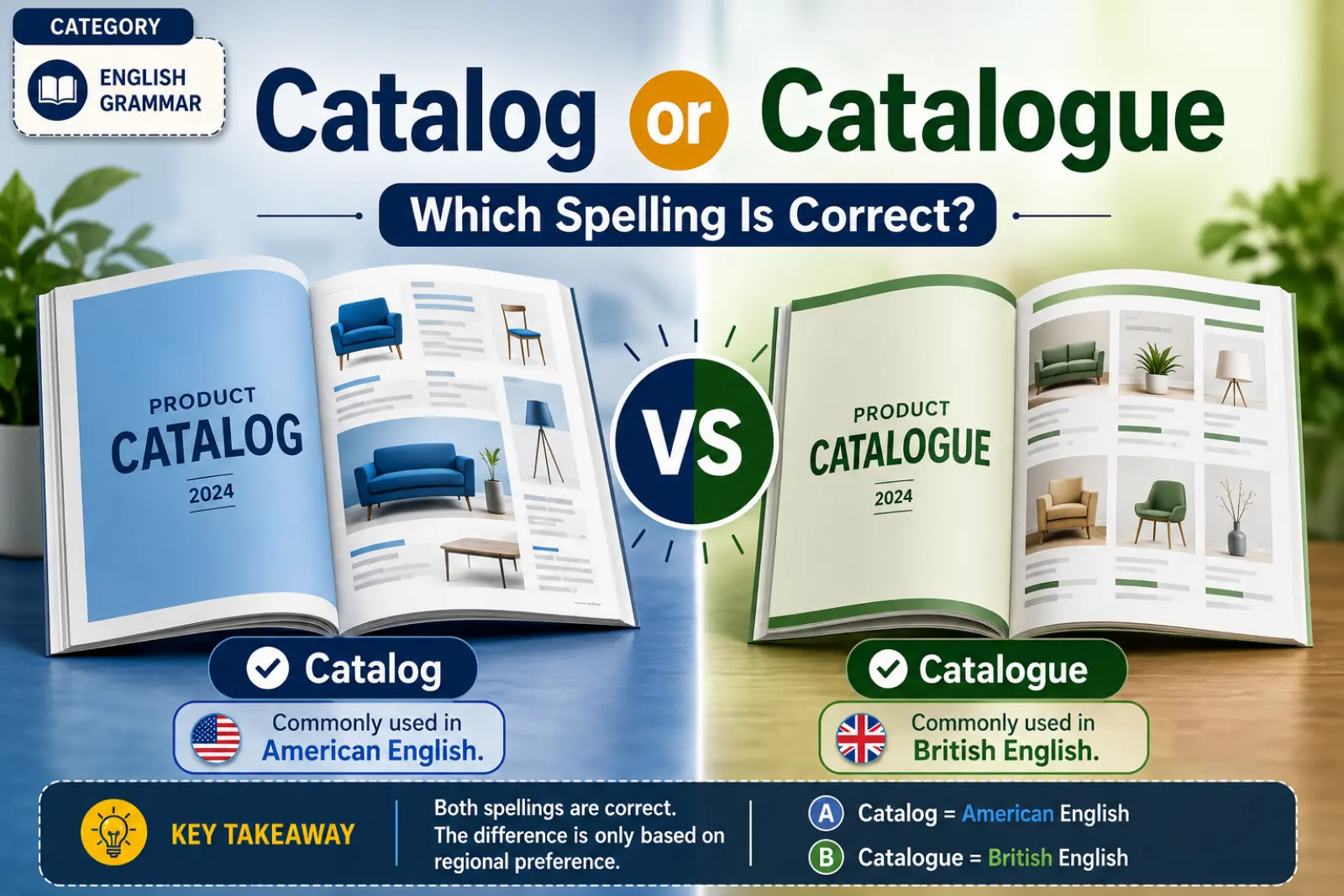
Catalog or catalogue is a common spelling question that confuses many writers. Both words have the same meaning, but their usage depends on the country and writing style.
If you write for an international audience, knowing the difference matters. It helps you maintain consistency and appear more professional.
Many people see both spellings online and wonder which one is correct. The good news is that both are correct. However, each version is preferred in different regions.
In this guide, you’ll learn the meaning of catalog and catalogue, their differences, real-life examples, common mistakes, and expert tips. By the end, you’ll know exactly when to use each spelling.
Quick Summary Box
- Catalog and catalogue have the same meaning.
- Both refer to a list of items, products, books, or information.
- Catalog is the preferred spelling in American English.
- Catalogue is the preferred spelling in British English.
- Choose one spelling and stay consistent.
- Both versions are accepted by dictionaries.
- The meaning does not change with the spelling.
What Does Catalog or Catalogue Mean?
A catalog or catalogue is an organized list of items.
These items may include:
- Products for sale
- Books in a library
- Courses in a school
- Art collections
- Digital content
Simple Definition
A catalog or catalogue is a list that helps people find information quickly.
Example
A clothing store may publish a catalog showing all available products and prices.
Catalog vs Catalogue: The Main Difference
The only major difference is spelling.
| Feature | Catalog | Catalogue |
| Meaning | List of items | List of items |
| American English | Preferred | Less common |
| British English | Acceptable | Preferred |
| Pronunciation | Same | Same |
| Usage | USA and Canada | UK, Australia, New Zealand |
Key Point
The meaning remains identical. Only regional spelling preferences change.
Why Are There Two Spellings?
English developed differently across regions.
American English often simplifies spellings.
Examples include:
| American English | British English |
| Color | Colour |
| Favor | Favour |
| Catalog | Catalogue |
| Dialog | Dialogue |
As a result, Americans usually write catalog, while British writers often use catalogue.
How to Use Catalog in American English
American English prefers the shorter spelling.
Examples
- The company released a new product catalog.
- I downloaded the course catalog.
- The library catalog helps students find books.
Common Industries Using Catalog
- E-commerce
- Retail
- Education
- Technology
- Marketing
Many American companies use “catalog” in websites, apps, and documents.

How to Use Catalogue in British English
British English generally uses “catalogue.”
Examples
- The museum published a new catalogue.
- Please review the product catalogue.
- The art gallery catalogue contains detailed descriptions.
Common Usage
- Publishing
- Museums
- Academic institutions
- Retail businesses in the UK
Real-Life Examples of Catalog and Catalogue
Online Shopping
American website:
“Browse our summer catalog.”
British website:
“Browse our summer catalogue.”
Libraries
Students use a library catalog to search for books.
Museums
Visitors often receive an exhibition catalogue.
Universities
Many colleges publish course catalogs each year.

Catalog as a Verb vs Catalogue as a Verb
Both words can act as verbs.
Meaning as a Verb
To catalog or catalogue means to organize and list items.
Examples
- The librarian cataloged new books.
- The curator catalogued historical artifacts.
Quick Tip
American English usually uses:
- Catalog
- Cataloged
- Cataloging
British English usually uses:
- Catalogue
- Catalogued
- Cataloguing
Common Mistakes People Make
Many writers make simple spelling errors.
Mistake 1: Mixing Styles
❌ The catalog contains products from our new catalogue.
✅ Choose one spelling style and stay consistent.
Mistake 2: Using the Wrong Audience Style
If writing for American readers, use “catalog.”
If writing for British readers, use “catalogue.”
Mistake 3: Assuming One Is Incorrect
Both spellings are correct.
The difference is regional preference.
When Should You Use Catalog?
Use catalog when:
- Writing for American audiences
- Creating U.S.-based content
- Following AP Style
- Publishing on American websites
Example
An American e-commerce store should usually use “product catalog.”
When Should You Use Catalogue?
Use catalogue when:
- Writing for British readers
- Publishing in the UK
- Following British English standards
- Targeting audiences in Australia or New Zealand
Example
A London-based museum may publish an exhibition catalogue.
Synonyms
- Directory
- Inventory
- Register
- Listing
- Index
- Record
- Archive
- Collection
How Catalogs Help Businesses
Catalogs remain important in modern business.
Benefits
- Showcase products clearly
- Improve customer experience
- Increase sales
- Organize information
- Build brand trust
Digital Catalogs
Today many businesses use:
- Online catalogs
- Interactive catalogs
- Mobile catalogs
- E-commerce product catalogs
These tools help customers find products quickly.

Tips for Choosing the Right Spelling
Know Your Audience
Audience location should guide your spelling choice.
Follow Style Guidelines
Many organizations have language standards.
Stay Consistent
Never switch between catalog and catalogue in the same document.
Check Existing Content
Match the spelling already used on your website.
Use SEO Consistently
Choose one version and optimize around it.
Usage in Daily Life
People encounter catalogs every day.
Shopping
Retailers display products through catalogs.
Education
Schools publish course catalogs.
Libraries
Book catalogs help users locate resources.
Museums
Visitors use exhibition catalogues to learn about displays.
Business
Companies maintain product catalogs for customers.
Expert Insights: Why This Difference Matters
Language consistency improves credibility.
Search engines also value clear and consistent content.
If your audience is mainly American, use catalog throughout your content.
If your audience is British, use catalogue consistently.
For global websites, research audience demographics before choosing a spelling.
Professional writers and brands rarely mix the two forms.
Consistency helps create a stronger user experience and reinforces trust.
Frequently Asked Questions (FAQs)
Is catalog or catalogue correct?
Both are correct. Catalog is American English, while catalogue is British English.
Which spelling is more common?
Catalog is more common worldwide because many websites use American English.
Do catalog and catalogue have different meanings?
No. They mean exactly the same thing.
Is catalog used in the UK?
Yes, but catalogue remains the preferred British spelling.
Which spelling should businesses use?
Use the spelling that matches your target audience.
Is product catalog correct?
Yes. It is the standard American English form.
Is product catalogue correct?
Yes. It is the standard British English form.
Can I use both spellings in one article?
It is better to choose one version and remain consistent.
Conclusion
The debate between catalog or catalogue is really about regional spelling preferences. Both words carry the same meaning and serve the same purpose. The only difference is where they are commonly used.
American English favors catalog, while British English prefers catalogue. Neither spelling is wrong. What matters most is consistency and understanding your audience.
If your readers are primarily in the United States, use catalog. If your audience is in the United Kingdom or other British English regions, use catalogue. By choosing the right spelling and using it consistently, your writing will look more professional, polished, and trustworthy.