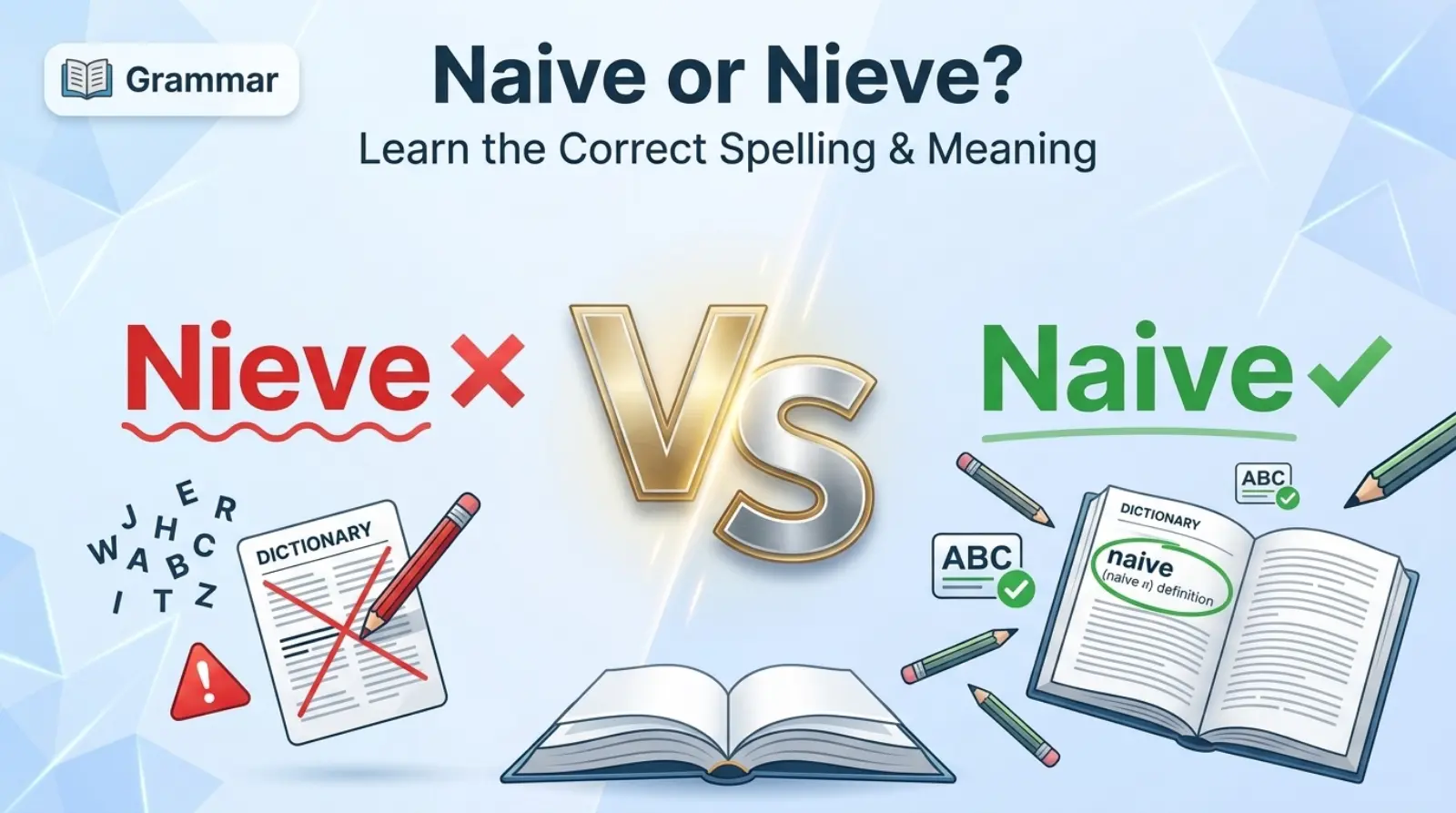
Naive or nieve is a common spelling question that confuses many English learners and native speakers. The two words look very similar. However, only one spelling is correct in standard English.
Many people type “nieve” because it sounds similar to “naive.” Spell check tools often catch the mistake, but it still appears in emails, essays, and social media posts.
In this guide, you will learn the correct spelling, meaning, pronunciation, examples, and common mistakes. You will also discover simple tricks to remember the right spelling forever.
By the end of this article, you will know exactly when and how to use naive with confidence.
Quick Summary
- Correct spelling: Naive
- Incorrect spelling: Nieve
- Meaning: Someone who is innocent or lacks experience.
- Part of speech: Adjective
- Pronunciation: ny-EEV
- Remember: “Naive” contains AI, not IE.
- Use: Writing, speaking, school, business, and everyday conversations.
What Does Naive Mean?
The word naive describes a person who trusts others too easily or lacks experience about how the world works.
Being naive is not always bad. Sometimes it simply means someone is honest, innocent, or inexperienced.
Simple definition
Naive means innocent, trusting, or lacking experience.
Example sentences
- She was too naive to believe the scam.
- The young student asked a naive question.
- His naive view changed after working for several years.
- They made a naive decision without enough research.
Is It Naive or Nieve?
The correct spelling is naive.
The spelling nieve is incorrect when you mean someone who is innocent or inexperienced.
| Word | Correct? | Meaning |
| Naive | Yes | Innocent or lacking experience |
| Nieve | No | Misspelling of naive |
Whenever you write about someone’s innocence or lack of experience, choose naive.
Why Do People Write “Nieve”?
Many writers accidentally type nieve because of English spelling patterns.
Here are the main reasons:
- The pronunciation sounds confusing.
- Many English words use “ie.”
- People type quickly.
- Auto-correct does not always catch every typo.
- Some learners confuse it with foreign-language words.
Fortunately, the mistake is easy to avoid once you know the correct spelling.
Easy Trick to Remember the Correct Spelling
A simple memory trick can help.
Remember this sentence:
Naive has AI because an innocent person still has a lot to learn from AI… and life!
Another easy trick:
- Think of naive as NA + IVE
- Never write NIEVE
The more you write naive, the easier it becomes to remember.
How to Pronounce Naive
The standard pronunciation is:
ny-EEV
Some dictionaries also show it as:
nah-EEV
Both are accepted depending on accent.
Real-Life Examples of Naive
Here are examples from daily life.
School
A new student may be naive about school rules.
Workplace
A beginner employee might make naive assumptions.
Online Safety
Someone can be naive enough to click a fake website.
Relationships
A person may have naive expectations in their first relationship.
Investing
New investors sometimes make naive financial decisions.

Naive in Everyday Conversations
People often use naive in casual speech.
Examples:
- “I was naive when I started college.”
- “Don’t be so naive.”
- “His idea sounds a little naive.”
- “She has a naive way of looking at life.”
The word is common in conversations, books, news articles, and movies.
Common Mistakes People Make
Many writers confuse naive with similar spellings.
Incorrect
- Nieve
- Nave
- Naiive
- Naeve
Correct
- Naive
Another mistake is assuming naive always means “stupid.”
That is incorrect.
A person can be intelligent but still be naive because they lack experience.
Naive vs Innocent
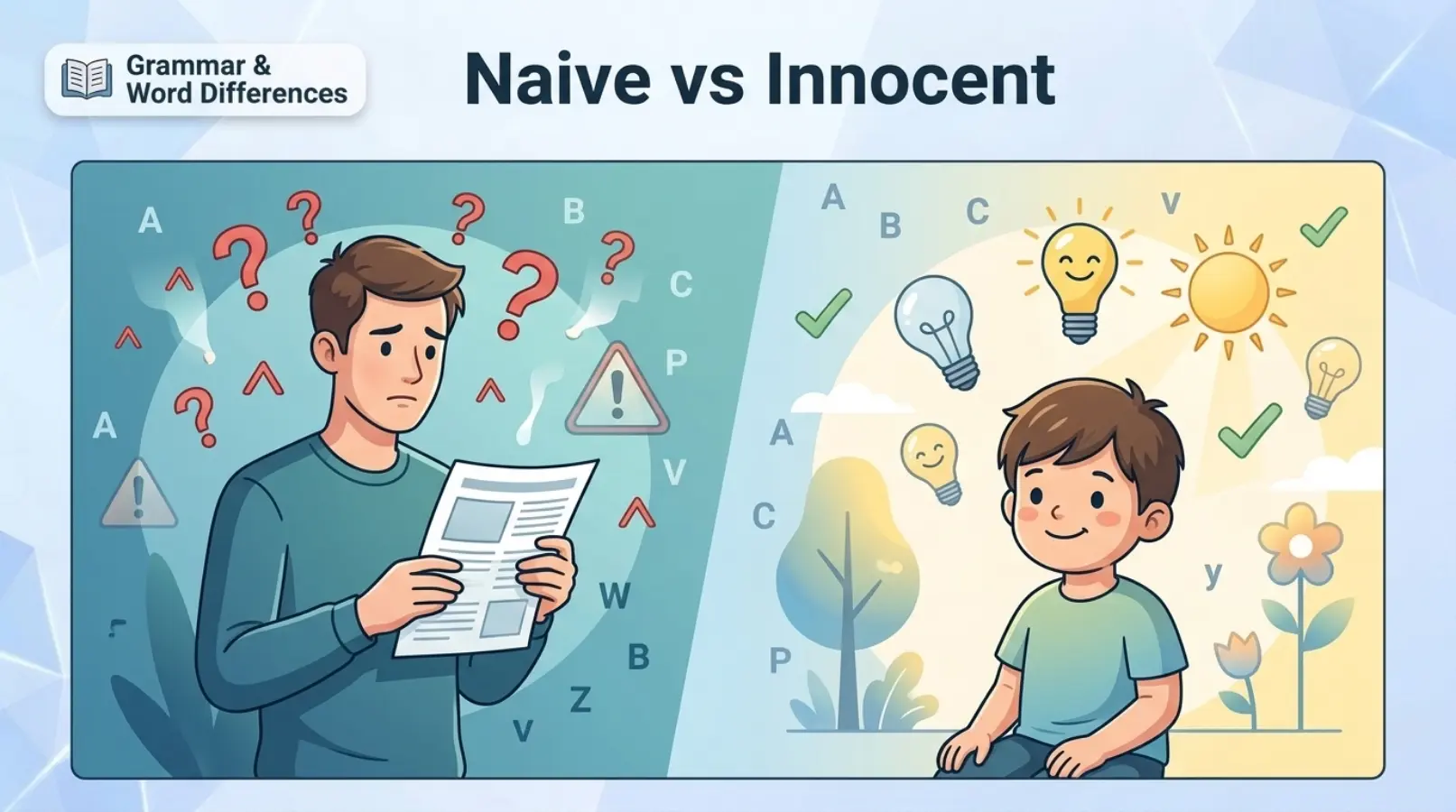
Although these words are similar, they are not identical.
| Feature | Naive | Innocent |
| Lacks experience | Yes | Sometimes |
| Trusts easily | Usually | Sometimes |
| Has no bad intentions | Often | Yes |
| Can learn through experience | Yes | Yes |
Someone can be innocent without being naive.
Likewise, someone can be naive but still very smart.
Synonyms of Naive
Using related words improves your writing.
Common synonyms
- Innocent
- Trusting
- Unsuspecting
- Gullible
- Inexperienced
- Simple
- Unsophisticated
- Childlike
- Unworldly
- Credulous
Choose the synonym that best matches your sentence.
Antonyms of Naive
Opposite words include:
- Experienced
- Wise
- Clever
- Practical
- Realistic
- Sophisticated
- Knowledgeable
- Worldly
- Cautious
When Should You Use Naive?
Use naive whenever someone lacks experience or trusts too easily.
Examples:
- Writing essays
- Business reports
- Stories
- Emails
- Social media
- Academic papers
- News articles
The word fits both formal and informal writing.
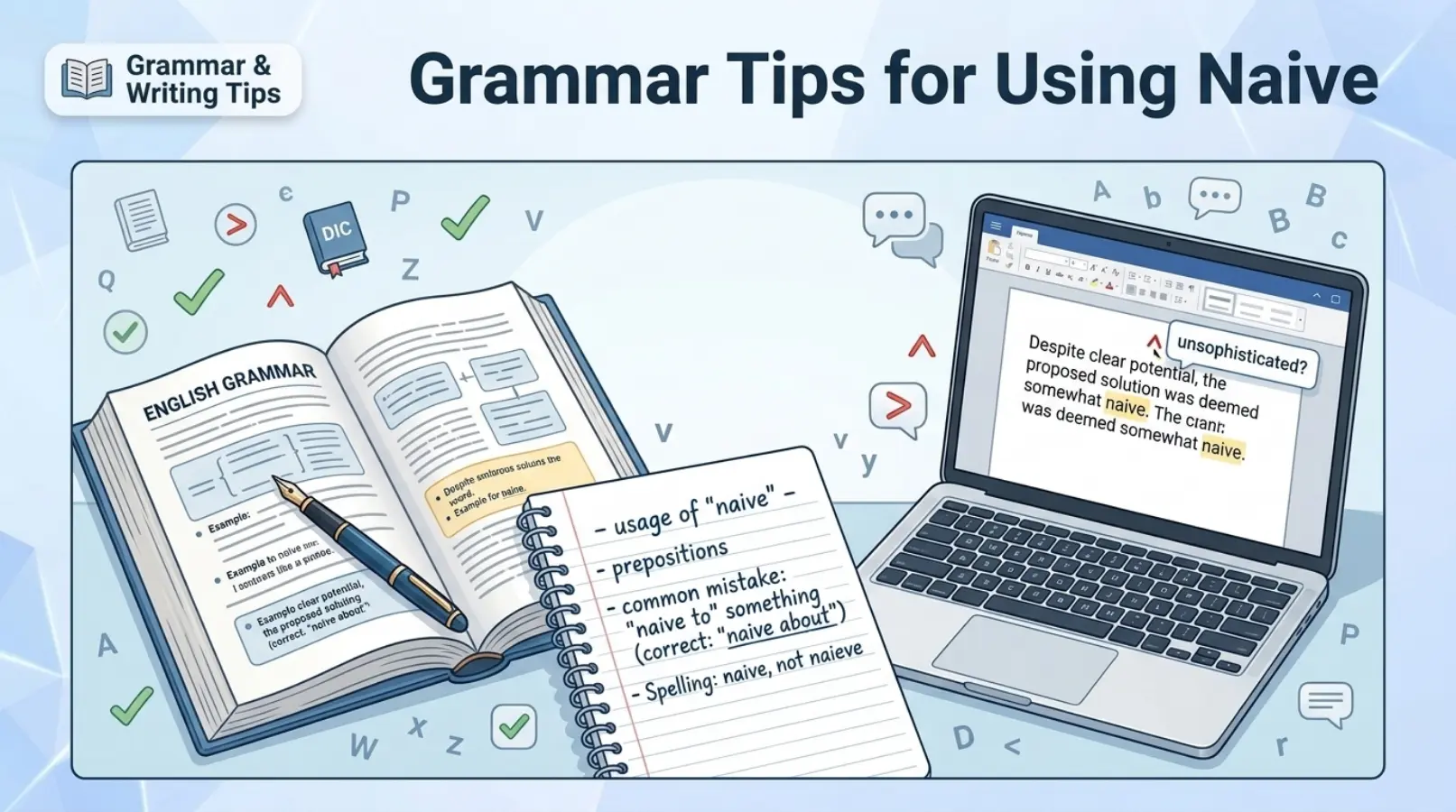
Grammar Tips for Using Naive
Naive is an adjective.
It describes a noun.
Examples:
- A naive child
- A naive investor
- A naive decision
- A naive belief
Do not use it as a verb.
Common Phrases Using Naive
English speakers often use these expressions:
- Naive belief
- Naive assumption
- Naive question
- Naive approach
- Naive mistake
- Naive thinking
- Naive optimism
- Naive expectation
These combinations appear often in books and newspapers.
Why Correct Spelling Matters
Correct spelling helps readers trust your writing.
Using naive instead of nieve offers several benefits.
- Improves readability
- Builds credibility
- Prevents confusion
- Creates professional content
Even small spelling mistakes can affect first impressions.
Expert Insights
Professional editors recommend checking confusing words before publishing.
The mistake nieve appears frequently because people rely on pronunciation instead of spelling.
Reading more books and using trusted dictionaries can improve spelling naturally.
Writers who consistently use correct spelling produce more reliable and professional content.
For bloggers, students, and business professionals, correct spelling also improves user experience and search engine optimization.
Frequently Asked Questions (FAQs)
Is naive or nieve correct?
Naive is the correct spelling. Nieve is a spelling mistake.
What does naive mean?
It means innocent, trusting, or lacking experience.
Is naive a negative word?
Not always. It can simply describe someone with little experience.
How do you pronounce naive?
It is commonly pronounced ny-EEV.
Why do people spell naive as nieve?
They often confuse the letter order because of pronunciation and common English spelling patterns.
Is naive formal or informal?
It works in both formal and informal English.
Can a smart person be naive?
Yes. Intelligence and experience are different things.
Is nieve ever correct?
Not when referring to someone who lacks experience. In English, nieve is considered a misspelling of naive.
Featured Snippet Answer
Question: Is it naive or nieve?
Answer: The correct spelling is naive. It means someone who is innocent, trusting, or lacking experience. Nieve is a common misspelling and should not be used in standard English.
Conclusion
Many people wonder if naive or nieve is the correct spelling. The answer is simple: naive is the only correct form in standard English. It describes someone who is innocent, trusting, or inexperienced. The spelling nieve is a common typo that often happens because of pronunciation or letter confusion.
A simple memory trick can help you remember the correct form. Think of naive as containing AI, not IE. With regular reading and writing, the correct spelling will become natural. If you are writing an email, school assignment, blog post, or professional document, using naive correctly makes your writing clearer and more credible.
Discover More Post:
W or L: Meaning, Uses, Examples, and When to Use Each
Spider Man Friend or Foe: Guide to the Classic Marvel Video Game