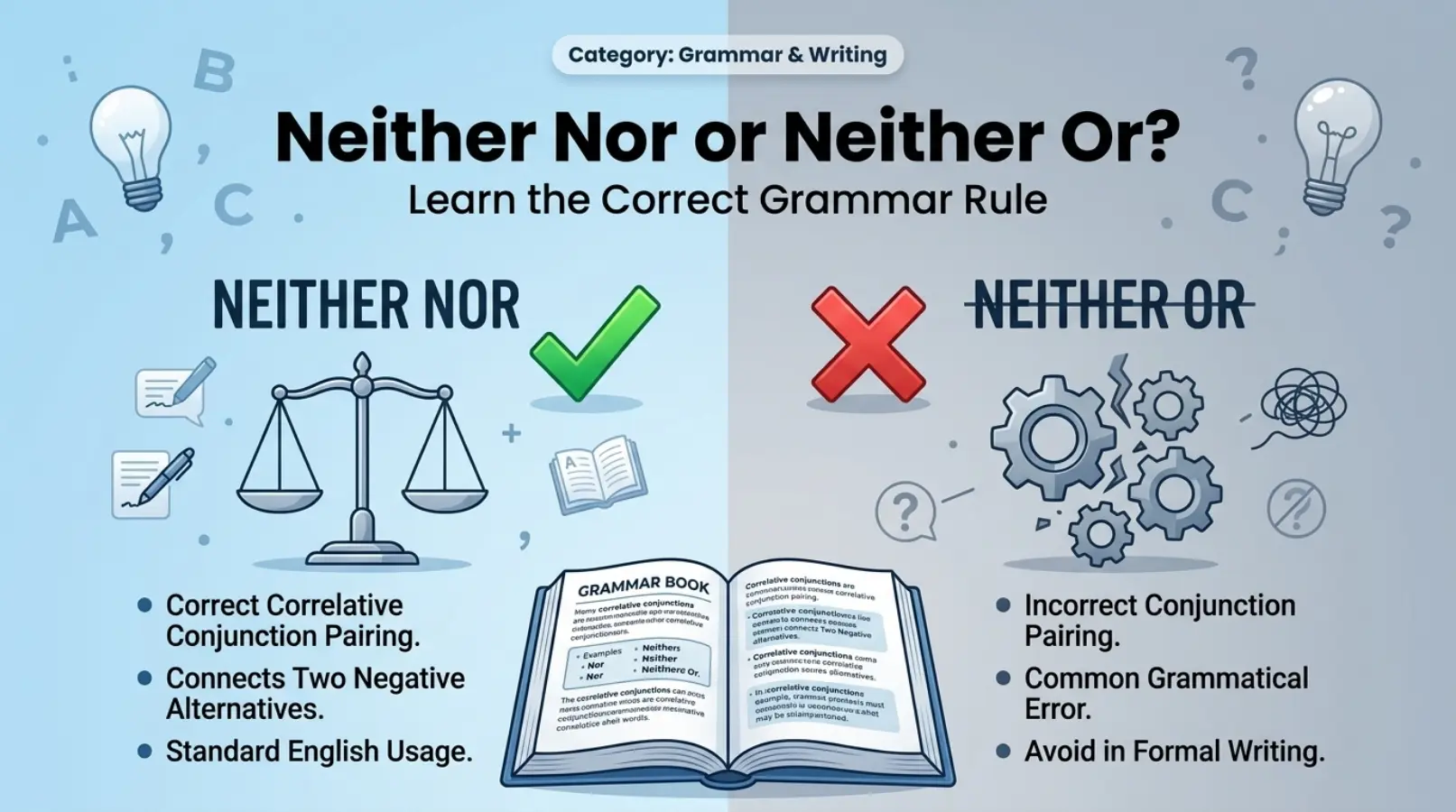
Neither nor or neither or is a common grammar question that confuses many English learners and writers. Both phrases may sound similar, but only one is grammatically correct in standard English.
Many people use these expressions when talking about two choices, options, or possibilities. However, using the wrong phrase can make your writing look less professional.
The good news is that the rule is simple. Once you learn it, you can avoid a common grammar mistake forever.
In this guide, you will learn the meaning of neither nor, why neither or is usually incorrect, how to use the phrase correctly, and examples from everyday life. By the end, you will feel confident using this grammar structure in both writing and conversation.
Quick Summary Box
- Neither nor is the correct grammatical pair.
- Neither or is generally incorrect in standard English.
- Use neither nor to connect two negative choices.
- Example: Neither John nor Sarah attended the meeting.
- Think of it as the negative version of either or.
- Use it in speaking and writing for clear communication.
What Does Neither Nor Mean?
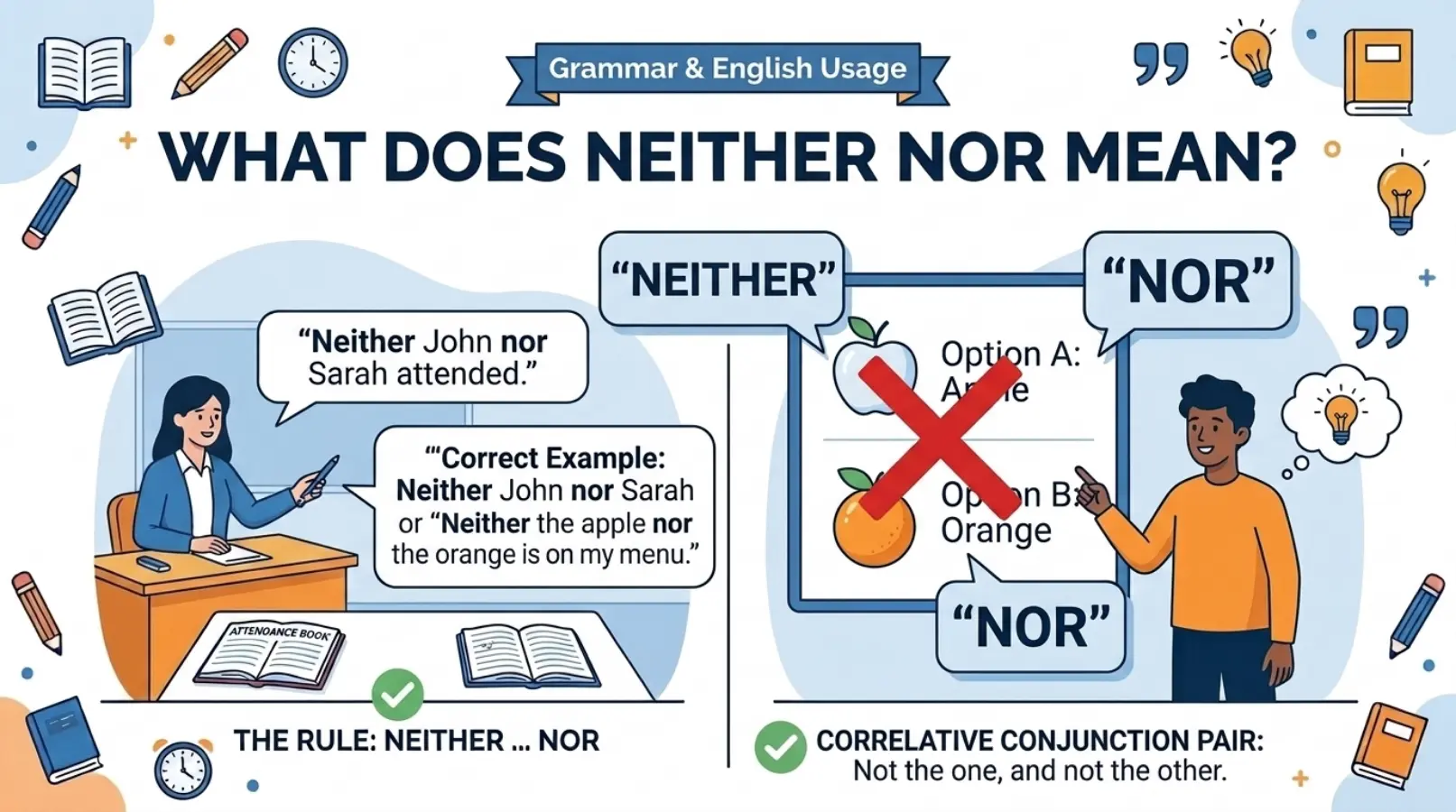
Neither nor means not one and not the other.
It connects two negative ideas in a single sentence.
Examples
- Neither tea nor coffee is available.
- Neither Alex nor Emma can come today.
- Neither option works for me.
In each example, both choices are rejected.
Is It Neither Nor or Neither Or?
The correct phrase is neither nor.
Correct
Neither Jack nor Jill went to the party.
Neither the blue shirt nor the black shirt fits me.
Incorrect
Neither Jack or Jill went to the party.
Neither the blue shirt or the black shirt fits me.
Standard grammar rules require nor after neither.
Why Is Neither Or Incorrect?
English uses fixed correlative conjunction pairs.
These pairs work together naturally.
| First Word | Correct Partner |
| Either | Or |
| Neither | Nor |
| Both | And |
| Not only | But also |
Because neither pairs with nor, using or breaks the grammatical pattern.
Example
Correct:
- Neither rain nor snow stopped the event.
Incorrect:
- Neither rain or snow stopped the event.
How to Use Neither Nor Correctly
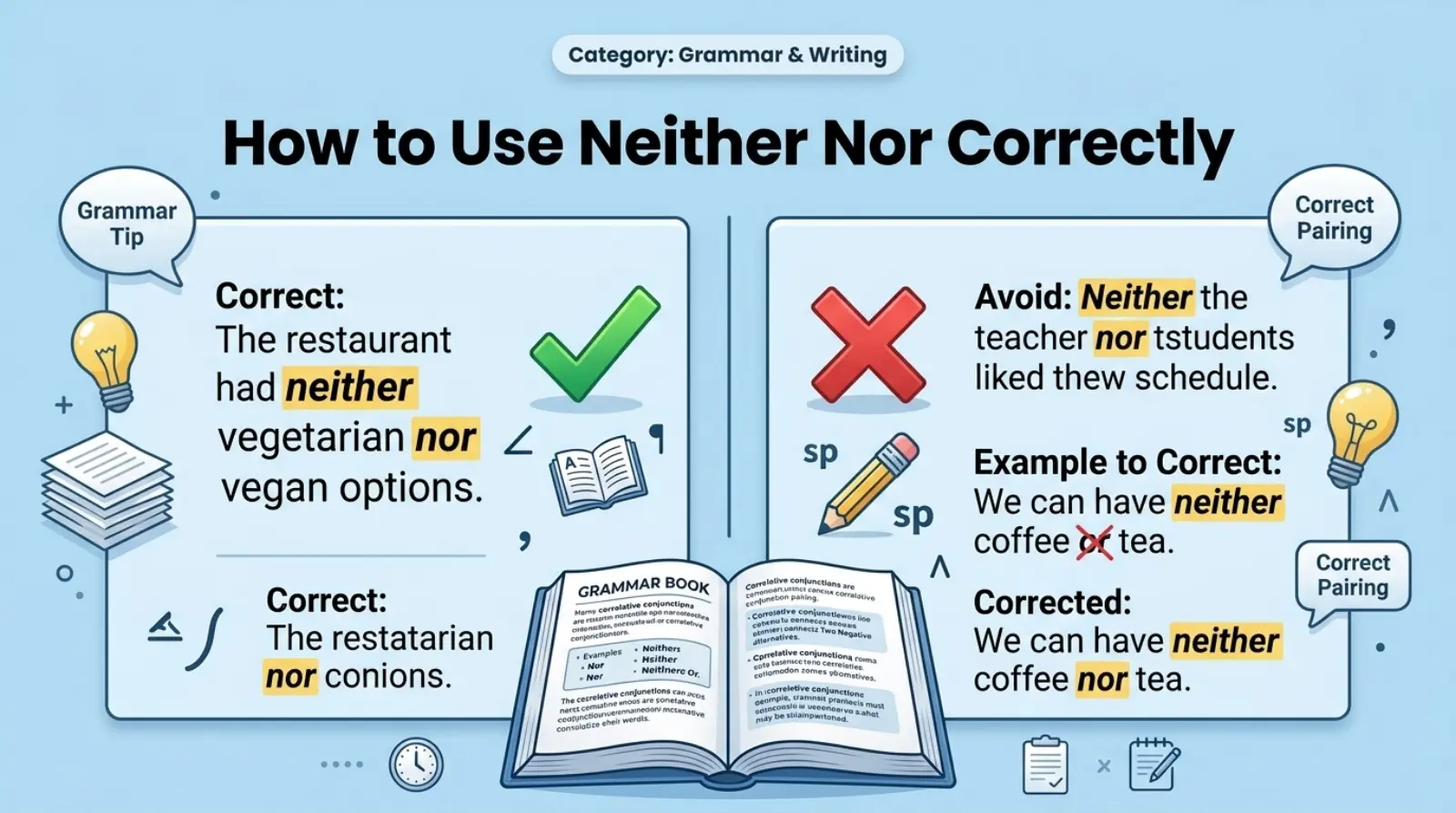
Use neither nor when discussing two negative choices.
Formula
Neither + option 1 + nor + option 2
Examples
- Neither my brother nor my sister likes spicy food.
- Neither the manager nor the employees were ready.
- Neither Monday nor Tuesday works for me.
This structure keeps sentences clear and concise.
Neither Nor vs Either Or
Many writers confuse these two expressions.
Comparison Table
| Feature | Neither Nor | Either Or |
| Meaning | Not this and not that | One choice from two |
| Tone | Negative | Positive |
| Example | Neither cats nor dogs are allowed. | Either cats or dogs are allowed. |
| Purpose | Rejects both options | Selects one option |
| Common Use | Negative statements | Choice statements |
Examples
Neither Nor
- Neither pizza nor pasta sounds good tonight.
Either Or
- Either pizza or pasta sounds good tonight.
The difference changes the meaning completely.
Real-Life Examples of Neither Nor
At School
- Neither the teacher nor the students expected the test.
At Work
- Neither the manager nor the assistant was available.
At Home
- Neither my phone nor my laptop is charging.
While Traveling
- Neither the train nor the bus arrived on time.
These examples show how often the phrase appears in daily communication.
Subject-Verb Agreement With Neither Nor
This rule causes confusion for many writers.
Usually, the verb agrees with the subject closest to it.
Examples
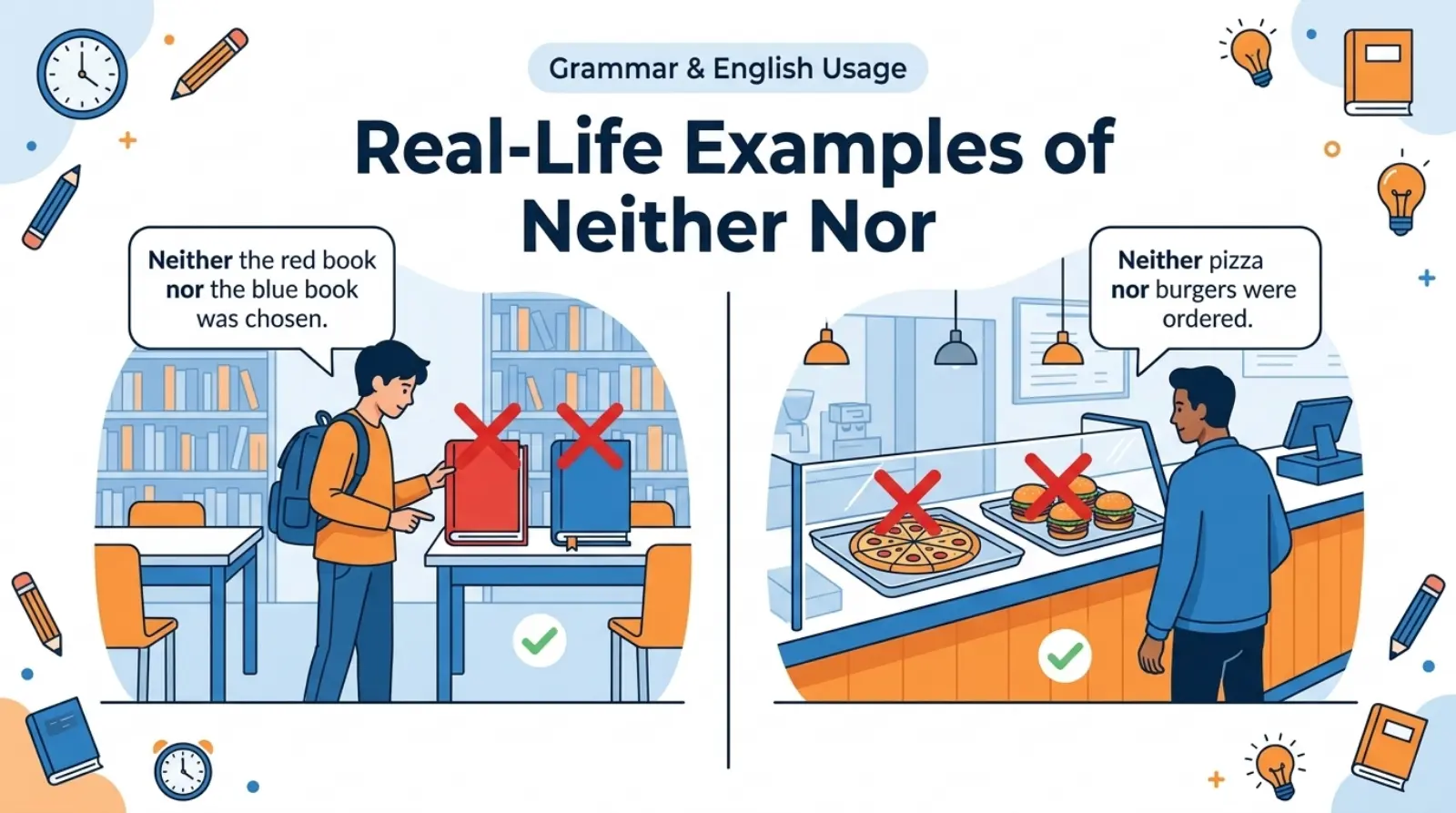
- Neither the students nor the teacher is present.
- Neither the teacher nor the students are present.
Notice how the verb changes.
Simple Tip
Look at the noun closest to the verb.
Match the verb to that noun.
Common Mistakes When Using Neither Nor
Many people make the same grammar errors.
Mistake 1: Using “Or” Instead of “Nor”
❌ Neither Tom or Jerry came.
✅ Neither Tom nor Jerry came.
Mistake 2: Using Double Negatives
❌ I don’t want neither option.
✅ I want neither option.
Mistake 3: Wrong Verb Agreement
❌ Neither the players nor the coach are ready.
✅ Neither the players nor the coach is ready.
Mistake 4: Mixing Structures
❌ Neither she likes coffee or tea.
✅ She likes neither coffee nor tea.
Neither Nor in Everyday Writing
You can use this structure in many situations.
Emails
- Neither date works for our meeting.
Academic Writing
- Neither theory explains the results fully.
Business Communication
- Neither proposal met the requirements.
Casual Conversation
- Neither movie was interesting.
Using the structure correctly makes writing sound polished and professional.
Tips and Tricks to Remember the Rule
Remembering the rule becomes easy with a few tricks.
Trick 1
Think:
Either → Or
Neither → Nor
Trick 2
The words start with similar sounds.
- Neither = Nor
- Either = Or
Trick 3
Read the sentence aloud.
If “or” sounds awkward after “neither,” replace it with “nor.”
Synonyms
- Not either
- Not one nor the other
- Not any
- None of the two
- Not this or that
Expert Insights: Why This Grammar Rule Matters
Grammar experts recommend learning correlative conjunctions early.
Why?
Because these structures appear in business writing, academic papers, emails, and everyday conversations.
Using neither nor correctly helps you:
- Write with confidence
- Avoid common grammar mistakes
- Improve professional communication
- Sound more fluent in English
- Build credibility as a writer
Small grammar improvements often create a stronger overall impression.
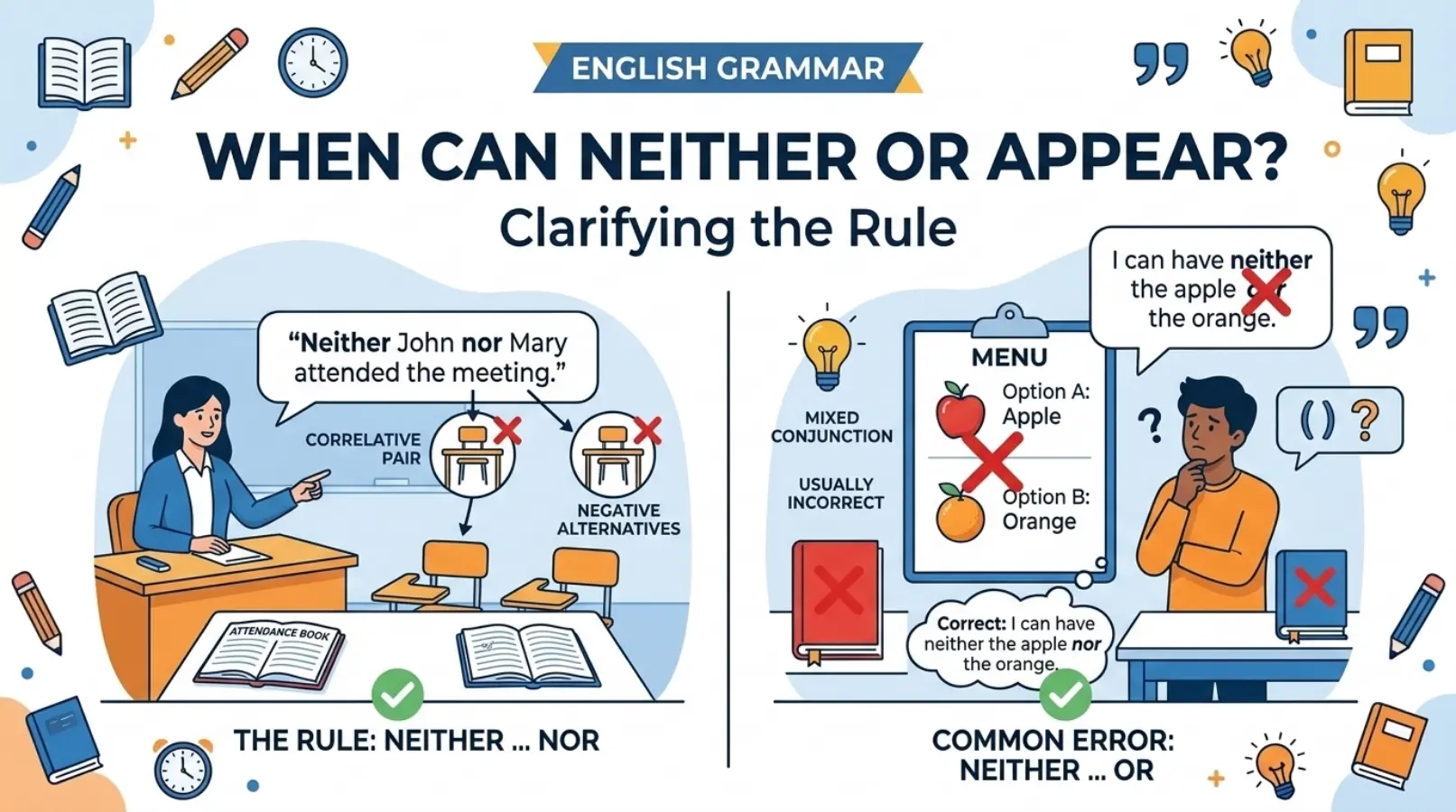
When Can Neither Or Appear?
In rare cases, you may see neither and or in the same sentence.
However, they are not functioning as the standard pair.
Example
- Neither the manager was present, or at least nobody saw him.
This structure is unusual and unrelated to the normal grammar rule.
For standard English writing, use neither nor.
Frequently Asked Questions (FAQs)
Is it correct to say neither nor or neither or?
Neither nor is correct in standard English grammar.
Why do people say neither or?
Some speakers use it informally, but grammar guides recommend neither nor.
What is the opposite of neither nor?
The opposite expression is either or.
Can neither nor be used with more than two items?
Yes.
Example:
- Neither the red, blue, nor green option worked.
Is neither nor always negative?
Yes. It expresses a negative meaning about all listed options.
Which verb should I use with neither nor?
Use the verb that agrees with the subject closest to it.
Can I start a sentence with neither?
Yes.
Example:
- Neither solution solved the problem.
Is neither nor formal or informal?
It works in both formal and informal writing.
Neither Nor or Neither Or: Which Is Correct?
Neither nor is the correct grammatical expression. It is used to connect two negative choices or ideas. Neither or is generally considered incorrect in standard English. Example: Neither Sarah nor David attended the meeting.
Conclusion
The answer to the question “neither nor or neither or” is simple: neither nor is the correct form in standard English grammar. The phrase helps connect two negative choices and serves as the negative counterpart of either or.
Understanding this rule improves both writing and speaking. It also helps you avoid one of the most common grammar mistakes in English. Remember the easy pattern: either goes with or, and neither goes with nor.
Whether you are writing an email, an essay, or a business document, using neither nor correctly will make your communication clearer and more professional. Keep practicing with real-life examples, and this grammar rule will soon become second nature.