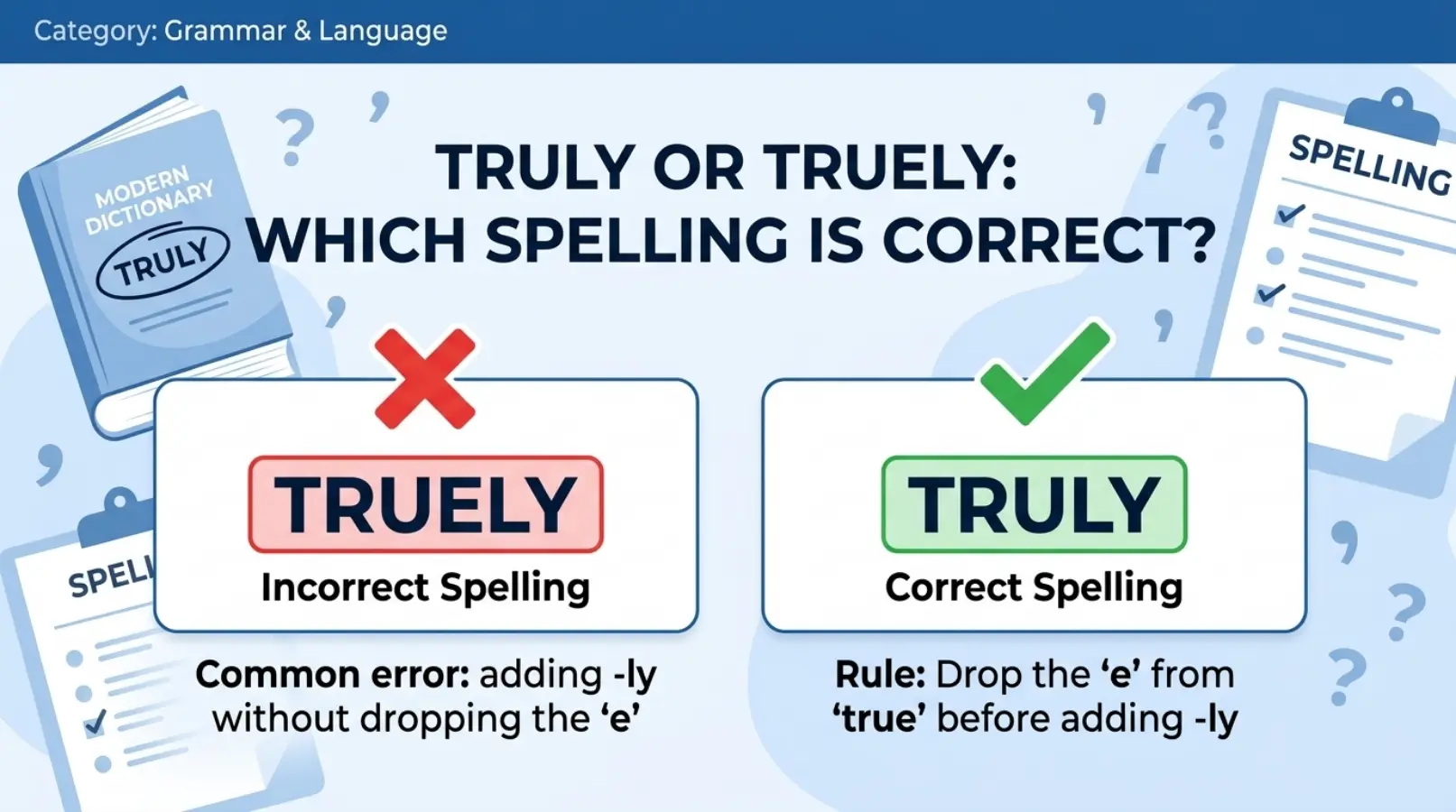
Truly or truely is a common spelling question that confuses many English learners and writers. Both words look similar, but only one is correct in standard English.
Many people assume that adding -ly to true creates truely. However, English spelling rules work differently in this case.
Understanding the correct spelling helps you write clearly and professionally. It also prevents mistakes in emails, school assignments, blog posts, and social media content.
In this guide, you’ll learn the meaning of truly, why truely is incorrect, examples of correct usage, common mistakes, and helpful memory tricks. By the end, you’ll never confuse these spellings again.
Quick Summary Box
- Truly is the correct spelling.
- Truely is incorrect in modern English.
- “Truly” means sincerely, honestly, or genuinely.
- The letter e is dropped from true before adding -ly.
- Use truly in formal and informal writing.
- Remember: true → truly, not truely.
What Does Truly Mean?
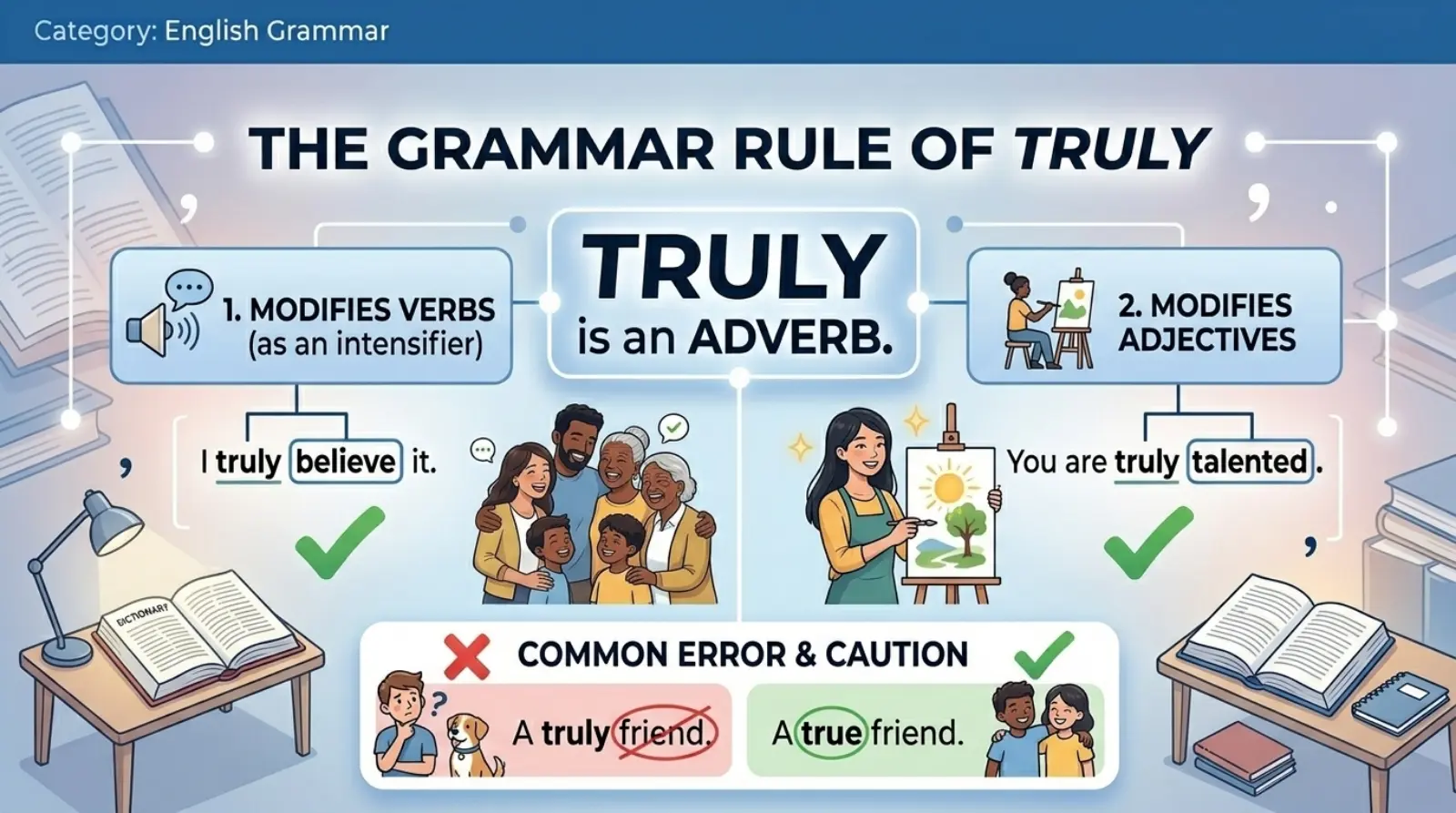
The word truly is an adverb.
It describes something done honestly, genuinely, or completely.
Simple Definition
Truly = in a truthful, sincere, or genuine way
Examples
- I truly appreciate your help.
- She truly loves her family.
- This is truly an amazing experience.
- He was truly sorry for the mistake.
In each sentence, truly adds emphasis and sincerity.
Is It Truly or Truely?
The correct spelling is truly.
Correct
Truly
Incorrect
Truely
English dictionaries recognize truly as the standard spelling.
Although truely may seem logical, it is considered a spelling error.
Example
✅ I truly enjoyed the movie.
❌ I truely enjoyed the movie.
Always use truly in professional, academic, and personal writing.
Why Is “Truely” Incorrect?
Many English words keep their final e when adding a suffix.
For example:
- Nice → Nicely
- Wise → Wisely
However, true follows a special rule.
The final e is removed before adding -ly.
Formation
- True + ly
- Remove the e
- Truly
This spelling has been accepted in English for centuries.
That is why dictionaries list truly as the only correct form.
Truly vs Truely Comparison Table
| Feature | Truly | Truely |
| Correct spelling | Yes | No |
| Found in dictionaries | Yes | No |
| Accepted in formal writing | Yes | No |
| Used in schools and exams | Yes | No |
| Recommended for professional writing | Yes | No |
| Standard English word | Yes | No |
Quick Answer
If you must choose between truly or truely, always choose truly.
How to Use Truly in a Sentence
The word truly can appear in different parts of a sentence.
At the Beginning
- Truly, this was the best day of my life.
- Truly, I did not expect that result.
In the Middle
- She truly understands the problem.
- We truly value our customers.
At the End
- I thank you truly.
- He cared for her truly.
Most writers place truly before the verb or adjective it emphasizes.
Real-Life Examples of Truly
Here are common situations where people use truly.
At Work
- We truly appreciate your business.
- Your support truly matters.
In School
- She truly enjoys learning science.
- This lesson is truly interesting.
In Relationships
- I truly trust you.
- They truly care about each other.
Online Reviews
- This restaurant is truly exceptional.
- The service was truly outstanding.
These examples show how natural and useful the word is in everyday communication.

Common Mistakes People Make
Many writers accidentally use truely because they follow the wrong spelling pattern.
Mistake 1: Keeping the Final E
❌ Truely
✅ Truly
Mistake 2: Mixing Both Spellings
Using both spellings in the same document creates inconsistency.
Mistake 3: Ignoring Spell Check
Modern spell-check tools usually flag truely as incorrect.
Mistake 4: Copying Incorrect Online Content
Some websites contain spelling errors. Always verify with trusted dictionaries.
Easy Trick to Remember the Correct Spelling
Use this simple memory trick:
Think of the Formula
True → Remove E → Truly
Visualize it like this:
TRUE
↓
Drop E
↓
TRULY
Another Memory Tip
Remember these words:
- Due → Duly
- True → Truly
Both words lose the final e before adding -ly.
This trick helps many learners remember the correct spelling instantly.
Grammar Rule Behind Truly
English spelling rules often change when suffixes are added.
General Rule
Many words ending in e drop the e before certain suffixes.
Examples:
| Base Word | New Word |
| True | Truly |
| Due | Duly |
| Whole | Wholly |
| Awe | Awfully |
These words do not keep the final e.
As a result, truly follows a recognized English spelling pattern.
Synonyms of Truly
Using synonyms improves writing variety and SEO relevance.
Common Synonyms
- Honestly
- Genuinely
- Sincerely
- Really
- Certainly
- Indeed
- Actually
- Authentically
- Undoubtedly
- Absolutely
Examples
- I genuinely appreciate your effort.
- She honestly wanted to help.
- They sincerely thanked everyone.
Choose the synonym that best fits your context.
Usage of Truly in Daily Life
You probably use truly more often than you realize.
Emails
- I truly appreciate your response.
Text Messages
- I truly miss you.
Social Media
- This is truly incredible.
Business Communication
- We are truly grateful for your support.
Academic Writing
- The study produced truly remarkable results.
Because it expresses sincerity, truly fits many situations.
Expert Insights: Why Correct Spelling Matters
Correct spelling affects credibility.
When readers notice spelling mistakes, they may question your expertise.
Why “Truly” Matters
- Improves professional communication
- Builds trust with readers
- Enhances academic writing
- Strengthens SEO content quality
- Reduces confusion
Search engines favor high-quality content. Accurate spelling contributes to a better user experience.
Professional writers always verify commonly confused words before publishing.
Frequently Asked Questions (FAQs)
Is truely ever correct?
No. Truely is considered a spelling mistake in standard English.
Why is truly spelled without an e?
The word true drops its final e before adding -ly.
What does truly mean?
It means honestly, sincerely, genuinely, or really.
Is truly an adverb?
Yes. Truly is an adverb.
How do you use truly in a sentence?
Example: I truly appreciate your kindness.
Do dictionaries recognize truely?
No. Major dictionaries list truly as the correct spelling.
What is the easiest way to remember truly?
Remember: True → Drop the E → Truly.
Is truly formal or informal?
It works in both formal and informal writing.
Conclusion
Understanding the difference between truly or truely is simple once you know the rule. Truly is the only correct spelling, while truely is considered incorrect in modern English. The word comes from true, but the final e is removed before adding -ly.
Using the correct spelling helps improve your writing, strengthens credibility, and prevents common grammar mistakes. Whether you are writing emails, academic papers, blog posts, or social media updates, always choose truly.
A simple reminder can help: True → Drop the E → Truly. Keep this rule in mind, and you’ll never struggle with this spelling again.