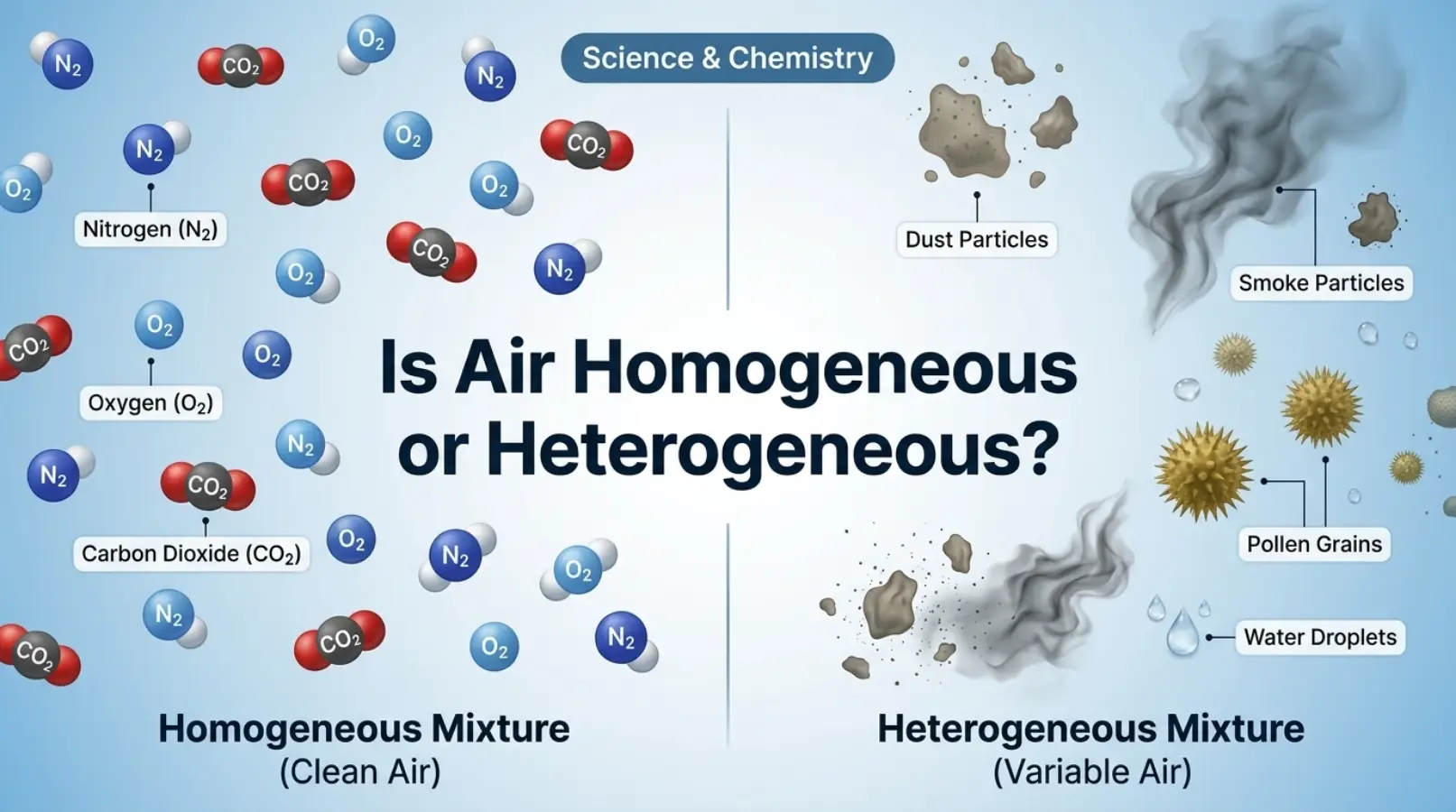
Is air homogeneous or heterogeneous? This is a common science question that many students ask. The answer may seem simple, but it depends on the situation.
In most cases, air is a homogeneous mixture. This means its gases mix evenly and look the same throughout. You cannot easily see the different gases in the air around you.
However, air can sometimes become heterogeneous. Dust, smoke, fog, and pollution can make air uneven. When this happens, different parts of the air contain different substances.
Understanding this topic helps you learn about mixtures, chemistry, and the environment. In this guide, you will discover what homogeneous and heterogeneous mixtures are, why air is usually homogeneous, and when it becomes heterogeneous.
Quick Summary Box
- Air is usually a homogeneous mixture.
- A homogeneous mixture has a uniform composition.
- Air contains nitrogen, oxygen, carbon dioxide, and other gases.
- These gases mix evenly under normal conditions.
- Air becomes heterogeneous when dust, smoke, or fog is present.
- Clean air is generally homogeneous.
- Polluted air can be heterogeneous.
- Scientists classify air based on its composition and appearance.
What Does Homogeneous Mean?
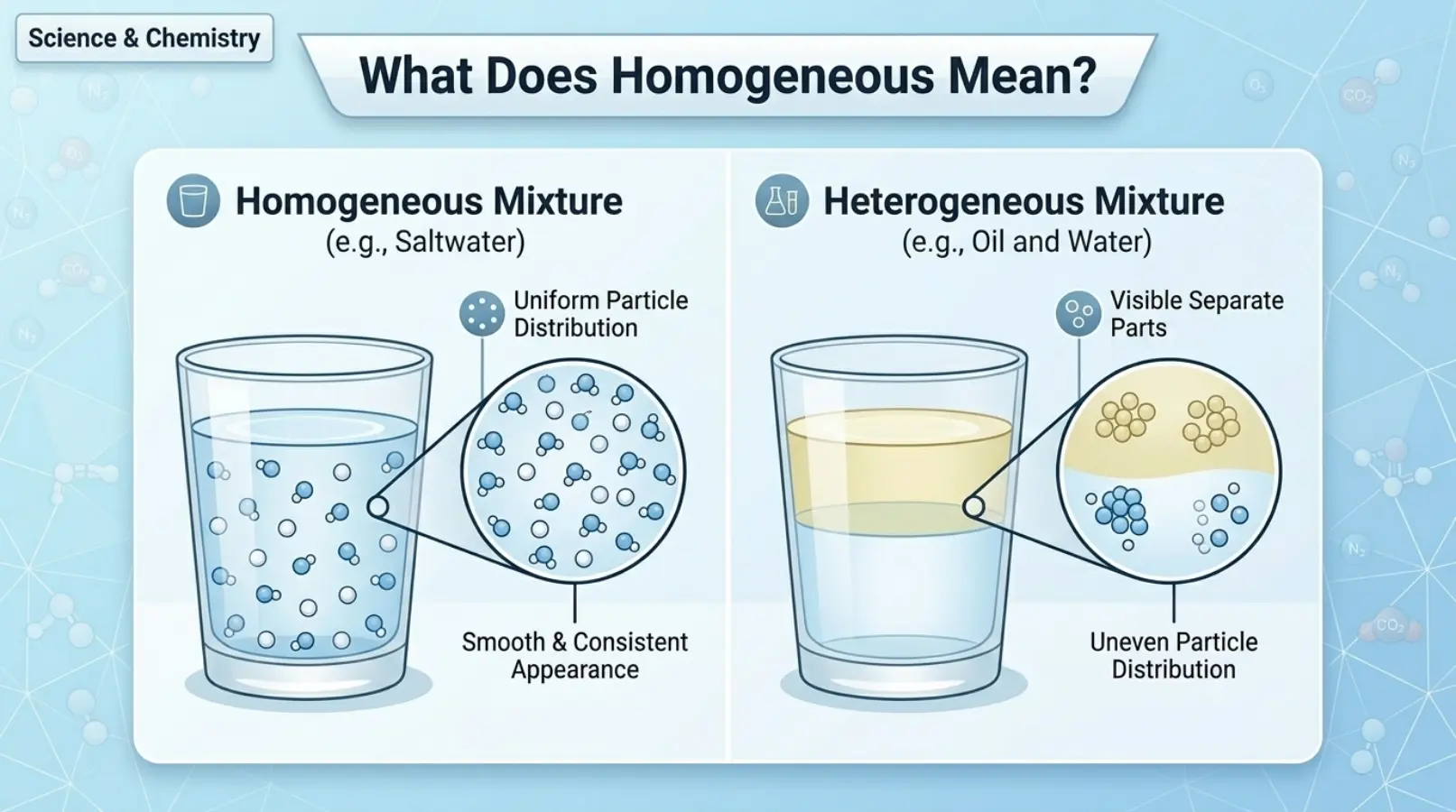
A homogeneous mixture has the same composition throughout.
You cannot easily separate its components by looking at it.
Key Features of a Homogeneous Mixture
- Uniform composition
- Same appearance throughout
- Components mix completely
- No visible boundaries
Examples
- Salt water
- Vinegar
- Air (under normal conditions)
- Sugar dissolved in water
What Does Heterogeneous Mean?
A heterogeneous mixture does not have a uniform composition.
Different parts of the mixture contain different substances.
Key Features
- Uneven composition
- Visible particles or layers
- Components do not mix fully
Examples
- Salad
- Sand and water
- Oil and water
- Muddy water
Is Air Homogeneous or Heterogeneous?
Under normal conditions, air is homogeneous.
The gases in air mix evenly. Every breath contains nearly the same proportion of gases.
Typical Composition of Air
| Gas | Approximate Percentage |
| Nitrogen | 78% |
| Oxygen | 21% |
| Argon | 0.93% |
| Carbon Dioxide | 0.04% |
| Other Gases | Trace amounts |
Because these gases distribute evenly, air appears uniform everywhere.
Therefore, scientists generally classify air as a homogeneous mixture.
Why Is Air Considered a Homogeneous Mixture?
Air qualifies as a homogeneous mixture because its components blend completely.
You cannot see separate layers of oxygen and nitrogen. Instead, the gases spread evenly through constant movement.
Reasons
- Gas molecules move freely.
- Gases mix naturally.
- No visible boundaries exist.
- Composition remains mostly uniform.
As a result, a sample of clean air from one area closely resembles air from another area.
When Does Air Become Heterogeneous?
Air can become heterogeneous when additional particles enter it.
These particles do not always distribute evenly.
Examples
- Smoke
- Dust
- Fog
- Pollen
- Industrial pollution
For example, a room filled with smoke may contain areas with higher particle concentrations. In this case, the air becomes heterogeneous.
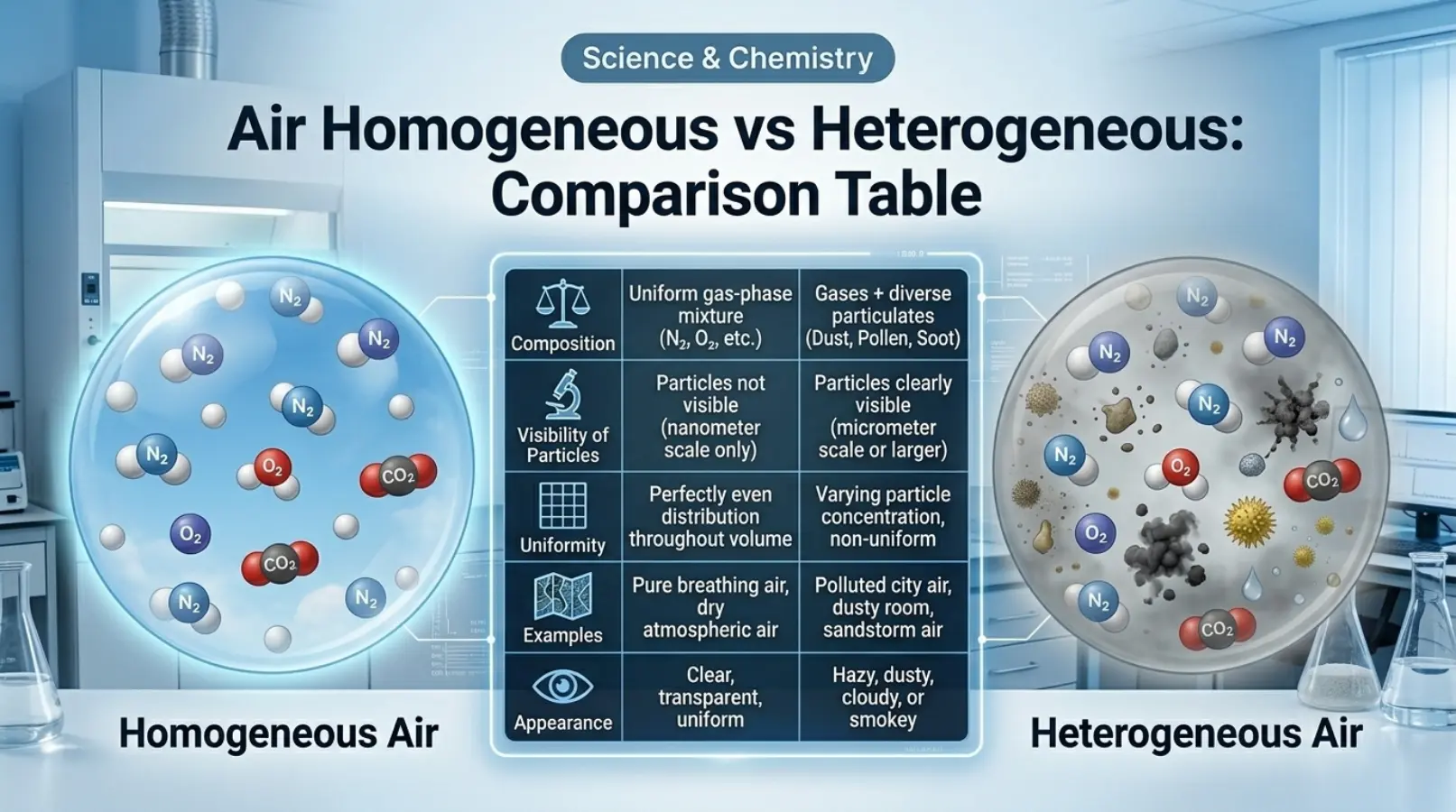
Air Homogeneous vs Heterogeneous: Comparison Table
| Feature | Homogeneous Air | Heterogeneous Air |
| Composition | Uniform | Non-uniform |
| Appearance | Same throughout | Uneven |
| Visible Particles | No | Often yes |
| Examples | Clean atmosphere | Smoky room |
| Gas Distribution | Even | Uneven |
| Classification | Homogeneous mixture | Heterogeneous mixture |
Real-Life Examples of Homogeneous Air
You encounter homogeneous air every day.
Common Examples
- Air in a clean classroom
- Fresh outdoor air
- Air in a park
- Air inside a ventilated house
- Air at high altitudes
In these situations, gases remain evenly mixed.
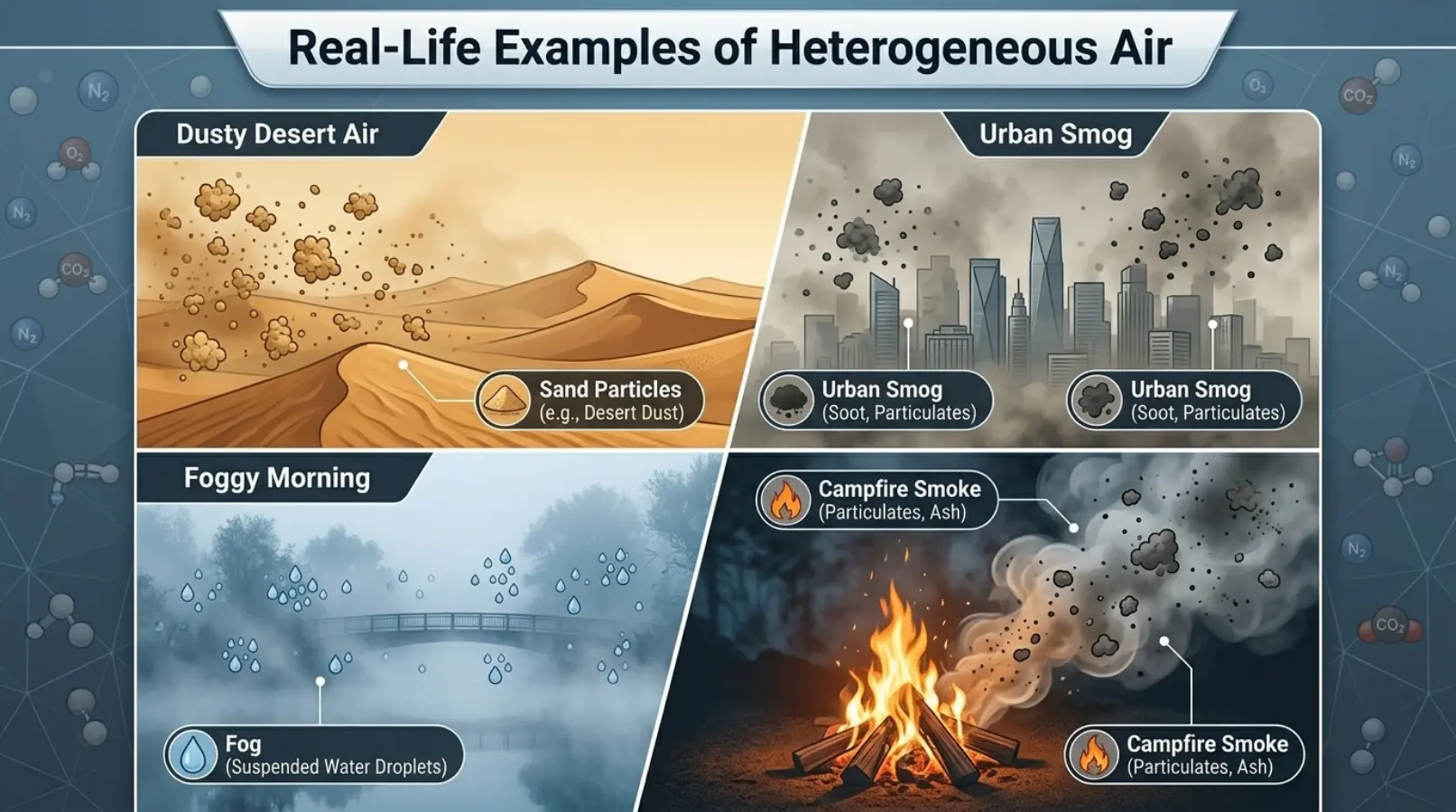
Real-Life Examples of Heterogeneous Air
Some environments contain particles that disrupt uniformity.
Common Examples
- Foggy mornings
- Dust storms
- Wildfire smoke
- Construction sites
- Polluted city streets
These conditions create uneven distributions of particles.
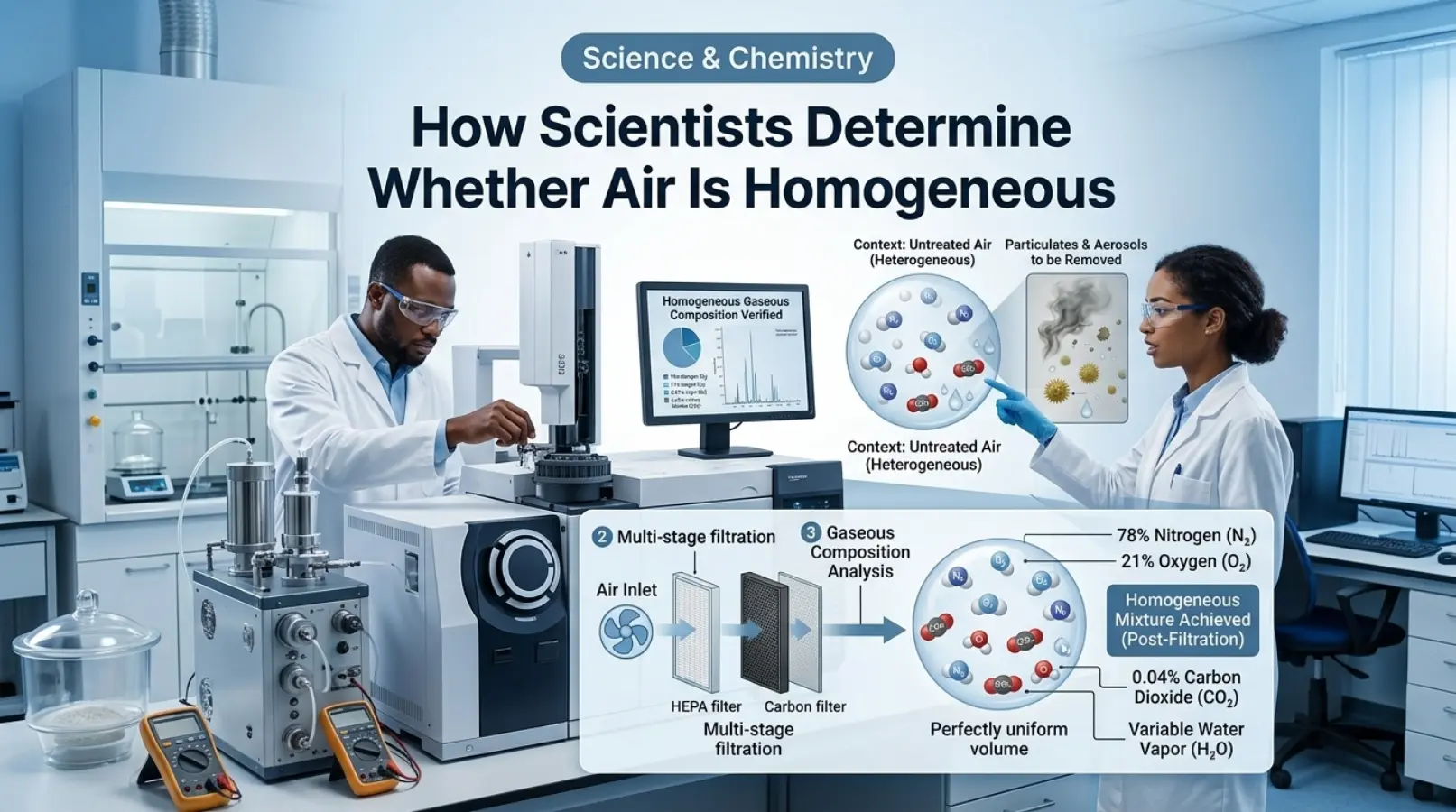
How Scientists Determine Whether Air Is Homogeneous
Scientists study the composition of air samples.
They analyze gas concentrations and particle distributions.
Methods Used
- Air quality testing
- Gas chromatography
- Environmental monitoring
- Particle counting
If the composition remains uniform, the air is classified as homogeneous.
Common Mistakes About Air Mixtures
Many students misunderstand the classification of air.
Mistake 1: Air Is a Pure Substance
Air is not a pure substance.
It contains many gases.
Mistake 2: Air Is Always Heterogeneous
Clean air is generally homogeneous.
Only certain conditions make it heterogeneous.
Mistake 3: Air Contains Only Oxygen
Air mostly contains nitrogen.
Oxygen makes up only about 21%.
Mistake 4: Invisible Means Pure
Many mixtures are invisible.
That does not make them pure substances.
Tips to Remember the Difference
Use these simple tricks.
Homogeneous
- Think “same throughout.”
- Looks uniform.
- No visible parts.
Heterogeneous
- Think “different parts.”
- Uneven composition.
- Visible particles may exist.
Easy Memory Trick
Homo = Same
Hetero = Different
This simple trick helps students remember mixture types quickly.
How This Concept Appears in Daily Life
Understanding air mixtures helps in many situations.
Environmental Studies
Scientists track pollution levels.
Weather Forecasting
Fog and smog affect air quality.
Health Awareness
Polluted air can impact breathing.
School Science
Mixture classification is a basic chemistry topic.
Synonyms
- Uniform mixture
- Non-uniform mixture
- Gas mixture
- Atmospheric mixture
Expert Insights: Why Understanding Air Matters
Chemists classify substances based on composition.
Air provides one of the best examples of a homogeneous mixture.
However, environmental conditions can change that classification.
Students who understand this concept find chemistry easier. They can also better understand pollution, weather, and air quality reports.
The key lesson is simple. Classification depends on how evenly substances mix.
This idea appears throughout science and everyday life.
Frequently Asked Questions (FAQs)
Is air homogeneous or heterogeneous?
Air is generally a homogeneous mixture because its gases mix evenly.
Why is air considered homogeneous?
Its components distribute uniformly throughout the mixture.
Can air become heterogeneous?
Yes. Dust, smoke, fog, and pollution can make air heterogeneous.
Is air a pure substance?
No. Air contains multiple gases mixed together.
What type of mixture is clean air?
Clean air is a homogeneous mixture.
Is polluted air homogeneous?
Not always. Heavy pollution often creates a heterogeneous mixture.
What gases are found in air?
Nitrogen, oxygen, argon, carbon dioxide, and trace gases.
Is foggy air homogeneous?
No. Fog contains water droplets that make the mixture heterogeneous.
Conclusion
So, is air homogeneous or heterogeneous? The correct answer is that air is usually a homogeneous mixture. Its gases mix evenly, creating a uniform composition throughout the atmosphere. Because of this uniform distribution, scientists classify clean air as homogeneous.
However, special conditions can change this classification. Dust, smoke, fog, and pollution can create uneven distributions of particles. When that happens, air becomes heterogeneous.
The easiest way to remember the difference is simple: homogeneous means the same throughout, while heterogeneous means different throughout. Understanding this concept helps students learn chemistry, environmental science, and everyday observations more effectively. In most situations, when asked whether air is homogeneous or heterogeneous, the correct answer is homogeneous.