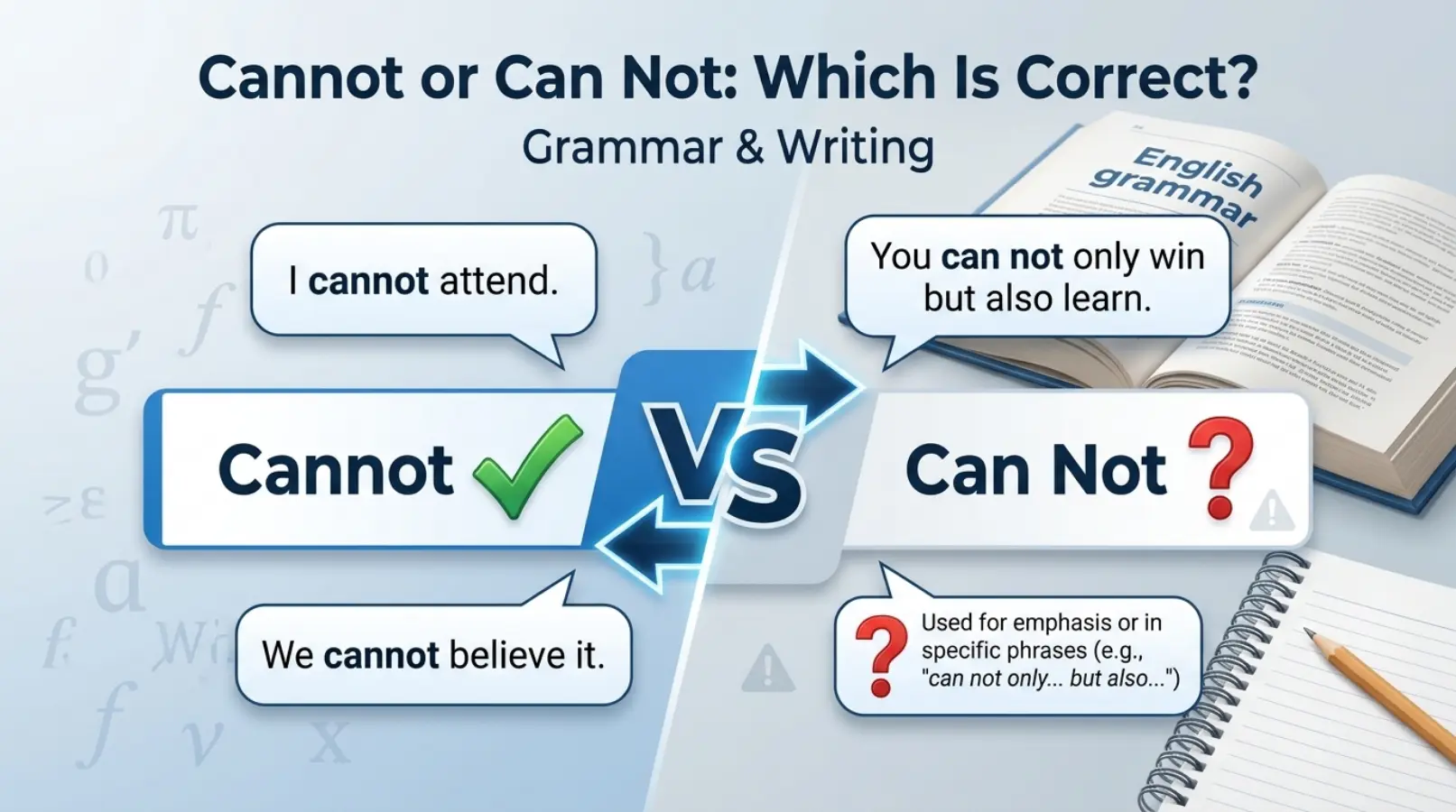
Cannot or can not is a common grammar question that confuses many English learners and writers. Although both forms exist, cannot is the standard spelling in most situations. The two-word form can not is only correct in specific cases where you want to emphasize the word not or use phrases like “not only.”
Knowing when to use cannot or can not helps you write more clearly and avoid common mistakes. In this guide, you’ll learn the difference between the two forms, when each one is correct, real-life examples, and simple tips to remember the right choice. By the end, you’ll be able to use cannot and can not with confidence in both formal and everyday writing.
Quick Summary Box
- Cannot is the standard spelling in modern English.
- Can not is correct only in special situations.
- Use cannot when you mean “not able to.”
- Use can not when “not” belongs to another word or phrase.
- Can’t is the common contraction of cannot.
- In formal writing, cannot is usually the best choice.
What Does “Cannot or Can Not” Mean?
Both cannot and can not relate to the verb can, which expresses ability or possibility.
The difference is how they function.
- Cannot means is not able to.
- Can not separates can and not because not modifies another part of the sentence.
Examples
I cannot swim.
She cannot attend the meeting.
You can not only learn English but also speak it well.
Notice the last example. Here, not belongs to only, so can not is correct.
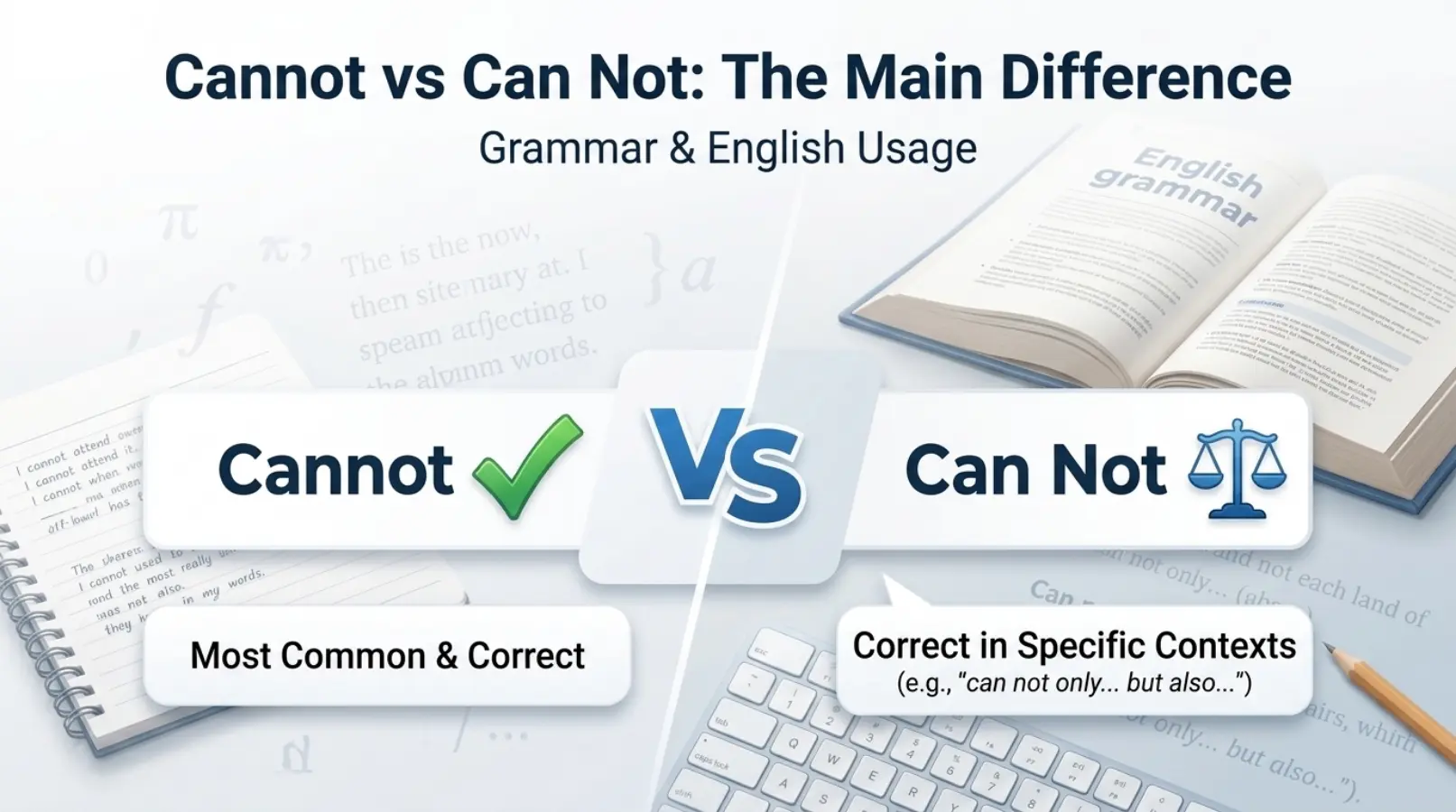
Cannot vs Can Not: The Main Difference
| Feature | Cannot | Can Not |
| Standard spelling | Yes | Usually no |
| Most common choice | Yes | Rare |
| Means “not able to” | Yes | Sometimes |
| Used in formal writing | Yes | Rarely |
| Used before “only” or similar expressions | No | Yes |
Simple Rule
If you can replace the phrase with can’t, use cannot.
Why “Cannot” Is More Common
Modern English style guides recommend writing cannot as one word.
Most dictionaries, grammar books, and editors prefer it.
Examples
- I cannot believe it.
- We cannot wait any longer.
- He cannot answer the question.
- They cannot find the keys.
These examples sound natural in both formal and informal writing.
When Is “Can Not” Correct?
Although rare, can not is correct when not belongs to another word or phrase.
Most often, it appears before words like:
- only
- necessarily
- always
- completely
Examples
You can not only improve your grammar but also your vocabulary.
We can not always predict the weather.
Here, not changes the meaning of only or always, not the verb can itself.
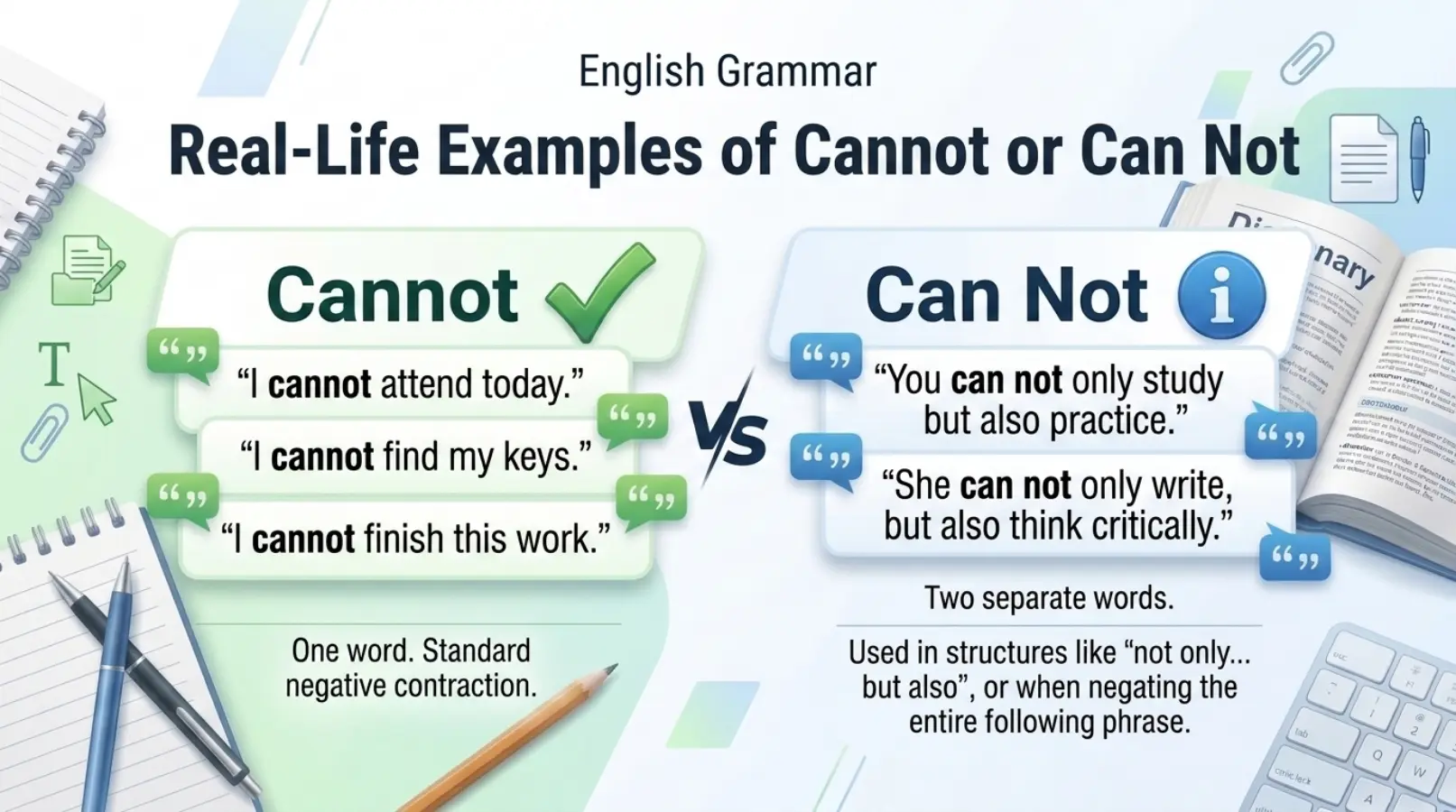
Real-Life Examples
Here are examples you may see every day.
At School
Correct:
- I cannot finish my homework today.
- She cannot answer every question.
At Work
Correct:
- We cannot approve the request.
- I cannot attend tomorrow’s meeting.
During Travel
Correct:
- You cannot park here.
- We cannot enter without tickets.
Daily Conversations
Correct:
- I cannot hear you.
- We cannot stay long.
Special Case
Correct:
- You can not only save money but also earn rewards.
Cannot vs Can’t
Many writers also wonder whether they should use cannot or can’t.
| Cannot | Can’t |
| Formal | Informal |
| Professional writing | Casual conversations |
| Academic writing | Text messages |
| Business emails | Friendly chats |
Examples
Formal:
- We cannot accept late submissions.
Informal:
- We can’t come tonight.
Both are grammatically correct. The difference is the writing style.
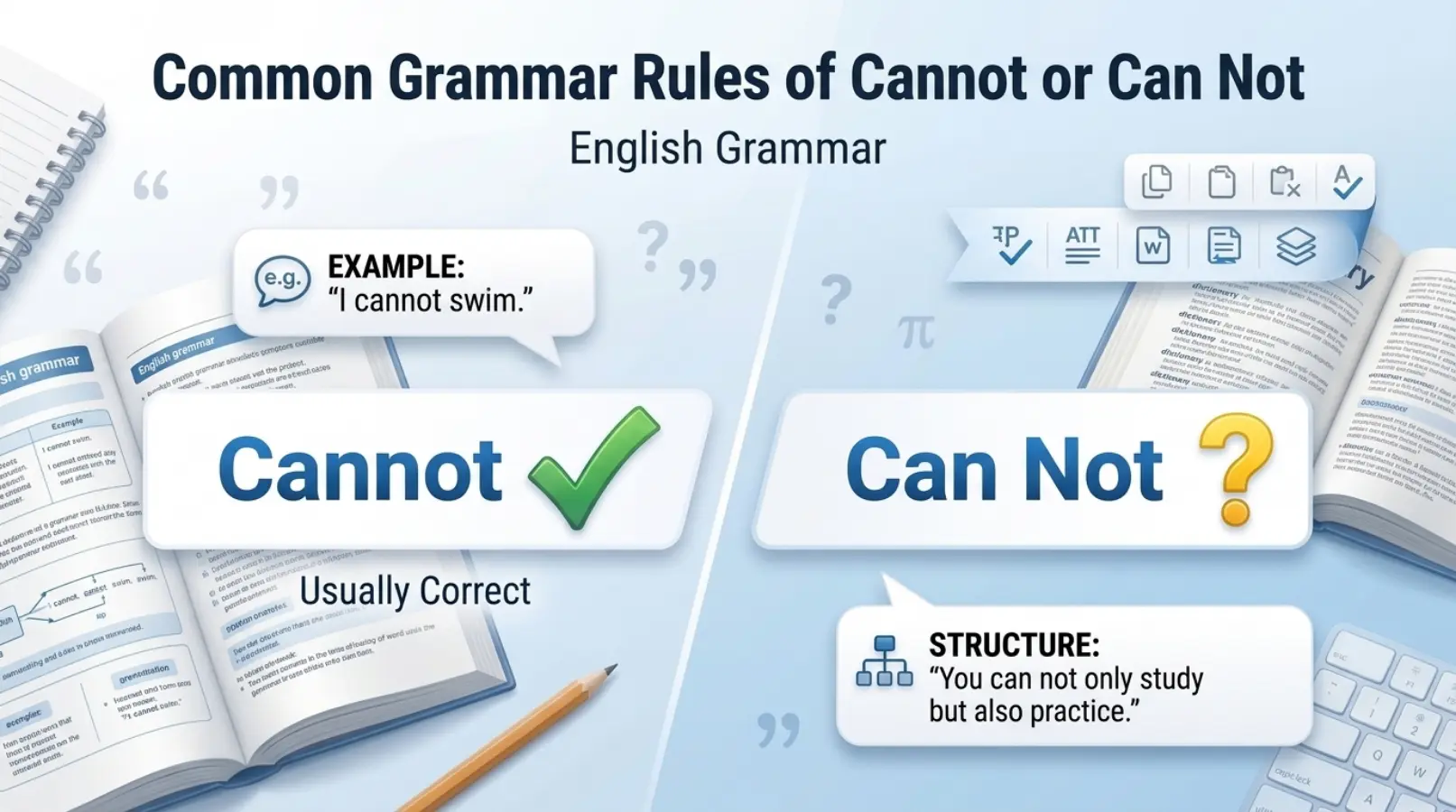
Common Grammar Rules
Remember these simple rules.
Rule 1
Use cannot for almost every negative sentence.
I cannot drive.
Rule 2
Use can’t in casual speech.
I can’t help you today.
Rule 3
Use can not only when not belongs to another word.
You can not only learn but also teach.
Rule 4
Avoid writing can not if you simply mean cannot.
I can not swim.
I cannot swim.
Common Mistakes to Avoid
Many writers make these errors.
Mistake 1
❌ I can not understand.
✅ I cannot understand.
Mistake 2
❌ She can not come today.
✅ She cannot come today.
Mistake 3
Using can’t in formal documents.
Instead write:
✅ The company cannot guarantee delivery.
Mistake 4
Writing cannot only.
Correct version:
can not only
Example:
You can not only improve your writing but also your speaking.
Easy Memory Trick
Ask yourself this question:
Can I replace it with “can’t”?
If yes:
➡ Use cannot.
Example:
I cannot swim.
↓
I can’t swim.
Works perfectly.
Now try this:
You can not only sing but also dance.
↓
You can’t only sing but also dance.
The meaning changes.
So can not stays separate.
Usage in Daily Life
You will often use cannot in these situations:
- Emails
- Homework
- Exams
- Reports
- Business letters
- Blog articles
- Academic papers
You may see can not mostly in expressions like:
- can not only
- can not always
- can not necessarily
Synonyms
- unable to
- not able to
- impossible to
- incapable of
Expert Insights
Professional editors and grammar experts generally recommend using cannot in almost every situation.
Here are some best practices:
- Choose cannot in professional writing.
- Use can’t for friendly conversations.
- Use can not only when grammar requires it.
- Proofread your writing before publishing.
- Follow a trusted style guide for consistency.
Using the correct form makes your writing clearer and more professional.
Real-Life Scenario
Imagine you are writing an email to your manager.
Incorrect:
I can not attend tomorrow’s meeting.
Correct:
I cannot attend tomorrow’s meeting.
Now imagine you are giving a presentation.
Correct:
This software can not only reduce costs but also improve efficiency.
Both sentences are correct because they follow different grammar rules.
Frequently Asked Questions (FAQs)
Is “cannot” one word or two?
Usually, cannot is one word and is the preferred spelling.
Is “can not” ever correct?
Yes. It is correct when not belongs to another word, such as only.
Which is more common, cannot or can not?
Cannot is far more common in modern English.
Can I use “can’t” instead of “cannot”?
Yes. Can’t is the informal contraction of cannot.
Is “cannot” formal?
Yes. It works well in academic, business, and professional writing.
Why do grammar experts recommend “cannot”?
Because it is the standard spelling and avoids confusion.
Can I write “I can not swim”?
Generally, no. The correct form is I cannot swim.
Is “cannot” accepted worldwide?
Yes. Both American and British English recognize cannot as the standard spelling.
Conclusion
The choice between cannot or can not becomes simple once you know the grammar rule. In almost every situation, cannot is the correct spelling. It clearly means not able to and is accepted in both American and British English. The two-word form can not appears only in special cases when not modifies another word, such as in the phrase can not only.
When writing emails, essays, reports, or blog posts, choose cannot unless there is a clear grammatical reason to separate the words. This small change makes your writing look polished and professional. Remember the simple test: if you can replace it with can’t, then cannot is the right choice.
Discover More Post:
For Better or Worse: Meaning, Origin, Examples, and How to Use It
Layed or Laid: Which Is Correct? Meaning, and Grammar Rules