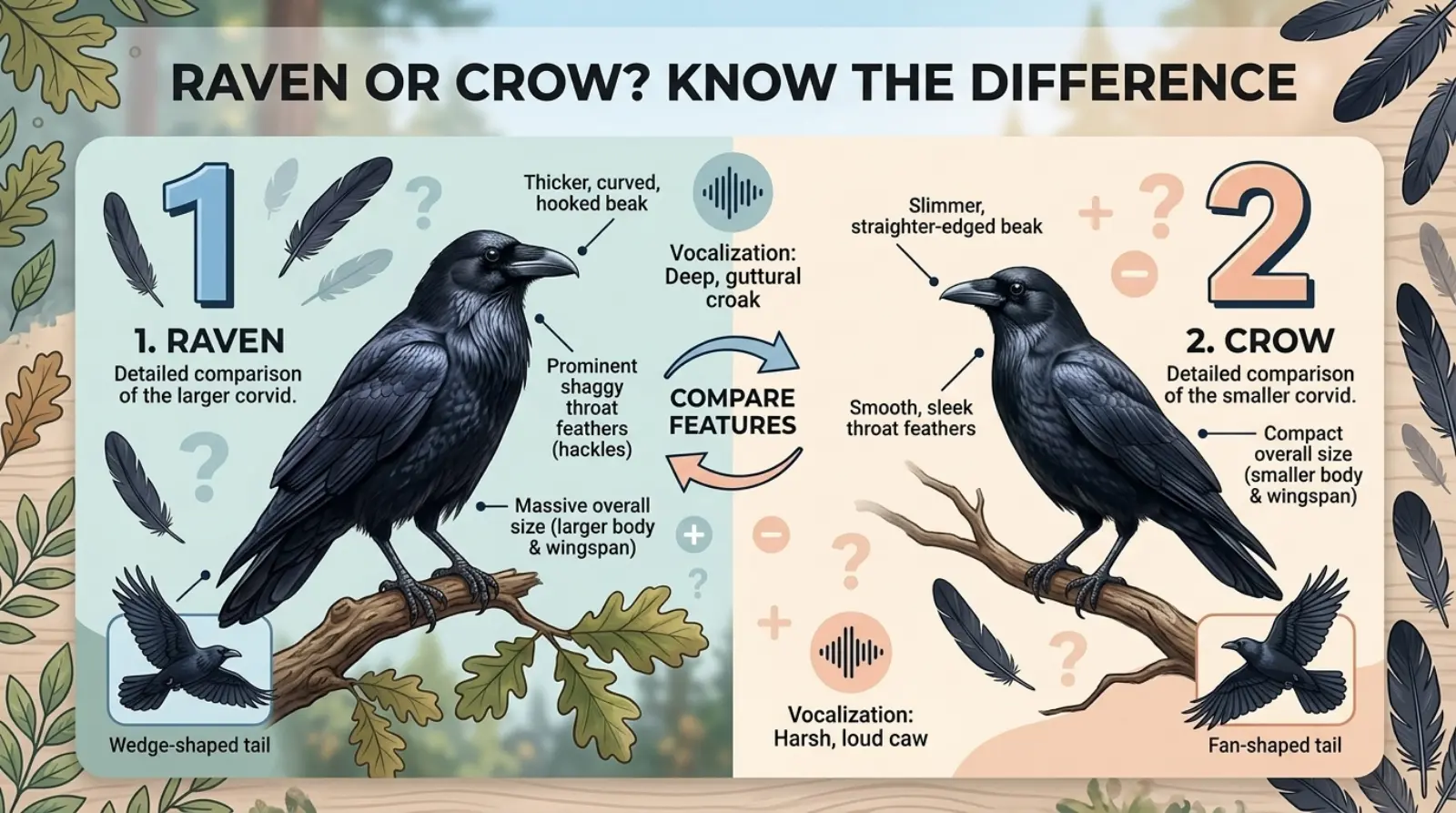
Raven or crow is a common question many bird lovers ask. At first glance, these black birds look almost the same. However, they have many differences.
Both ravens and crows belong to the same bird family. They are highly intelligent and can solve problems. Yet, they differ in size, behavior, sounds, and appearance.
Knowing the difference helps bird watchers, nature lovers, and students identify them correctly. It also helps you understand their role in nature.
In this guide, you will learn simple ways to tell a raven from a crow. You will also discover interesting facts, common mistakes, and expert tips.
By the end, you will easily recognize whether you’re looking at a raven or a crow.
Quick Summary Box
Raven or Crow at a Glance
- Both are members of the corvid family
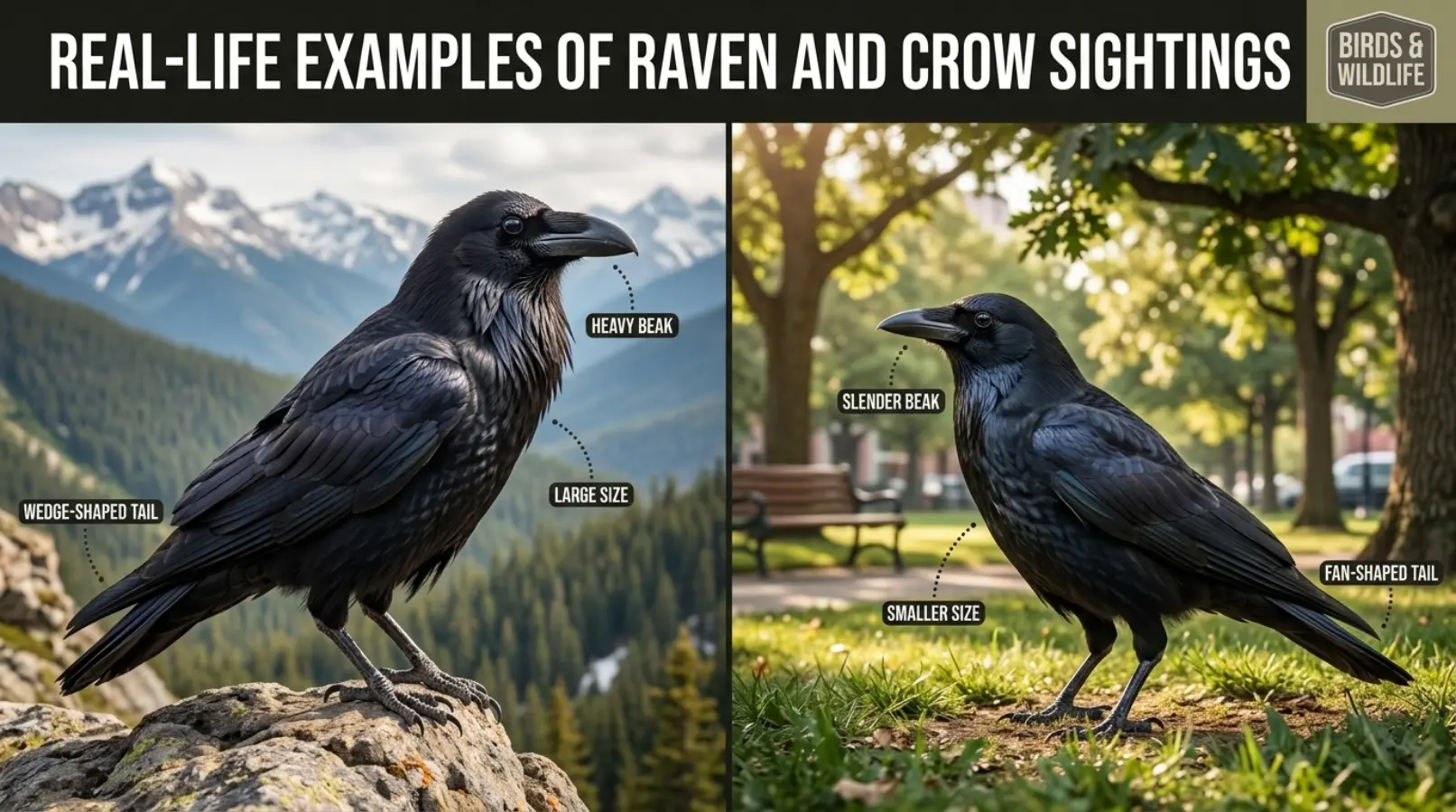
- Ravens are larger than crows
- Ravens have thicker beaks
- Crows make a “caw” sound
- Ravens make deep croaking sounds
- Ravens often fly alone or in pairs
- Crows usually gather in groups
- Ravens have wedge-shaped tails
- Crows have fan-shaped tails
- Both birds are highly intelligent
- Ravens generally live in wild areas
- Crows adapt well to cities and towns
What Is a Raven?
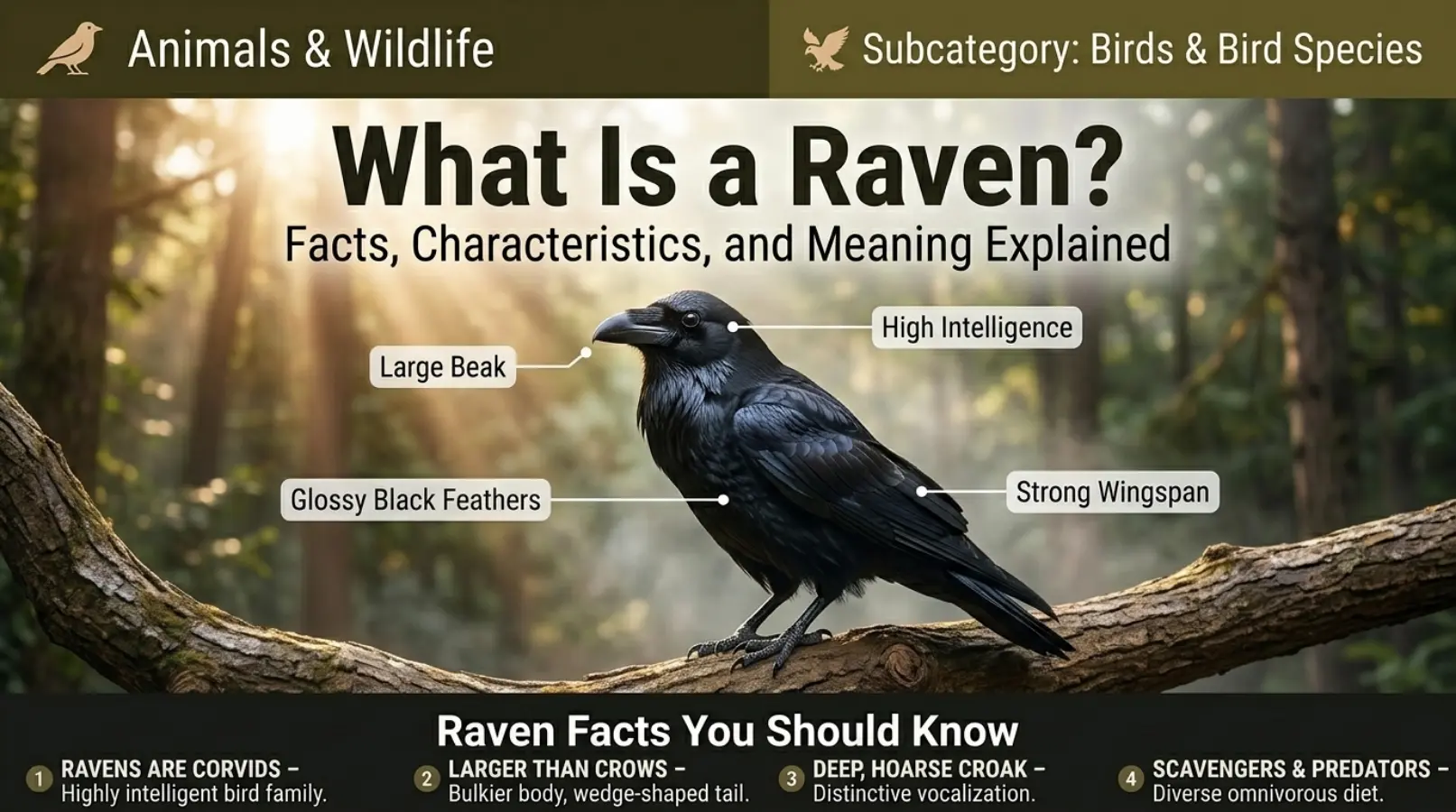
A raven is a large black bird known for its intelligence and strong survival skills.
Ravens belong to the genus Corvus. The most common species is the Common Raven.
These birds have:
- Large bodies
- Thick necks
- Heavy curved beaks
- Shaggy throat feathers
- Deep croaking calls
Ravens often live in mountains, forests, deserts, and open countryside.
What Is a Crow?
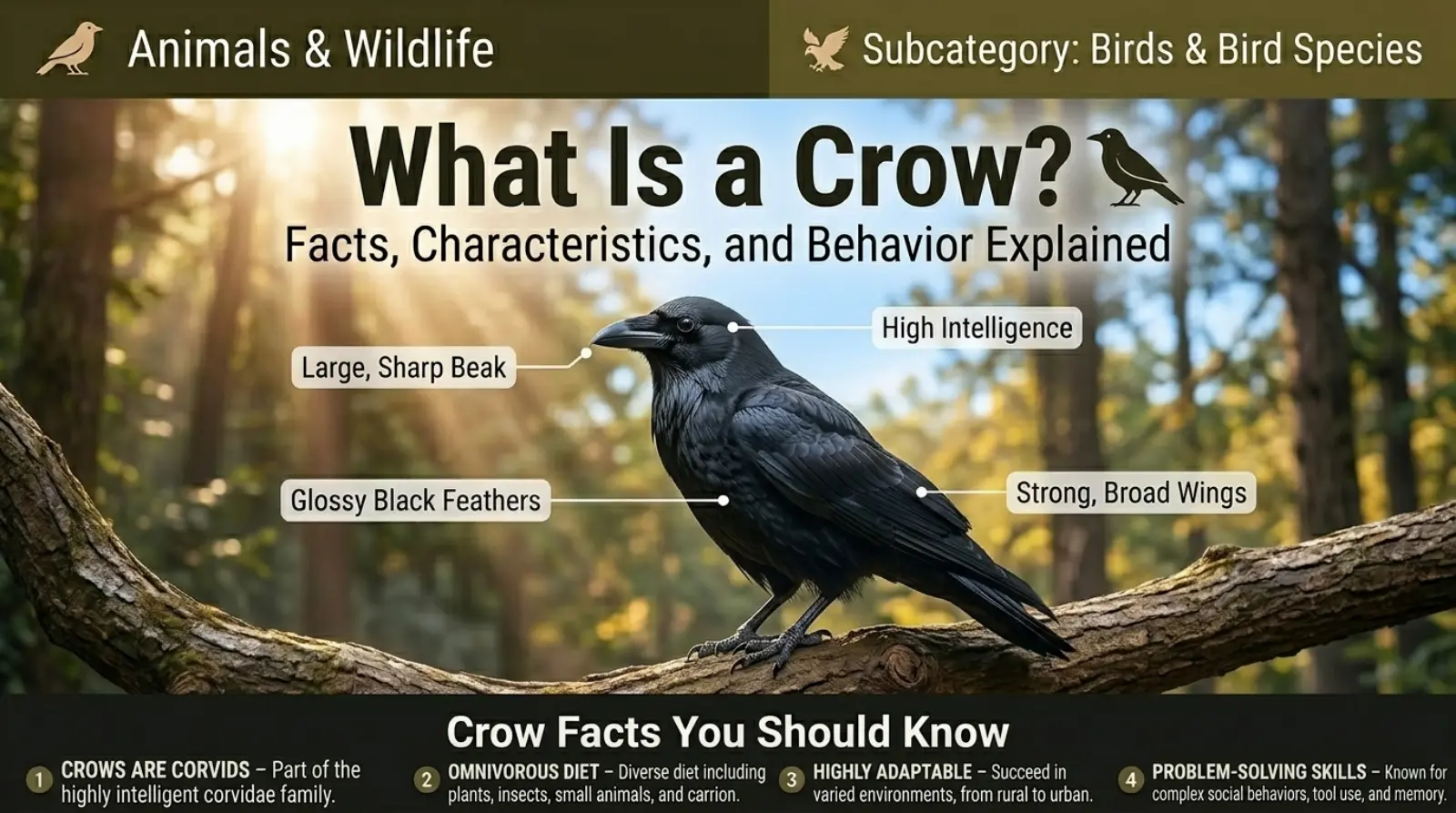
A crow is a medium-sized black bird found in many parts of the world.
Crows are also members of the Corvus genus. The American Crow is one of the best-known species.
Crows have:
- Smaller bodies
- Slimmer beaks
- Smooth throat feathers
- Loud cawing calls
- Strong social behavior
They thrive in cities, suburbs, farms, and parks.
Raven or Crow: Key Differences
Many people confuse these birds because both are black. However, several features help identify them.
Comparison Table
| Feature | Raven | Crow |
| Size | Much larger | Smaller |
| Wingspan | Up to 4 feet | Around 2.5 feet |
| Beak | Thick and curved | Slimmer and straighter |
| Tail Shape | Wedge-shaped | Fan-shaped |
| Voice | Deep croak | Sharp caw |
| Flight Style | Soars and glides | Frequent wing flaps |
| Social Behavior | Alone or pairs | Large groups |
| Habitat | Wild areas | Urban and rural areas |
| Throat Feathers | Shaggy | Smooth |
| Intelligence | Very high | Very high |
How to Tell a Raven from a Crow
Identifying these birds becomes easier when you know what to look for.
Check the Size
Ravens are much bigger.
If the bird looks closer to a hawk’s size, it is probably a raven.
Look at the Tail
Watch the bird while flying.
- Raven = wedge-shaped tail
- Crow = fan-shaped tail
This is one of the easiest identification methods.
Observe the Beak
Ravens have thicker and heavier beaks.
Crows have narrower beaks.
Listen to the Sound
The voice often reveals the answer.
- Crow: “Caw! Caw!”
- Raven: Deep croaking or gurgling sounds
Real-Life Examples of Raven and Crow Sightings
Example 1: City Park
You see several black birds gathering near a playground.
They make loud cawing sounds.
These birds are likely crows.
Example 2: Mountain Trail
A single large black bird glides overhead.
It makes a deep croaking sound.
This bird is probably a raven.
Example 3: Farm Field
A group of black birds searches for food together.
Most likely, these are crows.
Example 4: Forest Wilderness
A pair of large black birds flies high above trees.
They are likely ravens.
Why Do People Confuse Ravens and Crows?
Several reasons cause confusion.
Similar Color
Both birds have shiny black feathers.
Same Family
They belong to the corvid family.
Similar Shape
From a distance, their body shapes appear alike.
Shared Behaviors
Both birds:
- Use tools
- Solve problems
- Remember faces
- Adapt well to challenges
Because of these similarities, many people mistake one for the other.
Intelligence: Raven vs Crow
Both birds rank among the smartest animals on Earth.
Raven Intelligence
Ravens can:
- Solve puzzles
- Use tools
- Mimic sounds
- Plan for future events
Scientists often compare their intelligence to that of great apes.
Crow Intelligence
Crows can:
- Recognize human faces
- Use sticks as tools
- Remember locations
- Teach other crows about dangers
Some studies suggest crows possess problem-solving abilities similar to young children.
Habitat and Distribution
Understanding where these birds live helps with identification.
Where Ravens Live
Ravens prefer:
- Mountains
- Forests
- Deserts
- Remote regions
They avoid crowded urban areas.
Where Crows Live
Crows thrive in:
- Cities
- Suburbs
- Farmland
- Parks
- Neighborhoods
They adapt very well to human environments.
Common Mistakes When Identifying a Raven or Crow
Mistake 1: Looking Only at Color
Both birds are black.
Color alone cannot identify them.
Mistake 2: Ignoring Size
Size is one of the biggest clues.
Mistake 3: Not Watching the Tail
Tail shape often provides the correct answer.
Mistake 4: Forgetting the Sound
Calls differ greatly between the two birds.
Mistake 5: Assuming All Large Crows Are Ravens
Some crows can appear larger due to angle and distance.
Always examine multiple features.
Tips and Tricks for Easy Identification
Use the “BATS” Method
Remember:
B = Beak
A = आवाज (Audio/Sound)
T = Tail
S = Size
Check all four factors before making a decision.
Watch Flying Behavior
Ravens soar more.
Crows flap their wings more often.
Notice Group Size
Large group = likely crows.
Single bird or pair = likely ravens.
Listen Carefully
The call often gives the quickest answer.
Raven or Crow in Daily Life
You may encounter these birds more often than you think.
In Cities
Crows dominate urban environments.
On Road Trips
You may spot ravens in remote regions.
In Popular Culture
Both birds appear in stories, myths, and movies.
They often symbolize wisdom, mystery, or intelligence.
In Nature Observation
Bird watchers frequently compare ravens and crows during field studies.
Synonyms
- Black bird
- Corvid
- Intelligent bird
- Wild bird
Expert Insights: Why Knowing the Difference Matters
Bird identification improves observation skills.
It also helps people appreciate wildlife more deeply.
Experts recommend focusing on behavior rather than color alone.
Learning the difference between a raven and a crow can improve birdwatching accuracy.
It also teaches valuable lessons about animal intelligence and adaptation.
Many conservation programs rely on accurate species identification.
Small details often make a big difference.
Frequently Asked Questions (FAQs)
Is a raven bigger than a crow?
Yes. Ravens are significantly larger than crows.
What sound does a raven make?
Ravens make deep croaking or grunting sounds.
What sound does a crow make?
Crows make the familiar “caw” sound.
Which bird is smarter, a raven or a crow?
Both are extremely intelligent. Scientists continue studying their abilities.
Do ravens and crows live together?
Sometimes. However, they often prefer different habitats.
How can I identify a raven while flying?
Look for a wedge-shaped tail and soaring flight pattern.
Are ravens rare?
In many areas, ravens are less commonly seen than crows.
Why are both birds black?
Their dark feathers provide several evolutionary advantages, including durability and camouflage.
Conclusion
The question of raven or crow becomes much easier once you know the key differences. Ravens are larger, have thicker beaks, wedge-shaped tails, and deep croaking calls. Crows are smaller, more social, fan-tailed, and known for their loud cawing sounds.
Although they look similar, careful observation reveals clear distinctions. Size, tail shape, voice, and behavior offer the best clues. Both birds are among the smartest animals in the world and play important roles in nature.
Next time you spot a black bird, take a closer look. With the tips in this guide, you’ll confidently identify whether it’s a raven or a crow.