Peoples’ or people’s is a common grammar question that confuses many writers. Both forms look similar, but they have different meanings. Using the correct form can make your writing clearer and more professional.
English grammar rules for apostrophes can seem tricky at first. However, once you understand the difference, choosing the right form becomes easy. If you are writing an essay, blog post, email, or social media post, knowing when to use peoples’ and people’s matters.
In this guide, you’ll learn the meaning of each term, see simple examples, avoid common mistakes, and discover easy tips to remember the correct usage. By the end, you’ll feel confident using both forms in everyday writing.
Quick Summary Box
Peoples’ or People’s at a Glance
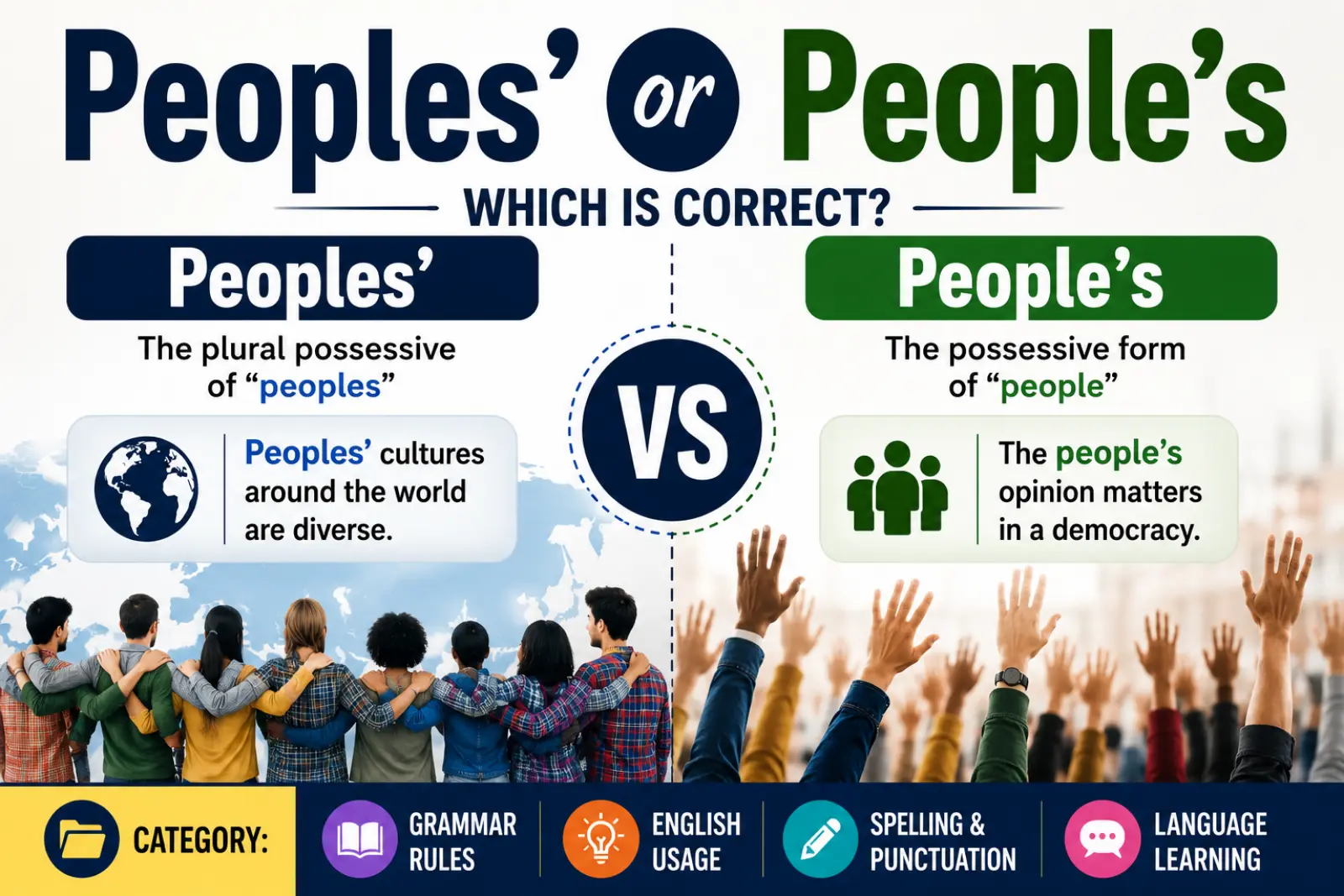
- People’s = something belongs to a group of people.
- Peoples’ = something belongs to multiple groups of people.
- People’s rights = rights belonging to people.
- Peoples’ traditions = traditions of several distinct peoples or ethnic groups.
- People’s is much more common in everyday writing.
- Peoples’ appears mainly in cultural, historical, and political contexts.
- Apostrophes show ownership or possession.
- Understanding the difference improves grammar accuracy.
What Does People’s Mean?
People’s is the possessive form of the word people.
It shows that something belongs to a group of people.
Formula
People + ‘s = People’s
Examples
- The people’s voices were heard.
- We must protect the people’s rights.
- The people’s opinion matters.
- The government listened to the people’s concerns.
In these examples, the rights, voices, opinions, and concerns belong to the people.
Simple Definition
People’s means “belonging to people.”
What Does Peoples’ Mean?
Peoples’ is the possessive form of peoples.
The word peoples refers to multiple distinct groups, nations, tribes, or ethnic communities.
Formula
Peoples + ‘ = Peoples’
Examples
- The conference celebrated many peoples’ traditions.
- The museum displayed several peoples’ artifacts.
- The treaty respected indigenous peoples’ rights.
- Researchers studied different peoples’ histories.
Here, ownership belongs to several separate groups of people.
Simple Definition
Peoples’ means “belonging to multiple peoples or ethnic groups.”
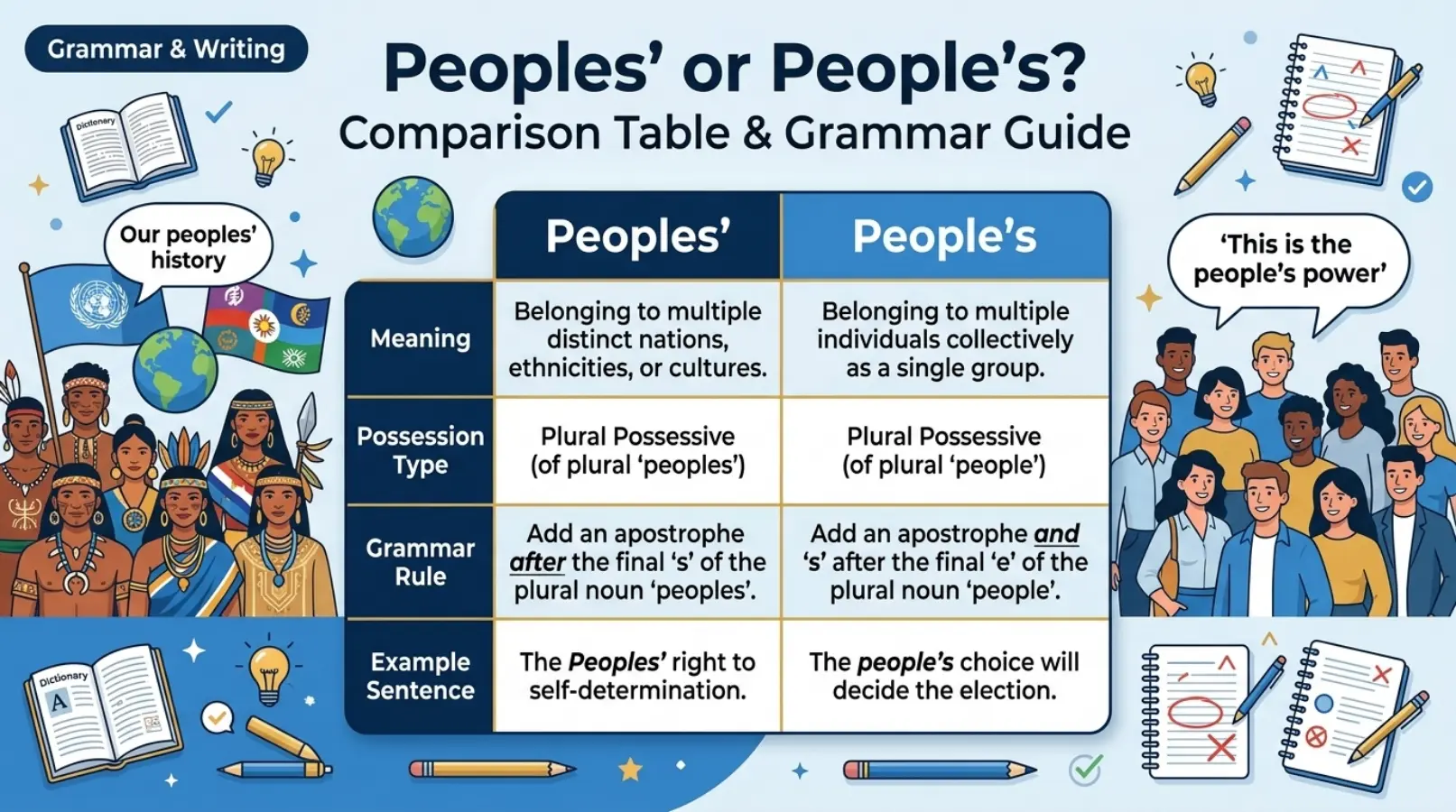
Peoples’ or People’s: Comparison Table
| Feature | People’s | Peoples’ |
| Base Word | People | Peoples |
| Meaning | Belonging to people | Belonging to multiple peoples |
| Usage Frequency | Very common | Less common |
| Context | Everyday writing | Cultural, historical, political writing |
| Example | People’s opinions | Peoples’ traditions |
| Apostrophe Placement | Before the final s | After the final s |
Quick Rule
If you mean one group of people, use people’s.
If you mean several distinct peoples or ethnic groups, use peoples’.
Why Do Many Writers Get Confused?
Many people rarely see the word peoples.
Most of the time, we use people as the plural form of person.
Because of this, writers assume people’s works in every situation.
However, peoples has its own meaning in anthropology, history, sociology, and politics.
Example
Correct:
- Indigenous peoples’ cultures deserve protection.
Incorrect:
- Indigenous people’s cultures deserve protection.
The second sentence suggests one group rather than multiple distinct groups.
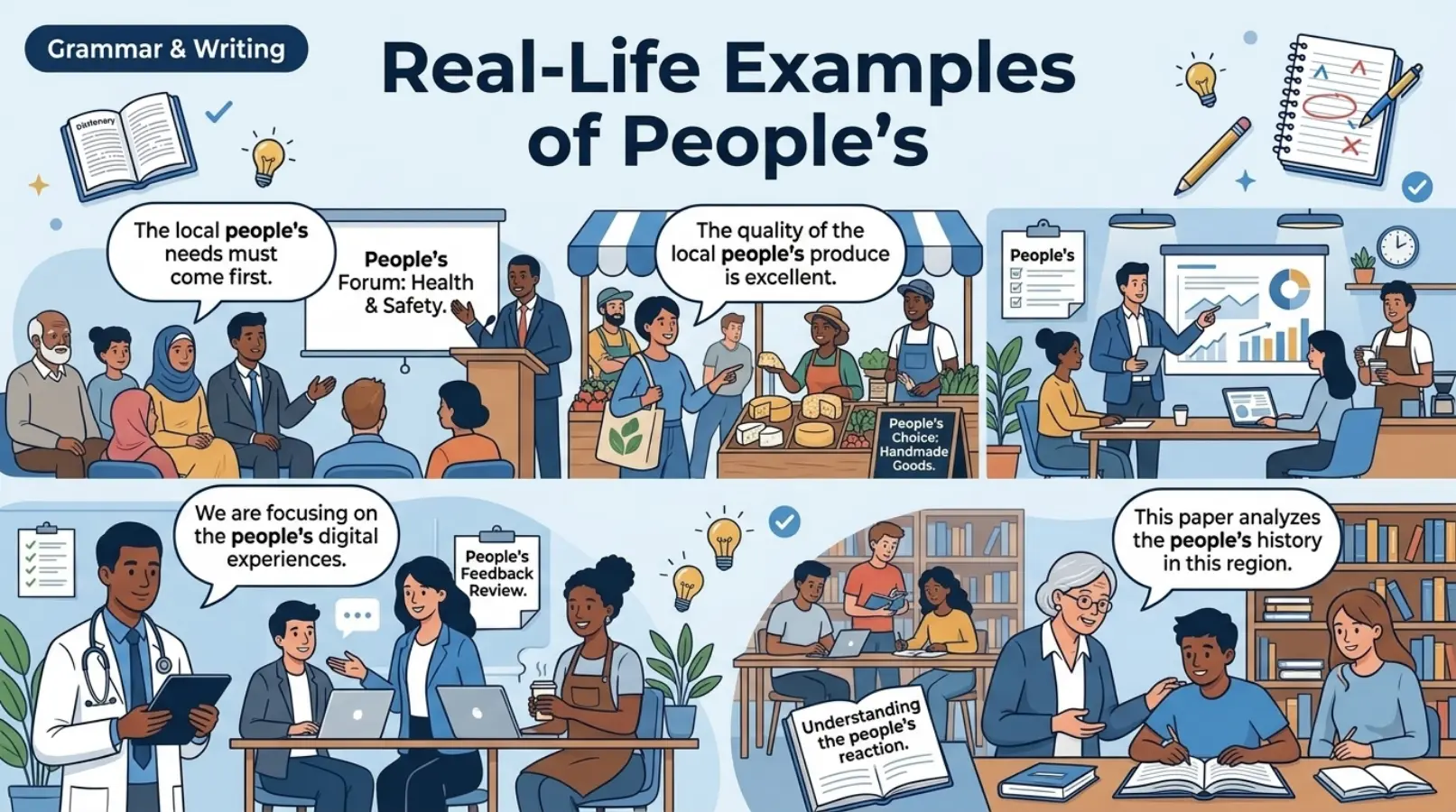
Real-Life Examples of People’s
Let’s look at common situations where people’s is correct.
In News
- The people’s vote changed the election result.
Business
- Companies study people’s buying habits.
Healthcare
- Doctors care about people’s health.
Education
- Teachers respect people’s learning styles.
Daily Conversation
- People’s opinions often differ.
These examples refer to people in general, not separate cultural groups.
Real-Life Examples of Peoples’
The word peoples’ appears in more specialized contexts.
History
- The empire influenced many peoples’ lives.
Anthropology
- Researchers examined different peoples’ customs.
Politics
- The declaration protected indigenous peoples’ rights.
Cultural Studies
- The festival showcased various peoples’ traditions.
International Relations
- Nations respected other peoples’ sovereignty.
These examples involve multiple distinct communities.
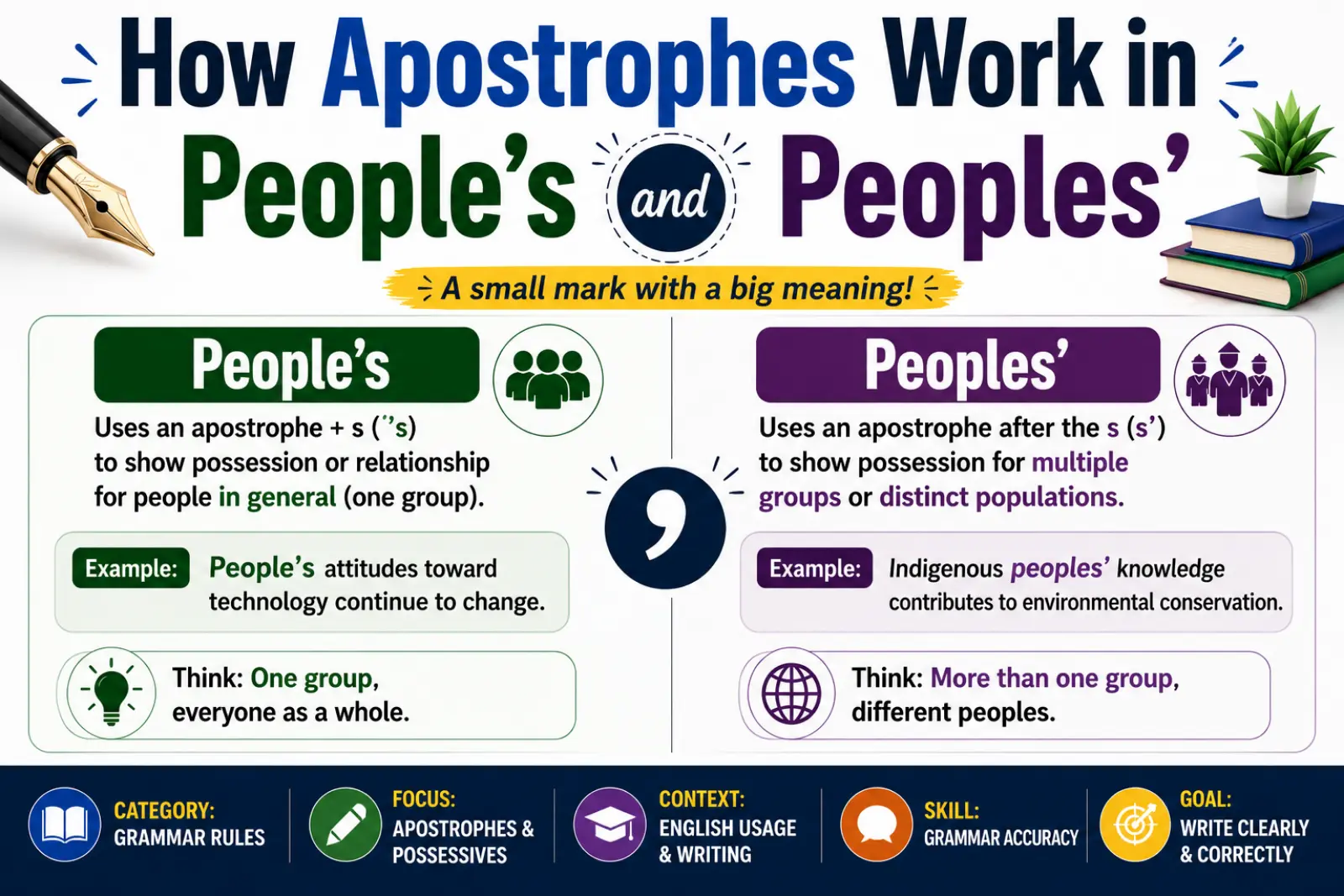
How Apostrophes Work in People’s and Peoples’
Understanding apostrophes helps you avoid mistakes.
Singular Possessive
Add ‘s
Example:
- Child → Child’s toy
Plural Possessive
Add ‘
Example:
- Students → Students’ books
Special Case: People
The word people is already plural.
Therefore:
- People → People’s rights
Special Case: Peoples
The word peoples is plural.
Therefore:
- Peoples → Peoples’ traditions
This rule explains why the apostrophe moves.
Common Mistakes to Avoid
Mistake #1: Using People’s for Multiple Ethnic Groups
Incorrect:
- The conference highlighted indigenous people’s traditions.
Correct:
- The conference highlighted indigenous peoples’ traditions.
Mistake #2: Forgetting the Apostrophe
Incorrect:
- Peoples rights must be protected.
Correct:
- Peoples’ rights must be protected.
Mistake #3: Adding Extra Apostrophes
Incorrect:
- People’s’ rights
Correct:
- People’s rights
Mistake #4: Confusing People and Peoples
Incorrect:
- Many peoples attended the concert.
Correct:
- Many people attended the concert.
The word peoples refers to distinct cultural groups, not simply many individuals.
Easy Tricks to Remember the Difference
Trick 1: Count the Groups
Ask yourself:
“Am I talking about one group or several groups?”
- One group = People’s
- Several groups = Peoples’
Trick 2: Look for Cultures or Nations
Words like these often signal peoples’:
- Tribes
- Nations
- Ethnic groups
- Indigenous communities
- Civilizations
Trick 3: Use the Common Option Carefully
In most everyday situations, people’s is correct.
However, don’t assume it always works.
People’s and Peoples’ in Academic Writing
Academic writing often uses both forms.
People’s
Used when discussing society in general.
Example:
- People’s attitudes toward technology continue to change.
Peoples’
Used when discussing separate populations.
Example:
- Indigenous peoples’ knowledge contributes to environmental conservation.
Researchers choose the form based on meaning.
Usage in Daily Life
Most writers encounter people’s far more often.
Everyday Examples
- People’s choices affect markets.
- People’s feelings matter.
- People’s behavior changes over time.
- People’s experiences shape opinions.
You may rarely use peoples’ unless discussing history, culture, or politics.
Synonyms
for People’s
- Human beings’
- Citizens’
- Community members’
- Public’s
- Society’s
for Peoples’
- Ethnic groups’
- Nations’
- Tribes’
- Indigenous communities’
- Cultural groups’
Expert Insights: Why Correct Usage Matters
Grammar accuracy builds trust.
Readers notice errors, especially in professional writing.
Using people’s and peoples’ correctly shows attention to detail.
Expert Tips
- Always identify the noun before adding an apostrophe.
- Think about whether one group or many groups exist.
- Review academic and cultural terms carefully.
- Proofread possessive nouns before publishing.
- Use grammar tools as a second check.
Correct grammar improves readability, authority, and SEO performance.
Frequently Asked Questions (FAQs)
1. Which is more common, peoples’ or people’s?
People’s is much more common in everyday writing.
2. What does people’s mean?
It means something belongs to people.
3. What does peoples’ mean?
It means something belongs to multiple distinct peoples or ethnic groups.
4. Is peoples a real word?
Yes. It refers to different nations, tribes, or cultural groups.
5. How do I know which form to use?
Determine whether you mean one group of people or several distinct groups.
6. Is indigenous peoples’ rights correct?
Yes. It refers to rights belonging to multiple indigenous peoples.
7. Can I use people’s rights instead?
Only if you mean people generally rather than distinct indigenous groups.
8. Why is there an apostrophe after the s in peoples’?
Because peoples is already plural, so the apostrophe comes after the final s.
Featured Snippet Answer
Peoples’ vs People’s: What’s the Difference?
People’s is the possessive form of people and means something belongs to people. Peoples’ is the possessive form of peoples and means something belongs to multiple distinct cultural, ethnic, or national groups. Use people’s rights when referring to people generally and peoples’ traditions when referring to several separate peoples.
Conclusion
Understanding peoples’ or people’s becomes simple once you know the difference between people and peoples. People’s shows possession for people in general, while peoples’ shows possession for multiple distinct cultural, ethnic, or national groups. Although people’s appears more often in everyday writing, peoples’ plays an important role in academic, historical, and cultural discussions.
When in doubt, ask yourself one question: Are you talking about one group of people or several separate peoples? The answer will guide you to the correct form. By applying this simple rule, you can avoid common grammar mistakes and write with greater confidence and accuracy.