CH3Cl polar or nonpolar is a common chemistry question. Many students learn about molecular polarity when studying chemical bonds and molecular shapes.
The simple answer is that CH3Cl (chloromethane) is a polar molecule.
However, understanding why it is polar can seem confusing at first. The molecule contains different atoms with different electronegativities. These differences affect how electrons move within the molecule.
In this guide, you will learn the meaning of polarity, the structure of CH3Cl, and the reasons behind its polarity. You will also see comparison tables, real-life examples, common mistakes, and expert tips.
By the end, you will clearly understand whether CH3Cl is polar or nonpolar and how to identify polarity in similar molecules.
Quick Summary Box
- CH3Cl is the chemical formula for chloromethane.
- CH3Cl is a polar molecule.
- Chlorine attracts electrons more strongly than carbon and hydrogen.
- The molecule has a tetrahedral shape.
- Electron distribution is uneven.
- CH3Cl has a net dipole moment.
- Polar molecules have positive and negative ends.
- CH3Cl dissolves better in polar solvents than nonpolar molecules do.
- The C–Cl bond plays the biggest role in its polarity.
What Is CH3Cl?
CH3Cl is called chloromethane or methyl chloride.
It contains:
- One carbon atom (C)
- Three hydrogen atoms (H)
- One chlorine atom (Cl)
Molecular Formula
CH3Cl
Structure
H
|
H — C — Cl
|
H
Carbon sits in the center and forms four single covalent bonds.
What Does Polar Mean?
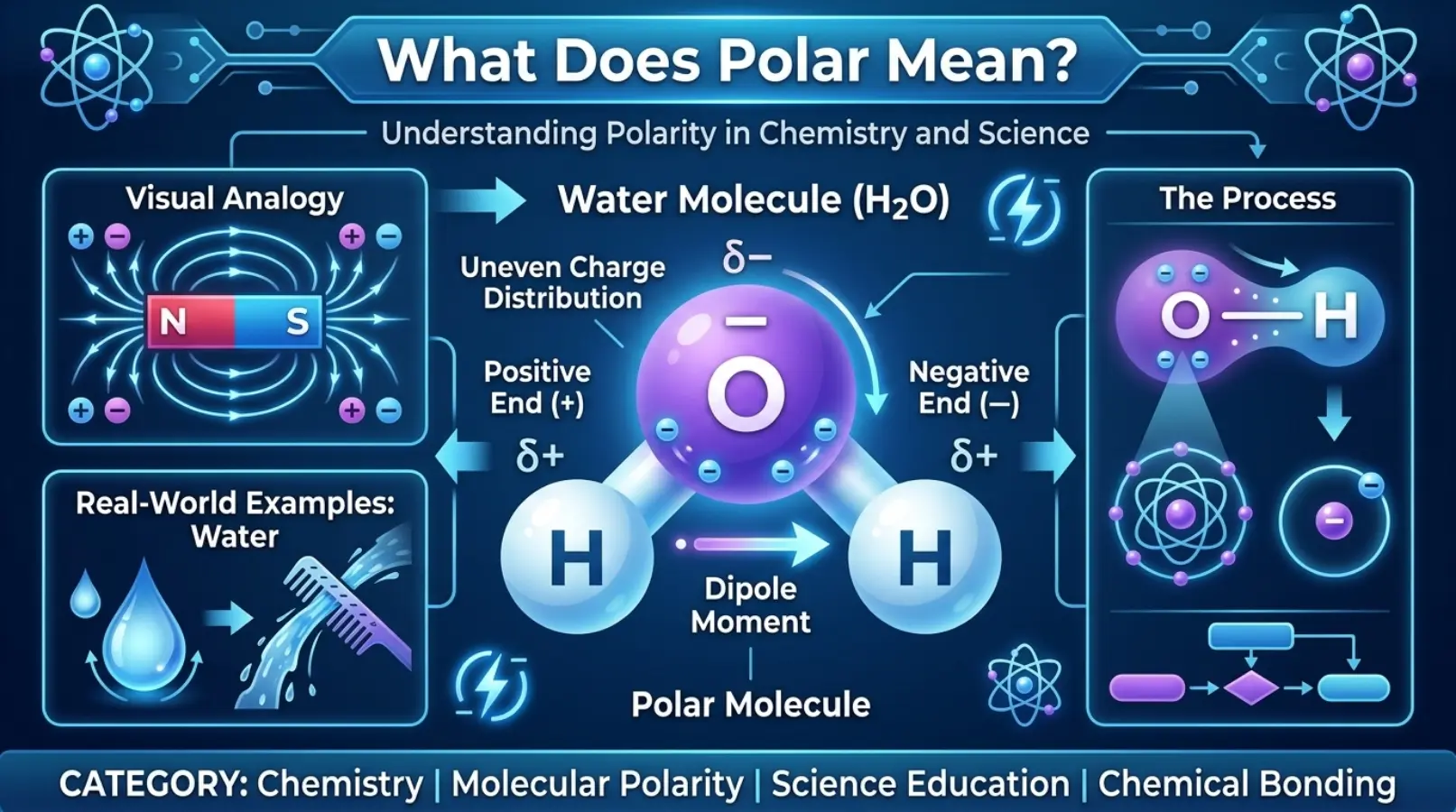
A molecule is polar when electrons are not shared equally between atoms.
This unequal sharing creates:
- A slightly positive end (δ+)
- A slightly negative end (δ−)
As a result, the molecule develops a dipole moment.
Simple Example
Think of a tug-of-war game.
If one team pulls harder, the rope moves toward that side.
Similarly, electrons move toward the more electronegative atom.
Why Is CH3Cl Polar?
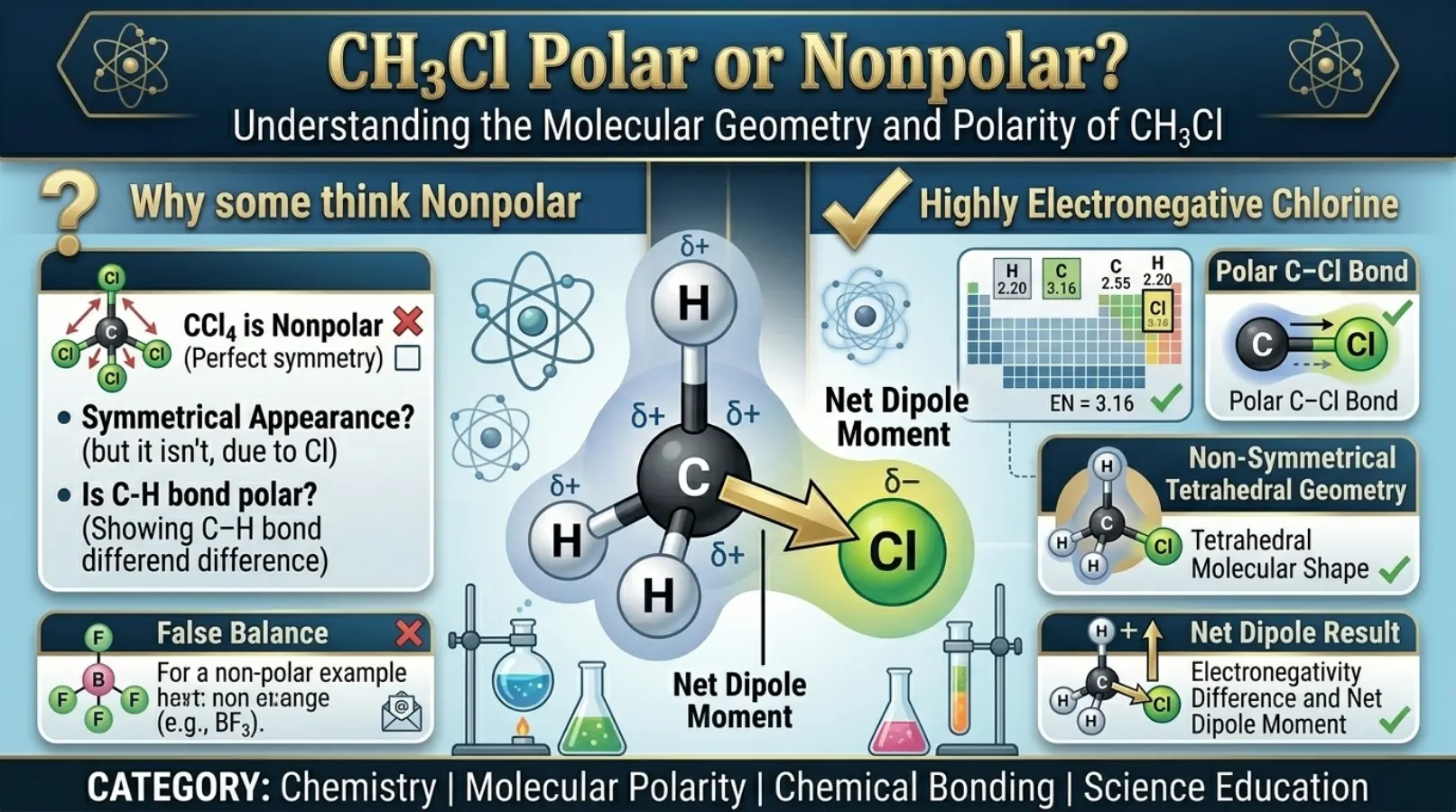
CH3Cl is polar because chlorine attracts electrons much more strongly than carbon and hydrogen.
Key Reason
The chlorine atom has higher electronegativity.
Electronegativity values:
| Atom | Electronegativity |
| Hydrogen | 2.20 |
| Carbon | 2.55 |
| Chlorine | 3.16 |
Because chlorine pulls electrons strongly:
- Chlorine becomes slightly negative.
- Carbon becomes slightly positive.
This creates a permanent dipole.
Molecular Geometry of CH3Cl
The shape of a molecule affects polarity.
CH3Cl Shape
CH3Cl has a tetrahedral geometry.
According to VSEPR theory:
- Carbon forms four sigma bonds.
- Bond angles are about 109.5°.
- The arrangement is tetrahedral.
Why Shape Matters
In some molecules, dipoles cancel each other.
In CH3Cl, the dipoles do not cancel completely because chlorine differs from hydrogen.
Therefore, a net dipole remains.
Bond Polarity in CH3Cl
To understand molecular polarity, first examine bond polarity.
C–H Bonds
The electronegativity difference is small.
These bonds are nearly nonpolar.
C–Cl Bond
The electronegativity difference is larger.
This bond is strongly polar.
| Bond | Polarity |
| C–H | Slightly polar |
| C–Cl | Strongly polar |
The strong C–Cl bond dipole dominates the molecule.
CH3Cl Polar or Nonpolar: Final Verdict
Answer
✅ CH3Cl is a polar molecule.
Why?
- Chlorine is highly electronegative.
- The C–Cl bond is strongly polar.
- The tetrahedral shape does not cancel dipoles.
- A net dipole moment exists.
Therefore, CH3Cl shows overall polarity.
CH3Cl vs CH4: Polarity Comparison
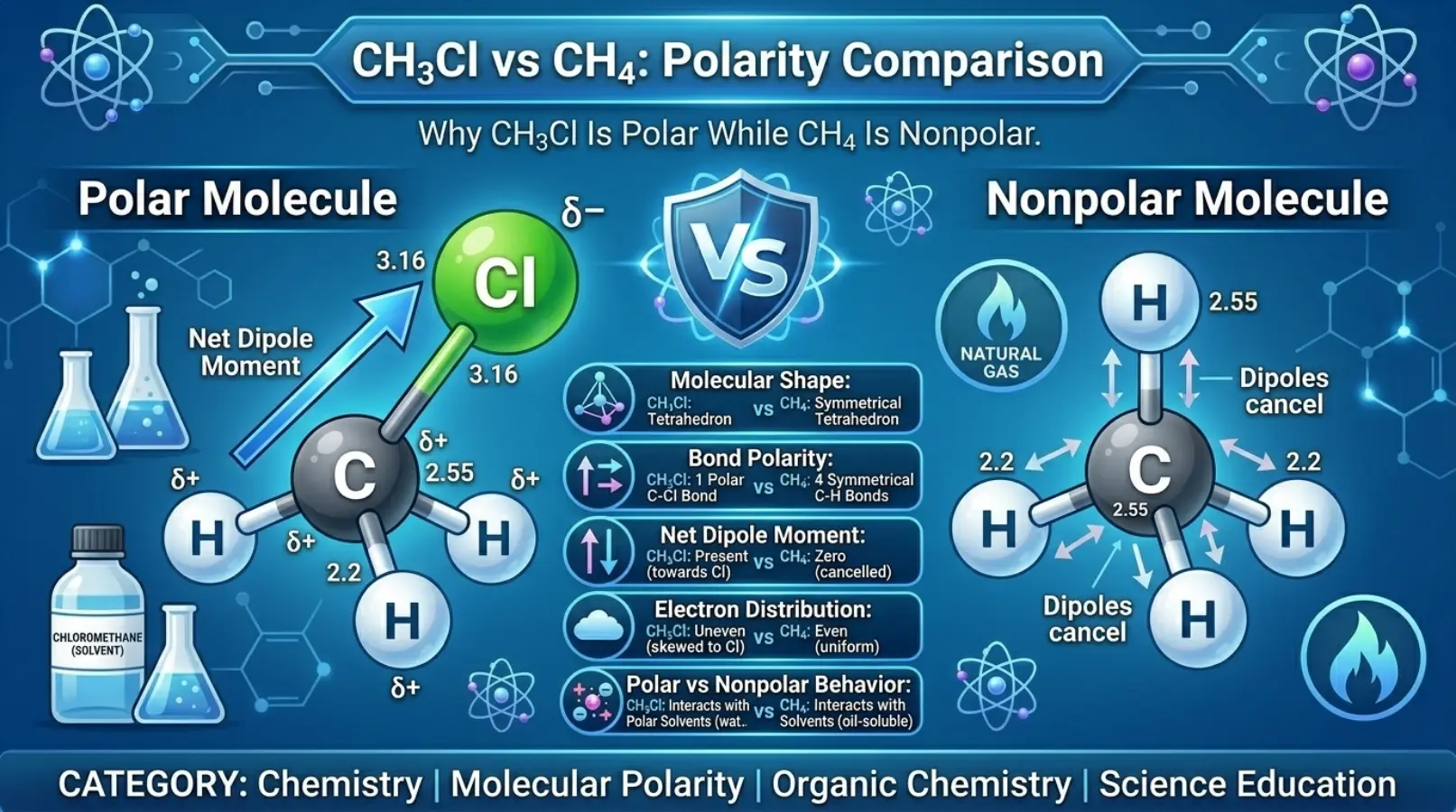
Students often compare CH3Cl with methane (CH4).
| Feature | CH3Cl | CH4 |
| Molecular Name | Chloromethane | Methane |
| Shape | Tetrahedral | Tetrahedral |
| Polar Bond Present | Yes | No |
| Net Dipole Moment | Yes | No |
| Polar or Nonpolar | Polar | Nonpolar |
Key Difference
CH4 contains four identical hydrogen atoms.
The bond dipoles cancel completely.
CH3Cl contains one chlorine atom, which creates asymmetry.
Real-Life Examples of Polar Molecules
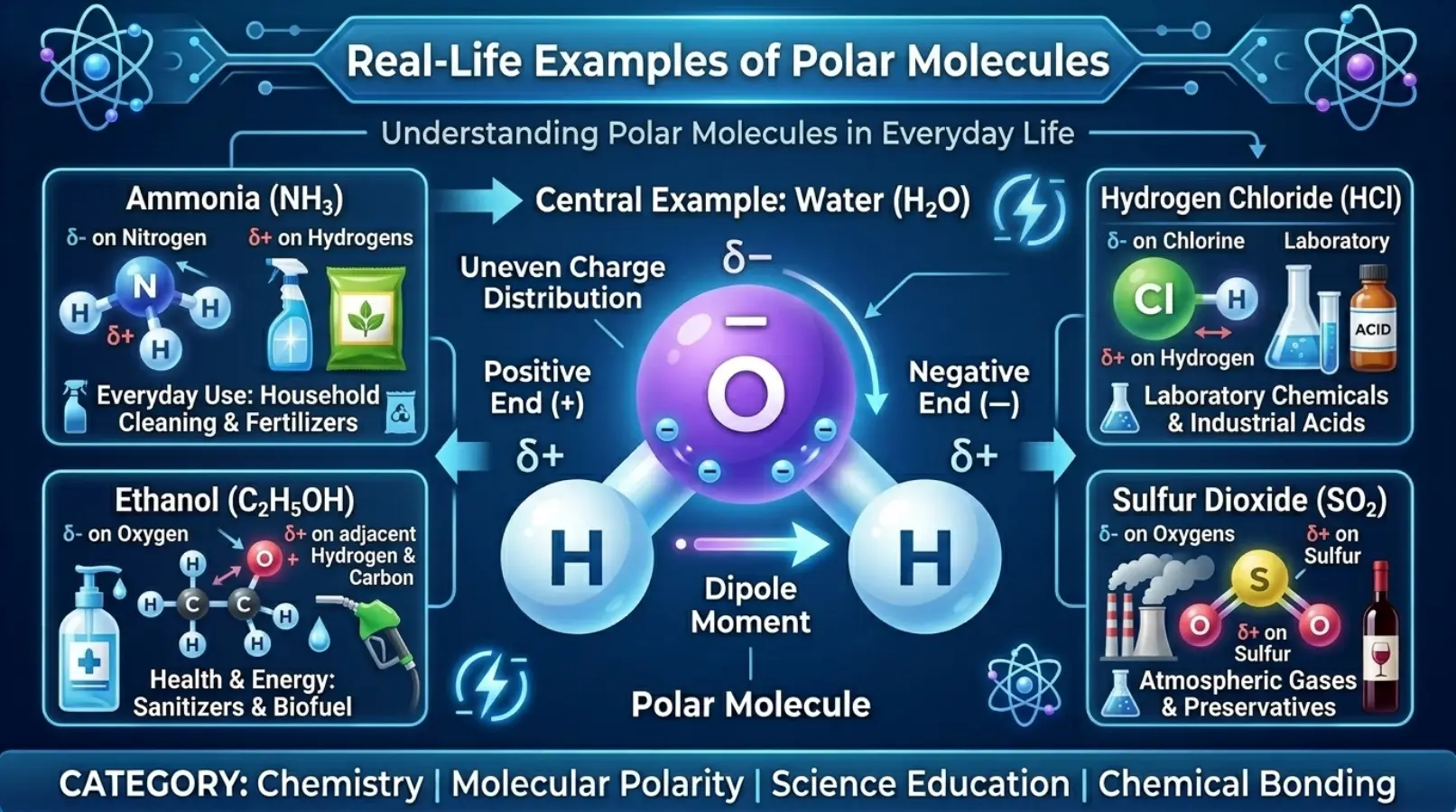
CH3Cl behaves similarly to many other polar compounds.
Examples include:
- Water (H2O)
- Ammonia (NH3)
- Sulfur dioxide (SO2)
- Hydrogen chloride (HCl)
Common Feature
Each molecule has:
- Uneven electron distribution
- A net dipole moment
- Positive and negative regions
How to Determine if a Molecule Is Polar
Use these simple steps.
Step 1: Check Electronegativity
Look for differences between atoms.
Large differences create polar bonds.
Step 2: Identify Molecular Shape
Use VSEPR theory.
Determine the molecular geometry.
Step 3: Examine Dipole Cancellation
Ask:
Do the bond dipoles cancel?
- If yes → Nonpolar
- If no → Polar
Applying to CH3Cl
- Polar C–Cl bond ✔
- Tetrahedral shape ✔
- Dipoles do not cancel ✔
Result: Polar molecule.
Common Mistakes Students Make
Mistake 1: Looking Only at Shape
Some students see a tetrahedral shape and assume nonpolar.
Shape alone does not determine polarity.
Mistake 2: Ignoring Electronegativity
Electronegativity differences are essential.
Without them, polarity cannot be determined.
Mistake 3: Confusing Bond Polarity and Molecular Polarity
A molecule can contain polar bonds but still be nonpolar.
Always examine the overall structure.
Mistake 4: Assuming All Tetrahedral Molecules Are Nonpolar
CH4 is nonpolar.
CH3Cl is polar.
The surrounding atoms make the difference.
Practical Uses of CH3Cl
Chloromethane has several industrial uses.
Applications
- Silicone production
- Chemical manufacturing
- Refrigerant production
- Laboratory research
Its polarity influences how it interacts with other chemicals.
Expert Insights: Why Molecular Polarity Matters
Chemists use polarity to predict molecular behavior.
Polarity affects:
- Solubility
- Boiling point
- Melting point
- Chemical reactions
- Intermolecular forces
Understanding why CH3Cl is polar helps students solve many chemistry problems.
Experts often recommend analyzing both bond polarity and molecular geometry together.
This method gives the most accurate answer.
Frequently Asked Questions (FAQs)
Is CH3Cl polar or nonpolar?
CH3Cl is a polar molecule because the C–Cl bond creates a net dipole moment.
Why is CH3Cl considered polar?
Chlorine attracts electrons more strongly than carbon and hydrogen.
What is the shape of CH3Cl?
CH3Cl has a tetrahedral molecular geometry.
Does CH3Cl have a dipole moment?
Yes. CH3Cl has a permanent dipole moment.
Is CH3Cl more polar than CH4?
Yes. CH4 is nonpolar, while CH3Cl is polar.
Which bond makes CH3Cl polar?
The C–Cl bond contributes most to the polarity.
Can CH3Cl dissolve in water?
It has limited solubility in water because it is only moderately polar.
Is chloromethane a covalent compound?
Yes. CH3Cl contains covalent bonds between its atoms.
Conclusion
Understanding CH3Cl polar or nonpolar becomes easy when you examine electronegativity and molecular shape together. Chlorine attracts electrons much more strongly than carbon and hydrogen. As a result, the C–Cl bond becomes strongly polar. Although CH3Cl has a tetrahedral geometry, the dipoles do not cancel out. This creates a permanent dipole moment across the molecule.
Therefore, CH3Cl is a polar molecule. This polarity affects its chemical behavior, intermolecular forces, and interactions with other substances. When determining polarity for any molecule, always check bond polarity, molecular geometry, and dipole cancellation. Following these steps will help you solve similar chemistry questions with confidence.