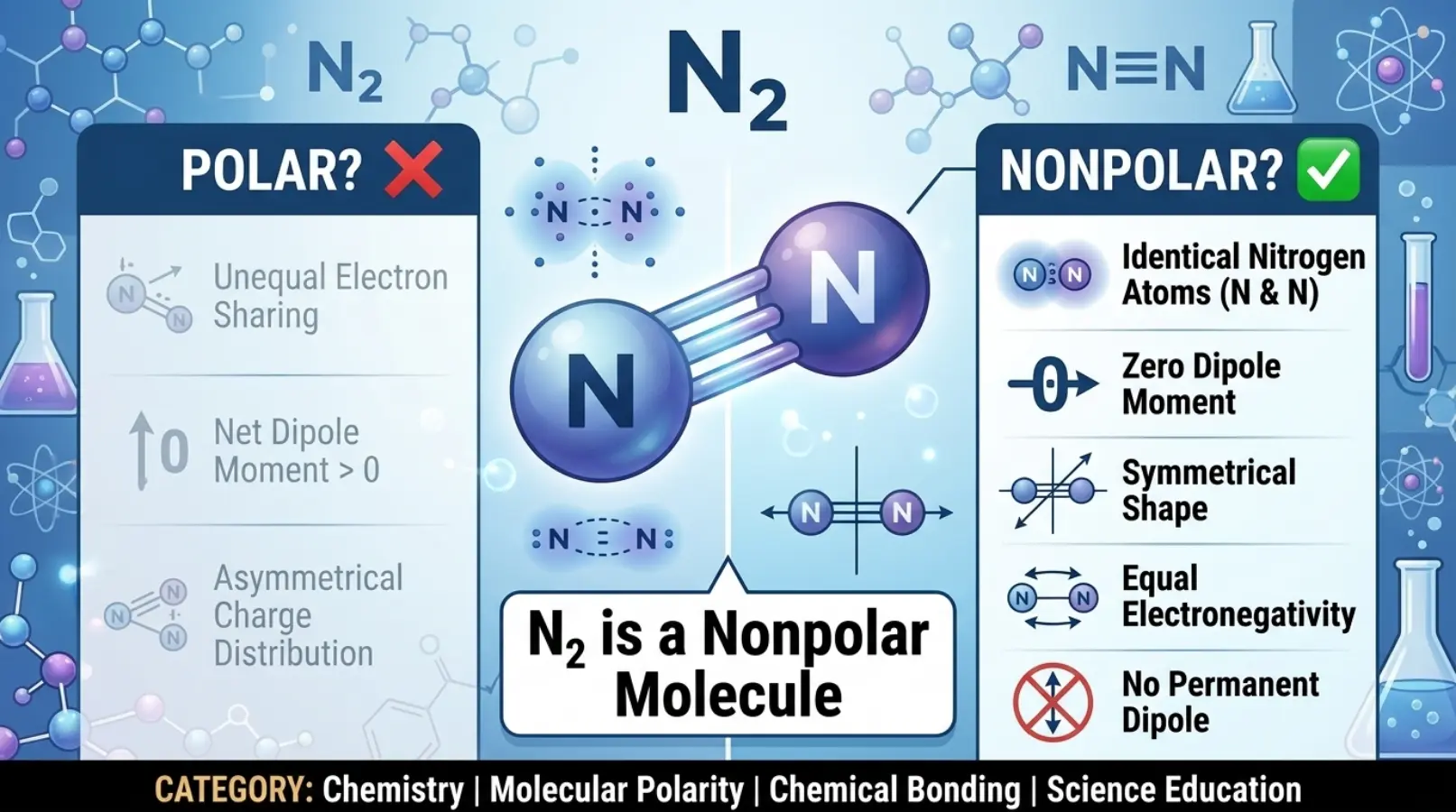
Is N2 polar or nonpolar? The short answer is that N2 is nonpolar. Many students ask this question when learning about chemical bonding and molecular polarity.
Nitrogen gas (N2) contains two nitrogen atoms joined by a strong triple bond. Since both atoms are the same, they share electrons equally. As a result, no side of the molecule becomes more positive or negative than the other.
Understanding whether N2 is polar or nonpolar helps you learn molecular geometry, chemical bonding, and intermolecular forces. It also helps explain why nitrogen behaves the way it does in the atmosphere.
In this guide, you’ll learn what N2 is, why it is nonpolar, how polarity works, common mistakes to avoid, and real-life examples that make the concept easy to understand.
Quick Summary Box
- N2 is a nonpolar molecule.
- It consists of two identical nitrogen atoms.
- The atoms share electrons equally.
- N2 has a triple covalent bond.
- The electronegativity difference is zero.
- No permanent dipole moment exists.
- The molecule has a symmetrical electron distribution.
- Nitrogen gas makes up about 78% of Earth’s atmosphere.
What Is N2?
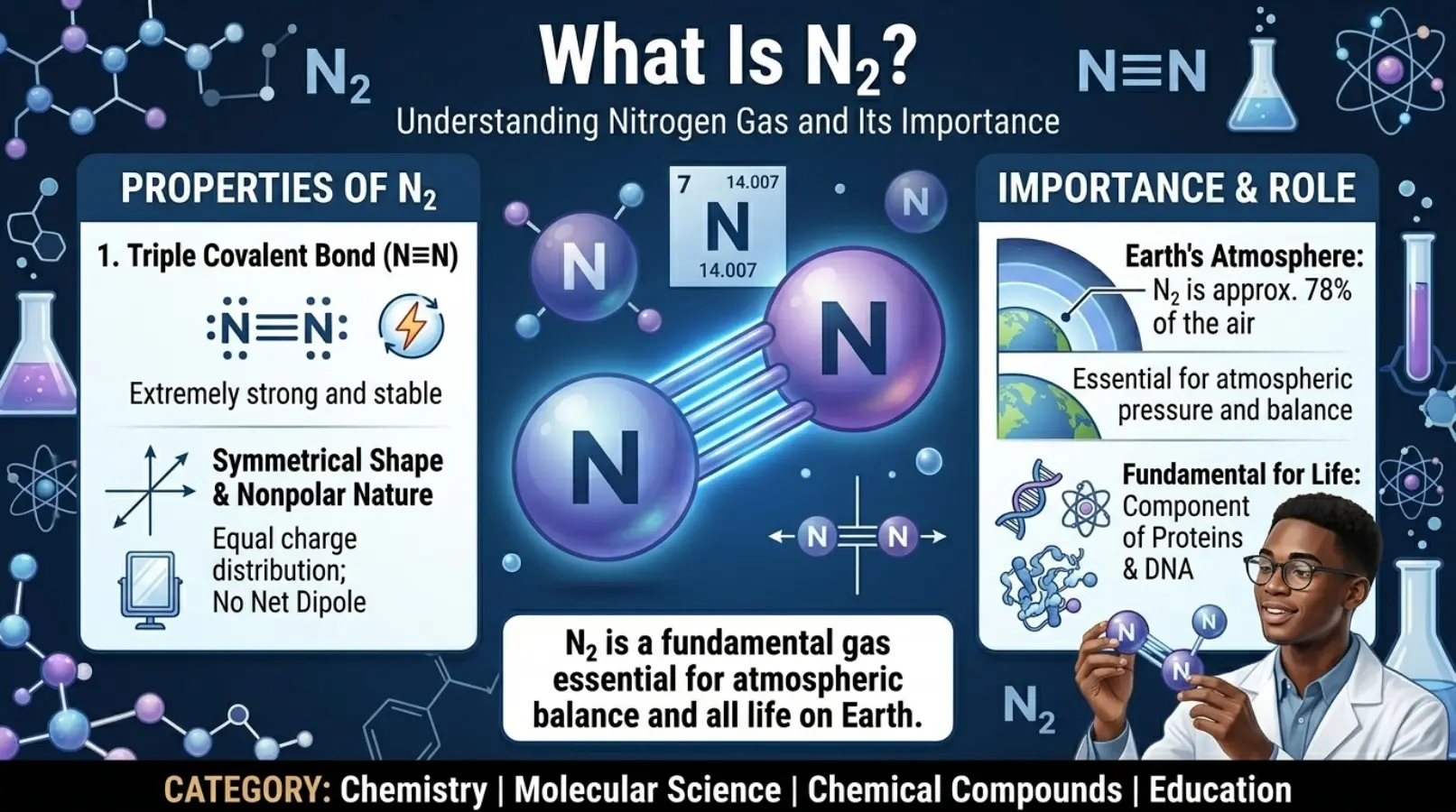
N2 is the chemical formula for nitrogen gas.
Each nitrogen atom has five valence electrons. To complete their outer shells, two nitrogen atoms share three pairs of electrons. This creates a strong triple bond.
Structure of N2
N ≡ N
The triple bond includes:
- One sigma bond
- Two pi bonds
This bond makes N2 one of the most stable molecules in nature.
What Does Polar and Nonpolar Mean?
Before deciding whether N2 is polar or nonpolar, you must understand these terms.
Polar Molecules
A molecule is polar when:
- Electrons are shared unequally.
- One side becomes slightly positive.
- The other side becomes slightly negative.
- A dipole moment exists.
Examples:
- Water (H2O)
- Ammonia (NH3)
- Hydrogen chloride (HCl)
Nonpolar Molecules
A molecule is nonpolar when:
- Electrons are shared equally.
- Charge distribution remains balanced.
- No permanent dipole moment exists.
Examples:
- N2
- O2
- H2
- Cl2
Is N2 Polar or Nonpolar?
Direct Answer
N2 is nonpolar.
Both nitrogen atoms have the same electronegativity value. Therefore, they pull shared electrons equally.
Because the electron distribution is perfectly balanced, no positive or negative end develops.
As a result:
- Dipole moment = 0
- Electron distribution = symmetrical
- Molecular polarity = nonpolar
This makes N2 a classic example of a nonpolar molecule.
Why Is N2 Nonpolar?
Several factors explain why N2 is nonpolar.
1. Identical Atoms
The molecule contains two nitrogen atoms.
Since both atoms are identical, neither attracts electrons more strongly.
2. Equal Electron Sharing
The shared electrons remain evenly distributed between the two atoms.
No unequal charge develops.
3. Zero Electronegativity Difference
Nitrogen has an electronegativity of about 3.04.
Since both atoms have the same value:
3.04 – 3.04 = 0
A difference of zero means the bond is nonpolar.
4. No Dipole Moment
A dipole moment appears when charges separate.
In N2, no charge separation occurs.
Therefore, the dipole moment equals zero.
Lewis Structure of N2
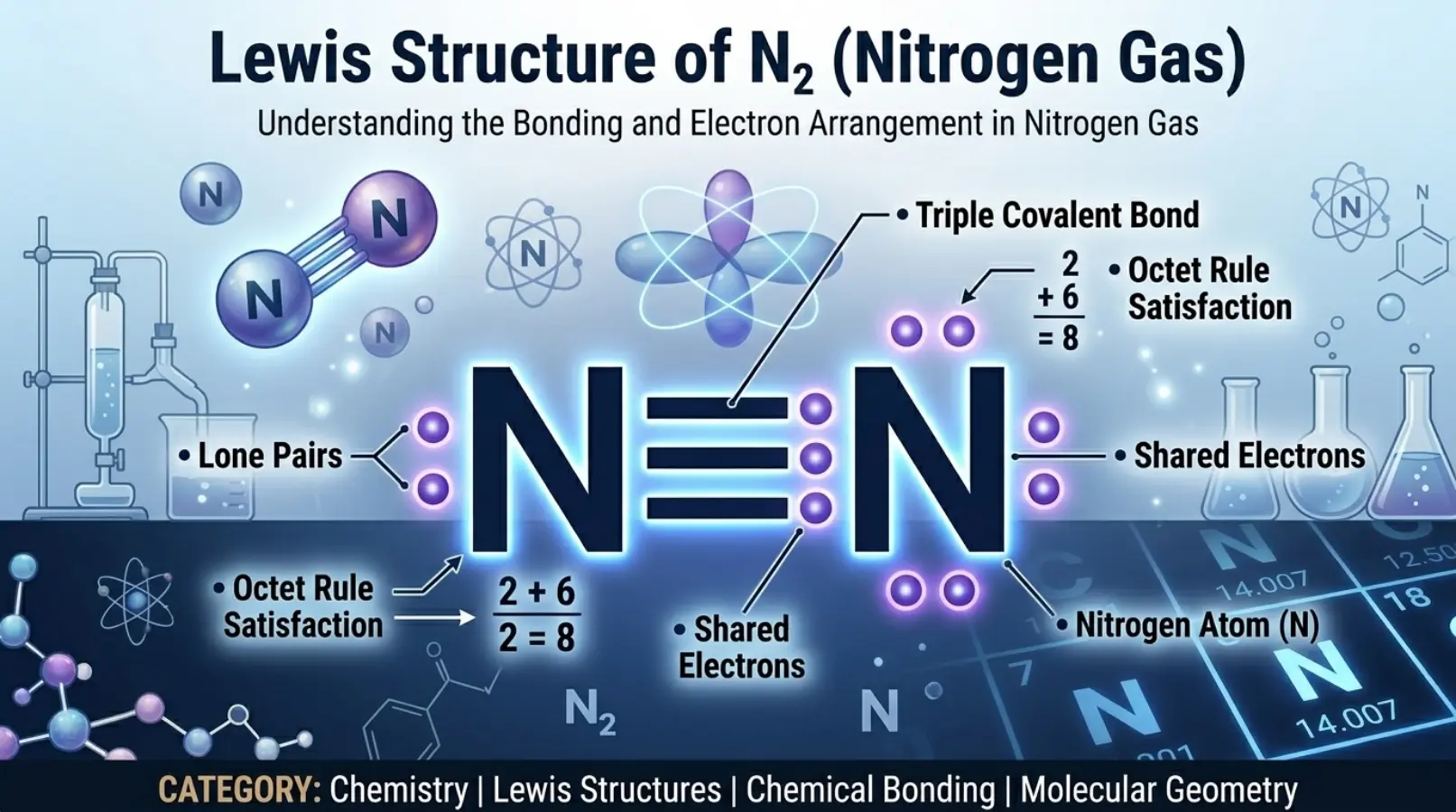
The Lewis structure helps explain bonding and polarity.
Steps
- Count valence electrons.
- Nitrogen has 5 valence electrons.
- Total electrons = 10.
- Form a triple bond.
- Leave one lone pair on each nitrogen atom.
Lewis Structure
:N≡N:
This structure shows:
- Triple bond
- One lone pair on each atom
- Complete octets
The symmetrical arrangement supports its nonpolar nature.
Electronegativity and N2 Polarity
Electronegativity measures an atom’s ability to attract electrons.
Formula
Electronegativity Difference = EN1 − EN2
For N2:
| Atom | Electronegativity |
| N | 3.04 |
| N | 3.04 |
Difference:
3.04 − 3.04 = 0
Since the difference is zero, the bond is nonpolar.
Dipole Moment of N2
Dipole moment determines molecular polarity.
Polar Molecules
- Dipole moment greater than zero.
- Uneven charge distribution.
N2
- Equal electron sharing.
- No charge separation.
- Dipole moment = 0 Debye.
Because the dipole moment is zero, N2 is nonpolar.
Comparison Table: Polar vs Nonpolar Molecules
| Feature | Polar Molecules | Nonpolar Molecules |
| Electron Sharing | Unequal | Equal |
| Dipole Moment | Present | Absent |
| Charge Distribution | Uneven | Even |
| Positive and Negative Ends | Yes | No |
| Example | H2O | N2 |
| Solubility in Water | Usually High | Usually Low |
N2 fits perfectly into the nonpolar category.
N2 vs NH3: Why One Is Nonpolar and the Other Is Polar
Students often confuse N2 with NH3.
| Property | N2 | NH3 |
| Molecular Type | Diatomic | Trigonal Pyramidal |
| Electronegativity Difference | 0 | Present |
| Symmetry | Perfectly Symmetrical | Asymmetrical |
| Dipole Moment | 0 | Greater Than 0 |
| Polarity | Nonpolar | Polar |
Although both contain nitrogen, their structures differ greatly.
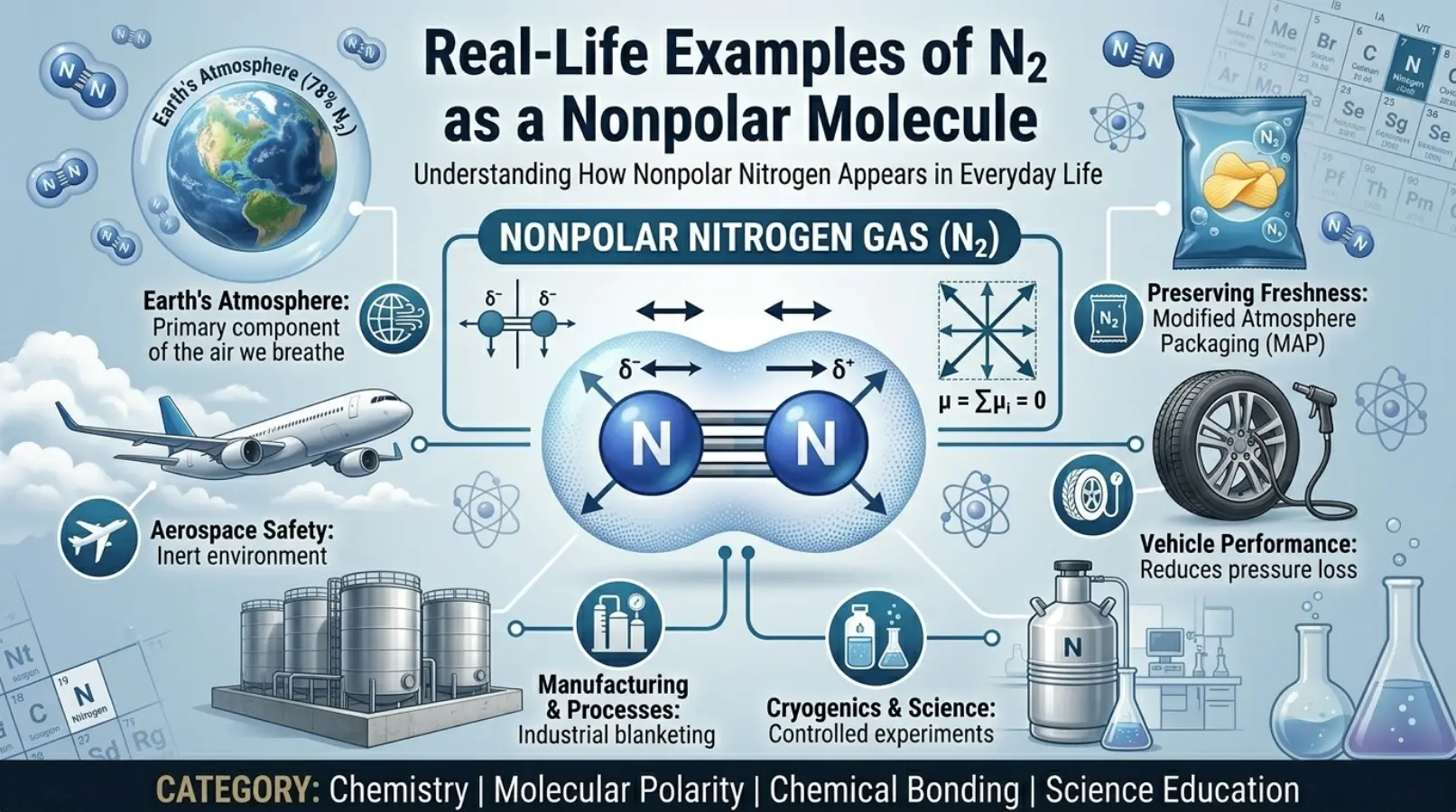
Real-Life Examples of N2 as a Nonpolar Molecule
You encounter nitrogen gas every day.
Air Around You
Nitrogen forms about 78% of Earth’s atmosphere.
Its nonpolar nature helps keep it chemically stable.
Food Packaging
Manufacturers fill packages with nitrogen gas.
This prevents oxidation and keeps food fresh.
Tire Inflation
Many vehicles use nitrogen-filled tires.
Nitrogen remains stable under changing temperatures.
Industrial Applications
Factories use nitrogen to create safe, oxygen-free environments.
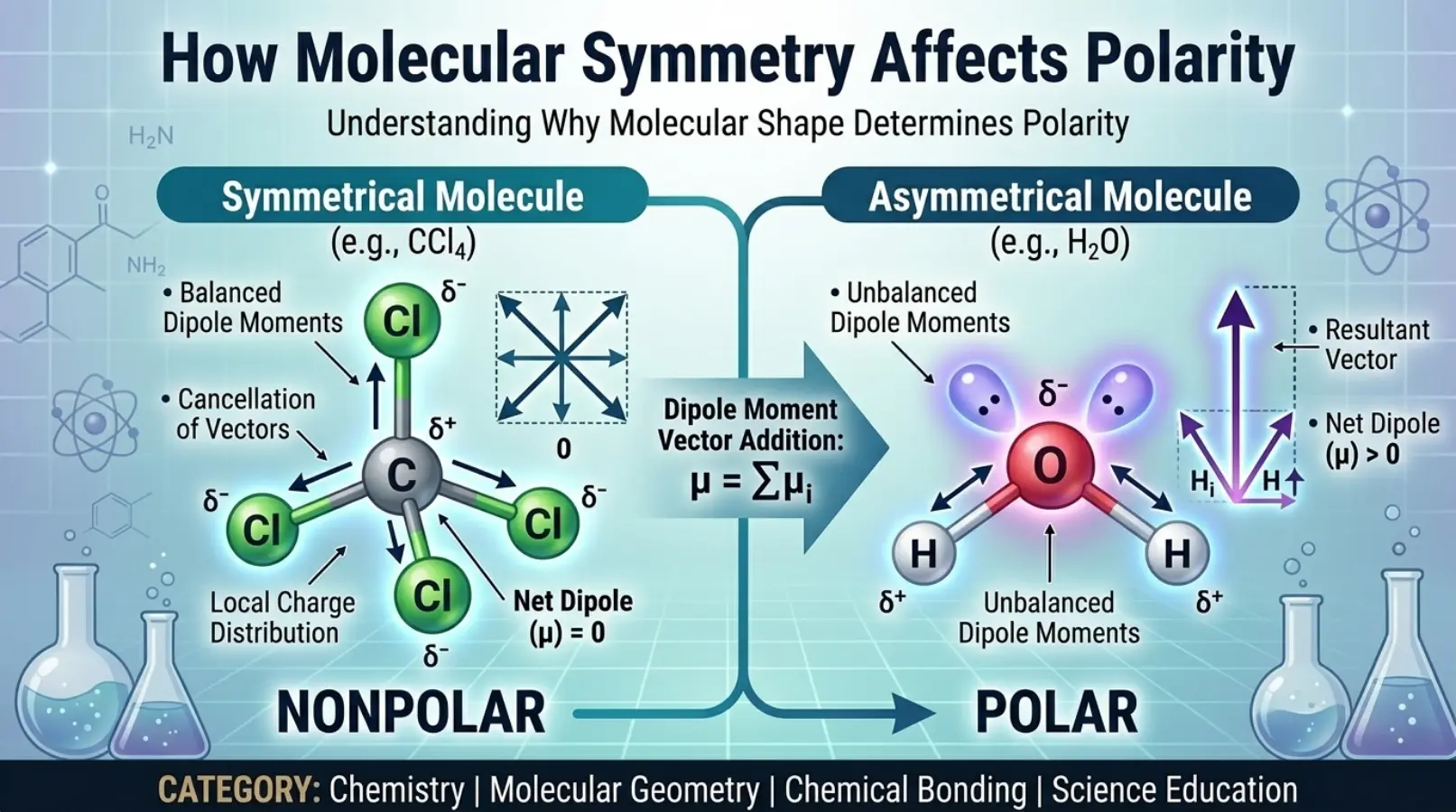
How Molecular Symmetry Affects Polarity
Symmetry plays a major role in determining polarity.
Symmetrical Molecules
When charge distributes evenly:
- Dipoles cancel.
- Molecule becomes nonpolar.
Examples:
- N2
- O2
- CO2
Asymmetrical Molecules
When charge distributes unevenly:
- Dipoles remain.
- Molecule becomes polar.
Examples:
- H2O
- NH3
N2 is perfectly symmetrical, making it nonpolar.
Common Mistakes When Determining N2 Polarity
Many students make these errors.
Mistake 1: Looking Only at Bonds
Some think every covalent bond creates polarity.
Actually, equal sharing creates nonpolar bonds.
Mistake 2: Ignoring Electronegativity
Always compare electronegativity values.
For N2, the difference is zero.
Mistake 3: Forgetting Symmetry
Symmetry often determines molecular polarity.
N2 is completely symmetrical.
Mistake 4: Confusing N2 With Nitrogen Compounds
N2 is nonpolar.
However, compounds like NH3 are polar.
Tips and Tricks to Remember N2 Is Nonpolar
Use these simple tricks.
Same Atoms = Usually Nonpolar
Examples:
- H2
- O2
- N2
- Cl2
Check Electronegativity Difference
Difference = 0
Therefore, the bond is nonpolar.
Look for Symmetry
Perfect symmetry usually means no dipole moment.
Remember the Rule
Identical atoms share electrons equally.
Expert Insights: Why Understanding N2 Polarity Matters
Chemistry students often memorize answers without understanding them.
A better approach is to focus on three factors:
- Electronegativity
- Molecular geometry
- Dipole moment
When all three indicate balanced charge distribution, the molecule is nonpolar.
N2 is one of the easiest examples because it contains identical atoms and perfect symmetry. Learning this concept makes it easier to analyze more complex molecules later.
Understanding polarity also helps in biology, environmental science, and industrial chemistry.
Frequently Asked Questions (FAQs)
Is N2 polar or nonpolar?
N2 is nonpolar because both nitrogen atoms share electrons equally.
Why is N2 considered nonpolar?
It has identical atoms, zero electronegativity difference, and no dipole moment.
Does N2 have a dipole moment?
No. The dipole moment of N2 is zero.
Is the N≡N bond polar?
No. The bond is nonpolar because both atoms have the same electronegativity.
Is N2 soluble in water?
It has limited solubility because nonpolar molecules do not interact strongly with water.
What type of bond exists in N2?
A triple covalent bond exists between the two nitrogen atoms.
Is nitrogen gas symmetrical?
Yes. N2 has a perfectly symmetrical structure.
Which is more polar, N2 or NH3?
NH3 is polar, while N2 is nonpolar.
Conclusion
The answer to “is N2 polar or nonpolar” is simple: N2 is nonpolar. The molecule contains two identical nitrogen atoms joined by a strong triple bond. Since both atoms have the same electronegativity, they share electrons equally. This creates a balanced electron distribution and produces no dipole moment.
When determining polarity, always examine electronegativity, molecular symmetry, and dipole moments. In the case of N2, all three factors point to a nonpolar molecule. Understanding why N2 is nonpolar helps build a strong foundation in chemistry and makes it easier to analyze more complex molecules. Remember the simple rule: identical atoms sharing electrons equally usually form nonpolar molecules.