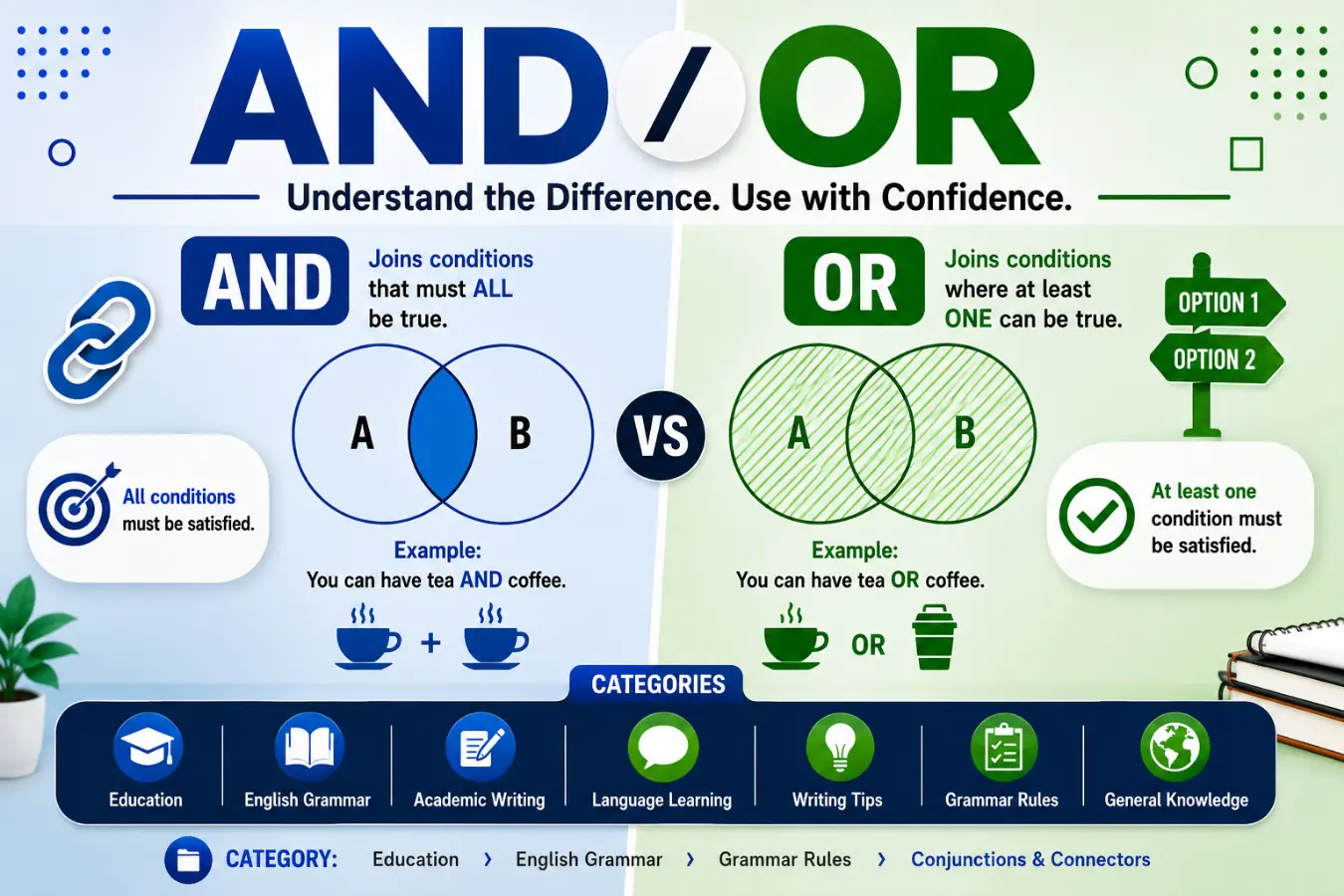
And/Or is a common term in English writing, legal documents, business communication, and everyday language. Many people see and/or in contracts, instructions, and forms but are unsure about its exact meaning.
Simply put, and/or means one option, the other option, or both options together. It combines the meanings of “and” and “or” into a single expression.
While and/or can be useful in certain situations, it can also create confusion when used incorrectly. Understanding how and when to use and/or helps improve clarity in writing and communication.
In this guide, you’ll learn the meaning of and/or, its correct usage, common mistakes, real-life examples, and situations where it works best.
Quick Summary Box
What Does And/Or Mean?
- Combines the meanings of and and or
- Means one option, the other option, or both
- Common in legal and business writing
- Can sometimes create confusion
- Often replaced with clearer wording in modern writing
- Useful when all possible combinations are allowed
- Helps avoid repeating multiple options
What Is And/Or?
And/or is a conjunction used to show that one, both, or all listed options may apply.
Simple Definition
And/or = A, B, or both A and B
Example
You may submit your application by email and/or postal mail.
This means:
- Email only
- Postal mail only
- Both email and postal mail
All three choices are acceptable.
Meaning of And/Or in Simple Words
The phrase combines two basic conjunctions:
| Word | Meaning |
| And | Both things happen |
| Or | One thing happens |
| And/Or | One, the other, or both happen |
Example
Bring your passport and/or driver’s license.
Accepted options:
Passport only
Driver’s license only
Both documents
Why Do People Use And/Or?
Writers use and/or because it saves space and covers multiple possibilities.
Instead of writing:
“Employees may work remotely, work in the office, or do both.”
You can write:
“Employees may work remotely and/or in the office.”
This shorter version communicates the same idea.
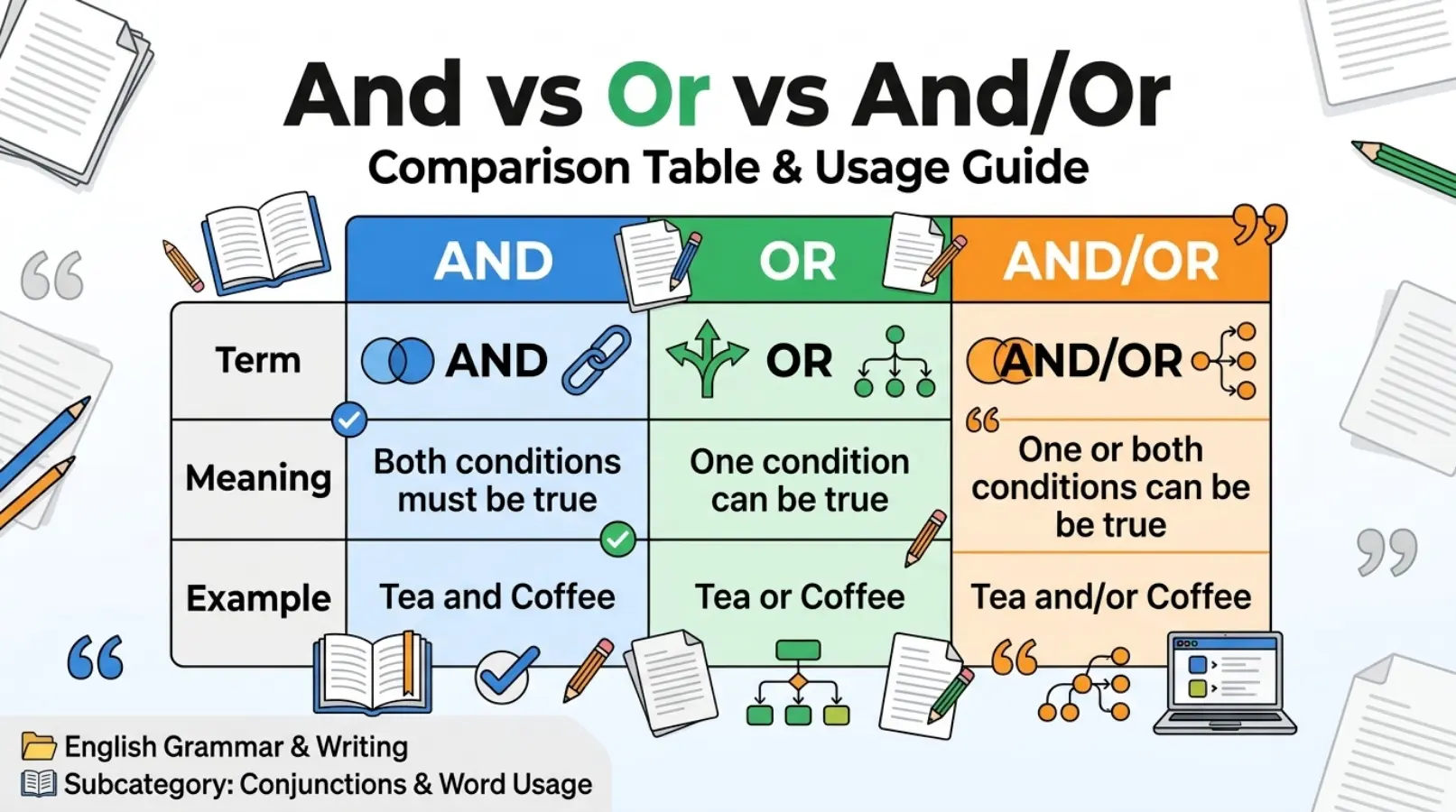
And vs Or vs And/Or
Comparison Table
| Term | Meaning | Example |
| And | Both options required | Bring your ID and ticket |
| Or | One option required | Bring your ID or passport |
| And/Or | One, the other, or both | Bring your ID and/or passport |
| Neither/Nor | Both excluded | Neither tea nor coffee |
| Either/Or | One of two choices | Either tea or coffee |
Key Difference
- And requires both.
- Or requires one.
- And/or allows one or both.
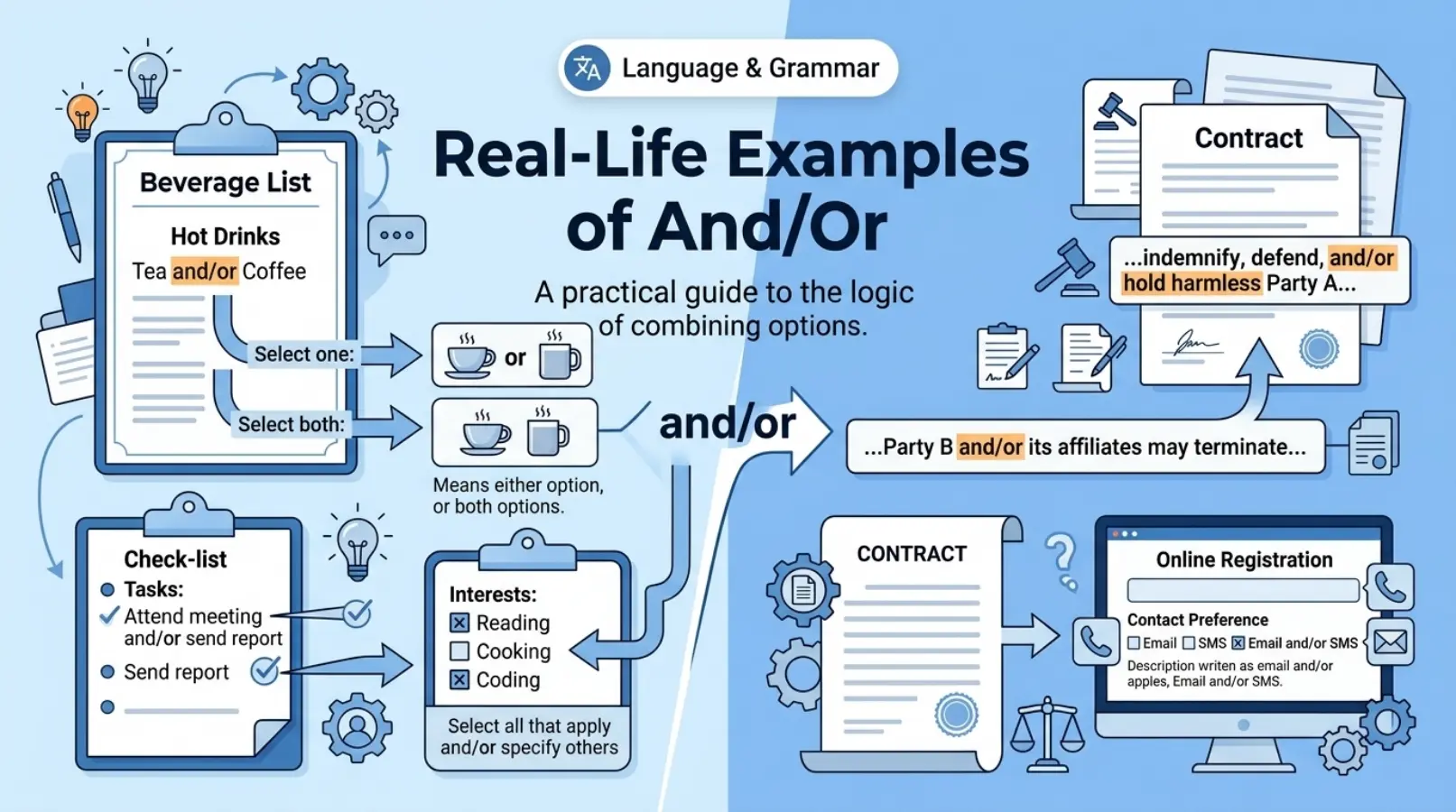
Real-Life Examples of And/Or
Workplace
Employees may attend the meeting in person and/or online.
Education
Students may submit projects through email and/or the learning portal.
Healthcare
Patients may receive medication and/or physical therapy.
Shopping
Customers can pay using cash and/or credit cards.
Travel
Travelers may carry passports and/or government-issued IDs.
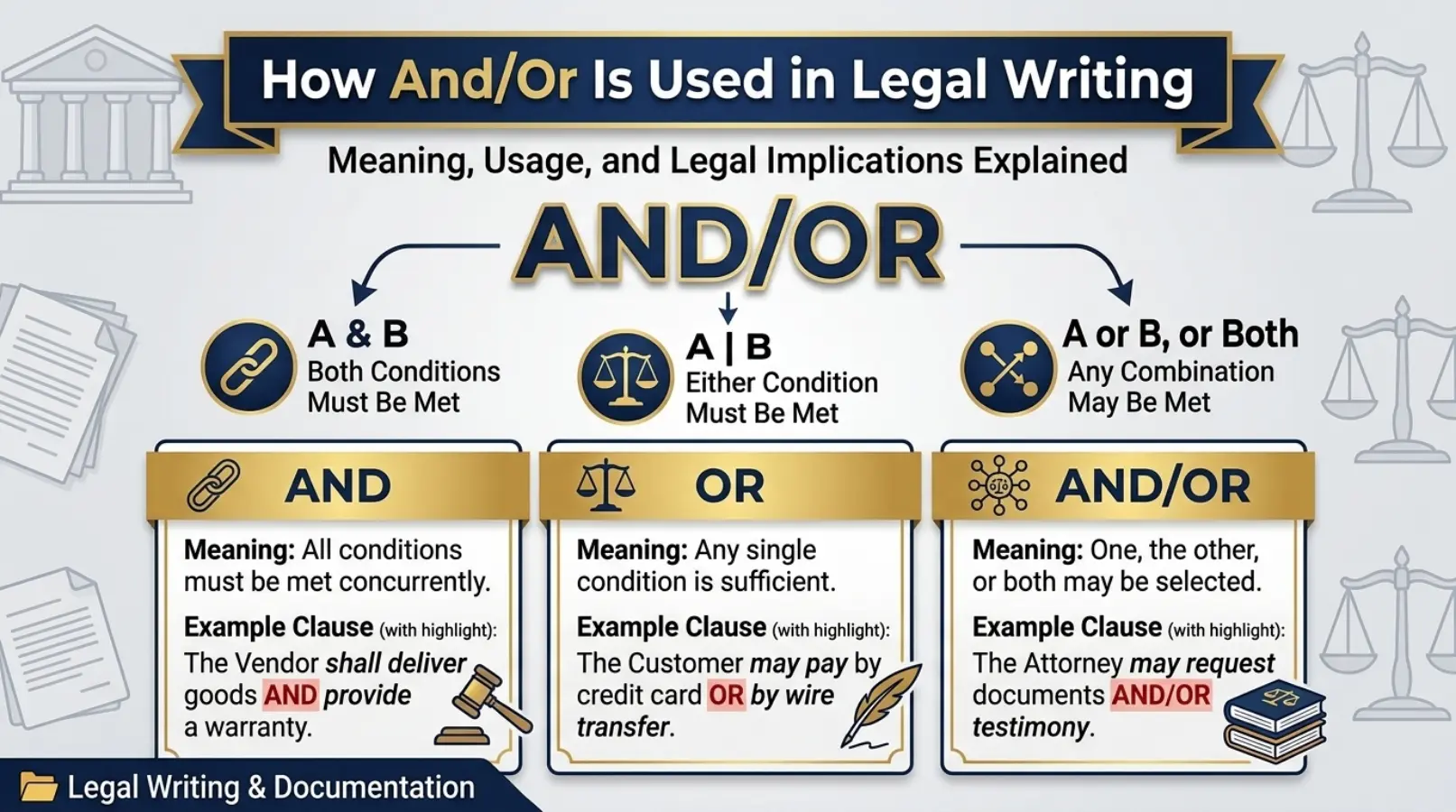
How And/Or Is Used in Legal Writing
Legal documents often use and/or because every possibility matters.
Example
The tenant and/or landlord shall maintain the property.
This can mean:
- Tenant alone
- Landlord alone
- Both parties
However, many legal experts now recommend clearer wording because and/or can create disputes.
Better Alternative
“The tenant, the landlord, or both shall maintain the property.”
This wording leaves less room for confusion.
Common Mistakes When Using And/Or
1. Using It Too Often
Overusing and/or makes writing harder to read.
Poor Example
Applicants must submit forms and/or certificates and/or references.
Better Example
Applicants may submit forms, certificates, references, or any combination of these.
2. Using It When “And” Works Better
Incorrect
Bring your ticket and/or seat number.
Better
Bring your ticket and seat number.
Both are required.
3. Using It When “Or” Works Better
Incorrect
Choose tea and/or coffee.
Better
Choose tea or coffee.
Only one choice is allowed.
4. Creating Ambiguity
Sometimes readers cannot tell what the writer means.
Always ask:
“Will readers understand every possible option clearly?”
When Should You Avoid And/Or?
Many style guides suggest avoiding and/or in general writing.
Avoid it when:
- Writing blog posts
- Creating marketing content
- Writing for young readers
- Simplicity matters
- Clear alternatives exist
Example
Instead of:
Students may complete assignments and/or quizzes.
Write:
Students may complete assignments, quizzes, or both.
This sounds more natural.
Tips for Using And/Or Correctly
Tip 1: Use It Only When All Options Apply
Make sure:
- A works
- B works
- A and B work
Tip 2: Consider Your Audience
Legal professionals may expect it.
General readers often prefer clearer wording.
Tip 3: Rewrite for Clarity
If readers must stop and think, rewrite the sentence.
Tip 4: Test Every Combination
Before using and/or, check whether every possible combination makes sense.
And/Or in Everyday Communication
People use and/or in many daily situations.
Family
You can bring snacks and/or drinks.
School
Students may use pencils and/or pens.
Sports
Players may practice indoors and/or outdoors.
Business
Customers can contact support by phone and/or email.
These examples show why and/or remains popular.
Synonyms
- Either
- Both
- Either or both
- Any combination of
- Together with
- As well as
- One or both
Expert Insights: Why And/Or Matters
Professional writers focus on clarity.
While and/or can save words, it sometimes creates confusion.
Many editors prefer rewriting sentences instead of relying on and/or.
Expert Recommendation
Use and/or only when:
- All combinations are valid
- Short wording matters
- Legal precision is necessary
Otherwise, write the options clearly.
Readers appreciate simple language.
Clear writing improves understanding and trust.
Examples of Correct and Incorrect Usage
| Correct Usage | Incorrect Usage |
| Bring a pen and/or pencil. | Bring your ticket and/or seat assignment. |
| Submit by email and/or mail. | Choose tea and/or coffee when only one choice is allowed. |
| Attend online and/or in person. | Complete both forms and/or documents. |
| Use cash and/or credit card. | Follow the rules and/or guidelines if both are mandatory. |
Frequently Asked Questions (FAQs)
What does and/or mean?
It means one option, the other option, or both options together.
Is and/or grammatically correct?
Yes. Most dictionaries and style guides recognize it as correct.
Should I use and/or in formal writing?
You can, but many editors recommend clearer alternatives.
Why do lawyers use and/or?
It covers multiple possibilities in a compact way.
Is and/or the same as and?
No. “And” requires both options, while “and/or” allows one or both.
Is and/or the same as or?
No. “Or” usually means one option, while “and/or” includes both as a possibility.
Can I avoid using and/or?
Yes. Many writers replace it with clearer phrases such as “A, B, or both.”
Is and/or acceptable in business writing?
Yes, but clear wording is usually preferred.
Conclusion
And/or is a useful expression that combines the meanings of and and or into one phrase. It allows one option, the other option, or both options together. Because of this flexibility, it appears frequently in legal documents, contracts, business communications, and formal writing.
However, clarity should always come first. Many professional editors recommend replacing and/or with more direct wording whenever possible. Readers often understand simple sentences faster than condensed expressions.
When using and/or, make sure every possible combination makes sense. If the sentence feels confusing, rewrite it. Clear communication always wins.
By understanding the meaning and proper usage of and/or, you can write more accurately, avoid misunderstandings, and improve the quality of your communication.