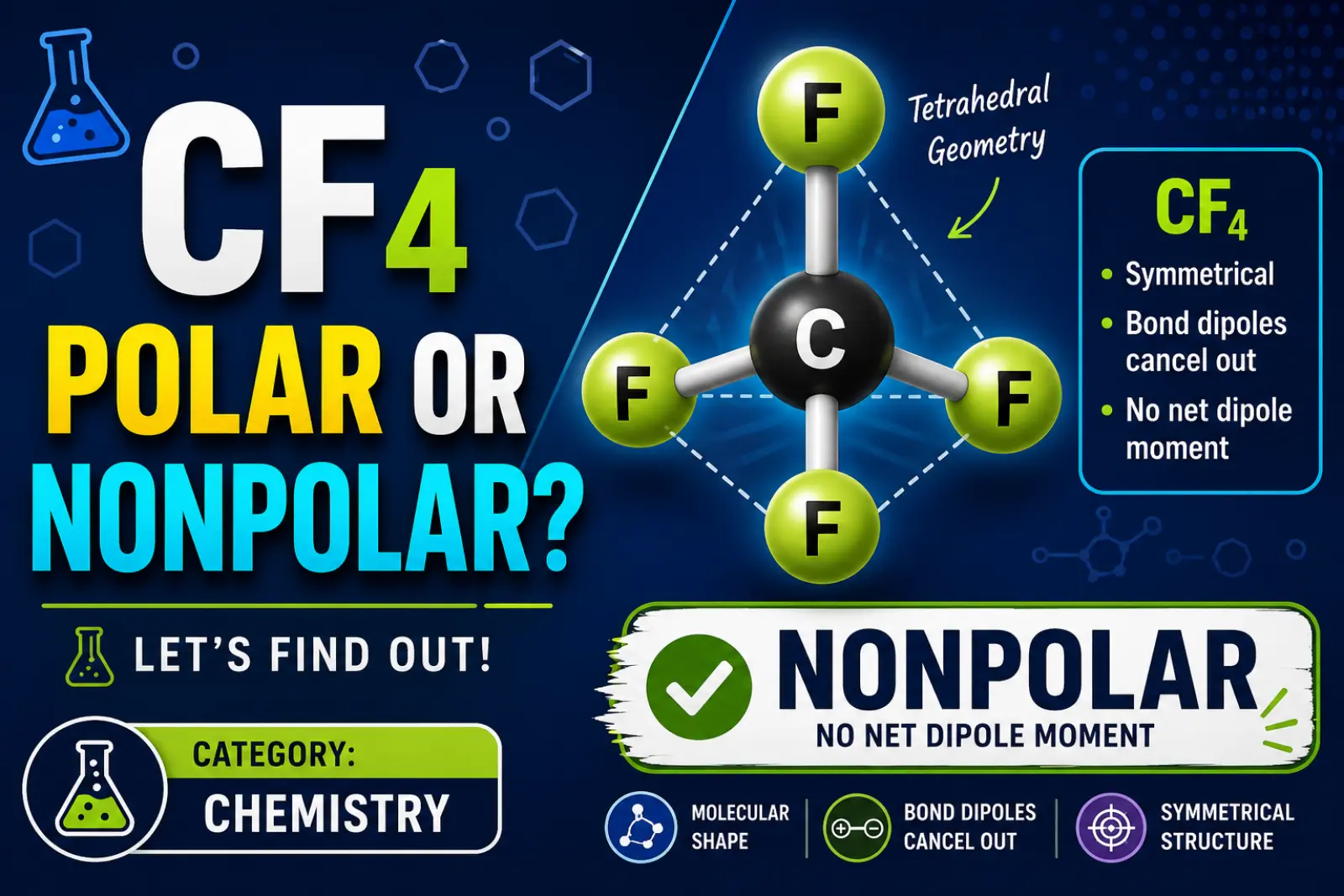
CF4 polar or nonpolar is a common question in chemistry. Many students find molecular polarity confusing at first. However, understanding CF4 becomes easy when you learn its shape and bond arrangement.
CF4 stands for carbon tetrafluoride. It contains one carbon atom and four fluorine atoms. Fluorine is highly electronegative, which means it strongly attracts electrons. Because of this, many people assume CF4 must be polar.
The answer may surprise you. Even though CF4 contains polar bonds, the entire molecule behaves differently. Its special structure causes the bond effects to cancel out.
In this guide, you will learn why CF4 is nonpolar, how molecular geometry affects polarity, and how to identify similar molecules with confidence.
Quick Summary Box
- CF4 stands for carbon tetrafluoride.
- CF4 contains one carbon atom and four fluorine atoms.
- Each C–F bond is polar.
- CF4 has a symmetrical tetrahedral shape.
- The bond dipoles cancel each other.
- CF4 is a nonpolar molecule.
- Molecular symmetry determines its overall polarity.
- CF4 has a bond angle of approximately 109.5°.
What Is CF4?
CF4 is the chemical formula for carbon tetrafluoride.
The molecule contains:
- 1 Carbon (C) atom
- 4 Fluorine (F) atoms
Carbon sits at the center of the molecule. Four fluorine atoms surround it evenly.
Basic Properties of CF4
| Property | Value |
| Chemical Name | Carbon Tetrafluoride |
| Formula | CF4 |
| Molecular Shape | Tetrahedral |
| Bond Angle | 109.5° |
| Central Atom | Carbon |
| Polar or Nonpolar | Nonpolar |
| Hybridization | sp³ |
Is CF4 Polar or Nonpolar?
CF4 Is Nonpolar
Although every carbon-fluorine bond is polar, the entire CF4 molecule is nonpolar.
This happens because:
- CF4 has a perfectly symmetrical tetrahedral shape.
- The four bond dipoles point in different directions.
- The dipoles cancel one another.
- Net dipole moment becomes zero.
Therefore, CF4 has no positive or negative side overall.
Final Answer
CF4 is a nonpolar molecule because its tetrahedral geometry causes all bond dipoles to cancel out.
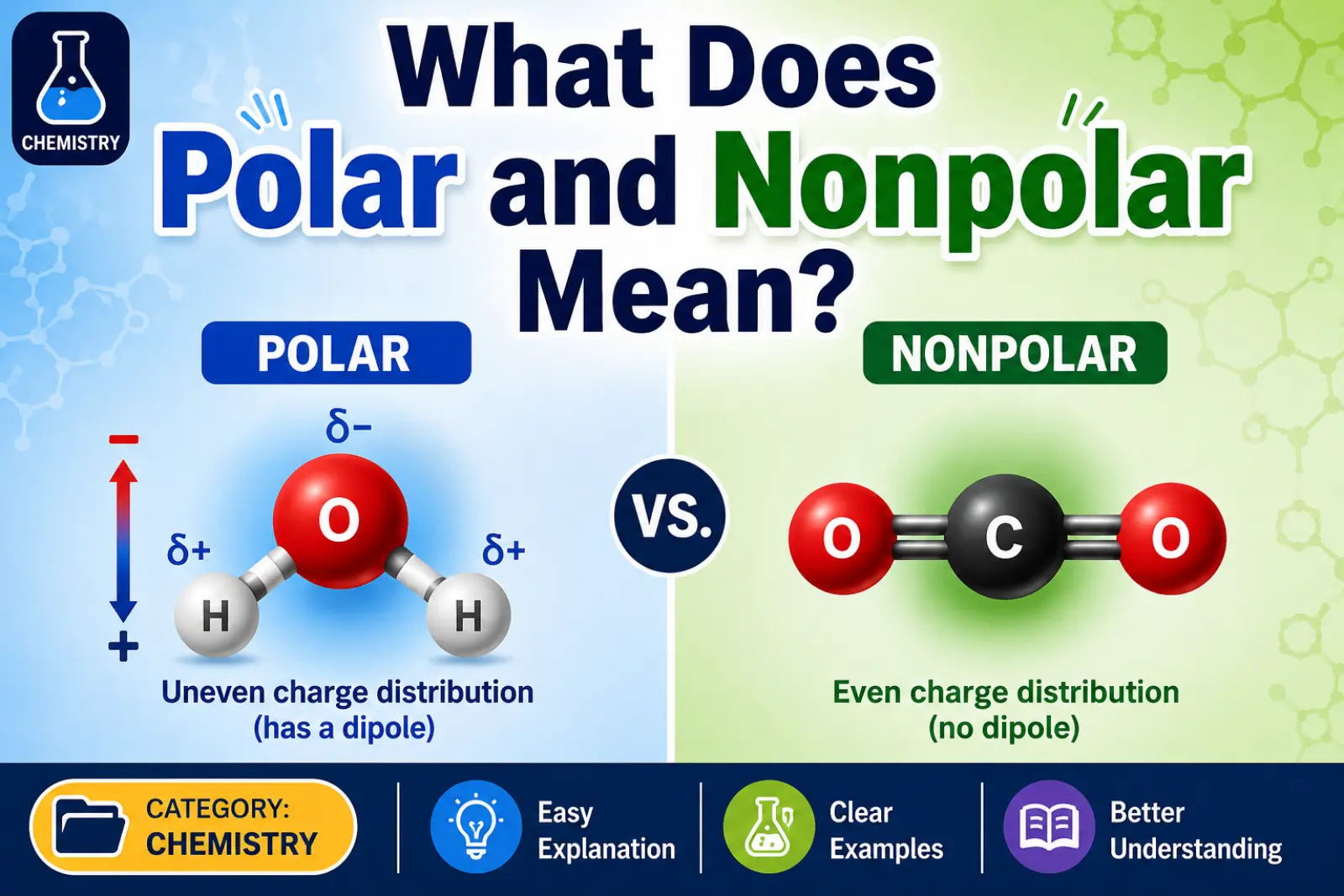
What Does Polar and Nonpolar Mean?
Before understanding CF4, let’s review polarity.
Polar Molecules
A molecule is polar when:
- Electrons are shared unequally.
- One side becomes slightly positive.
- The other side becomes slightly negative.
- Net dipole moment exists.
Examples
- Water (H₂O)
- Ammonia (NH₃)
- Sulfur dioxide (SO₂)
Nonpolar Molecules
A molecule is nonpolar when:
- Electrons are shared equally overall.
- Charges balance out.
- Dipoles cancel each other.
- Net dipole moment equals zero.
Examples
- Methane (CH₄)
- Carbon dioxide (CO₂)
- Carbon tetrafluoride (CF4)
Why Are C–F Bonds Polar?
The carbon-fluorine bond is highly polar.
Electronegativity Values
| Element | Electronegativity |
| Carbon | 2.55 |
| Fluorine | 3.98 |
The difference is:
3.98 − 2.55 = 1.43
This large difference creates polar covalent bonds.
Fluorine pulls electrons closer to itself. As a result:
- Fluorine gains a partial negative charge (δ−).
- Carbon gains a partial positive charge (δ+).
So each individual C–F bond is polar.
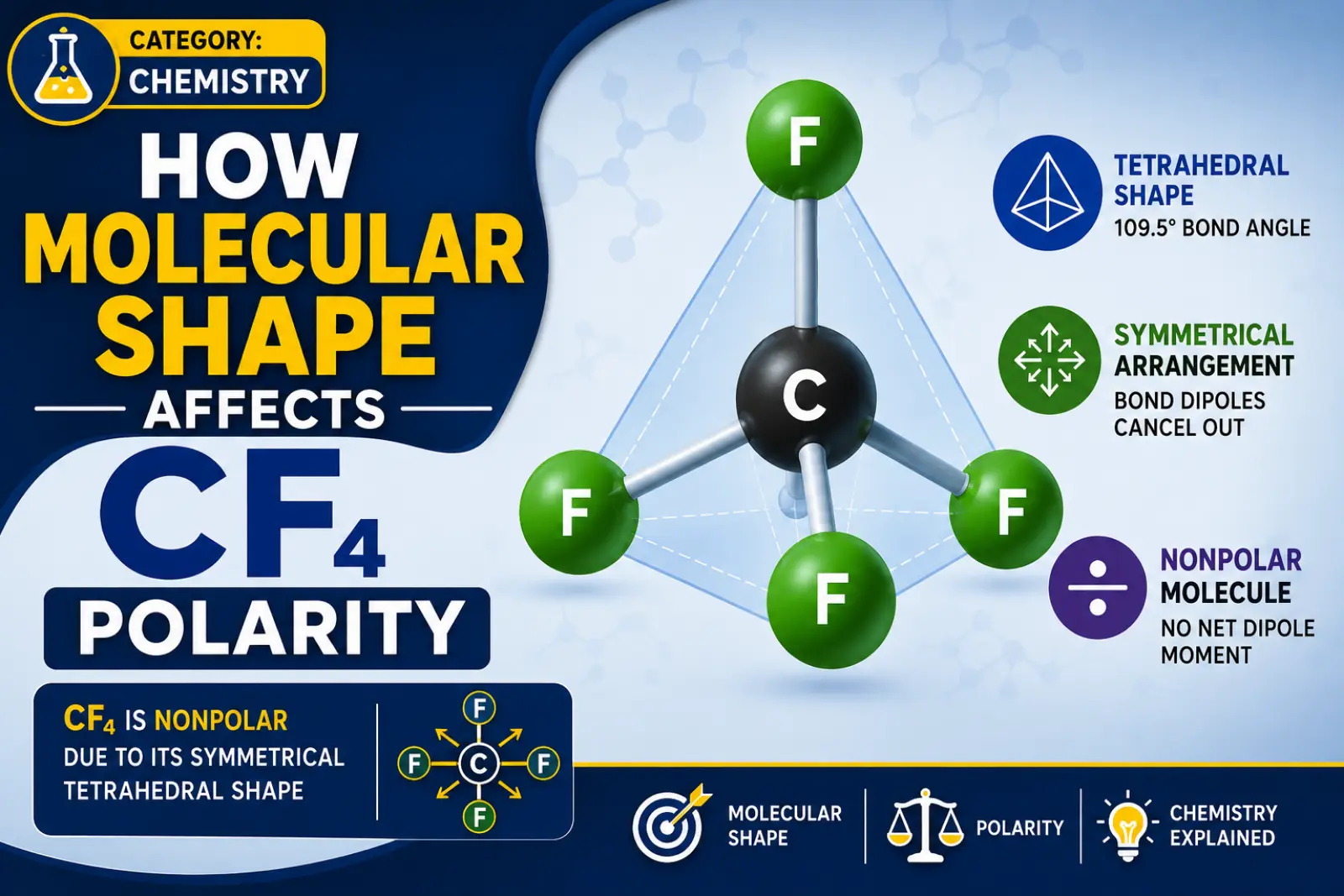
How Molecular Shape Affects CF4 Polarity
Molecular geometry plays a major role in polarity.
CF4 Structure
The central carbon atom forms four single bonds with fluorine atoms.
The arrangement creates a tetrahedral shape.
F
|
F – C – F
/ \
F F
In reality, the fluorine atoms spread evenly in three dimensions.
Result
Since all four fluorine atoms occupy identical positions:
- Bond dipoles have equal strength.
- Dipoles point symmetrically.
- They cancel completely.
Therefore, CF4 remains nonpolar.
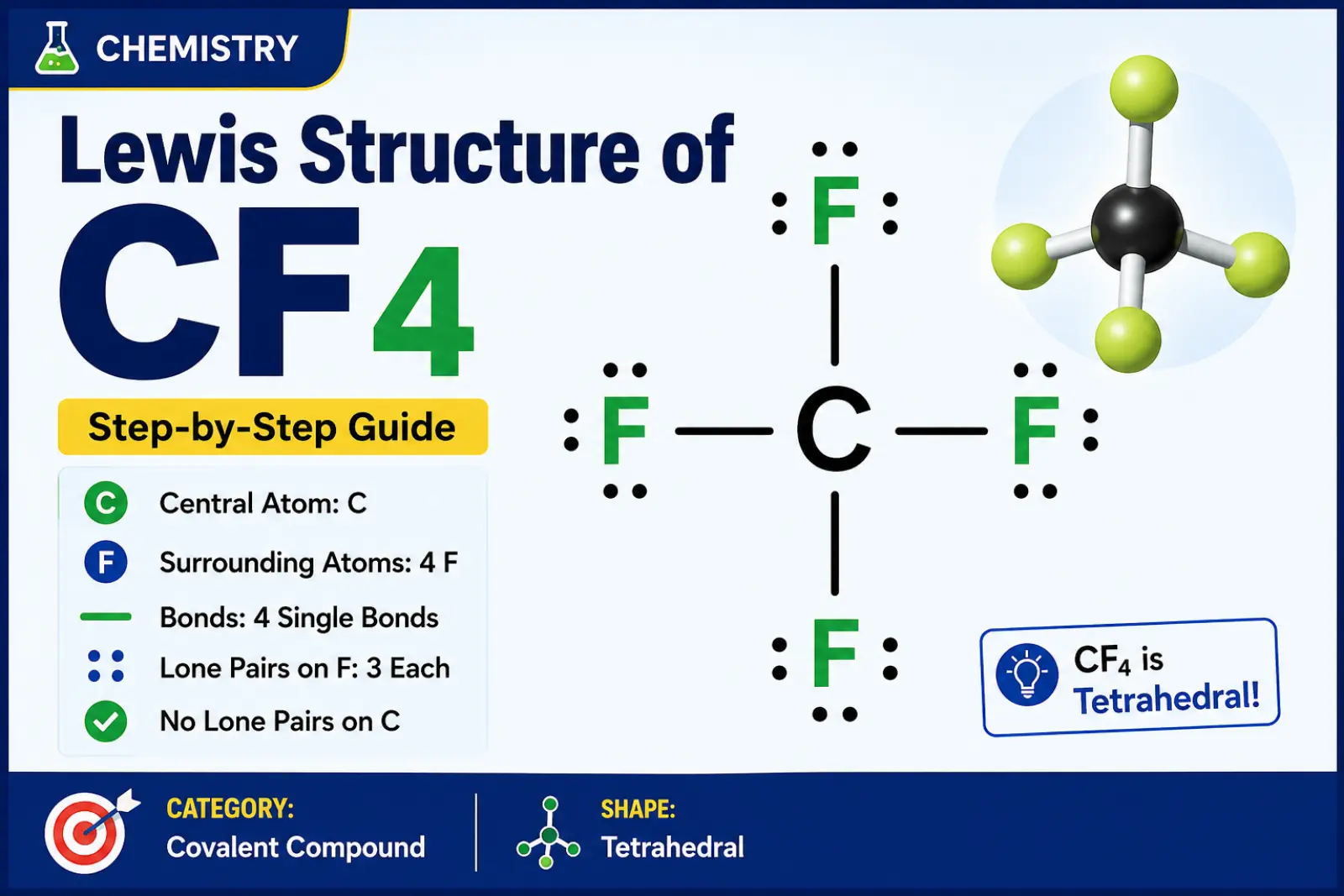
Lewis Structure of CF4
The Lewis structure helps explain bonding.
Steps
- Carbon goes in the center.
- Four fluorine atoms surround carbon.
- Carbon forms four single bonds.
- Each fluorine gets three lone pairs.
- Carbon satisfies the octet rule.
Key Observation
- Carbon has no lone pairs.
- Four identical surrounding atoms exist.
- Symmetry remains perfect.
This supports CF4’s nonpolar nature.
VSEPR Theory and CF4
VSEPR stands for:
Valence Shell Electron Pair Repulsion Theory
This theory predicts molecular shape.
CF4 According to VSEPR
- Central atom: Carbon
- Bonding pairs: 4
- Lone pairs: 0
Notation:
AX4
According to VSEPR:
- AX4 molecules form tetrahedral shapes.
- Bond angle equals about 109.5°.
This symmetry leads to nonpolarity.
Dipole Moment in CF4
A dipole moment measures molecular polarity.
Formula Concept
Dipole moment depends on:
- Bond polarity
- Molecular geometry
In CF4
- Each bond has a dipole.
- Dipoles point outward.
- Symmetrical arrangement cancels all vectors.
Therefore:
Net Dipole Moment = 0
This confirms that CF4 is nonpolar.
CF4 Polar vs Nonpolar Molecules Comparison
| Feature | CF4 (Nonpolar) | H₂O (Polar) |
| Bond Type | Polar Bonds | Polar Bonds |
| Shape | Tetrahedral | Bent |
| Symmetry | Symmetrical | Asymmetrical |
| Dipole Cancellation | Yes | No |
| Net Dipole Moment | Zero | Nonzero |
| Overall Polarity | Nonpolar | Polar |
Key Lesson
Polar bonds do not always create a polar molecule.
Molecular shape matters just as much.
Real-Life Examples Similar to CF4
Many molecules behave like CF4.
Methane (CH4)
- Tetrahedral shape
- Symmetrical structure
- Nonpolar
Carbon Tetrachloride (CCl4)
- Four identical surrounding atoms
- Symmetrical
- Nonpolar
Silicon Tetrafluoride (SiF4)
- Tetrahedral geometry
- Dipoles cancel
- Nonpolar
These molecules follow the same principle as CF4.
Common Mistakes Students Make
Mistake 1: Looking Only at Bond Polarity
Many students see polar C–F bonds and conclude CF4 is polar.
This is incorrect.
Always check molecular geometry.
Mistake 2: Ignoring Symmetry
Symmetrical molecules often become nonpolar even when bonds are polar.
Mistake 3: Forgetting Dipole Cancellation
Bond dipoles can cancel completely.
Always examine the overall structure.
Mistake 4: Confusing Bond Polarity With Molecular Polarity
A molecule can contain polar bonds and still be nonpolar.
CF4 is a perfect example.
Easy Trick to Determine CF4 Polarity
Use this simple method:
Step 1
Check electronegativity difference.
- C–F bonds are polar.
Step 2
Identify molecular shape.
- CF4 is tetrahedral.
Step 3
Check symmetry.
- Four identical fluorine atoms surround carbon.
Step 4
Ask whether dipoles cancel.
- Yes, they cancel completely.
Result
CF4 is nonpolar.
Usage and Importance of CF4 in Daily Life
CF4 has several industrial applications.
Uses of Carbon Tetrafluoride
- Semiconductor manufacturing
- Plasma etching processes
- Electronics production
- Research laboratories
- Chemical processing
Understanding its polarity helps scientists predict:
- Solubility
- Reactivity
- Intermolecular forces
- Industrial behavior
Expert Insight: Why Understanding CF4 Polarity Matters
Chemistry students often memorize polarity rules. However, true understanding comes from recognizing patterns.
CF4 teaches a valuable lesson:
Bond polarity alone does not determine molecular polarity.
Scientists examine:
- Electronegativity differences
- Molecular geometry
- Symmetry
- Dipole moments
Mastering CF4 helps you solve polarity questions for many other molecules quickly and accurately.
Frequently Asked Questions (FAQs)
Is CF4 polar or nonpolar?
CF4 is nonpolar because its tetrahedral shape causes all bond dipoles to cancel.
Why is CF4 nonpolar if C–F bonds are polar?
Each C–F bond is polar, but the symmetrical arrangement cancels the dipole effects.
What is the shape of CF4?
CF4 has a tetrahedral molecular geometry.
Does CF4 have a dipole moment?
No. The net dipole moment of CF4 is zero.
Is CF4 symmetrical?
Yes. Four identical fluorine atoms surround the central carbon atom symmetrically.
What is the bond angle in CF4?
The bond angle is approximately 109.5°.
Is CF4 similar to CH4?
Yes. Both molecules have tetrahedral geometry and are nonpolar.
What theory predicts the shape of CF4?
VSEPR theory predicts the tetrahedral shape of CF4.
Conclusion
So, CF4 polar or nonpolar? The answer is clear: CF4 is nonpolar. Although each carbon-fluorine bond is polar, the molecule’s tetrahedral shape creates perfect symmetry. This symmetry causes all bond dipoles to cancel out, leaving no overall dipole moment.
When determining polarity, always examine both bond polarity and molecular geometry. Many students focus only on electronegativity differences and miss the importance of shape. CF4 demonstrates why symmetry is essential in chemistry.
Remember this simple rule: polar bonds plus perfect symmetry often produce a nonpolar molecule. By understanding CF4, you can confidently analyze many other molecules and solve polarity questions with ease.