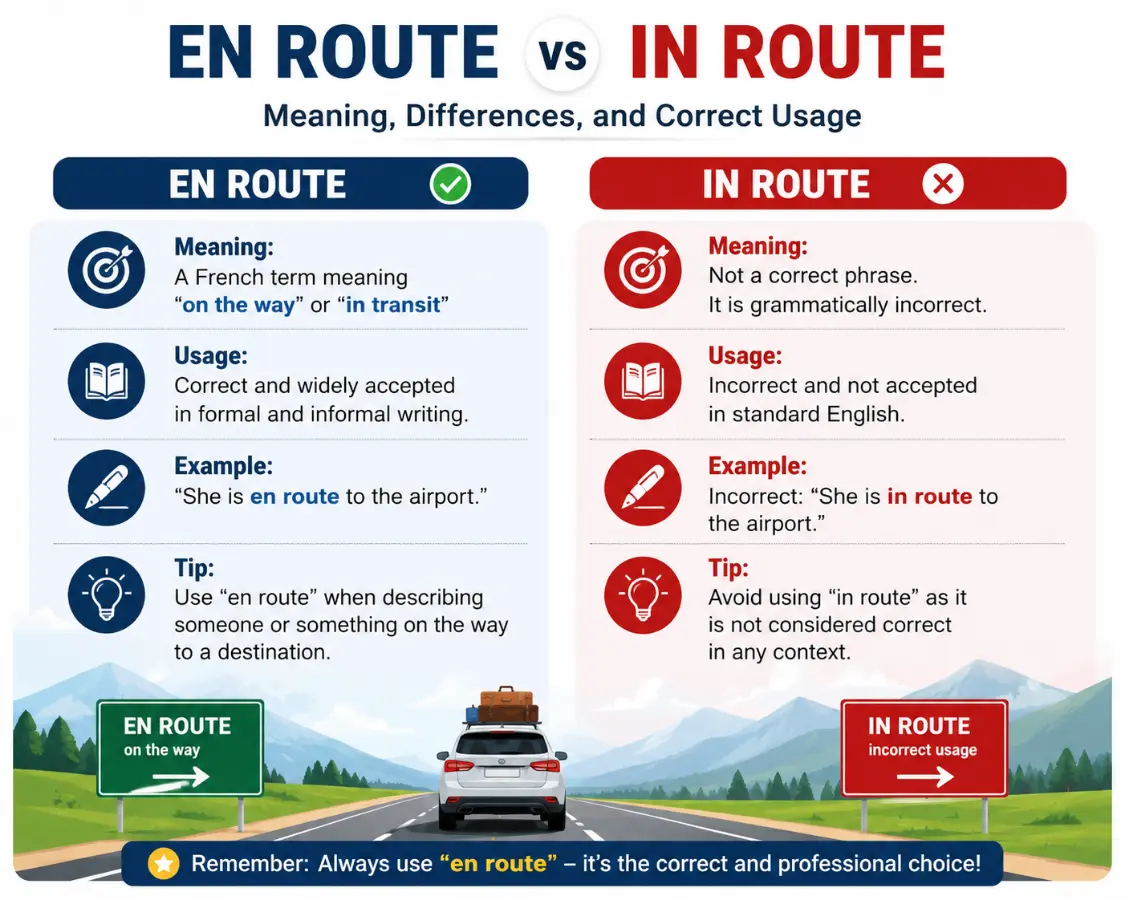
En Route vs In Route can be confusing because both phrases seem to describe traveling or being on the way. However, they are not equally correct in standard English. En route is the correct and widely accepted phrase for saying that someone or something is traveling toward a destination. For example, “The package is en route to your home.” In route is usually considered incorrect when used with this meaning. Learning the difference helps you avoid common grammar mistakes in emails, messages, travel writing, and daily conversations. In this guide, we will explain en route vs in route in simple words. You will also learn their meanings, correct usage, examples, common mistakes, and easy ways to remember which phrase to use.
Quick Summary Box
- En route is the correct phrase.
- En route means “on the way” or “traveling toward a destination.”
- The phrase comes from French.
- In route is generally considered incorrect in standard English.
- Use en route in formal and informal writing.
- Example: “The package is en route to your address.”
What Does En Route Mean?
En route means someone or something is currently traveling to a destination.
It describes movement from one place to another.
Simple Definition
En route = On the way to a destination.
Examples
- I am en route to the office.
- The ambulance is en route to the hospital.
- Your order is en route.
- We are en route to the airport.
The phrase works for people, vehicles, packages, and services.
What Does In Route Mean?
In route is usually considered incorrect.
Many people mistakenly use it instead of en route because the words sound similar.
Why the Confusion Happens
People often hear “en route” in conversations. When they write it, they replace “en” with “in.”
This creates the incorrect phrase “in route.”
Example
❌ I am in route to school.
✅ I am en route to school.
In professional writing, always choose en route.
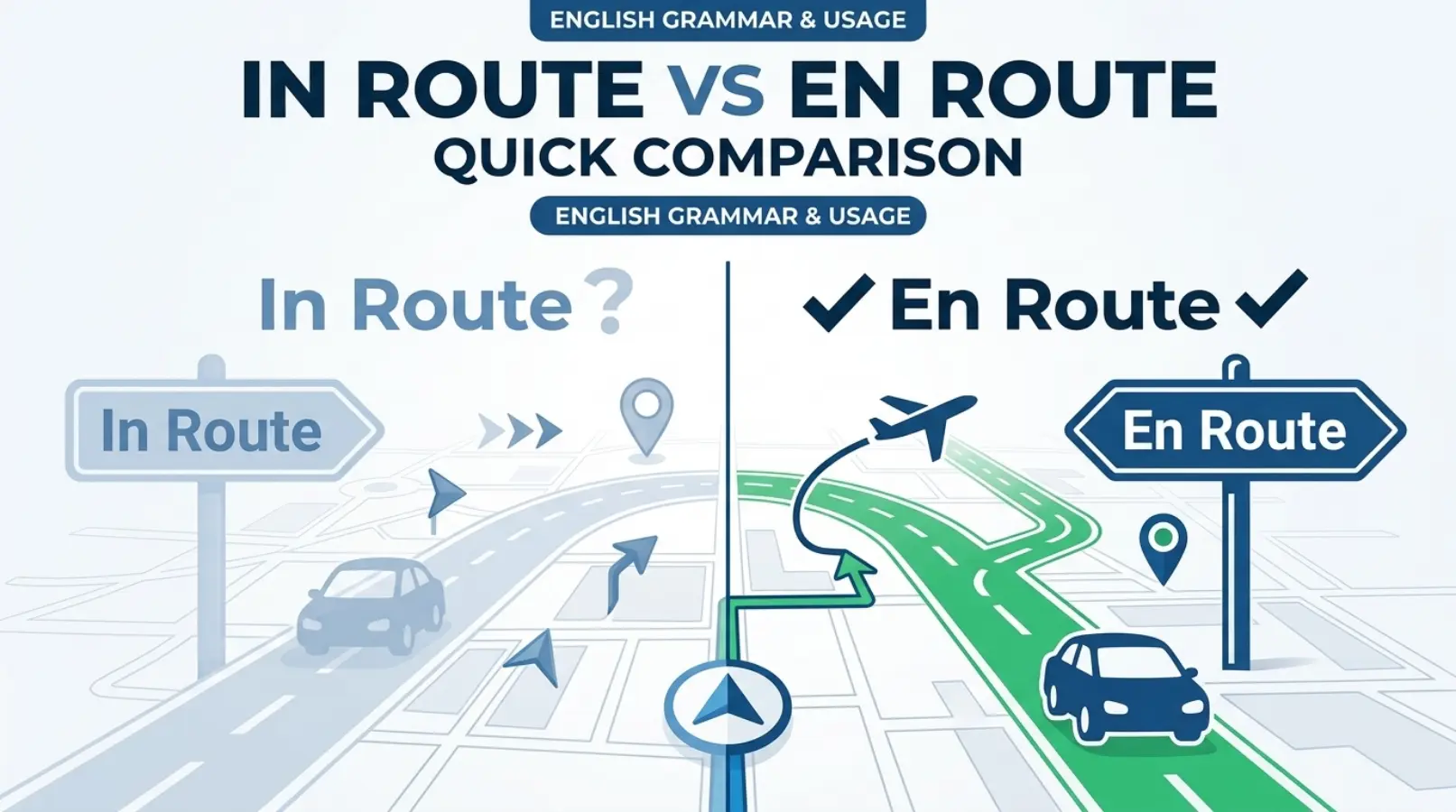
In Route vs En Route: Quick Comparison
| Feature | En Route | In Route |
|---|---|---|
| Correct English Usage | Yes | No |
| Meaning | On the way | Usually incorrect |
| Common in Formal Writing | Yes | No |
| Used in Business Communication | Yes | No |
| Found in Dictionaries | Yes | Rarely |
| Recommended Usage | Always | Avoid |
Winner
En route is the correct and accepted phrase.
Where Does En Route Come From?
The phrase en route comes from French.
In French:
- En means “on” or “in.”
- Route means “road” or “way.”
Together, the phrase means:
“On the road” or “on the way.”
English adopted the phrase many years ago. Today, it remains a standard part of the English language.
How to Use En Route Correctly
Using en route is simple.
Place it after a subject and helping verb.
Examples
- We are en route to the conference.
- The train is en route to London.
- She was en route home.
- The shipment is en route.
Email Examples
- I am en route and should arrive in 15 minutes.
- Our team is en route to the meeting venue.
- The documents are en route via courier.
These examples sound natural and professional.
Real-Life Examples of En Route
You will often see en route in daily life.
Travel
- The flight is en route to New York.
- We are en route to our hotel.
Delivery Services
- Your package is en route.
- The driver is en route with your order.
Emergency Services
- Police are en route.
- Firefighters are en route to the scene.
Business Communication
- Our representative is en route.
- The shipment is en route to the warehouse.
The phrase appears in many industries because it is short and clear.

Common Mistakes People Make
Many writers misuse the phrase.
Mistake 1: Writing In Route
❌ We are in route to the destination.
✅ We are en route to the destination.
Mistake 2: Using Extra Words
❌ We are en route on the way home.
✅ We are en route home.
The phrase already means “on the way.”
Mistake 3: Wrong Spelling
❌ On route
❌ Inroute
✅ En route
Always use the correct spelling.
En Route in Business and Professional Writing
Business professionals often use en route because it sounds concise and professional.
Examples
- The project manager is en route to the client meeting.
- The delivery truck is en route to the warehouse.
- Our technician is en route and will arrive shortly.
This phrase helps communicate progress clearly.
It is common in:
- Logistics
- Customer service
- Transportation
- Healthcare
- Corporate communication

En Route in Daily Conversations
You can use en route in casual conversations too.
Examples
- I’m en route now.
- We are en route to dinner.
- Dad is en route home.
- The kids are en route from school.
Many native speakers use it regularly.
It sounds natural and easy to understand.
Synonyms
If you want variety, several phrases have similar meanings.
Synonyms for En Route
- On the way
- Heading toward
- Traveling to
- Going to
- In transit
- Moving toward
- Bound for
- Journeying to
Examples
Instead of:
- The package is en route.
You can write:
- The package is in transit.
- The package is on the way.
These alternatives work in many situations.
Tips to Remember the Correct Phrase
Remembering the correct phrase becomes easy with a few tricks.
Tip 1: Think of Delivery Tracking
Most shipping companies use en route.
You rarely see “in route.”
Tip 2: Remember Its French Origin
The phrase came from French.
That is why it starts with en, not in.
Tip 3: Use “On the Way” Test
If “on the way” fits, use en route.
Example:
- We are on the way home.
- We are en route home.
Both work perfectly.
Why Correct Usage Matters
Correct grammar improves communication.
Using the right phrase helps you:
- Sound professional
- Build credibility
- Avoid confusion
- Improve writing quality
- Create better first impressions
Small grammar choices often make a big difference.
Especially in business writing, accuracy matters.
Expert Insight: Why Writers Should Use En Route
Language experts consistently recommend en route.
Major dictionaries and style guides recognize it as the standard form.
Using accurate language shows attention to detail.
It also helps maintain professionalism in emails, reports, articles, and customer communication.
When readers trust your writing, they stay longer and engage more with your content.
Frequently Asked Questions (FAQs)
Is “in route” grammatically correct?
No. Standard English uses en route.
What does en route mean?
It means “on the way” to a destination.
Why do people say in route?
People often confuse the pronunciation and spelling of en route.
Is en route formal or informal?
It works in both formal and informal situations.
Can I use en route in emails?
Yes. It is common in professional emails.
Is en route French?
Yes. The phrase originated from French.
What is another word for en route?
You can use “on the way” or “in transit.”
How do you pronounce en route?
Most English speakers pronounce it as “ahn root” or “en root.”
Conclusion
The debate between en route or in route has a simple answer. En route is the correct phrase in standard English. It means “on the way” and comes from the French language. Although many people mistakenly write in route, grammar experts and dictionaries recommend using en route in all situations.
If you are writing emails, sending text messages, tracking shipments, or creating professional documents, the correct phrase helps you communicate clearly. It also improves your credibility and writing quality.
The easiest way to remember the rule is simple: if you mean “on the way,” use en route. Avoid in route and choose the accepted form every time.