
Domain is X or Y is a common phrase used in mathematics, especially in functions. It helps describe the input values of a function.
In simple words, the domain tells us what values of X are allowed. Sometimes, these values are written as X or Y depending on the problem setup.
Understanding domain is important for solving equations and graphing functions correctly. Many students get confused between domain and range. But once you learn the basics, it becomes very easy.
In this guide, you will learn the meaning of domain, how to find it, and how it works in real-life problems. You will also see examples, mistakes to avoid, and simple tricks to master it quickly.
This article is written in easy English to help beginners understand the concept without stress.
Quick Summary Box
- Domain means allowed input values in a function
- Usually written as X values in math problems
- It tells which numbers can be used
- Helps define function behavior clearly
- Excludes invalid values like division by zero
- Works with range (output values)
- Important in graphs, algebra, and real-life models
What Does “Domain is X or Y” Mean?
The phrase domain is X or Y refers to possible input values in a function.
In most cases, X represents independent values. Y is usually the output. However, in some explanations, X or Y may be used to show different valid inputs depending on context.
For example, if a function is defined as:
f(x) = x + 2
Then the domain is all valid X values. You can plug in X, but not all numbers may always work in every function.
So, “domain is X or Y” simply means the function accepts certain values depending on rules.

Domain in Simple Words
Domain is the set of values you can put into a function.
Think of it like a machine:
- You put X inside
- The machine gives you an output
But the machine only accepts safe inputs. These safe inputs are called the domain.
If you enter the wrong value, the function may break. That is why domain is important.
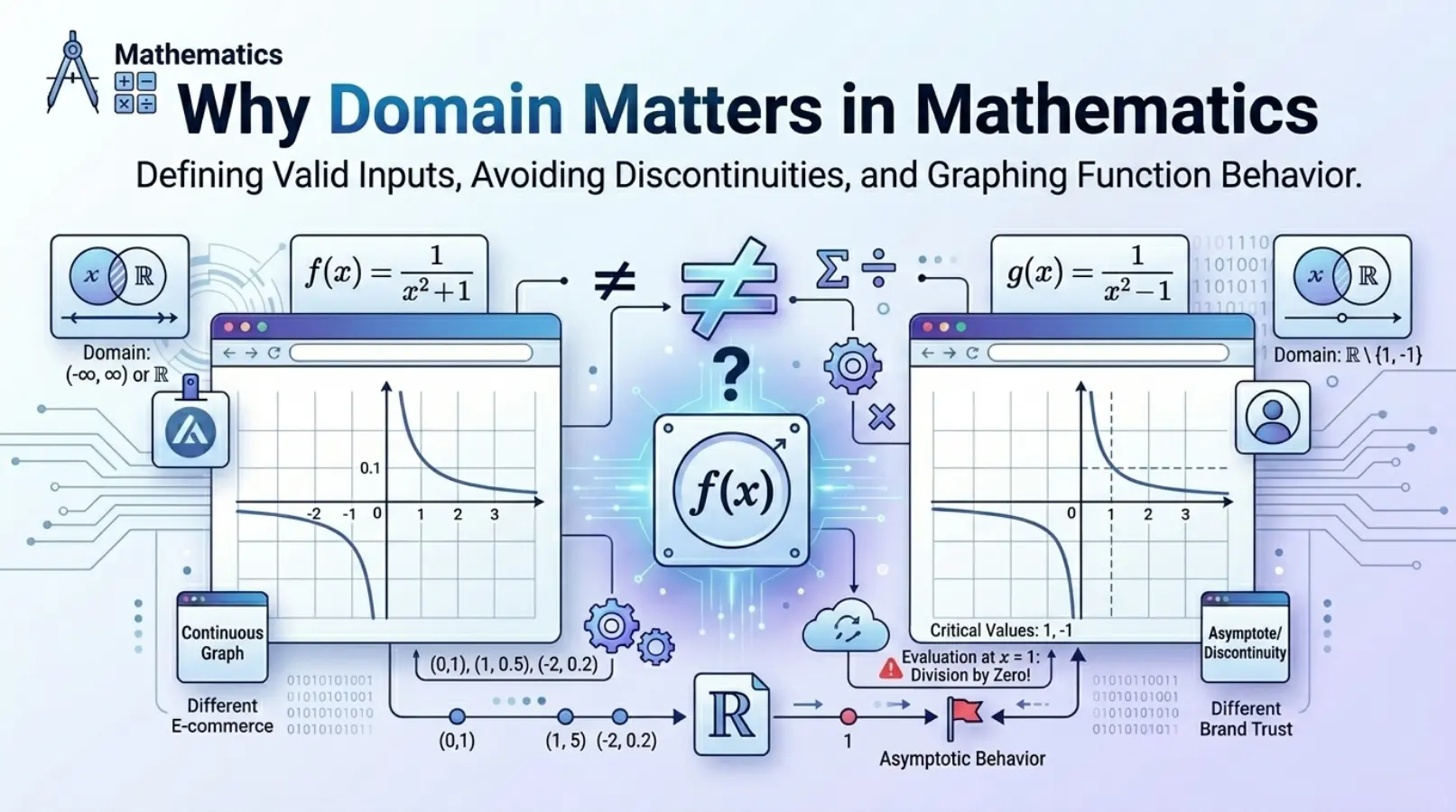
Why Domain Matters in Mathematics
Domain is important because it helps:
- Avoid invalid answers
- Keep equations correct
- Understand graph limits
- Solve real-world problems
Without domain, a function has no clear meaning. It tells us where the function works and where it does not.
For example, in real life:
- You cannot divide by zero in calculations
- You cannot take square roots of negative numbers (in basic math)
These rules define the domain.
Types of Domain
1. Discrete Domain
These are separate values like:
- 1, 2, 3, 4
Used in counting problems.
2. Continuous Domain
These include all numbers in a range:
- All real numbers between 1 and 10
Used in graphs and physics.
How to Identify Domain
To find domain, follow these steps:
Step 1: Check division
Make sure denominator is not zero.
Step 2: Check square roots
No negative values under square root (basic level).
Step 3: Check function rules
Some functions restrict values.
Step 4: Write final set
Express domain in interval or set form.
Example:
f(x) = 1 / (x – 3)
Here, x ≠ 3
So domain is all real numbers except 3.
Real-Life Examples of Domain
Example 1: Age Limit
A game allows users aged 10–18 only.
Domain = 10 to 18
Example 2: Speed Limit
A vehicle system accepts speed from 0 to 120 km/h.
Domain = 0 to 120
Example 3: Temperature Model
A weather model works from -10°C to 50°C.
Domain = -10 to 50
These show how domain works outside math too.

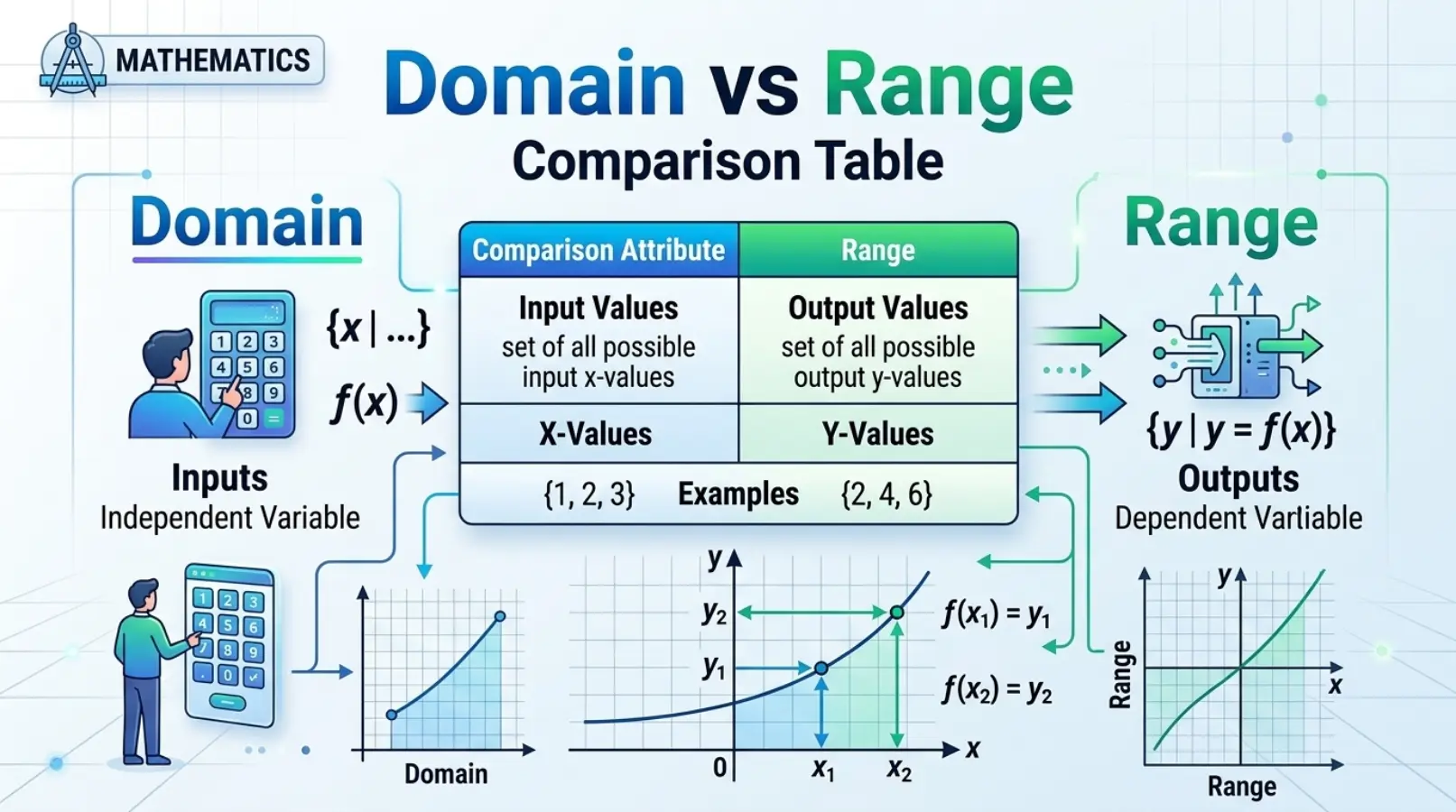
Domain vs Range (Comparison Table)
| Feature | Domain | Range |
| Meaning | Input values | Output values |
| Variable | X values | Y values |
| Role | Independent | Dependent |
| Direction | Goes into function | Comes out of function |
| Example | x = 1, 2, 3 | y = 2, 4, 6 |
Domain is what you enter. Range is what you get.
Common Mistakes Students Make
- Confusing domain with range
- Ignoring division by zero rules
- Forgetting square root restrictions
- Writing incorrect interval notation
- Mixing input and output values
These mistakes can change final answers completely. Always double-check conditions.
Tips and Tricks to Find Domain Easily
- Always check denominator first
- Look for square roots early
- Break function into parts
- Think about real-world limits
- Practice interval notation daily
These small habits improve accuracy quickly.
Usage in Daily Life
Domain is used in many real-world systems:
- Banking apps (transaction limits)
- Weather forecasting models
- Engineering calculations
- Computer programming functions
- Scientific experiments
Every system has limits, and those limits define domain.
Expert Insights on Domain Concept
Experts say domain is the foundation of functions.
Without domain, graphs become meaningless. It defines where a function is valid and safe to use.
In higher mathematics, domain becomes more complex, including:
- Complex numbers
- Piecewise functions
- Advanced constraints
Learning domain early helps build strong math skills later.
FAQs
1. What is domain in simple words?
Domain is the set of input values a function accepts.
2. Is domain always X values?
Yes, domain usually represents X or input values.
3. Can domain be negative?
Yes, if the function allows negative values.
4. What is difference between domain and range?
Domain is input, range is output.
5. How do you find domain quickly?
Check division, roots, and restrictions.
6. Why is domain important?
It prevents invalid answers and defines function limits.
7. Can domain be all real numbers?
Yes, if no restrictions exist.
Conclusion
The concept of domain is X or Y helps us understand how functions work in mathematics. The domain tells us which input values are allowed in a function. These values are usually written as X values.
Understanding domain makes math easier and more accurate. It helps avoid errors and improves problem-solving skills. It also plays an important role in real-life systems like science, engineering, and programming.
Once you learn how to find domain, you can solve many math problems with confidence. Always remember to check rules like division and square roots. With practice, domain becomes very simple.
In short, domain is the starting point of every function, and mastering it is key to understanding higher mathematics.