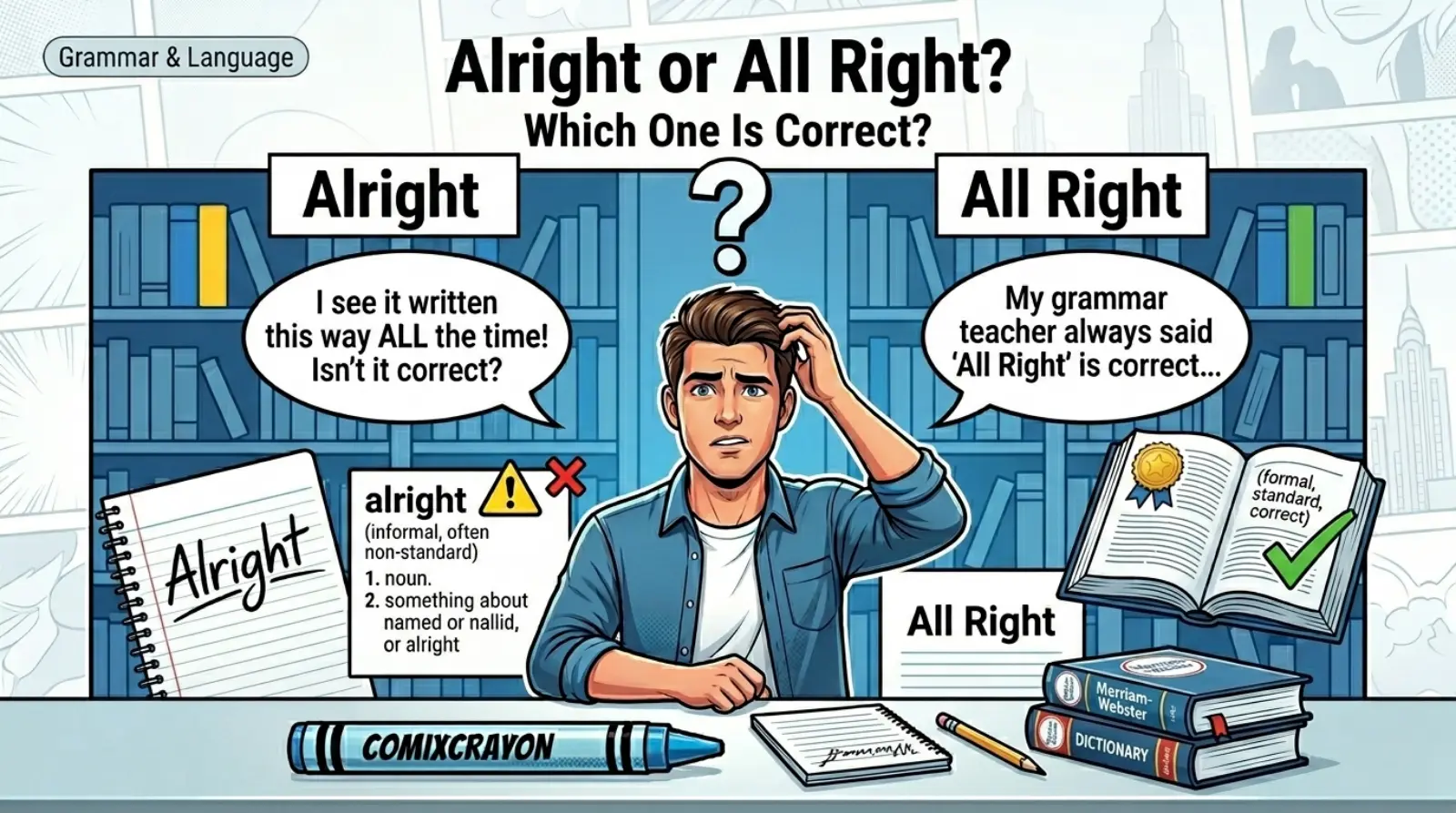
Alright or all right is a common question for students, writers, and English learners. Many people see both forms and wonder which one they should use.
The good news is that both terms appear in English writing. However, they do not always fit the same situation. Some style guides prefer one form over the other.
Understanding the difference can improve your writing. It can also help you avoid mistakes in school, work, and daily communication.
In this guide, you will learn the meaning of each term, see real-life examples, compare their usage, and discover expert tips. By the end, you will know exactly when to use alright and when to use all right.
Quick Summary Box
- All right is the traditional and widely accepted form.
- Alright is a newer spelling.
- Many editors and style guides prefer all right.
- Both usually mean “okay,” “acceptable,” or “fine.”
- Formal writing should generally use all right.
- Informal writing may use alright.
- Knowing the difference improves grammar and writing quality.
What Does “All Right” Mean?
All right means:
- Okay
- Fine
- Acceptable
- Safe
- Correct
It has been part of English for a very long time.
Examples
- Everything is all right now.
- Are you all right after the fall?
- Your answer is all right.
In these sentences, all right means everything is fine or acceptable.
What Does “Alright” Mean?
Alright has the same meaning as all right.
Many people use it in casual writing, text messages, emails, and online conversations.
Examples
- I’m alright today.
- The movie was alright.
- It will be alright.
Although many readers accept this spelling, some editors still consider it less formal.
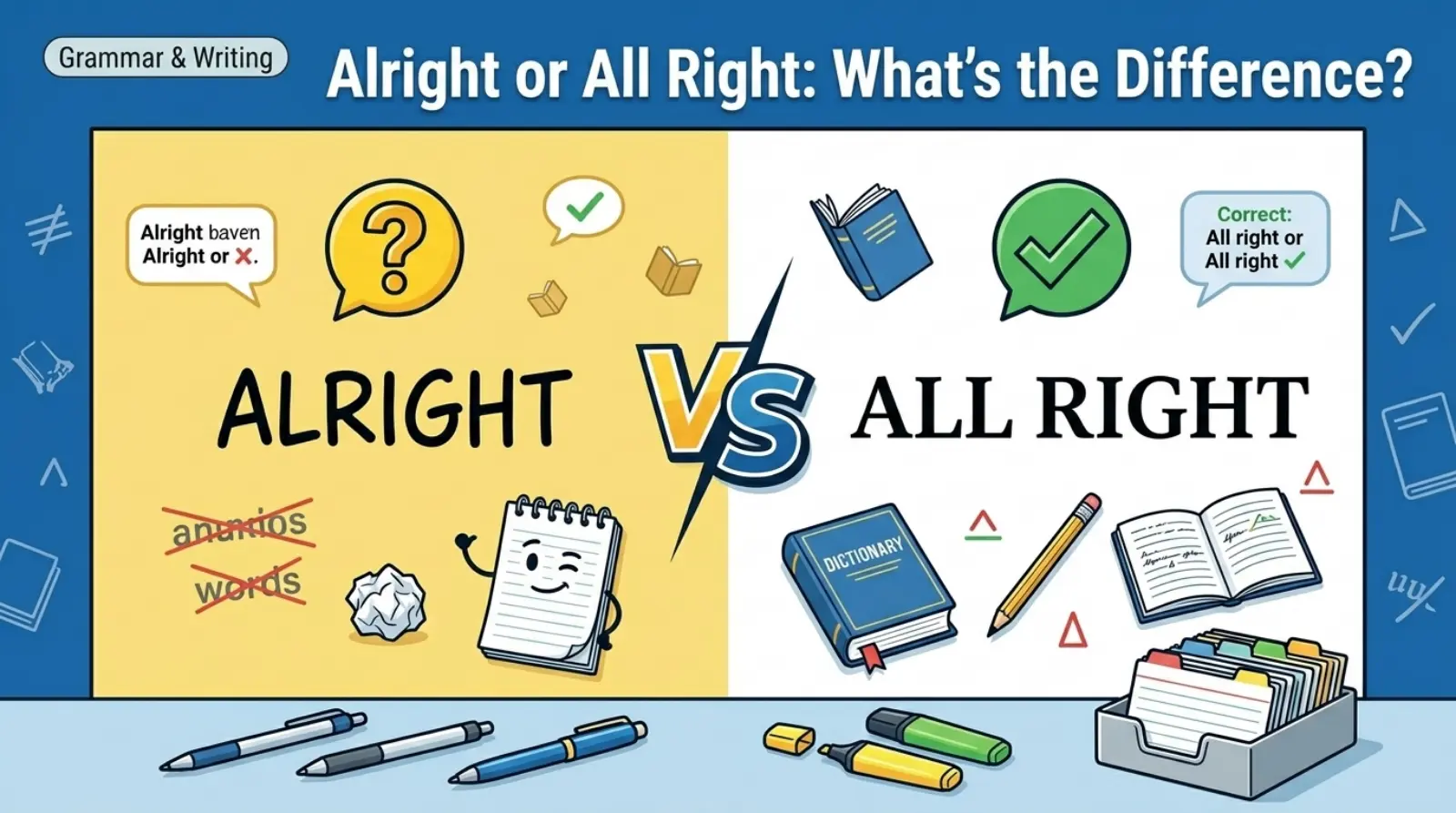
Alright or All Right: What’s the Difference?
The main difference is not meaning. The difference is acceptance and formality.
Comparison Table
| Feature | All Right | Alright |
| Meaning | Okay, acceptable | Okay, acceptable |
| Traditional spelling | Yes | No |
| Formal writing | Preferred | Usually avoided |
| Academic papers | Recommended | Often discouraged |
| Casual writing | Acceptable | Acceptable |
| Style guide approval | Widely approved | Mixed opinions |
Simple Rule
- Use all right for formal writing.
- Use alright only when a casual tone is acceptable.
Why Do Some People Prefer “All Right”?
Many grammar experts prefer all right because it follows the traditional structure of English.
Words like:
- Already
- Altogether
- Always
merged into single words over time.
However, many editors believe all right has not fully completed that transition.
As a result, formal publications often keep the two-word version.
Is “Alright” Wrong?
No. Most modern dictionaries recognize alright as a real word.
However, acceptance varies.
Some teachers, editors, and style guides still prefer all right.
Example
If you write:
The report looks alright.
Many readers will understand it.
But in professional writing, this may be changed to:
The report looks all right.
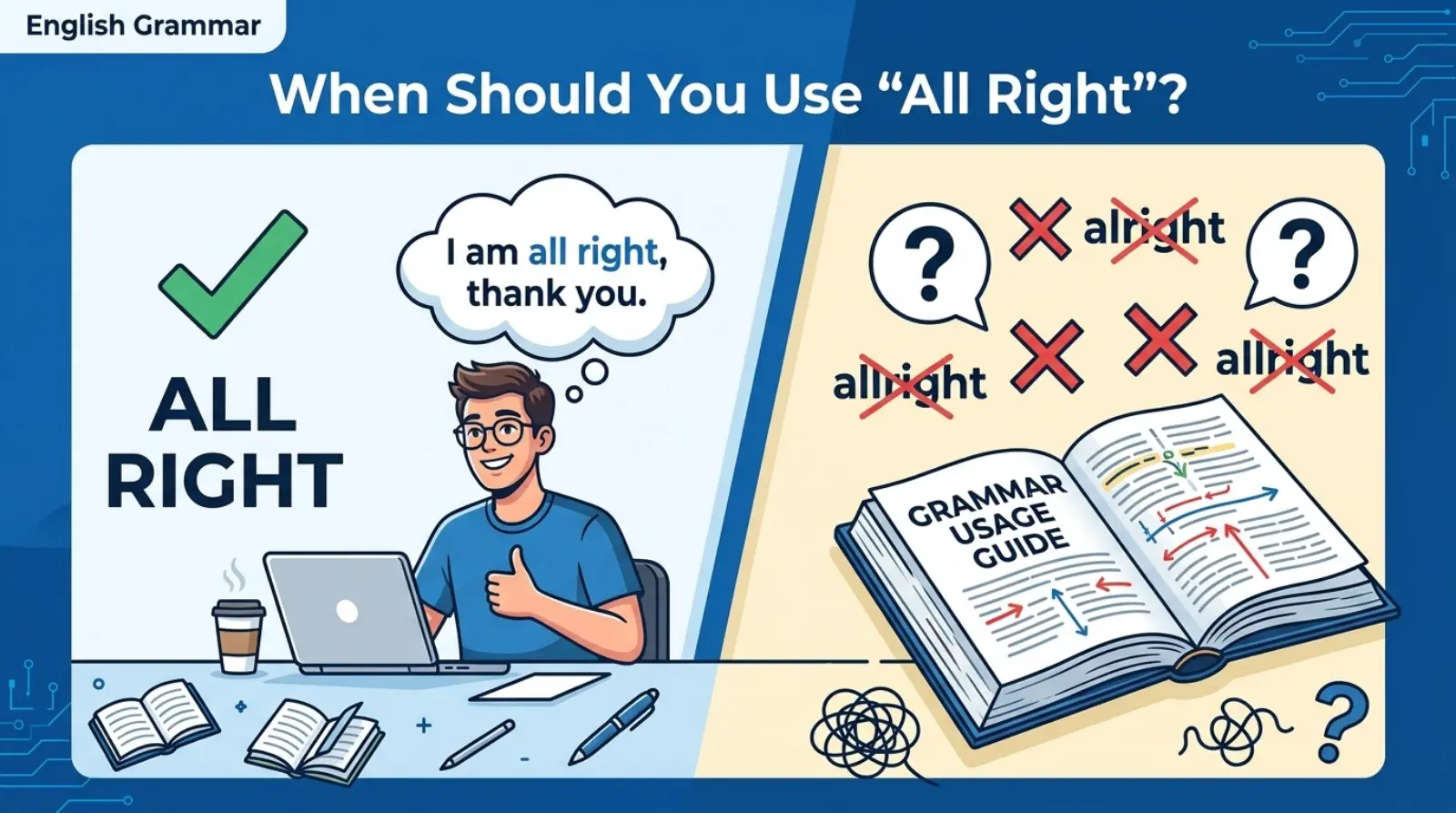
When Should You Use “All Right”?
Use all right in:
Academic Writing
- Essays
- Research papers
- Assignments
Business Writing
- Reports
- Proposals
- Professional emails
Published Content
- Books
- News articles
- Official documents
Examples
- The project is all right for submission.
- Everything is all right with the budget.
- The data appears all right.
When Can You Use “Alright”?
Use alright when writing casually.
Suitable Situations
- Text messages
- Social media posts
- Personal emails
- Informal blogs
- Creative writing
Examples
- I’m alright, thanks.
- The party was alright.
- It’s alright if you’re late.
Many people use this spelling every day.
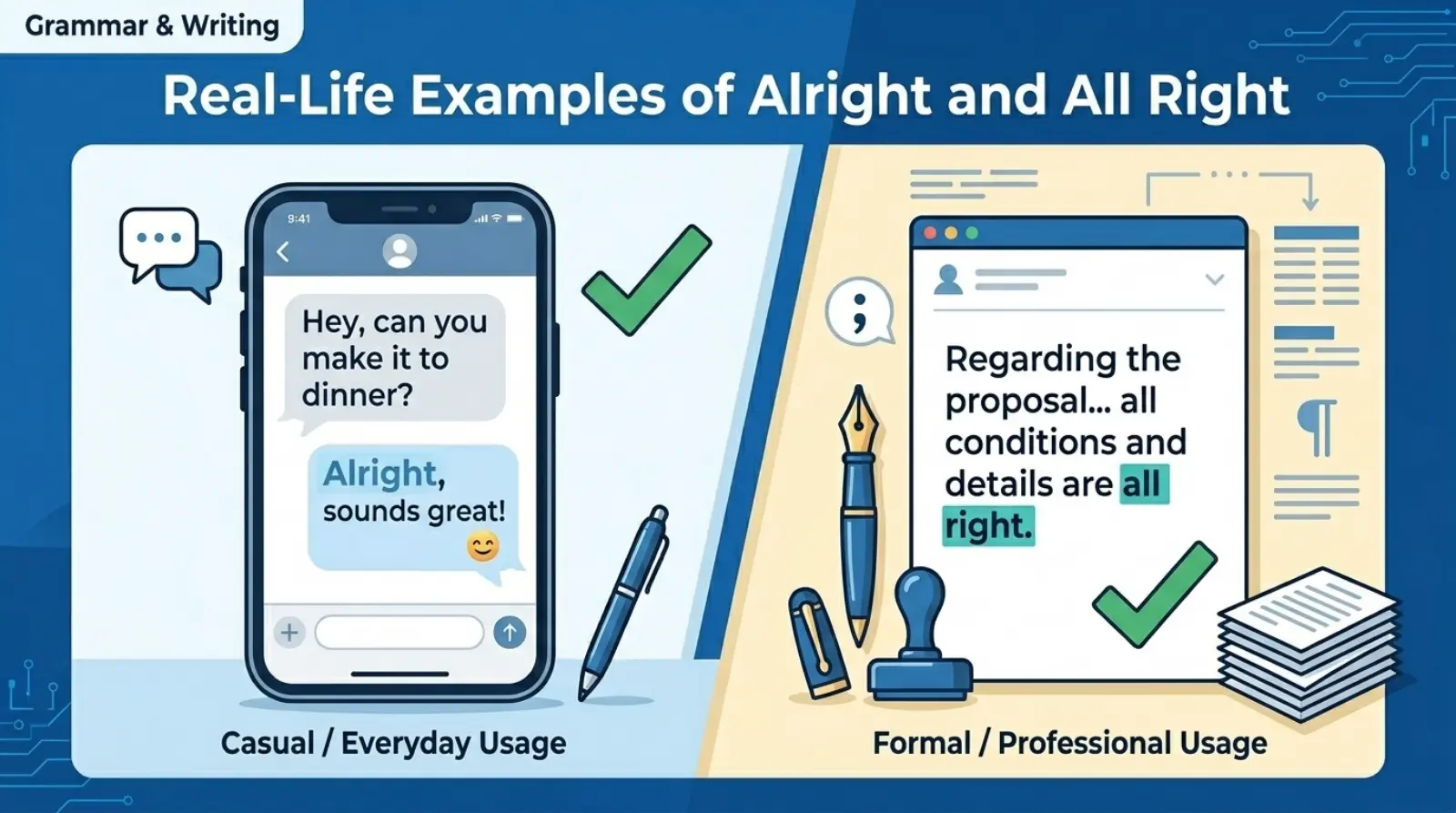
Real-Life Examples of Alright and All Right
Conversation
Friend: Are you okay?
You: Yes, I’m all right.
Text Message
Friend: How was the movie?
You: It was alright.
Business Email
Correct:
“The proposal looks all right.”
Less Preferred:
“The proposal looks alright.”
School Essay
Recommended:
“The experiment results were all right.”
Common Mistakes People Make
Mistake 1: Using Alright in Formal Writing
❌ The report is alright.
✅ The report is all right.
Mistake 2: Thinking Alright Is Always Wrong
❌ Alright is never correct.
✅ Alright is accepted in many informal contexts.
Mistake 3: Mixing Styles
Keep your style consistent.
If your document is formal, use all right throughout.
Mistake 4: Ignoring Audience Expectations
Academic readers often expect all right.
Casual readers may accept either version.
Easy Trick to Remember the Difference
Use this simple memory rule:
Formal = All Right
Think:
All Right = All Professional
Both have two words.
Casual = Alright
Think:
Alright = Relaxed Writing
This trick helps you choose quickly.
How Native Speakers Use These Terms
Native speakers use both forms.
However, usage depends on context.
Formal Context
- News articles
- Professional reports
- Academic writing
Most writers choose all right.
Informal Context
- Texting
- Chat messages
- Social media
Many people choose alright.
This trend has increased in modern digital communication.
Synonyms
Here are useful alternatives.
Synonyms for All Right
- Okay
- Fine
- Acceptable
- Good
- Satisfactory
- Suitable
- Correct
Expert Insights: Why This Difference Matters
Grammar choices affect credibility.
Readers often judge writing quality by small details.
Using all right in formal settings shows attention to language standards.
Writers, students, and professionals benefit from understanding this distinction.
Many style guides continue to recommend all right because it remains the safest choice.
If your goal is clear and professional communication, choosing the preferred form can make a positive impression.
Alright vs All Right in Modern English
Language changes over time.
Many words started as separate words and later became single words.
Some experts believe alright may eventually become the dominant spelling.
Today, both forms exist.
However, all right remains the safer option for formal communication.
This is why many schools, publishers, and businesses still recommend it.
Frequently Asked Questions (FAQs)
Is alright grammatically correct?
Yes. Most modern dictionaries recognize it. However, many style guides prefer all right.
Which is more formal, alright or all right?
All right is more formal.
Can I use alright in an essay?
It is better to use all right in essays and academic writing.
Do both words mean the same thing?
Yes. Both usually mean okay, fine, or acceptable.
Why do editors change alright to all right?
Many editors follow traditional style guides that prefer all right.
Is alright accepted in modern English?
Yes. It appears in many dictionaries and informal writing.
Which spelling should students use?
Students should generally use all right.
Will people understand either spelling?
Yes. Most readers understand both forms.
Conclusion
The debate over alright or all right often confuses writers, but the answer is simple. Both forms share the same meaning and usually mean “okay” or “acceptable.” However, all right remains the preferred choice in formal writing, academic work, and professional communication. Meanwhile, alright is widely used in casual conversations, text messages, and informal content.
If you want the safest option, choose all right. It meets the expectations of most teachers, editors, and style guides. Understanding this small difference can make your writing look more polished and professional. The next time you wonder whether to use alright or all right, remember this simple rule: formal writing favors all right, while casual writing may accept either form.