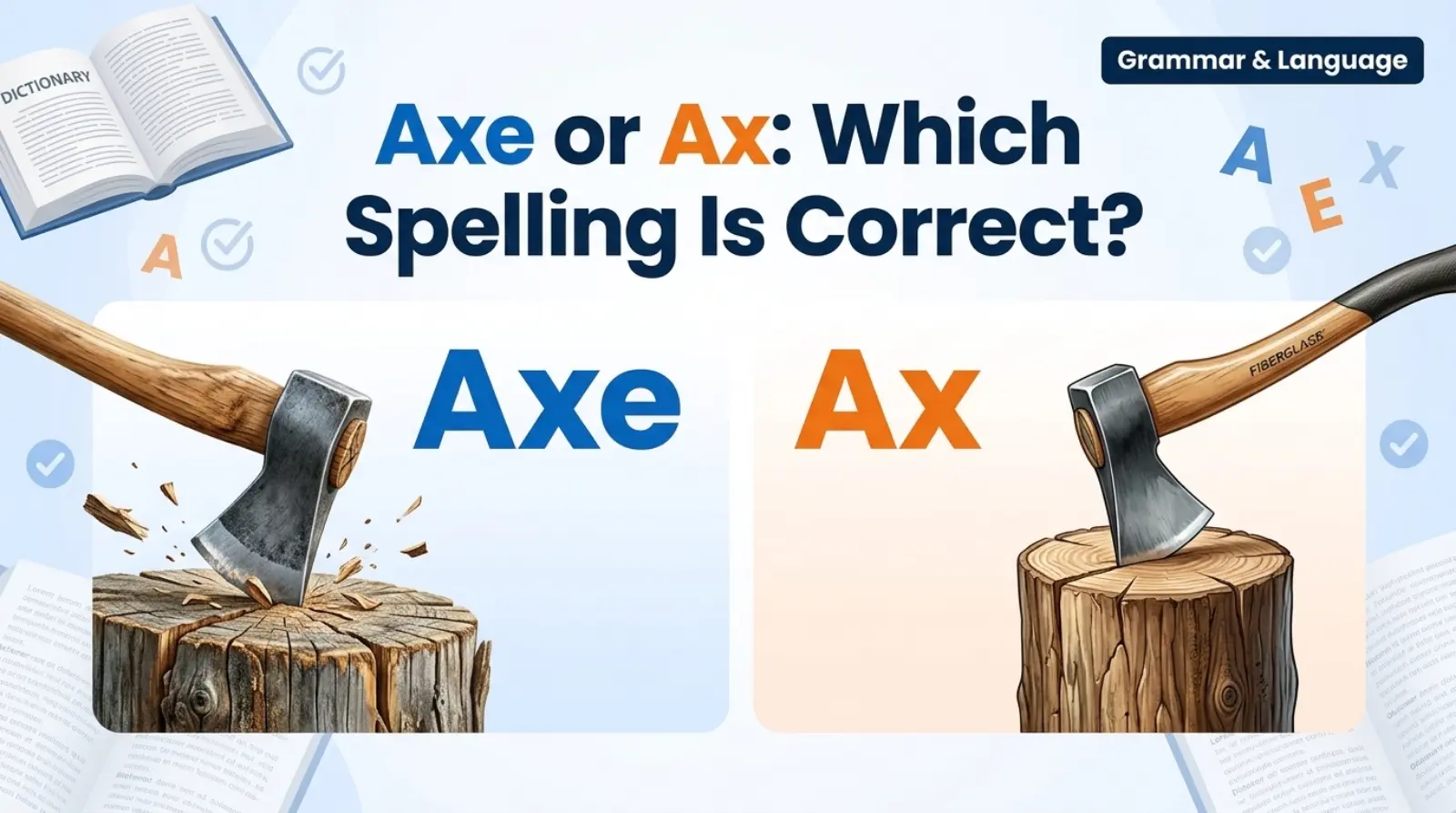
Axe or ax is a common spelling question in English. Many people see both words online. So, they wonder which one is correct.
The simple answer is this: both spellings are correct. However, the preferred spelling depends on the country and writing style.
In American English, people often use ax. In British English, writers usually prefer axe. Both words mean the same thing. They describe a tool used for cutting wood.
This small spelling difference can confuse students, writers, and bloggers.
In this guide, you will learn the meaning of both words, the key differences, common mistakes, and the best way to use them in daily writing.
Quick Summary Box
- Axe and ax have the same meaning
- Both words describe a wood-cutting tool
- Ax is common in American English
- Axe is common in British English
- Pronunciation stays the same
- Both spellings are grammatically correct
- Choose one spelling and stay consistent
- “Axe” also appears more in figurative phrases
What Does Axe or Ax Mean?
The words axe and ax refer to a cutting tool. People use it to chop wood, trees, or other hard materials.
The tool usually has:
- A sharp metal blade
- A long wooden or metal handle
People also use the word in figurative ways. For example:
- “The company axed jobs.”
- “The show got the axe.”
In these examples, the word means to remove or end something.
Axe or Ax: What Is the Difference?
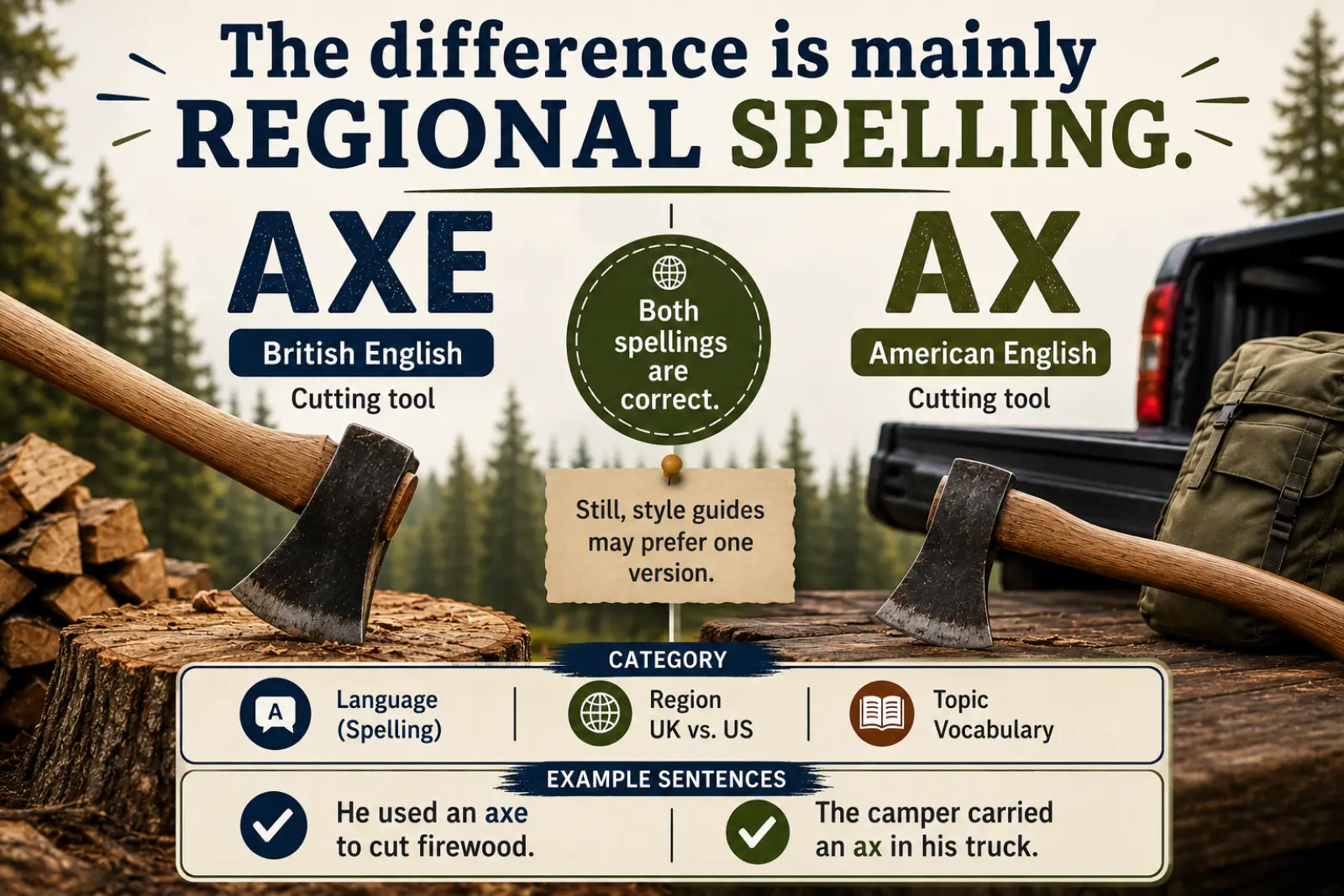
The difference is mainly regional spelling.
| Word | Common Region | Meaning |
| Axe | British English | Cutting tool |
| Ax | American English | Cutting tool |
Both spellings are correct. Still, style guides may prefer one version.
Example Sentences
- He used an axe to cut firewood.
- The camper carried an ax in his truck.
The meaning does not change.
Why Do Americans Use “Ax”?
American English often prefers shorter spellings.
For example:
| British English | American English |
| Colour | Color |
| Favourite | Favorite |
| Axe | Ax |
Noah Webster helped simplify many American spellings in the 1800s. Because of this, ax became popular in the United States.
Today, many American dictionaries accept both spellings. Still, ax appears more often in U.S. writing.
Why Do British Writers Prefer “Axe”?
British English usually keeps older spellings.
The word axe comes from Old English and Germanic roots. British publishers still prefer this traditional form.
You will often see axe in:
- UK newspapers
- British school books
- Academic writing
- International English content
Because of this, global websites often choose axe instead of ax.
Axe vs Ax Comparison Table
| Feature | Axe | Ax |
| Meaning | Cutting tool | Cutting tool |
| Pronunciation | Same | Same |
| Region | British English | American English |
| Formal Writing | Very common | Less common internationally |
| SEO Use | Higher global searches | Popular in U.S. searches |
| Correct Spelling | Yes | Yes |
How to Use Axe or Ax in Sentences
Here are simple examples for daily use.
Using “Axe”
- The firefighter grabbed an axe.
- She bought a camping axe.
- The movie got the axe after one season.
Using “Ax”
- He sharpened the ax before work.
- The old ax broke during chopping.
- The company plans to ax extra costs.
Both spellings work well. Just stay consistent in one article.
Common Mistakes People Make
Many writers confuse these spellings. Here are the most common mistakes.
Mixing Both Spellings
Wrong example:
- He bought an axe and sharpened his ax.
This creates inconsistency.
Correct approach:
- Use one spelling throughout the article.
Using the Wrong Regional Style
If you write for a British audience, use axe.
If you write for Americans, use ax.
Assuming One Is Incorrect
Some people think ax is wrong. That is false.
Modern dictionaries accept both forms.
Which Spelling Is Better for SEO?
The answer depends on your audience.
Use “Ax” If:
- Your audience is American
- Your website targets U.S. traffic
- You write in American English
Use “Axe” If:
- Your audience is international
- You target UK readers
- You prefer traditional spelling
Real-Life Examples of Axe and Ax
Here are real-world situations where people use these words.
Camping
Campers often carry an axe for cutting wood.
Firefighting
Firefighters use axes during rescue operations.
Lumber Work
Woodworkers and loggers use axes daily.
Business Slang
People say a company “got the axe” when jobs end.
Popular Idioms With Axe or Ax
English uses many idioms with this word.
“Get the Axe”
Meaning: to lose a job or position.
Example:
- The TV show got the axe last year.
“Have an Axe to Grind”
Meaning: to hold a personal grudge or hidden motive.
Example:
- He always complains because he has an axe to grind.

Synonyms
- Hatchet
- Chopper
- Cleaver
- Cutter
- Tool
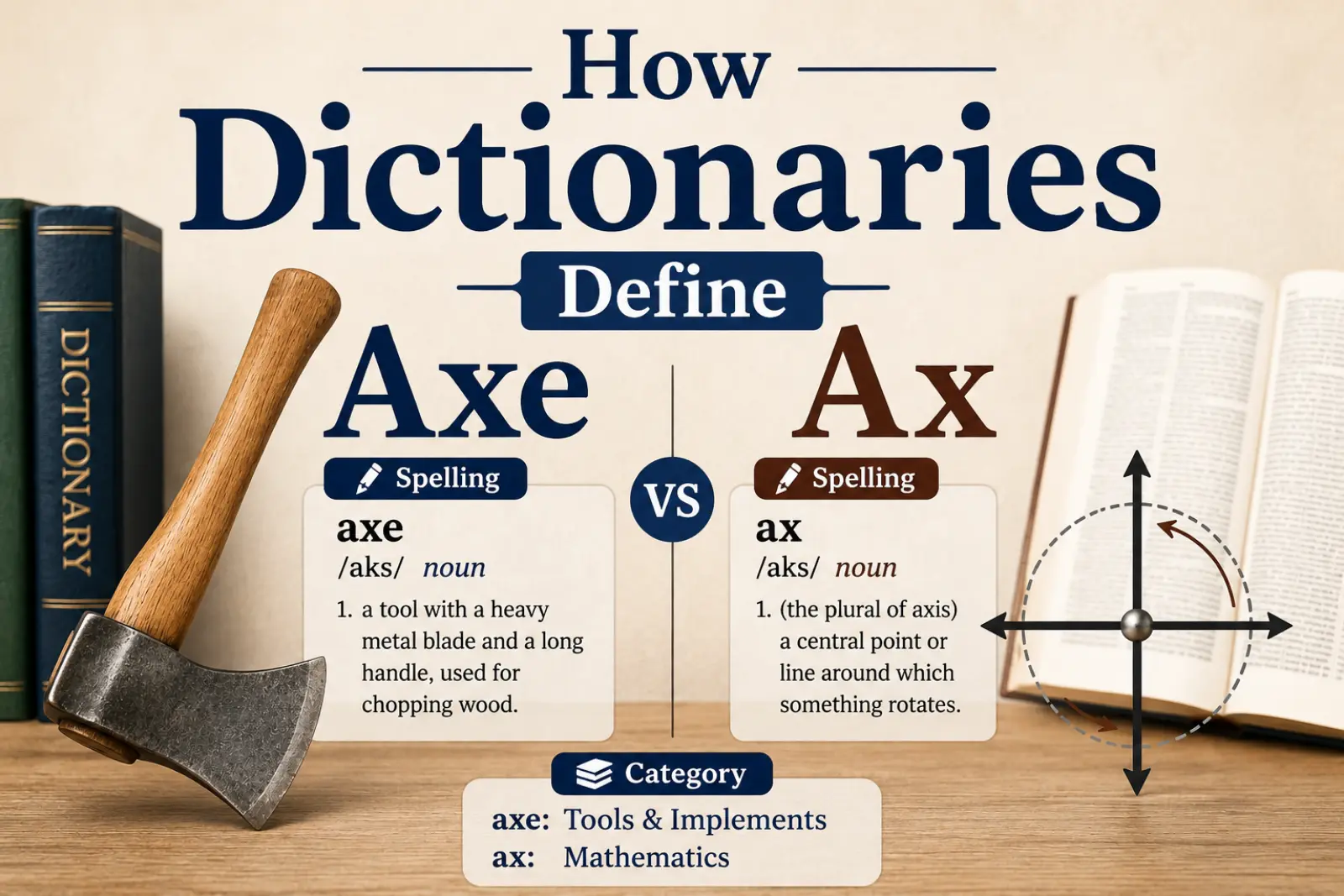
How Dictionaries Define Axe and Ax
Most major dictionaries accept both spellings.
Dictionary Preferences
| Dictionary | Preferred Form |
| Oxford Dictionary | Axe |
| Cambridge Dictionary | Axe |
| Merriam-Webster | Ax or Axe |
| Collins Dictionary | Axe |
American dictionaries usually list ax first. British dictionaries prefer axe.
Expert Insights: Why Correct Spelling Matters
Correct spelling improves readability and trust.
Readers notice spelling consistency quickly. Mixed spelling styles can look unprofessional.
Search engines also understand context better when content stays consistent.
EEAT Tip
Strong spelling and grammar improve:
- User trust
- Content quality
- Search visibility
- Reader engagement
Professional websites follow one language style throughout each article.
Tips to Remember Axe or Ax
Here are easy memory tricks.
Remember “Ax” for America
Both words are shorter:
- Ax
- US
This helps you remember the American spelling.
Remember “Axe” for England
Both words contain more letters:
- Axe
- England
This connects the British spelling.
Should You Use Axe or Ax in School Writing?
Follow your teacher’s style guide.
Use “Ax” If:
- Your school follows American English
Use “Axe” If:
- Your school follows British English
Consistency matters more than the spelling itself.
FAQs About Axe or Ax
Is ax a real word?
Yes. Ax is a correct American English spelling.
Is axe more correct than ax?
No. Both spellings are correct.
Which spelling is older?
Axe is older and comes from Old English.
Do Canadians use axe or ax?
Canadians often use axe, but both appear.
Which spelling should bloggers use?
Choose the spelling that matches your audience.
Is “get the axe” correct?
Yes. This is a common English idiom.
Can I use both spellings in one article?
You can mention both for SEO. However, keep the main writing style consistent.
Conclusion
The debate around axe or ax is simple once you understand regional spelling rules. Both words are correct and share the same meaning. The main difference comes from location and writing style.
American English often uses ax, while British English prefers axe. Neither spelling is wrong. The best choice depends on your audience.
If you write for SEO, consistency matters most. Choose one version for your article and stick with it. You can still mention both spellings naturally to capture extra search traffic.
Understanding small spelling differences improves writing quality, readability, and professionalism. It also helps readers trust your content more easily.