James’s or James’? This question confuses many writers. You may see both forms in books, articles, and online content. That makes it hard to know which one is correct.
The good news is that both forms can be correct. However, the right choice depends on the style guide you follow.
Most modern style guides prefer James’s. Yet some publications use James’ instead. Understanding the difference helps you write clearly and professionally.
In this guide, you’ll learn when to use each form. You’ll also see examples, common mistakes, expert tips, and easy rules to remember. By the end, you’ll know exactly how to write possessive nouns ending in s.
Quick Summary Box
- James’s and James’ are both possessive forms of the name James.
- Most modern style guides recommend James’s.
- James’s car means the car belongs to James.
- Some style guides allow James’ to avoid adding an extra s.
- Consistency matters more than personal preference.
- In everyday writing, James’s is usually the safest choice.
What Does “James’s or James'” Mean?
The phrase James’s or James’ refers to the possessive form of the name James.
A possessive noun shows ownership.
Examples
- James’s book is on the table.
- James’s phone rang during class.
- James’ house is near the park.
In these examples, the items belong to James.
The question is whether you should add ‘s or only an apostrophe after a name ending in s.
Understanding Possessive Nouns
A possessive noun shows that something belongs to someone.
Basic Rule
For most singular nouns:
- Sarah → Sarah’s bike
- John → John’s car
- Emma → Emma’s bag
The confusion starts when a singular name already ends in s.
Example
- James → James’s car
- Charles → Charles’s office
- Chris → Chris’s laptop
Many grammar experts support this rule because the noun remains singular.
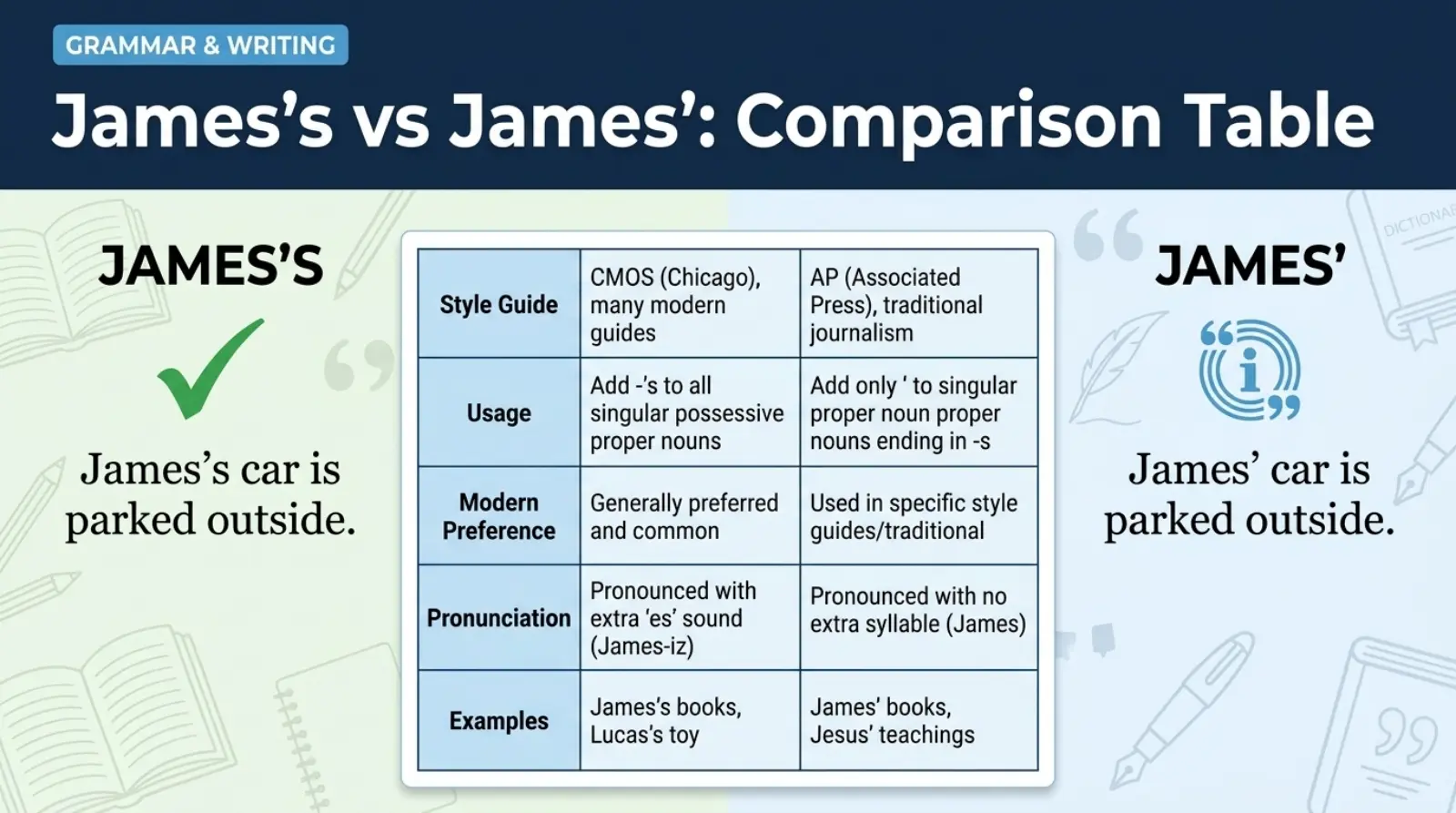
James’s vs James’: Comparison Table
| Feature | James’s | James’ |
| Shows ownership | Yes | Yes |
| Common in modern English | Yes | Sometimes |
| Preferred by Chicago Manual of Style | Yes | No |
| Preferred by MLA Style | Yes | No |
| Allowed by AP Style | Often Yes, but exceptions exist | Sometimes |
| Best for general writing | Yes | Less common |
| Pronunciation | James-iz | Often same pronunciation |
Quick Winner
For most writing situations, James’s is the preferred form.
Why Do Some People Use James’?
Many writers use James’ because it looks cleaner.
Historically, some grammar rules suggested adding only an apostrophe after names ending in s.
Examples
- James’ jacket
- Charles’ office
- Thomas’ desk
This style appears in some newspapers, older books, and publications that follow specific editorial rules.
However, many modern grammar experts now favor adding ‘s to singular nouns.
Why Is James’s More Common Today?
Most modern style guides recommend writing singular possessive nouns with ‘s.
Reasons
- It reflects natural pronunciation.
- It creates consistency.
- It follows modern grammar standards.
- It reduces confusion.
Examples
Correct according to many style guides:
- James’s car
- Chris’s computer
- Marcus’s notebook
These examples clearly show ownership.
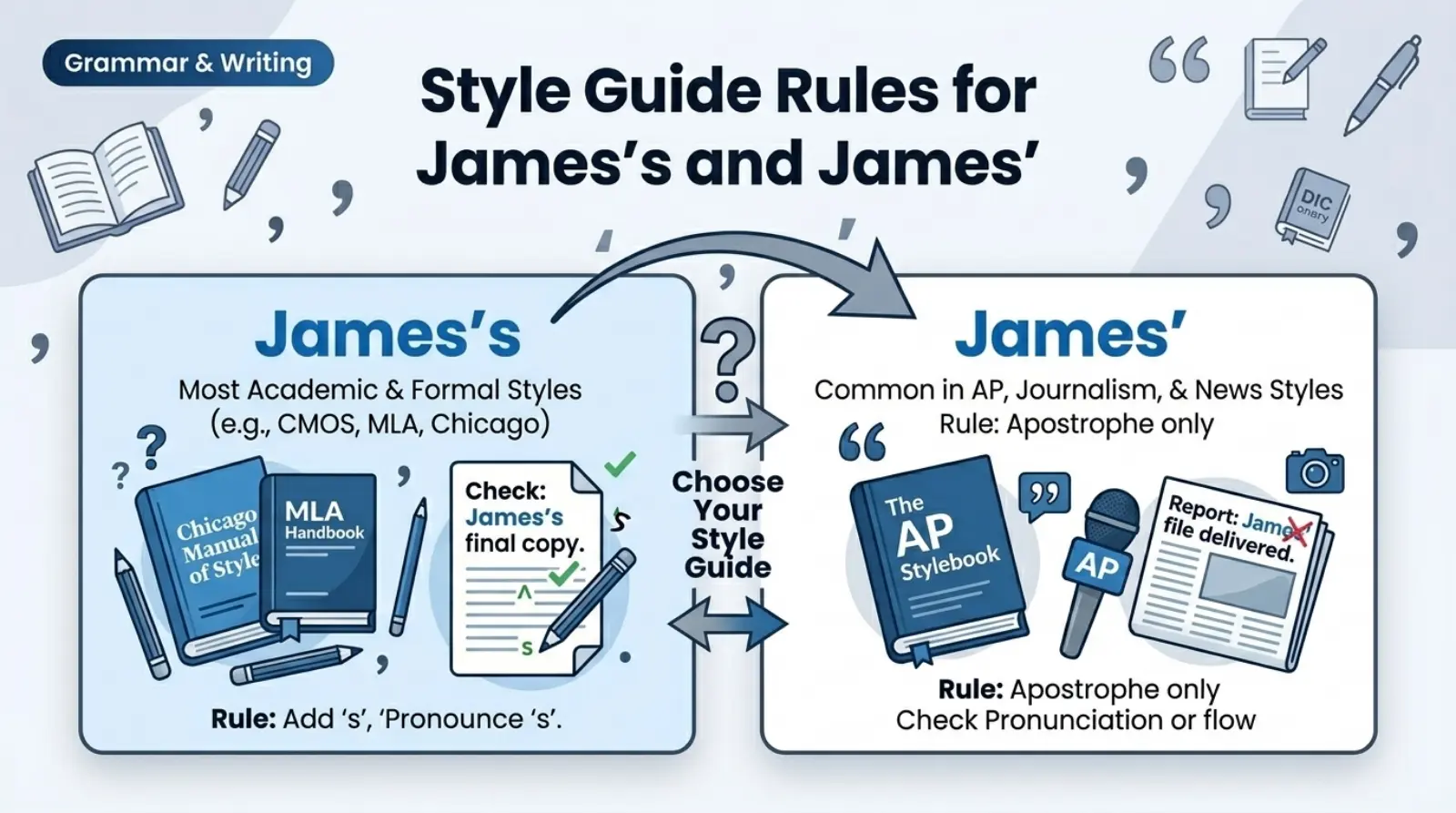
Style Guide Rules for James’s and James’
Different style guides have different recommendations.
Chicago Manual of Style
Use James’s.
Example:
- James’s report was approved.
MLA Style
Use James’s.
Example:
- James’s essay received praise.
APA Style
Use James’s.
Example:
- James’s research findings were accurate.
AP Style
AP Style often prefers adding only an apostrophe for some proper names ending in s.
Example:
- James’ book
Always check the style guide required by your organization.
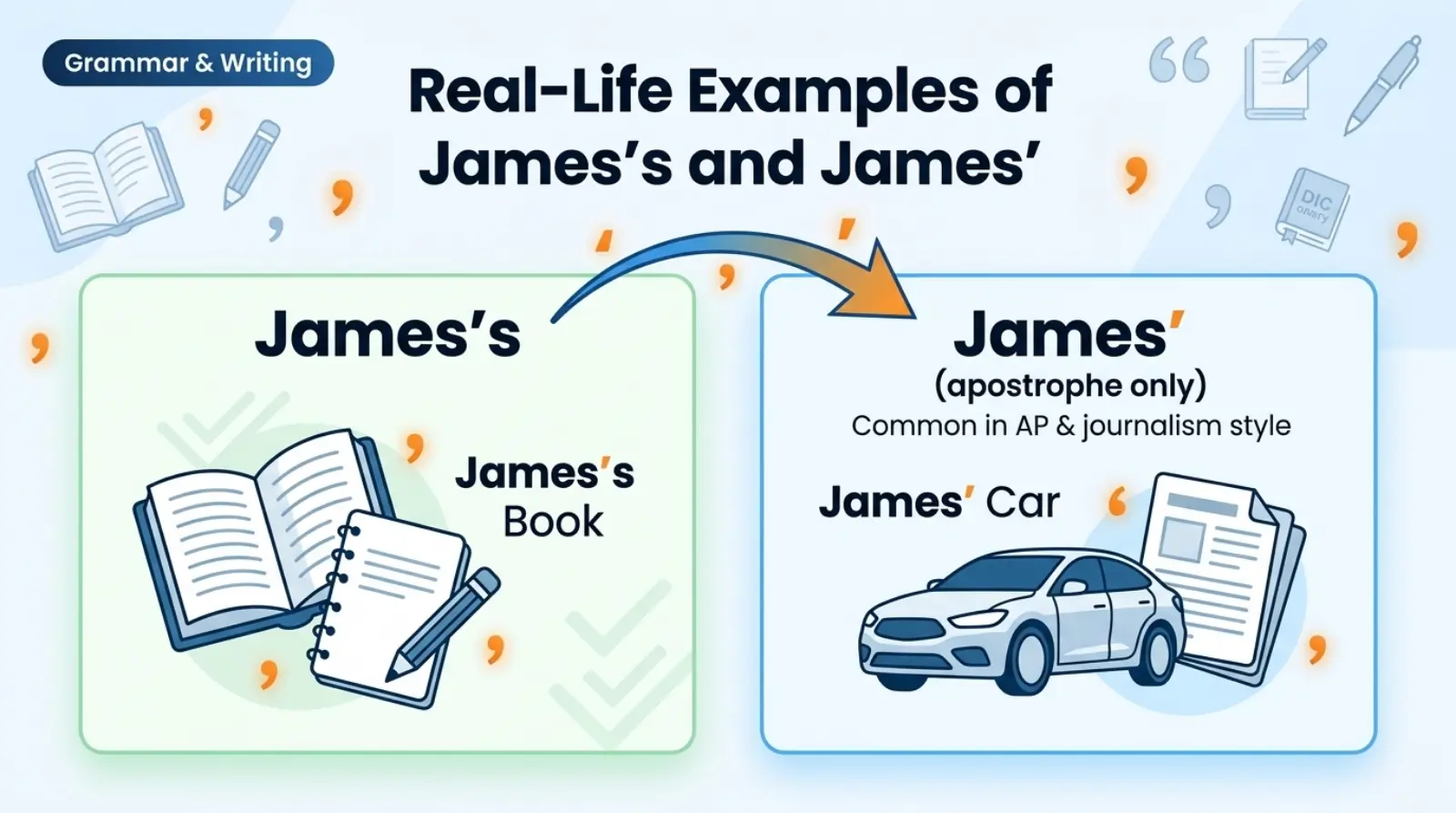
Real-Life Examples of James’s and James’
Here are examples you may encounter.
Everyday Writing
- James’s backpack is missing.
- James’s dog loves the park.
Business Writing
- James’s proposal impressed the team.
- James’s presentation increased sales.
Academic Writing
- James’s theory gained support.
- James’s research influenced the study.
Journalism
Some publications may write:
- James’ interview appeared yesterday.
The style depends on editorial guidelines.
Common Mistakes People Make
Many writers struggle with apostrophes.
Mistake 1: Leaving Out the Apostrophe
❌ James car
✅ James’s car
Mistake 2: Using an Apostrophe for Plurals
❌ The James’s family
✅ The James family
Mistake 3: Mixing Styles
❌ James’s book and James’ office
Choose one style and stay consistent.
Mistake 4: Using the Wrong Form for Multiple Owners
❌ James’s and Mark’s business (if jointly owned)
✅ James and Mark’s business
Easy Trick to Remember the Rule
A simple trick can help.
Ask Yourself:
“Would I add ‘s to another singular name?”
Examples:
- John’s car
- Emma’s bike
- Sarah’s notebook
Then use:
- James’s car
This creates consistency across your writing.
Memory Tip
If the owner is one person, add ‘s in most modern writing.
James’s or James’ in Daily Life
You may use possessive names every day.
School
- James’s homework was excellent.
Work
- James’s project finished ahead of schedule.
Social Media
- James’s photo received many likes.
Family Conversations
- James’s birthday party starts at six.
The possessive form appears often in spoken and written English.
Related Grammar Rules You Should Know
Understanding similar names helps reinforce the rule.
Names Ending in S
- Chris’s laptop
- Charles’s office
- Thomas’s book
- Marcus’s team
Names Not Ending in S
- John’s car
- Mary’s phone
- David’s house
The same ownership concept applies.
Expert Insights: Why This Grammar Rule Matters
Grammar affects credibility.
Readers notice mistakes quickly. Correct punctuation improves trust and readability.
Expert Tips
- Follow one style guide consistently.
- Use James’s unless your organization requires otherwise.
- Check editorial guidelines before publishing.
- Proofread possessive nouns carefully.
- Keep grammar choices consistent throughout a document.
Strong grammar makes writing appear more professional and authoritative.
Frequently Asked Questions (FAQs)
Is James’s grammatically correct?
Yes. Most modern grammar style guides consider James’s correct.
Is James’ also correct?
Yes. Some style guides and publications allow James’.
Which is more common today?
James’s is more common in modern English writing.
How do I pronounce James’s?
Most people pronounce it as “James-iz.”
What does James’s mean?
It means something belongs to James.
Should I use James’s in academic writing?
Yes. Most academic style guides recommend James’s.
Do all names ending in s follow this rule?
Generally, yes. Examples include Chris’s, Charles’s, and Marcus’s.
Which form should I choose?
For general writing, choose James’s and use it consistently.
Conclusion
The debate over James’s or James’ often causes confusion, but the answer is simpler than it seems. Both forms can be correct depending on the style guide you follow. However, most modern grammar authorities prefer James’s because it clearly shows possession and matches standard pronunciation.
When writing for school, business, blogs, or general audiences, James’s is usually the safest option. It follows the recommendations of major style guides and creates consistency across your writing.
The most important rule is consistency. Pick the style required for your audience and use it throughout your document. Once you understand the logic behind possessive nouns, choosing between James’s and James’ becomes much easier.