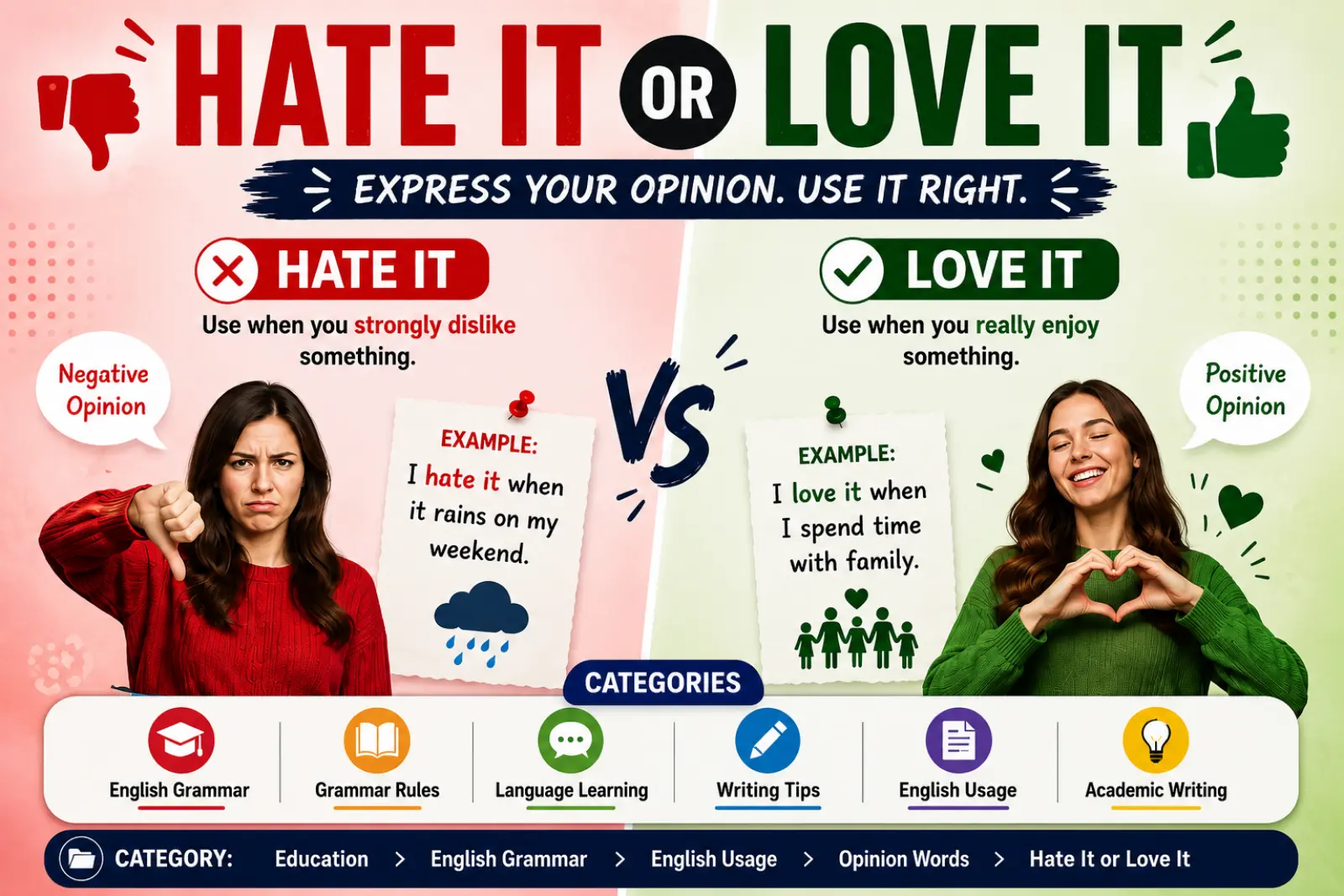
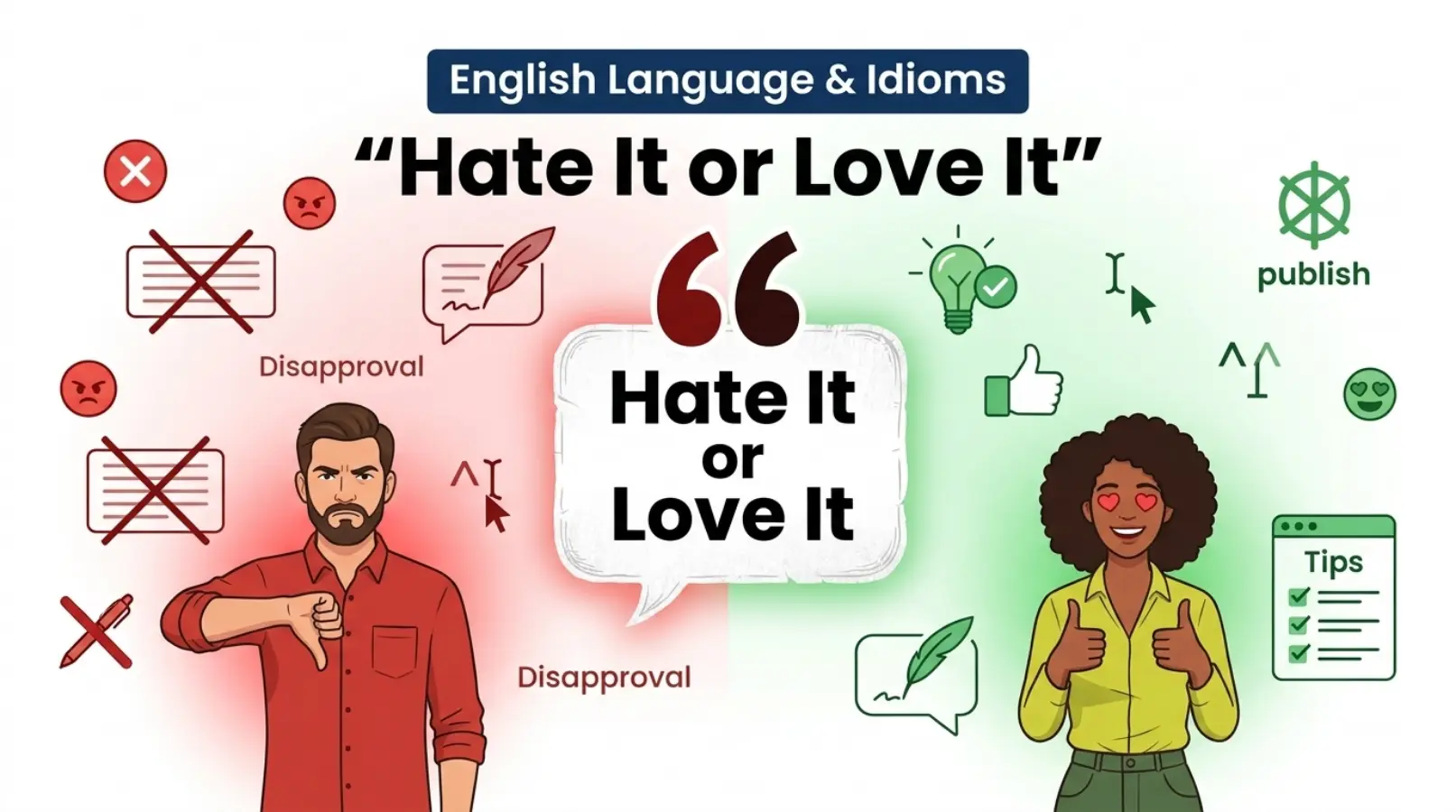
Hate it or love it is a popular English phrase used to describe something that creates strong opinions. People either strongly dislike it or strongly enjoy it. There is usually no middle ground.
You may hear this phrase in conversations about music, movies, fashion, sports, celebrities, or social trends. It highlights topics that divide opinions and spark discussion.
Many expressions become part of everyday language. However, it remains popular because it is simple and relatable. Everyone has experienced something that people either praise or criticize.
In this guide, you’ll learn the meaning of this phrase its origin, examples, common mistakes, synonyms, and tips for using it correctly in daily conversations.
Quick Summary Box
What Does “Hate It or Love It” Mean?
- A phrase used for something that creates strong opinions.
- People either strongly like it or strongly dislike it.
- There is little or no neutral opinion.
- Common in entertainment, sports, fashion, and culture.
- Often used to introduce a controversial topic.
- Expresses a “you either like it or you don’t” idea.
Featured Snippet Definition:
It means something causes strong reactions, where people either greatly enjoy it or strongly dislike it, with few neutral opinions.
What Does “Hate It or Love It” Mean?
The phrase describes a person, thing, idea, or trend that divides opinions.
Some people admire it. Others strongly dislike it.
The phrase suggests that no matter what people think, the subject remains noticeable and important.
Example
- Hate it or love it, the movie became a huge success.
- Hate it or love it, social media has changed communication.
The Origin of “Hate It or Love It”
The exact origin is difficult to trace. However, the phrase became widely known through popular culture.
It gained major popularity through music, entertainment, and media. Over time, people started using it in everyday speech.
Today, it appears in:
- News articles
- Social media posts
- TV shows
- Marketing campaigns
- Casual conversations
The phrase remains popular because it quickly communicates a strong divide in opinion.
Why Is This Phrase So Popular?
Several factors explain its popularity.
1. It Is Easy to Understand
The meaning is clear. People instantly know what it suggests.
2. It Creates Curiosity
Readers want to know why opinions differ.
3. It Fits Many Topics
You can use it for:
- Music
- Sports
- Politics
- Fashion
- Technology
- Food
4. It Sounds Memorable
The phrase has a catchy rhythm that people remember easily.
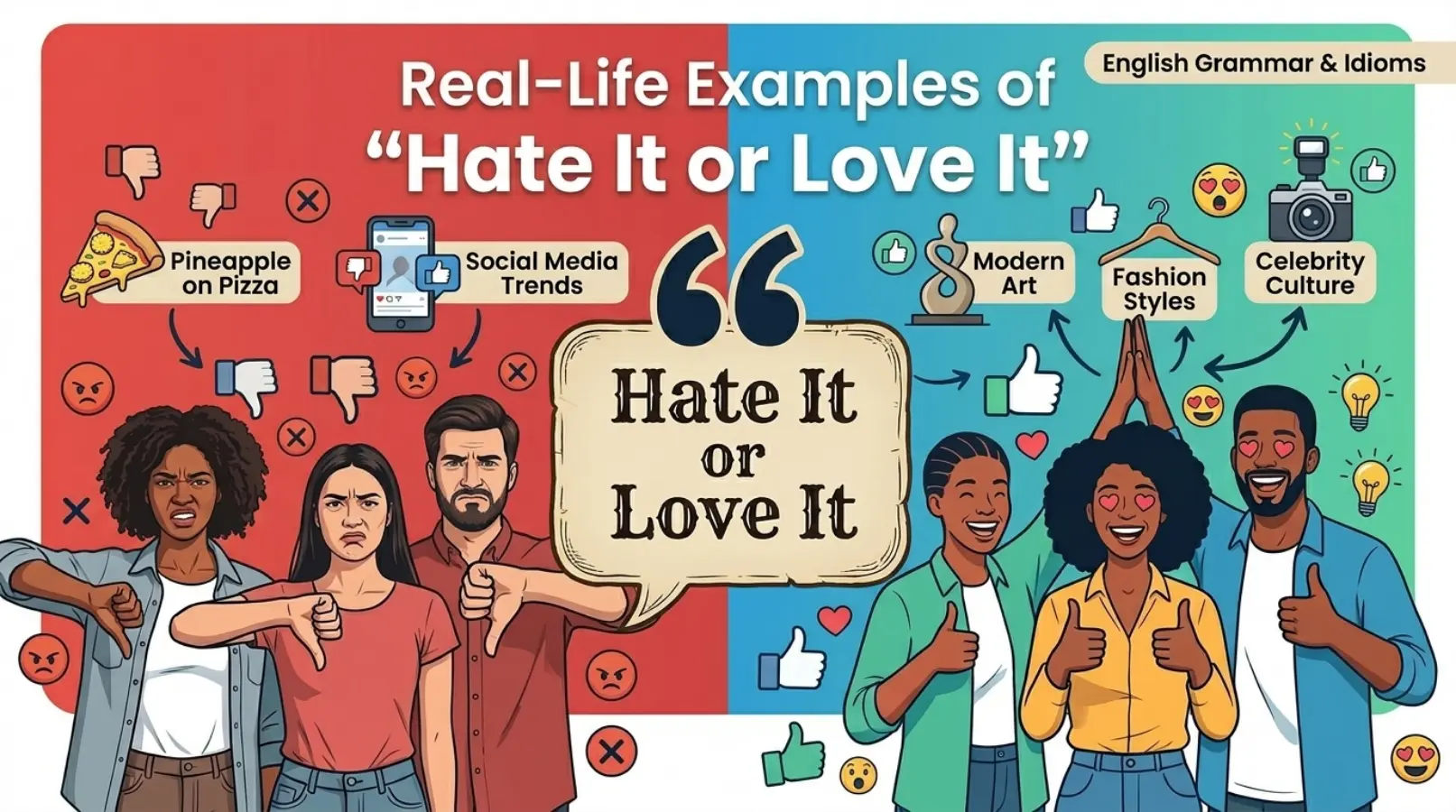
Real-Life Examples of “Hate It or Love It”
Here are common situations where the phrase appears.
Entertainment
“Hate it or love it, the movie broke box office records.”
Sports
“Hate it or love it, the athlete changed the game.”
Fashion
“Hate it or love it, oversized clothing is trending again.”
Technology
“Hate it or love it, artificial intelligence is becoming part of daily life.”
Food
“Hate it or love it, spicy food attracts passionate fans.”
Hate It or Love It vs Love It or Hate It
Many people wonder whether these phrases are the same.
| Phrase | Meaning | Common Usage |
| Hate It or Love It | Focuses on strong opposing opinions | More common in conversation |
| Love It or Hate It | Same basic meaning | Often sounds slightly more positive |
| You Either Love It or Hate It | Emphasizes no middle ground | Very common in writing |
Example
- Hate it or love it, the trend continues.
The meaning remains nearly identical.
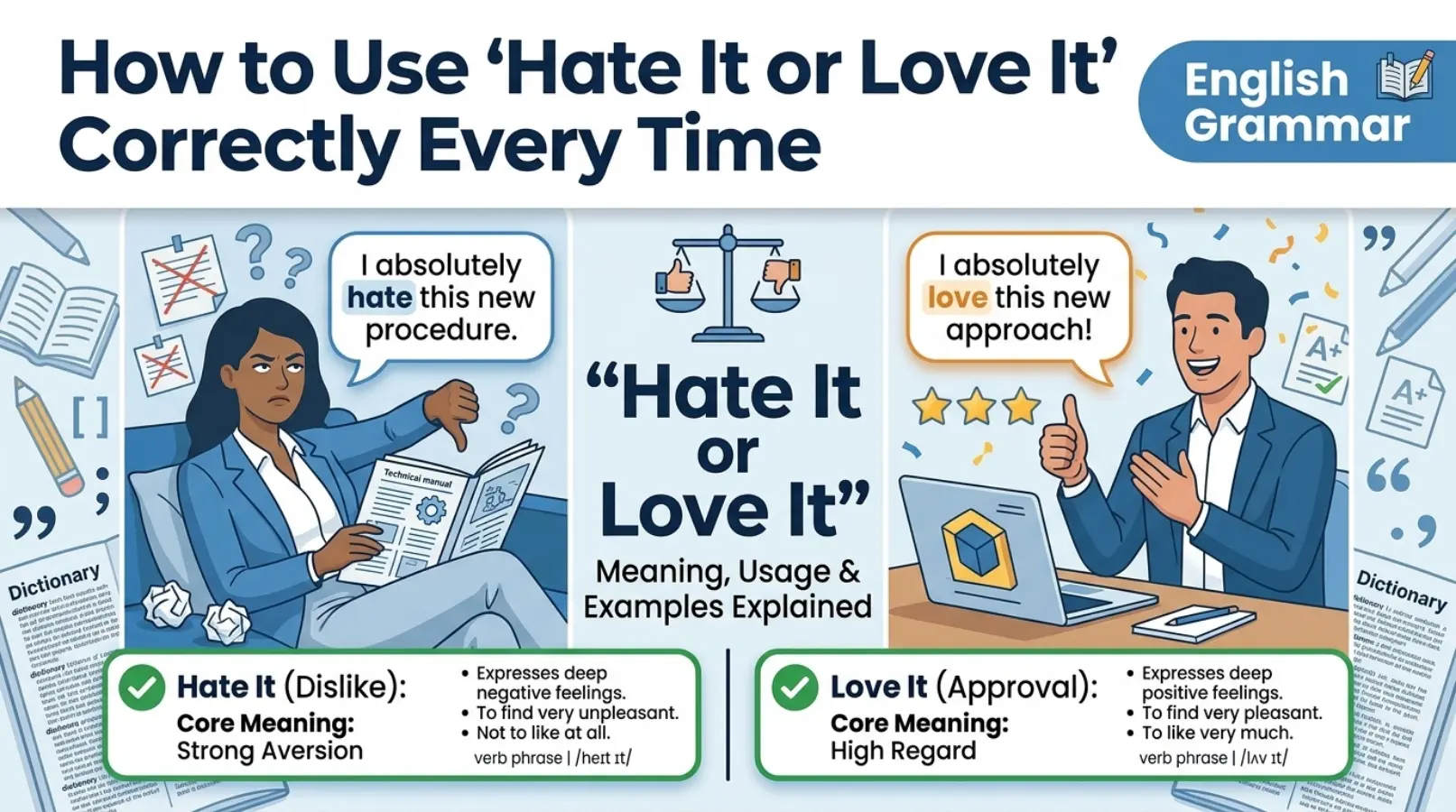
How to Use “Hate It or Love It” Correctly
The phrase usually appears at the beginning of a sentence.
Correct Examples
- Hate it or love it, the singer remains popular.
- Hate it or love it, remote work is here to stay.
Alternative Placement
- The show, hate it or love it, attracts millions of viewers.
The first structure sounds more natural.
Common Mistakes When Using the Phrase
Mistake 1: Using It for Neutral Topics
Hate it or love it, water is important.
Most people agree on this statement.
Mistake 2: Using It Without Strong Opinions
The phrase works best when opinions are divided.
Hate it or love it, pencils help students write.
Mistake 3: Overusing the Phrase
Using it repeatedly weakens its impact.
Instead, vary your language with similar expressions.
Synonyms
These alternatives have similar meanings.
Synonyms
- Divisive
- Polarizing
- Controversial
- Highly debated
- Opinion-splitting
- Mixed reactions
- Marmite effect
- Not everyone’s cup of tea
Usage in Daily Life
People use this phrase in many conversations.
Work
“Hate it or love it, the new software improves productivity.”
School
“Hate it or love it, online learning has become common.”
Home
“Hate it or love it, family game night brings everyone together.”
On Social Media
“Hate it or love it, the challenge went viral.”
The phrase adds personality and emphasis to communication.
Why Marketers Love This Phrase
Marketers often use this phrase because it attracts attention.
It encourages people to engage.
Benefits
- Creates curiosity
- Sparks discussion
- Increases clicks
- Encourages comments
- Makes headlines memorable
Example Headlines
- Hate It or Love It: The New Fashion Trend Taking Over
- Hate It or Love It: AI Is Changing Every Industry
Expert Insights: Why This Phrase Matters
Language shapes communication.
The phrase captures emotional reactions quickly.
Communication experts often use memorable expressions because they:
- Improve engagement
- Increase readability
- Make content more relatable
- Help readers connect emotionally
When used correctly, this phrase makes writing stronger and more persuasive.
EEAT Tip
Use the phrase only when discussing topics that genuinely divide opinions. Accurate usage builds trust and credibility.
Examples in Popular Culture
Many famous subjects fit the phrase perfectly.
Music
Certain artists attract devoted fans and strong critics.
Movies
Some films receive both praise and criticism.
Sports Teams
Popular teams often divide fans and rivals.
Technology
New innovations frequently create opposing viewpoints.
Fashion Trends
Bold styles often generate strong reactions.
These examples explain why the phrase remains relevant today.
Tips for Using “Hate It or Love It”
Keep These Tips in Mind
- Use it for divisive topics.
- Avoid using it for obvious facts.
- Place it near the beginning of a sentence.
- Use it sparingly for stronger impact.
- Consider your audience.
- Match it with real examples.
- Use it to start discussion.
- Avoid exaggerating opinions.
Following these tips helps your writing sound natural.
Frequently Asked Questions (FAQs)
What does “hate it or love it” mean?
It means people have strong opinions and usually either like something a lot or dislike it strongly.
Is “hate it or love it” an idiom?
It is commonly treated as an expression rather than a traditional idiom.
Can I use “hate it or love it” in formal writing?
Yes, but it works best in blogs, articles, and conversational content.
Is “love it or hate it” the same thing?
Yes. Both phrases have nearly identical meanings.
Why is the phrase so popular?
It is simple, memorable, and describes divided opinions clearly.
Can businesses use this phrase in marketing?
Yes. Marketers often use it to create curiosity and engagement.
Is the phrase negative?
Not necessarily. It simply highlights strong opposing opinions.
What topics fit this phrase best?
Movies, music, technology, fashion, sports, and social trends.
Conclusion
The phrase remains one of the most recognizable expressions in modern English. It describes situations where people hold strong and opposing opinions. Whether discussing music, movies, technology, fashion, or cultural trends, the phrase quickly communicates that a topic sparks debate.
Its simplicity makes it powerful. Readers instantly understand that there is little middle ground. Some people support the subject, while others strongly oppose it.
When used correctly, “hate it or love it” adds emphasis, personality, and engagement to your writing. The next time you encounter a controversial trend or widely debated topic, this phrase may be the perfect way to describe it.