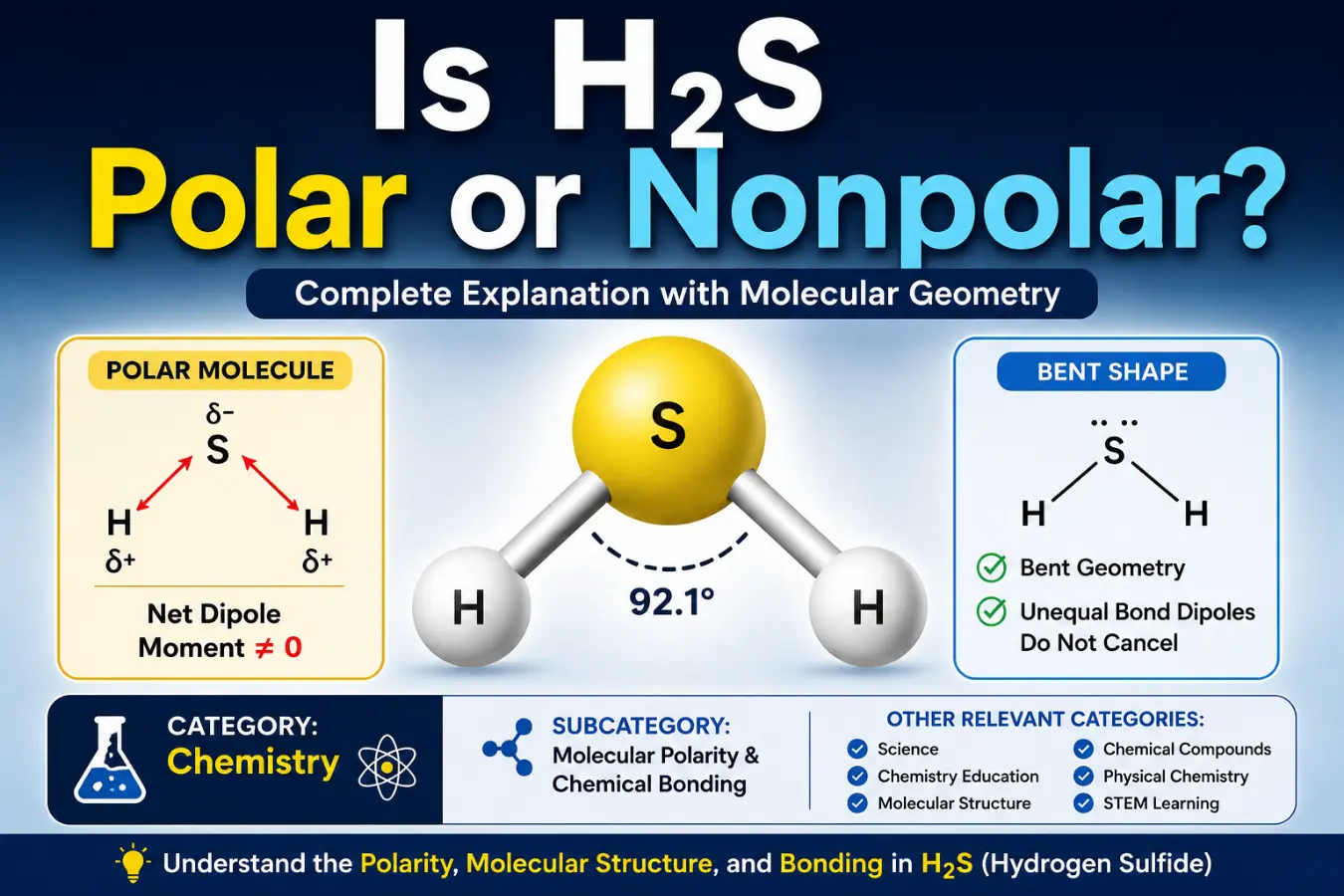
Is H2S polar or nonpolar? The short answer is that H2S (hydrogen sulfide) is a polar molecule. Many students find this topic confusing because sulfur and hydrogen do not have a very large difference in electronegativity. However, the shape of the molecule plays an important role.
Understanding molecular polarity helps explain how substances behave. It affects boiling points, solubility, chemical reactions, and intermolecular forces.
In this guide, you will learn why H2S is polar, how its molecular shape affects polarity, and how it compares with other molecules. We will also cover common mistakes, real-life examples, expert insights, and FAQs.
Quick Summary Box
- H2S stands for hydrogen sulfide.
- H2S is a polar molecule.
- Sulfur forms two bonds with hydrogen.
- Sulfur also has two lone pairs of electrons.
- The molecule has a bent shape.
- The bond dipoles do not cancel out.
- This creates a net dipole moment.
- Therefore, H2S is classified as polar.
What Is H2S?
H2S is the chemical formula for hydrogen sulfide.
It contains:
- 2 hydrogen atoms (H)
- 1 sulfur atom (S)
Hydrogen sulfide is a colorless gas with a strong smell that resembles rotten eggs.
Basic Facts About H2S
| Property | Value |
| Chemical Formula | H2S |
| Molecular Name | Hydrogen Sulfide |
| Molecular Shape | Bent |
| Bond Type | Covalent |
| Polarity | Polar |
| Odor | Rotten Egg Smell |
| State at Room Temperature | Gas |
Is H2S Polar or Nonpolar?
Direct Answer
H2S is a polar molecule.
The molecule becomes polar because:
- Sulfur is more electronegative than hydrogen.
- The molecule has a bent geometry.
- The bond dipoles do not cancel each other.
As a result, one side of the molecule carries a slightly negative charge while the other side carries a slightly positive charge.
Understanding Polarity in Simple Words
Polarity describes how electrons are distributed in a molecule.
A molecule is polar when:
- Electrons are shared unevenly.
- One side becomes slightly negative.
- Another side becomes slightly positive.
A molecule is nonpolar when:
- Electrons are shared evenly.
- Charges remain balanced.
- No permanent dipole exists.
Think of a polar molecule as a magnet with positive and negative ends.
Why Is H2S Polar?
Several factors make H2S polar.
1. Electronegativity Difference
Sulfur attracts electrons more strongly than hydrogen.
Electronegativity values:
| Element | Electronegativity |
| Hydrogen | 2.20 |
| Sulfur | 2.58 |
Sulfur pulls bonding electrons toward itself.
This creates polar H-S bonds.
2. Bent Molecular Shape
The sulfur atom contains two lone pairs.
These lone pairs push the hydrogen atoms downward.
As a result, H2S forms a bent structure rather than a straight line.
Because of this shape, the bond dipoles do not cancel.
3. Net Dipole Moment
The dipole moments point toward sulfur.
Since the molecule is bent, the vectors combine instead of canceling.
Therefore, H2S has a net dipole moment and behaves as a polar molecule.
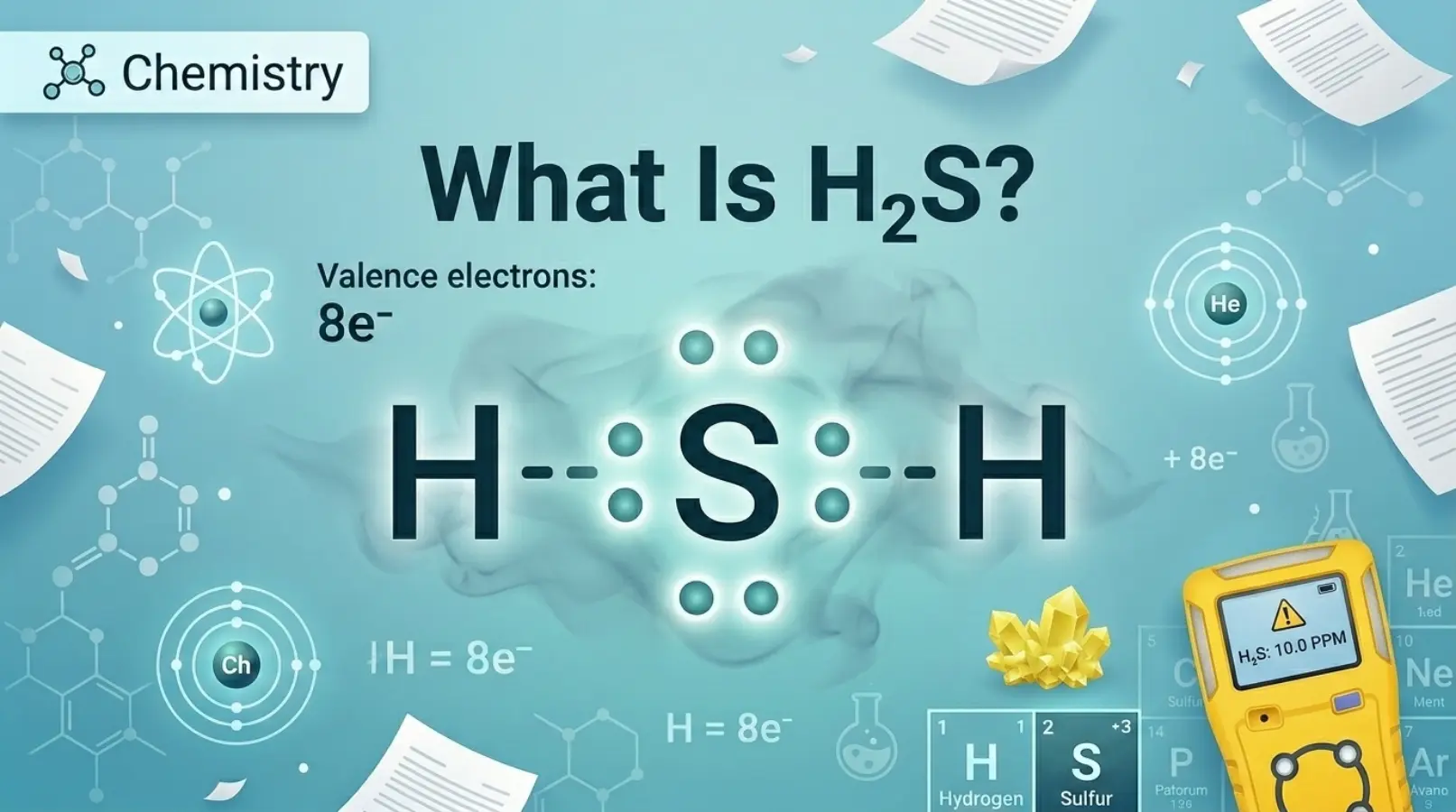
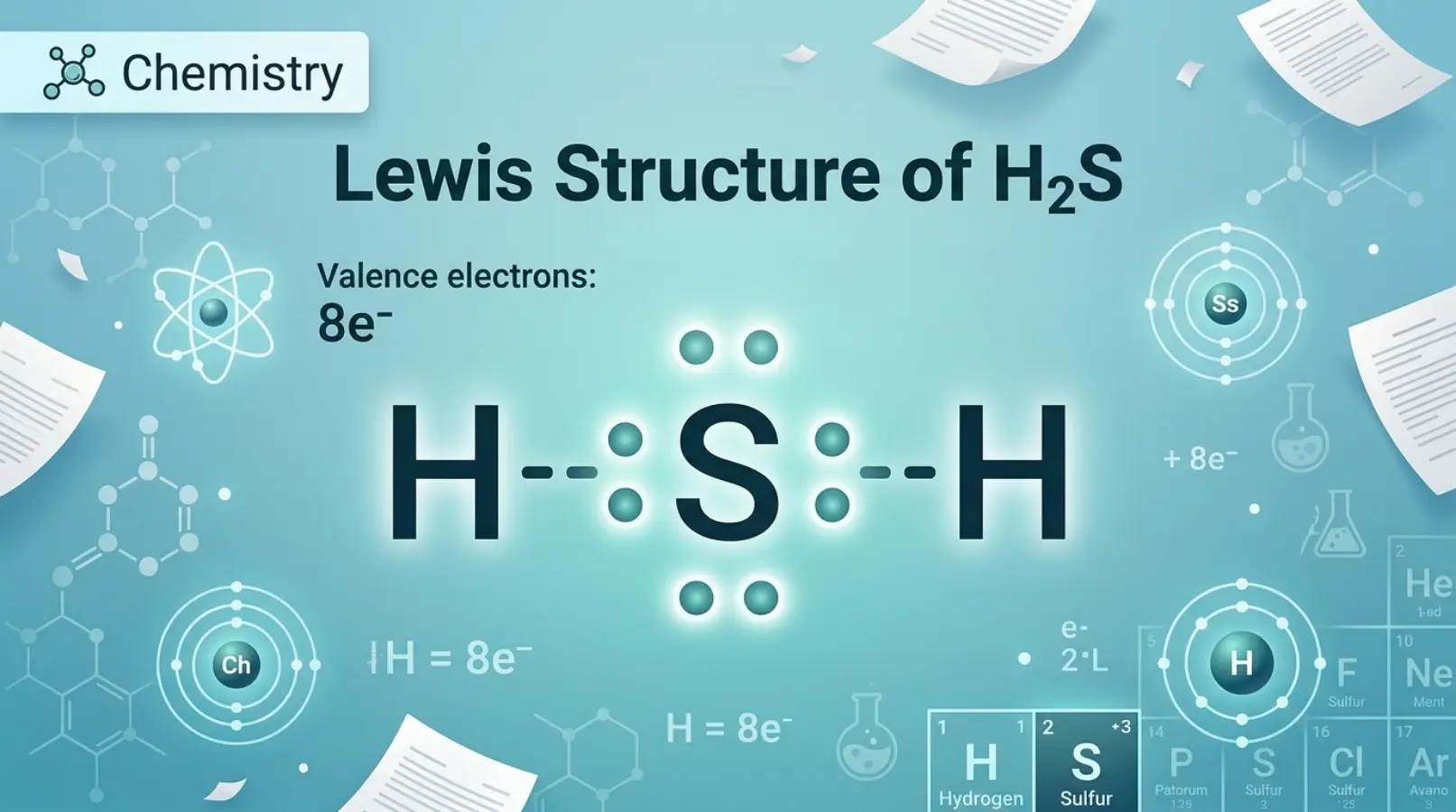
Lewis Structure of H2S
The Lewis structure helps explain polarity.
Steps
- Sulfur is the central atom.
- Two hydrogen atoms bond with sulfur.
- Sulfur keeps two lone pairs.
Representation:
..
H-S-H
..
The dots represent sulfur’s lone pairs.
These lone pairs create the bent geometry responsible for polarity.
Molecular Geometry of H2S
According to VSEPR theory, H2S has:
- Four electron regions around sulfur
- Two bonding pairs
- Two lone pairs
Molecular Shape
Bent or Angular
Bond Angle
Approximately 92°
Because the molecule is not symmetrical, it remains polar.
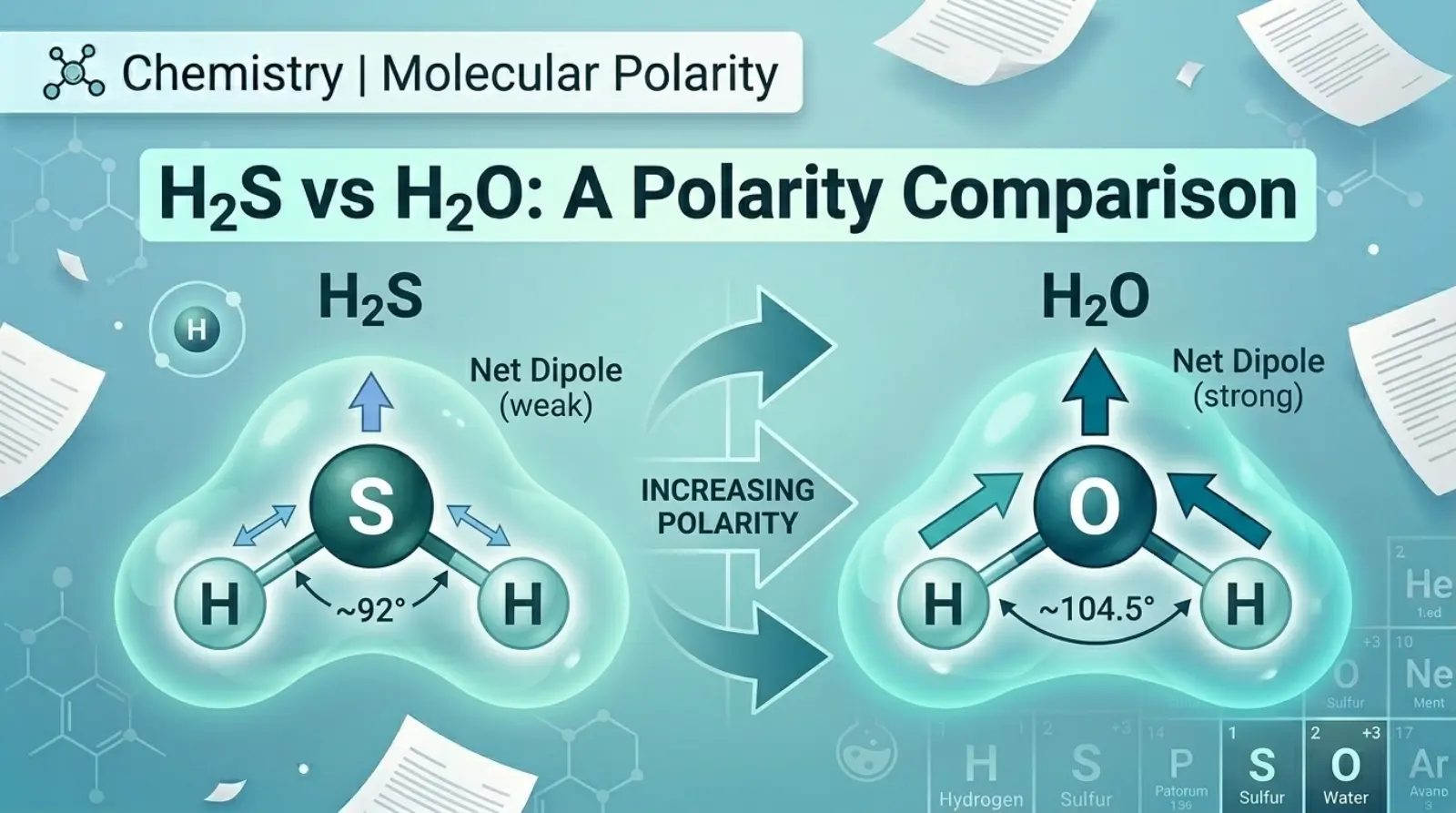
H2S vs H2O: A Polarity Comparison
Many students compare H2S with water.
Comparison Table
| Property | H2S | H2O |
| Central Atom | Sulfur | Oxygen |
| Shape | Bent | Bent |
| Polar? | Yes | Yes |
| Electronegativity Difference | Smaller | Larger |
| Hydrogen Bonding | Weak | Strong |
| Boiling Point | Lower | Higher |
Key Difference
Water is more polar because oxygen attracts electrons more strongly than sulfur.
Both molecules are polar, but water has stronger intermolecular forces.
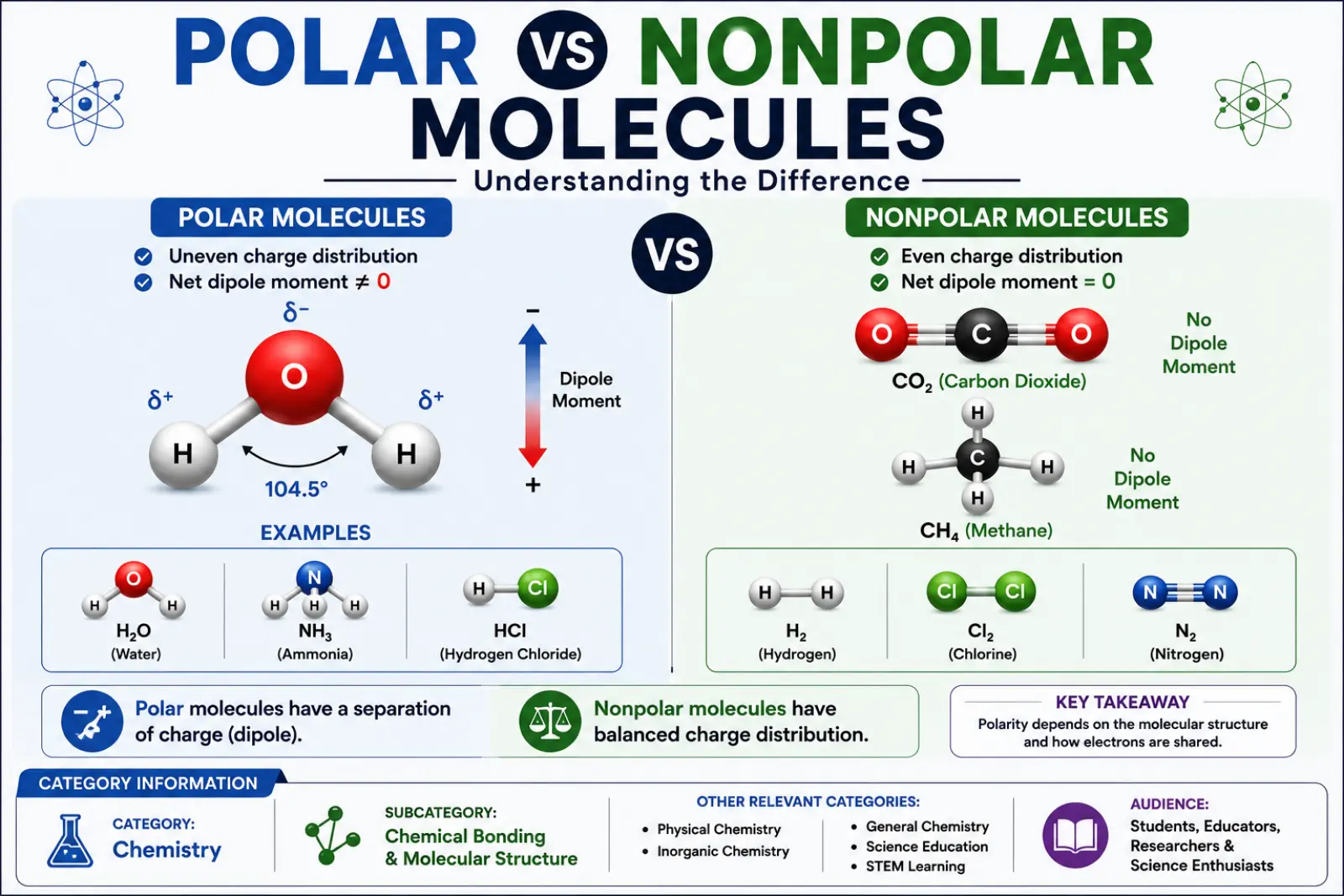
Polar vs Nonpolar Molecules
Understanding the difference helps identify molecular behavior.
| Polar Molecules | Nonpolar Molecules |
| H2S | CO2 |
| H2O | CH4 |
| NH3 | O2 |
| SO2 | N2 |
Quick Tip
Ask yourself:
- Is the molecule symmetrical?
- Are there lone pairs?
- Do bond dipoles cancel?
If not, the molecule is likely polar.
Real-Life Examples of H2S Polarity
Polarity affects many properties of hydrogen sulfide.
1. Solubility in Water
H2S dissolves in water because it is polar.
2. Chemical Reactions
Its polarity helps it react with other polar substances.
3. Industrial Applications
Industries monitor H2S because it can dissolve in moisture and form acidic solutions.
4. Environmental Impact
Polar molecules interact differently with water and air systems.
Common Mistakes Students Make
Mistake 1: Looking Only at Electronegativity
Many students stop after checking electronegativity.
Shape matters too.
Mistake 2: Ignoring Lone Pairs
Lone pairs change molecular geometry.
They can turn a nonpolar arrangement into a polar molecule.
Mistake 3: Assuming Small Molecules Are Nonpolar
Molecule size does not determine polarity.
Geometry and electron distribution matter more.
Mistake 4: Confusing Bond Polarity with Molecular Polarity
A molecule may contain polar bonds but still be nonpolar if dipoles cancel.
Always check the overall structure.
Easy Trick to Determine Whether H2S Is Polar
Follow this simple method:
Step 1
Check electronegativity difference.
Step 2
Draw the Lewis structure.
Step 3
Identify lone pairs.
Step 4
Determine molecular shape.
Step 5
See whether dipoles cancel.
For H2S:
- Polar bonds ✓
- Bent shape ✓
- Dipoles do not cancel ✓
Result:
H2S is polar.
Synonyms
- Hydrogen sulfide molecule
- Polar compound
- Covalent molecule
- Bent geometry molecule
- Dipole-containing molecule
Expert Insights: Why Understanding H2S Polarity Matters
Chemists use polarity to predict molecular behavior.
Polarity helps explain:
- Solubility
- Boiling points
- Chemical reactions
- Molecular attractions
- Environmental behavior
Students who understand polarity can solve chemistry problems faster and more accurately.
Knowing the relationship between shape and polarity is also essential for advanced chemistry topics.
Frequently Asked Questions (FAQs)
1. Is H2S polar or nonpolar?
H2S is a polar molecule because it has a bent shape and unequal electron distribution.
2. Why is H2S considered polar?
The sulfur atom attracts electrons more strongly, and the bent geometry prevents dipole cancellation.
3. What is the shape of H2S?
H2S has a bent or angular molecular geometry.
4. Does H2S have a dipole moment?
Yes. H2S has a net dipole moment due to its molecular shape.
5. Is H2S more polar than water?
No. Water is more polar because oxygen is more electronegative than sulfur.
6. What intermolecular forces exist in H2S?
H2S mainly experiences dipole-dipole forces and London dispersion forces.
7. Can H2S dissolve in water?
Yes. Its polarity allows it to dissolve in water to some extent.
8. Does H2S have hydrogen bonding?
No. Hydrogen bonding in H2S is very weak compared to water.
Conclusion
So, is H2S polar or nonpolar? The answer is clear: H2S is a polar molecule. Sulfur attracts electrons more strongly than hydrogen, creating polar bonds. In addition, sulfur has two lone pairs that force the molecule into a bent shape. Because of this geometry, the bond dipoles do not cancel each other.
Understanding H2S polarity helps explain its chemical behavior, solubility, and intermolecular forces. When determining whether a molecule is polar or nonpolar, always consider both electronegativity and molecular shape. For H2S, these factors work together to create a net dipole moment, making hydrogen sulfide a classic example of a polar molecule.