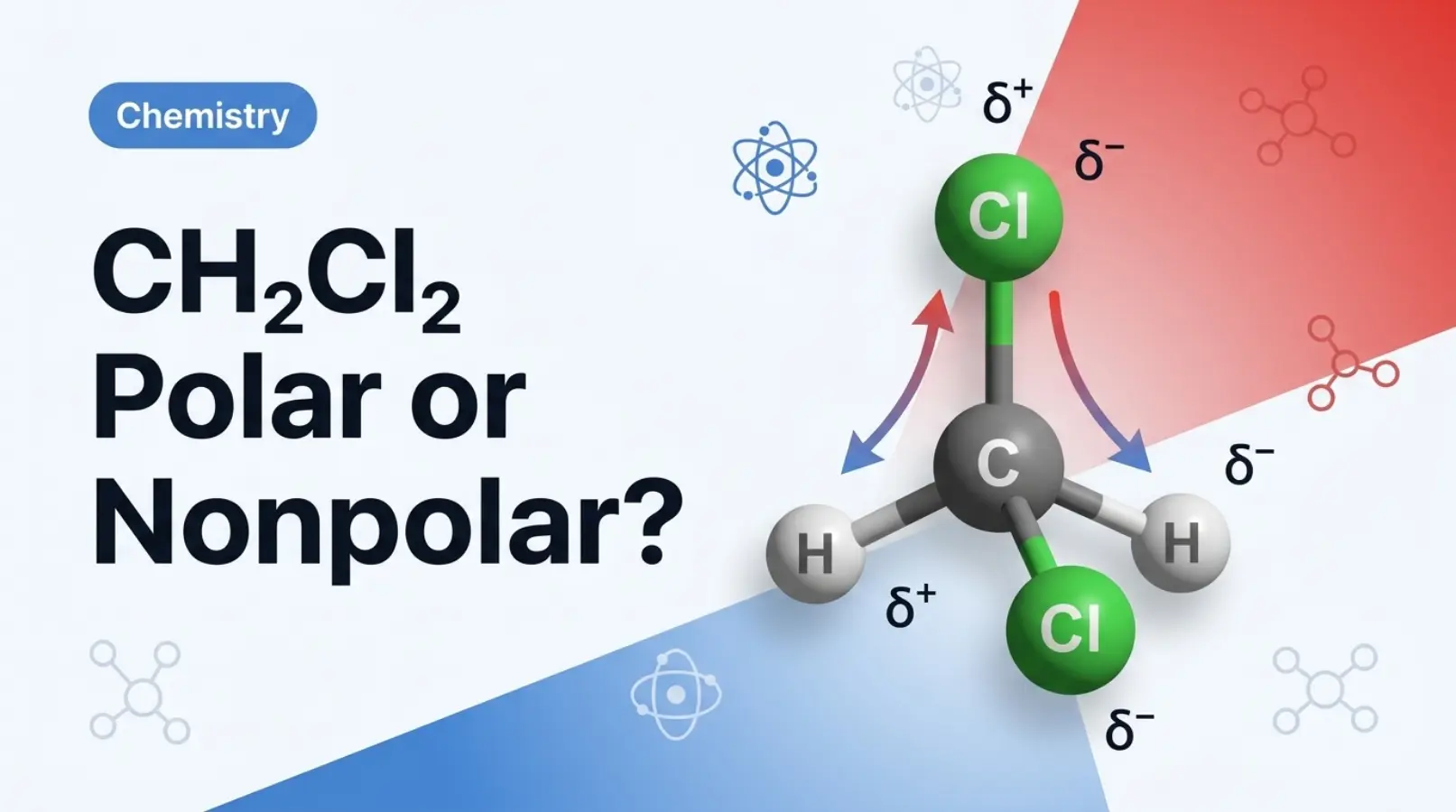
CH2Cl2 polar or nonpolar is a common chemistry question. Many students learn this topic when studying molecular shapes and chemical bonding. The answer is simple once you understand the molecule’s structure.
CH2Cl2, also called dichloromethane, has a unique arrangement of atoms. This arrangement affects how electrons spread across the molecule. As a result, it changes the molecule’s overall polarity.
In this guide, you will learn why CH2Cl2 is polar. You will also discover how its molecular shape, bond polarity, and dipole moments work together. We will use simple language, real-life examples, and easy diagrams to make the topic clear.
Whether you are preparing for an exam or just curious about chemistry, this guide will help you understand CH2Cl2 polarity with confidence.
Quick Summary Box
- Chemical Formula: CH2Cl2
- Chemical Name: Dichloromethane (Methylene Chloride)
- Is CH2Cl2 Polar or Nonpolar? ✅ Polar
- Molecular Shape: Tetrahedral
- Reason: Uneven distribution of electrons creates a net dipole moment.
- Carbon Atom: Central atom
- Bond Types: Two C–Cl bonds and two C–H bonds
- Electronegativity Difference: Makes C–Cl bonds polar
- Final Answer: CH2Cl2 is a polar molecule because its bond dipoles do not cancel.
What Is CH2Cl2?
CH2Cl2 is the chemical formula for dichloromethane.
It contains:
- One carbon atom
- Two hydrogen atoms
- Two chlorine atoms
The carbon atom forms four single covalent bonds. Two connect to hydrogen atoms. Two connect to chlorine atoms.
Scientists use CH2Cl2 as a solvent in laboratories and industries because it dissolves many substances.
Is CH2Cl2 Polar or Nonpolar?
The simple answer is:
CH2Cl2 is a polar molecule.
Although its shape is tetrahedral, the chlorine atoms attract electrons much more strongly than hydrogen atoms.
This uneven pull creates a permanent dipole moment.
Since the bond dipoles point in different directions and do not cancel each other, the molecule remains polar.
Featured Snippet Answer
CH2Cl2 (dichloromethane) is a polar molecule. Its tetrahedral shape and two highly polar carbon-chlorine bonds create an uneven charge distribution. The dipole moments do not cancel, giving the molecule a net dipole moment.
Why Is CH2Cl2 Polar?
There are three main reasons.
1. Chlorine Is More Electronegative
Chlorine attracts shared electrons much more strongly than carbon and hydrogen.
This makes every C–Cl bond polar.
2. The Molecule Is Not Symmetrical
CH2Cl2 has:
- Two chlorine atoms
- Two hydrogen atoms
Since these atoms are different, the molecule loses perfect symmetry.
Because of this, the dipoles cannot cancel completely.
3. Net Dipole Moment Exists
Each polar bond creates a dipole.
When scientists add all the bond dipoles together, a net dipole remains.
That is why CH2Cl2 is polar.
Molecular Geometry of CH2Cl2
The molecular geometry is tetrahedral.
Key facts
| Property | Value |
| Central atom | Carbon |
| Electron groups | 4 |
| Lone pairs on carbon | 0 |
| Molecular geometry | Tetrahedral |
| Bond angle | About 109.5° |
| Hybridization | sp³ |
The tetrahedral arrangement helps explain why the molecule has a permanent dipole.
Lewis Structure of CH2Cl2
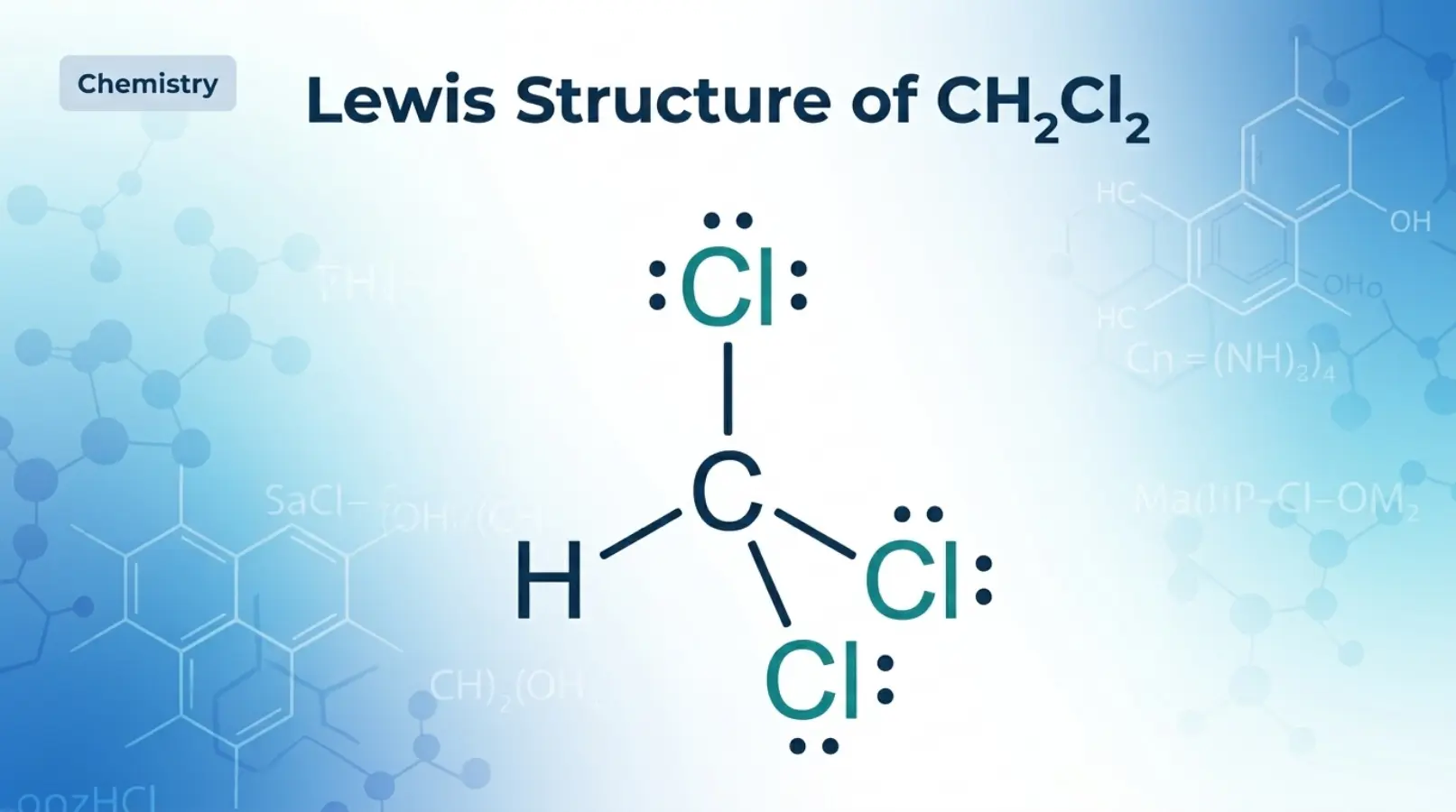
The Lewis structure is easy to draw.
- Carbon sits in the center.
- Carbon forms four single bonds.
- Two bonds connect to hydrogen.
- Two bonds connect to chlorine.
- Each chlorine has three lone pairs.
- Carbon follows the octet rule.
This stable structure explains the bonding pattern of CH2Cl2.
Bond Polarity in CH2Cl2
Different bonds have different polarities.
| Bond | Polar or Nonpolar | Reason |
| C–Cl | Polar | Chlorine is much more electronegative |
| C–H | Slightly polar | Small electronegativity difference |
The strong C–Cl bonds dominate the overall polarity.
CH2Cl2 vs CO2: Why One Is Polar and the Other Is Not
Many students confuse these molecules.
| Feature | CH2Cl2 | CO2 |
| Shape | Tetrahedral | Linear |
| Symmetry | No | Yes |
| Bond Dipoles | Do not cancel | Cancel completely |
| Net Dipole | Yes | No |
| Overall Polarity | Polar | Nonpolar |
Even though both molecules contain polar bonds, only CH2Cl2 has a net dipole.
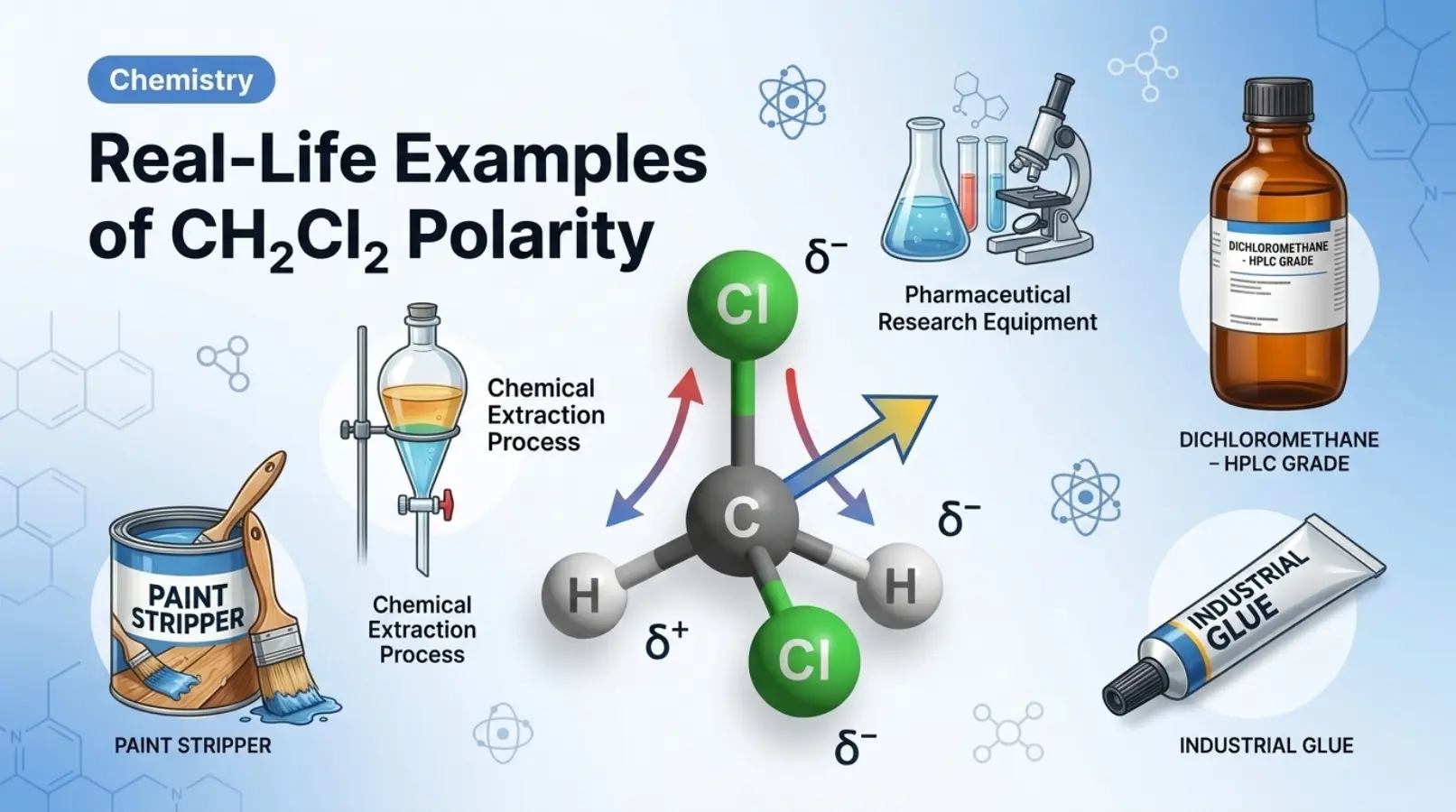
Real-Life Examples of CH2Cl2 Polarity
Polarity affects how CH2Cl2 behaves.
Paint Removers
CH2Cl2 dissolves paint because its polarity helps break chemical interactions.
Laboratory Solvent
Scientists use it to dissolve many organic compounds.
Pharmaceutical Industry
Manufacturers use it during chemical extraction processes.
Adhesive Production
Its polarity allows it to dissolve several industrial chemicals.
Common Mistakes Students Make
Thinking Tetrahedral Means Nonpolar
Not every tetrahedral molecule is nonpolar.
The atoms attached to the center matter.
Looking Only at Bond Polarity
A molecule can contain polar bonds but still be nonpolar.
Always check molecular geometry.
Ignoring Symmetry
Symmetry determines whether dipoles cancel.
CH2Cl2 lacks perfect symmetry.
Forgetting Dipole Moments
The final polarity depends on the sum of all dipole vectors.
Easy Trick to Remember CH2Cl2 Polarity
Use this simple rule:
Different surrounding atoms usually create polarity.
Remember:
- CH4 → Nonpolar
- CCl4 → Nonpolar
- CH2Cl2 → Polar
The mixed atoms create an uneven electron distribution.
CH2Cl2 in Daily Life
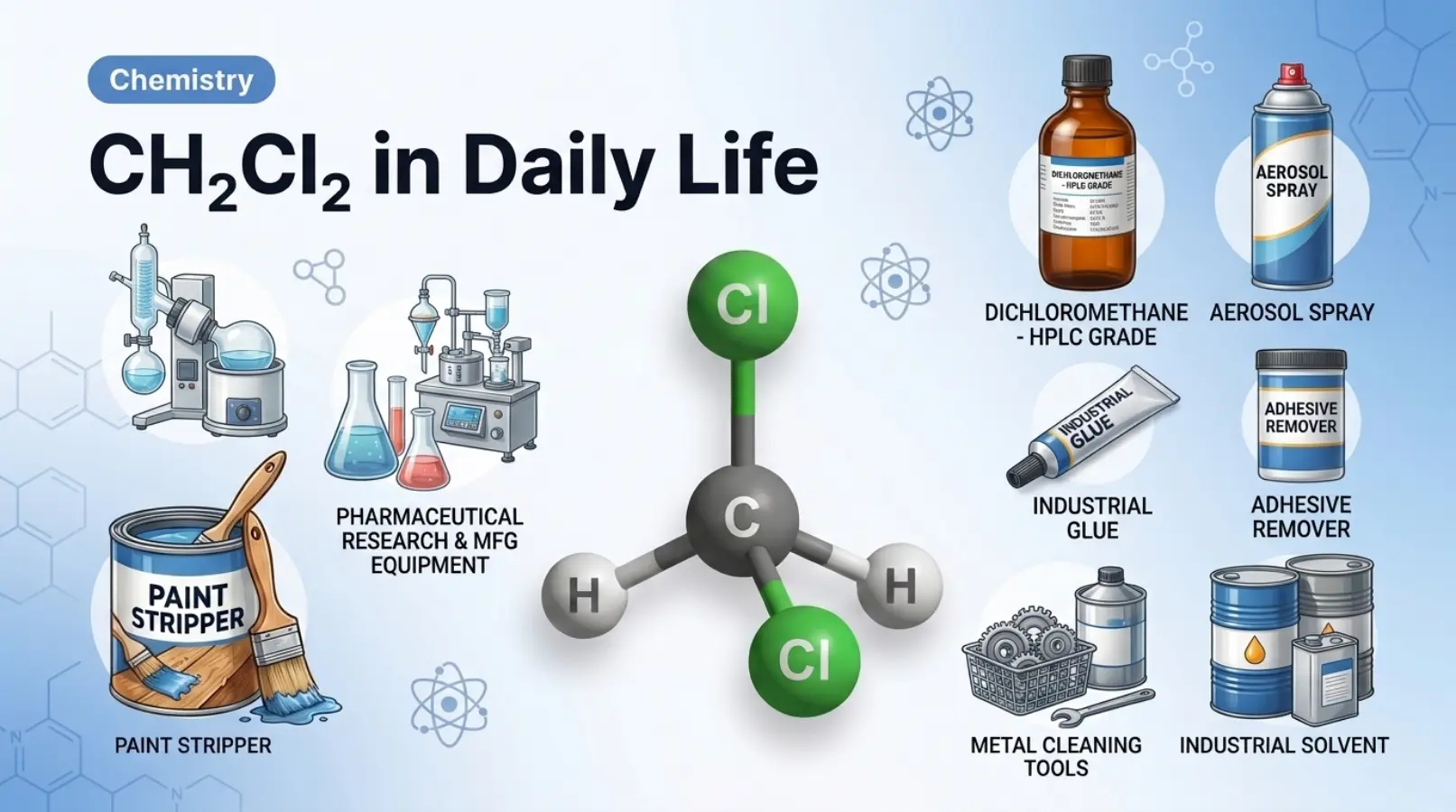
You may not notice CH2Cl2 often, but industries use it in many products.
Examples include:
- Paint stripping
- Foam manufacturing
- Chemical extraction
- Laboratory experiments
- Metal cleaning
- Industrial solvents
Its polarity makes it effective at dissolving many compounds.
Expert Insights: Why Understanding CH2Cl2 Polarity Matters
Chemists rarely judge polarity by bond type alone.
They study:
- Molecular geometry
- Electronegativity
- Bond dipoles
- Symmetry
This complete approach leads to accurate predictions.
Learning this method helps you solve questions about many molecules, not just CH2Cl2.
It also prepares you for advanced chemistry topics like intermolecular forces, solubility, and reaction mechanisms.
Frequently Asked Questions (FAQs)
Is CH2Cl2 polar or nonpolar?
CH2Cl2 is a polar molecule because its bond dipoles do not cancel.
Why is CH2Cl2 polar?
The molecule contains polar C–Cl bonds and an asymmetrical tetrahedral arrangement.
What is the molecular geometry of CH2Cl2?
It has a tetrahedral molecular geometry with bond angles close to 109.5°.
Does CH2Cl2 have a dipole moment?
Yes. It has a permanent net dipole moment.
Is CH2Cl2 soluble in water?
It is only slightly soluble in water because it is moderately polar.
Is CH2Cl2 a covalent compound?
Yes. All bonds in CH2Cl2 are covalent.
What hybridization does carbon have in CH2Cl2?
The carbon atom is sp³ hybridized.
Why doesn’t CH2Cl2 become nonpolar?
Its chlorine and hydrogen atoms create an uneven charge distribution, so the dipoles never fully cancel.
Final Verdict
| Question | Answer |
| CH2Cl2 Polar or Nonpolar? | Polar |
| Molecular Shape | Tetrahedral |
| Bond Type | Polar Covalent |
| Dipole Moment | Present |
| Symmetry | Asymmetrical |
Conclusion
The answer to CH2Cl2 polar or nonpolar is clear: CH2Cl2 is a polar molecule. Its two carbon-chlorine bonds are strongly polar because chlorine attracts electrons more than carbon. Although the molecule has a tetrahedral shape, the arrangement of two chlorine atoms and two hydrogen atoms is not perfectly symmetrical. As a result, the bond dipoles do not cancel, leaving a net dipole moment.
Understanding polarity becomes much easier when you examine electronegativity, molecular geometry, symmetry, and dipole moments together. This approach works not only for CH2Cl2 but also for many other molecules you will study in chemistry. Remember this simple rule: polar bonds plus an asymmetrical shape usually produce a polar molecule. Mastering these concepts will help you solve chemistry questions with confidence.
Discover More Post:
Preventive or Preventative: Which Is Correct? Use, and Examples
Naive or Nieve: Which Spelling Is Correct? Guide with Examples