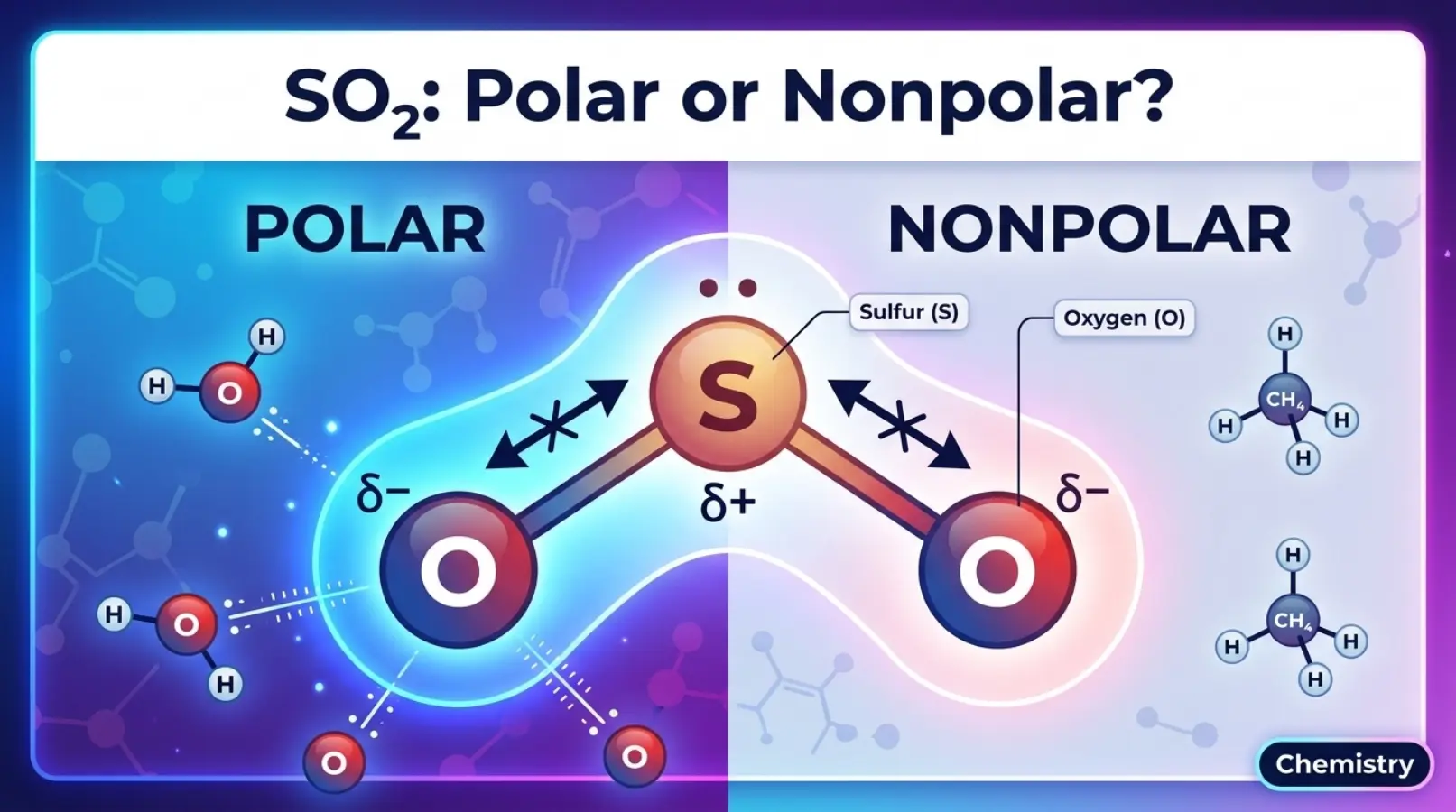
SO2 polar or nonpolar is a common chemistry question. Many students learn about molecular shapes and wonder how sulfur dioxide behaves.
The simple answer is that SO2 (sulfur dioxide) is a polar molecule.
However, understanding why it is polar is important. Molecular shape, electron distribution, and bond polarity all play a role.
In this guide, you will learn what SO2 is, why it is polar, and how to identify polarity in molecules. We will use simple language, easy examples, and helpful tips.
By the end of this article, you will clearly understand the polarity of SO2 and avoid common chemistry mistakes.
Quick Summary Box
- SO2 stands for sulfur dioxide.
- SO2 contains one sulfur atom and two oxygen atoms.
- The S–O bonds are polar covalent bonds.
- SO2 has a bent or V-shaped molecular structure.
- The bond dipoles do not cancel each other.
- Therefore, SO2 is a polar molecule.
- Polar molecules have unequal electron distribution.
- SO2 can interact strongly with other polar substances.
What Is SO2?
SO2 is the chemical formula for sulfur dioxide.
It consists of:
- One sulfur (S) atom
- Two oxygen (O) atoms
Sulfur dioxide is a colorless gas with a strong smell. It forms when sulfur-containing materials burn.
Common Sources of SO2
- Volcanoes
- Power plants
- Industrial processes
- Fossil fuel combustion
Scientists study SO2 because it affects air quality and environmental health.

SO2 Polar or Nonpolar: The Direct Answer
SO2 is a polar molecule.
The molecule has:
- Polar sulfur-oxygen bonds
- A bent molecular shape
- Uneven charge distribution
Because of these factors, the bond dipoles do not cancel out.
As a result, SO2 has a net dipole moment, making it polar.
Featured Snippet Answer
SO2 (sulfur dioxide) is a polar molecule because it has polar S–O bonds and a bent molecular geometry. The bond dipoles do not cancel each other, creating an uneven distribution of charge.
What Does Polar Mean in Chemistry?
A molecule is polar when electrons are shared unevenly.
This uneven sharing creates:
- A slightly positive end (δ+)
- A slightly negative end (δ−)
Polar molecules have an electrical imbalance.
Simple Example
Think of a tug-of-war.
If one team pulls harder, the rope moves toward that side.
Similarly, oxygen pulls electrons more strongly than sulfur.
This creates polarity in SO2.
Why Are the S–O Bonds Polar?
Oxygen is more electronegative than sulfur.
Electronegativity measures how strongly an atom attracts electrons.
Electronegativity Values
| Element | Electronegativity |
| Oxygen (O) | 3.44 |
| Sulfur (S) | 2.58 |
Since oxygen attracts electrons more strongly, the electrons shift toward oxygen.
This creates polar bonds.
Result
- Oxygen becomes slightly negative.
- Sulfur becomes slightly positive.
Therefore, each S–O bond is polar.
What Is the Shape of SO2?
The shape of SO2 is bent or V-shaped.
According to VSEPR theory:
- Sulfur sits in the center.
- Two oxygen atoms surround sulfur.
- One lone pair exists on sulfur.
The lone pair pushes the oxygen atoms closer together.
Molecular Geometry
- Electron geometry: Trigonal planar
- Molecular geometry: Bent
- Bond angle: Approximately 119°
This bent shape is the key reason SO2 is polar.
How Molecular Shape Affects Polarity
Shape plays a major role in determining polarity.
Even if bonds are polar, some molecules become nonpolar if dipoles cancel.
In SO2
The molecule bends.
Because of this shape:
- One bond dipole points in one direction.
- The other bond dipole points in another direction.
They do not cancel completely.
Therefore, SO2 remains polar.
SO2 Lewis Structure Explained
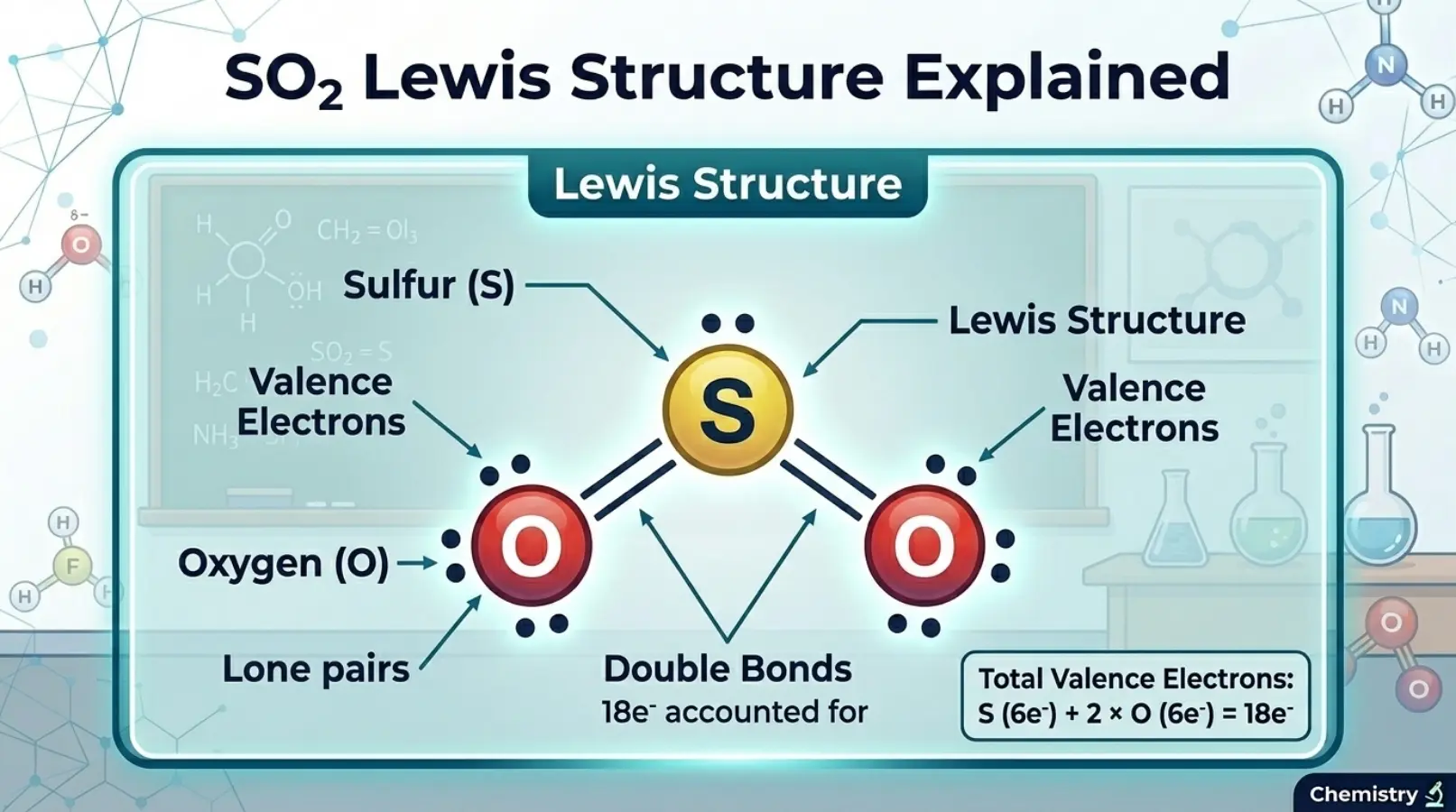
The Lewis structure helps visualize electron arrangement.
Steps
- Place sulfur in the center.
- Connect sulfur to two oxygen atoms.
- Add lone pairs.
- Form double bonds to satisfy octets.
Key Features
- Sulfur is the central atom.
- Two sulfur-oxygen double bonds exist.
- Sulfur contains one lone pair.
- Oxygen atoms contain lone pairs.
This structure leads to the bent molecular shape.
SO2 Polar vs Nonpolar Molecules
Understanding the difference helps students identify polarity faster.
| Feature | Polar Molecules | Nonpolar Molecules |
| Charge Distribution | Uneven | Even |
| Dipole Moment | Present | Absent |
| Molecular Shape | Often Asymmetrical | Often Symmetrical |
| Example | SO2, H2O, NH3 | CO2, CH4, N2 |
| Electron Sharing | Unequal | Equal or Balanced |
SO2 clearly fits the polar category.
SO2 vs CO2: Why One Is Polar and the Other Is Not
Students often confuse SO2 with CO2.
Both contain oxygen atoms.
However, their shapes differ.
| Property | SO2 | CO2 |
| Shape | Bent | Linear |
| Bond Polarity | Polar | Polar |
| Dipole Cancellation | No | Yes |
| Net Dipole Moment | Present | Zero |
| Polar or Nonpolar | Polar | Nonpolar |
Key Difference
CO2 is linear.
The two bond dipoles pull equally in opposite directions.
They cancel each other completely.
SO2 is bent, so cancellation does not occur.
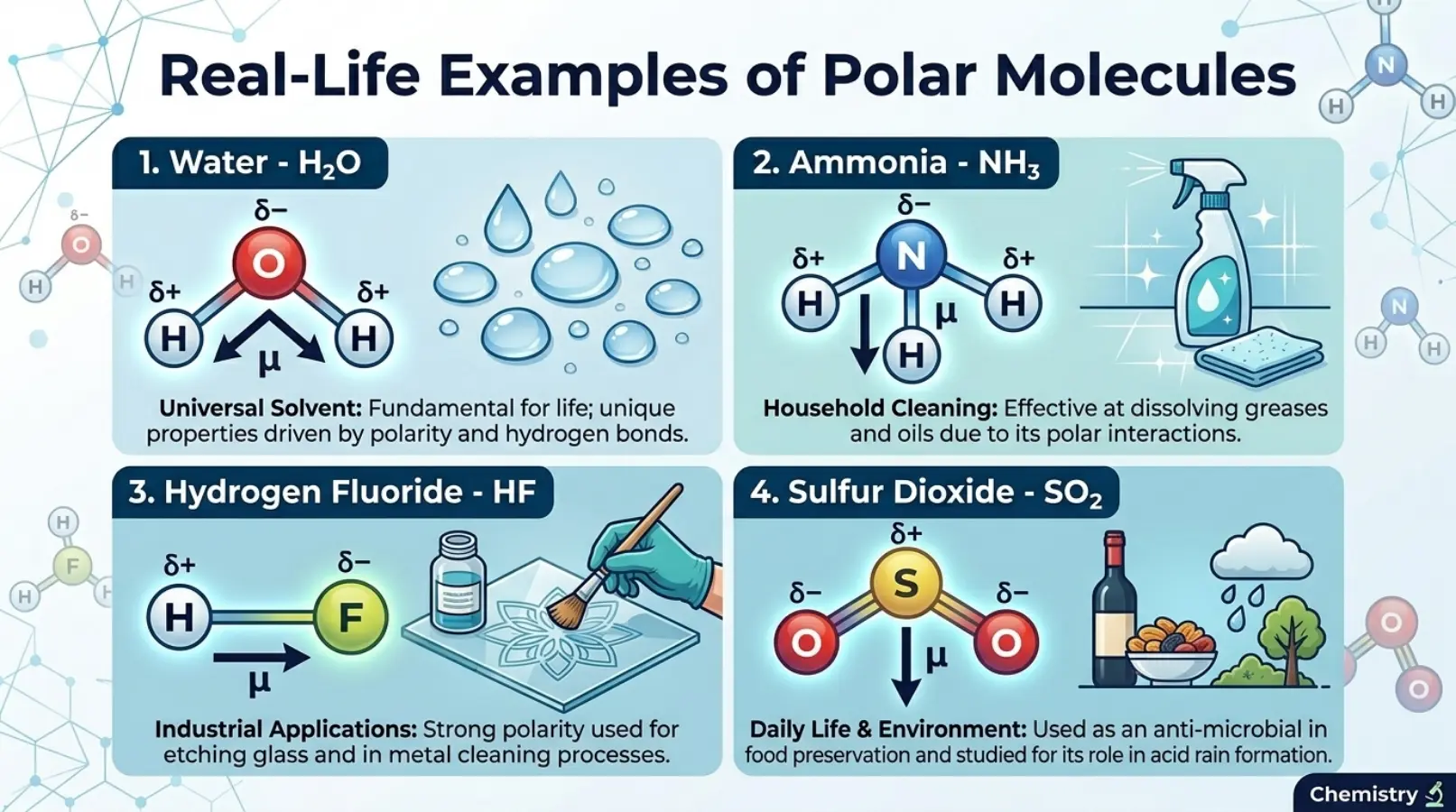
Real-Life Examples of Polar Molecules
Many common substances are polar.
Examples
- Water (H2O)
- Sulfur dioxide (SO2)
- Ammonia (NH3)
- Hydrogen chloride (HCl)
Why It Matters
Polar molecules often:
- Dissolve in polar liquids
- Have stronger intermolecular forces
- Exhibit higher boiling points
SO2 shares these characteristics because it is polar.
How to Determine if a Molecule Is Polar
Use this simple method.
Step 1: Check Bond Polarity
Look at electronegativity differences.
Step 2: Find Molecular Shape
Use VSEPR theory.
Step 3: Examine Dipole Cancellation
Ask:
- Do the dipoles cancel?
- Is the molecule symmetrical?
Step 4: Determine Net Dipole Moment
If dipoles do not cancel, the molecule is polar.
Applying these steps to SO2 confirms that it is polar.
Common Mistakes When Identifying SO2 Polarity
Students often make these errors.
Mistake 1: Looking Only at Bonds
Polar bonds alone do not guarantee a polar molecule.
Shape also matters.
Mistake 2: Assuming All Three-Atom Molecules Are Nonpolar
Some three-atom molecules are polar.
SO2 is a perfect example.
Mistake 3: Confusing SO2 With CO2
They have different shapes.
Therefore, they have different polarity.
Mistake 4: Ignoring Lone Pairs
Lone pairs affect molecular geometry.
They create the bent shape in SO2.
Tips and Tricks to Remember SO2 Polarity
Easy Trick #1
Remember:
Bent = Usually Polar
Easy Trick #2
Oxygen pulls electrons strongly.
This creates bond dipoles.
Easy Trick #3
Look for lone pairs on the central atom.
Lone pairs often create asymmetrical shapes.
Easy Trick #4
Compare SO2 with water.
Both have bent structures and are polar.
Importance of SO2 Polarity in Daily Life
Polarity affects how molecules behave.
Environmental Impact
SO2 dissolves in water droplets in the atmosphere.
This contributes to acid rain formation.
Industrial Applications
Understanding polarity helps engineers:
- Design chemical processes
- Predict reactions
- Control emissions
Laboratory Chemistry
Polarity influences:
- Solubility
- Reaction rates
- Molecular interactions
Expert Insights: Why Understanding SO2 Polarity Matters
Chemistry becomes easier when you understand molecular polarity.
Experts often focus on three factors:
- Bond polarity
- Molecular geometry
- Net dipole moment
Students who master these concepts can solve many chemistry questions quickly.
SO2 serves as an excellent example because it combines all three principles.
Learning why SO2 is polar also helps with molecules such as H2O, O3, and NH3.
Frequently Asked Questions (FAQs)
Is SO2 polar or nonpolar?
SO2 is polar because it has a bent shape and unequal charge distribution.
Why is SO2 considered a polar molecule?
Its S–O bonds are polar and their dipoles do not cancel.
What is the shape of SO2?
SO2 has a bent or V-shaped molecular geometry.
Does SO2 have a dipole moment?
Yes. SO2 has a net dipole moment.
Is SO2 more polar than CO2?
Yes. CO2 is nonpolar, while SO2 is polar.
What causes SO2 polarity?
The combination of polar bonds and bent geometry causes polarity.
Is sulfur dioxide symmetrical?
No. Its bent shape makes it asymmetrical.
Can SO2 dissolve in water?
Yes. Its polarity helps it interact with water molecules.
Conclusion
The answer to SO2 polar or nonpolar is simple: SO2 is a polar molecule. Oxygen attracts electrons more strongly than sulfur, creating polar bonds. In addition, sulfur dioxide has a bent molecular shape due to a lone pair on the sulfur atom. Because the bond dipoles do not cancel, the molecule develops a net dipole moment.
Understanding SO2 polarity helps students learn larger chemistry concepts such as molecular geometry, electronegativity, and dipole moments. Whenever you analyze a molecule, check its bond polarity and shape. Using this method makes identifying polar and nonpolar molecules much easier. For SO2, both the bond polarity and bent structure clearly show that it is polar.